Skip to content
27 states · 19,630 records

Firefly Season 2027

The flashing display peaks in the last week of May on the Texas plains and in the first week of July on the Great Lakes, and it walks north between the two at about a week for every three degrees of latitude. Peak weeks for 27 states from research grade observation records, the two national park lotteries and when they have actually opened, and what time it gets dark where you are.

27
States with a date
of 50
May 24
Earliest peak
Texas
July 5
Latest peak
8 states
19,630
Records behind it
research grade
The wave

When the display peaks, state by state

Fireflies are the rare seasonal subject where the folk wisdom and the data agree on the shape and disagree on almost every date. The shape is real: about a week later for every three degrees of latitude north, with the scatter around that line under a week.

The dates come from 19,630 research grade iNaturalist records counted by week of the year, divided by the total observations of everything in the same state and week to remove the effect of how many people were outdoors, and restricted to the flashing genera. They are a climatology, not a forecast: they say when fireflies have been recorded, which is the answer to when to start looking.

  1. May 24
  2. Jun 14
  3. Jun 21
  4. Jun 28
  5. Jul 5
Advertisement
Method

The correction that changes the answer

Ask iNaturalist when the firefly family Lampyridae is recorded in Massachusetts, correct it properly for observer effort, and the answer comes back March. That is not a bug in the correction. It is what the raw record actually says.

Massachusetts has 5,527 research grade firefly records. Four fifths of them are one species, Photinus corruscus, the Winter Firefly, which overwinters as an adult, sits on tree bark, is active in daylight and does not flash at all. The second most recorded is the Black Firefly, which is also day active and also does not flash. Between them they bury the actual lightning bugs: Massachusetts has exactly four research grade records of the common eastern firefly.

The Firefly Atlas splits the family into three groups for precisely this reason: “Flashing fireflies (or lightningbugs), day-active fireflies (which communicate with chemicals called pheromones), and glow-worms (whose females glow to attract mostly non-luminescent males).” A page about an evening light show has to count the first group and only the first group. So every number on this site comes from Photinus, Photuris and Pyractomena with the Winter Firefly removed. Drop that one species from the Massachusetts query and the curve becomes a clean June peak.

This was the surprise of building these pages. On every other observation based page on this site the important correction is for observer effort, because a raw count measures animals multiplied by how many people were outside with a phone. On fireflies, effort adjustment barely moves anything once the day active species are gone. What mattered was deciding which animal you are counting.

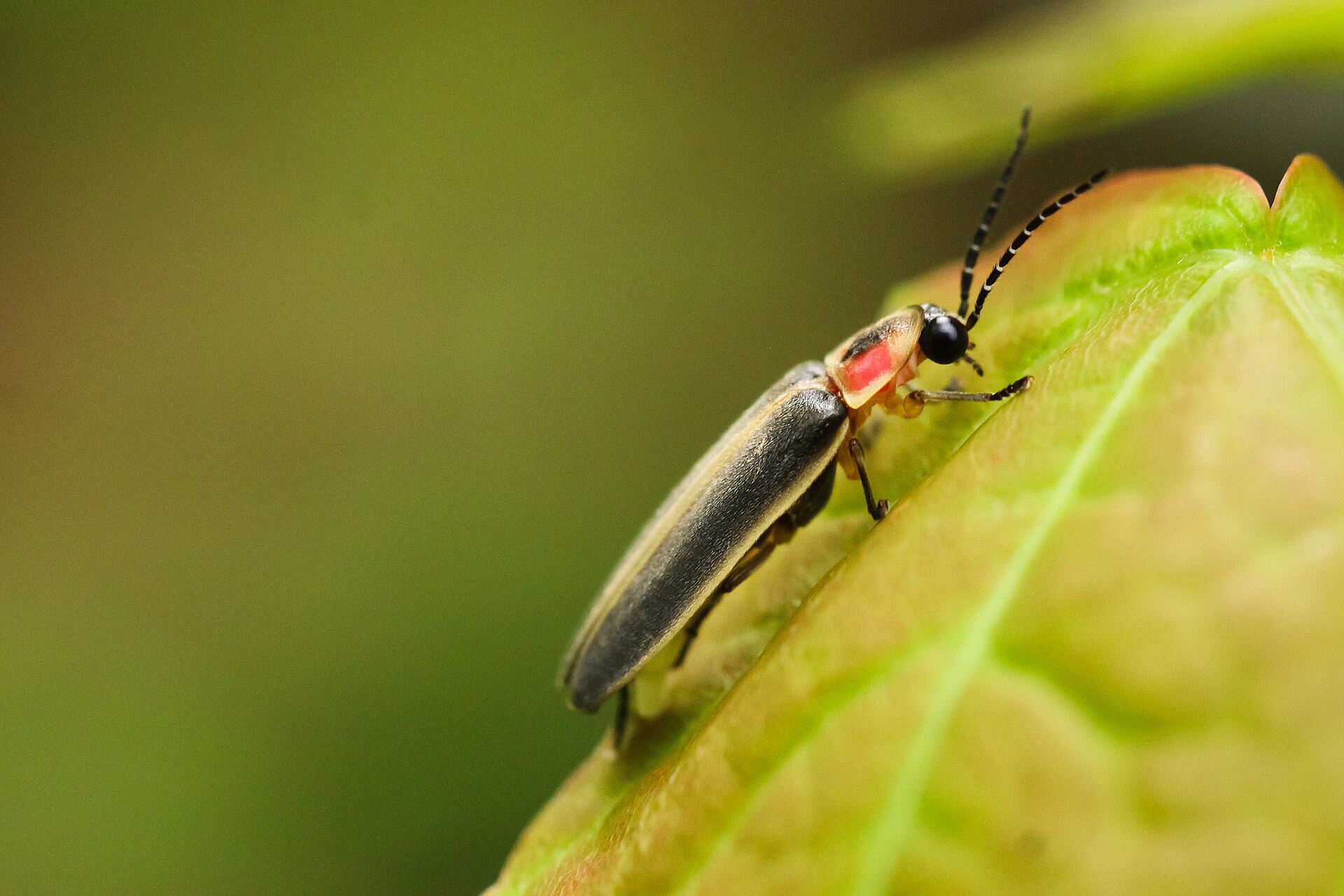
A common eastern firefly with black wing covers and a pink and black shield behind its head, perched on the edge of a green leaf
A common eastern firefly with black wing covers and a pink and black shield behind its head, perched on the edge of a green leaf. Photinus pyralis is the most recorded flashing firefly in every one of the 27 covered states. “Eastern firefly (Photinus pyralis), June 2025, Virginia” by Celari817, CC BY 4.0
Managed access

The synchronous firefly lotteries

Synchronous fireflies are the reason most people search for fireflies at all, and the two best known displays in the United States are both inside national parks with access limited to a few hundred people a night. Both allocate it by lottery through Recreation.gov, and both set their dates on the year rather than on the calendar. Great Smoky Mountains National Park says of its own method only that “The park uses soil temperatures to predict the optimal dates for the viewing opportunity in Elkmont”, and that “Since 1993, recorded peak dates have ranged from the third week of May to the third week of June”. A month of natural scatter is why the lottery cannot be put on a fixed date, and why the parks announce it fresh each spring.

No 2027 dates exist for either park as of the day this page was written. Several sites already publish 2027 Elkmont dates as though they were announced. They are extrapolated from previous years, and previous years disagree by more than a fortnight. Below is what actually happened in each year we could verify, and where the real announcement will appear.

Elkmont synchronous fireflies

Great Smoky Mountains National Park. Smokies synchronous firefly (Photinus carolinus).

Vehicle reservation lottery, run through Recreation.gov

Not announced yet. The 2027 dates are not yet announced. The park has historically posted them in late April, at https://www.nps.gov/grsm/learn/news/. Previous years have moved by more than two weeks, so they are a guide to the month rather than the day.

What has actually happened, year by year

YearLottery openViewing datesPassesFee
2026Apr 24 to Apr 27May 20 to May 27960 total, 120 per night$29
2025May 2 to May 5May 29 to Jun 5960 total, 120 per night$29
2024Apr 26 to Apr 29Jun 3 to Jun 101,120 total, 140 per night$24
2023Apr 28 to May 1Jun 4 to Jun 11960 total, 120 per night$24
2022Apr 29 to May 3Jun 3 to Jun 10800 total, 100 per night$24
2021Apr 30 to May 3Jun 1 to Jun 8800 total, 100 per night$24

2020: Cancelled. The park stated that the viewing area at Elkmont was not spacious enough to safely gather hundreds of people under the health guidance in force that spring.

Read down the viewing column rather than across it: the dates move by more than two weeks, and the 2027 dates will appear here once the park announces them.

The park uses soil temperatures to predict the optimal dates for the viewing opportunity in Elkmont.

Great Smoky Mountains National Park

Since 1993, recorded peak dates have ranged from the third week of May to the third week of June.

Great Smoky Mountains National Park
Worth correcting. Older guides tell you to take a shuttle from Sugarlands Visitor Center. That shuttle ended after 2019. Since 2021 the park has run the event with visitors driving their own vehicle and parking at Elkmont, which is what the reservation is for.

Rules, in their words

  • “Each reservation admits one vehicle with up to seven occupants.”
  • “Access is restricted after noon during the viewing period to vehicles with reservations and registered campers in Elkmont Campground.”
  • “Reservations are non-refundable, non-transferable and valid only for the date issued.”
  • “Overnight parking at Little River Trailhead, Jakes Creek Trailhead or the Appalachian Clubhouse is not allowed during this event.”

Congaree synchronous fireflies

Congaree National Park. snappy single sync (Photuris frontalis).

Pass lottery, run through Recreation.gov

Not announced yet. The 2027 dates are not yet announced. The park has historically posted them in March, at https://www.nps.gov/cong/fireflies.htm. Previous years have moved by more than two weeks, so they are a guide to the month rather than the day.

What has actually happened, year by year

YearLottery openViewing datesPassesFee
2026Apr 7 to Apr 14May 13 to May 20145 per night$25
2025Apr 3 to Apr 9May 14 to May 21145 per night$20
2024Apr 4 to Apr 10May 16 to May 25145 per night$25
2023Apr 6 to Apr 12May 13 to May 16 and May 19 to May 24130 per night$25
2022Mar 31 to Apr 6May 20 to May 22 and May 27 to May 29120 vehicles per night$20
2021Apr 15 to Apr 19May 20 to May 22 and May 27 to May 2925 vehicles per night$20

Read down the viewing column rather than across it: the dates move by more than two weeks, and the 2027 dates will appear here once the park announces them.

Between mid-May and mid-June, the synchronous firefly species Photuris frontalis will emerge, and for approximately 2 weeks flash in unison along the edge of the Congaree floodplain.

Congaree National Park

Fireflies of the species Photuris frontalis synchronize their flashes along the forest floor on the edge of the Congaree floodplain every year in the late spring.

Congaree National Park

Rules, in their words

  • “Cell phones may not be used in the viewing area for either a light source or taking photos/video”
  • “No pets are permitted in the park during this event”
  • “All visitors should stay on the designated Firefly Trail”
  • “Catching or disturbing fireflies is not permitted at Congaree National Park”
  • “No insect repellent can be applied after arrival at the park”
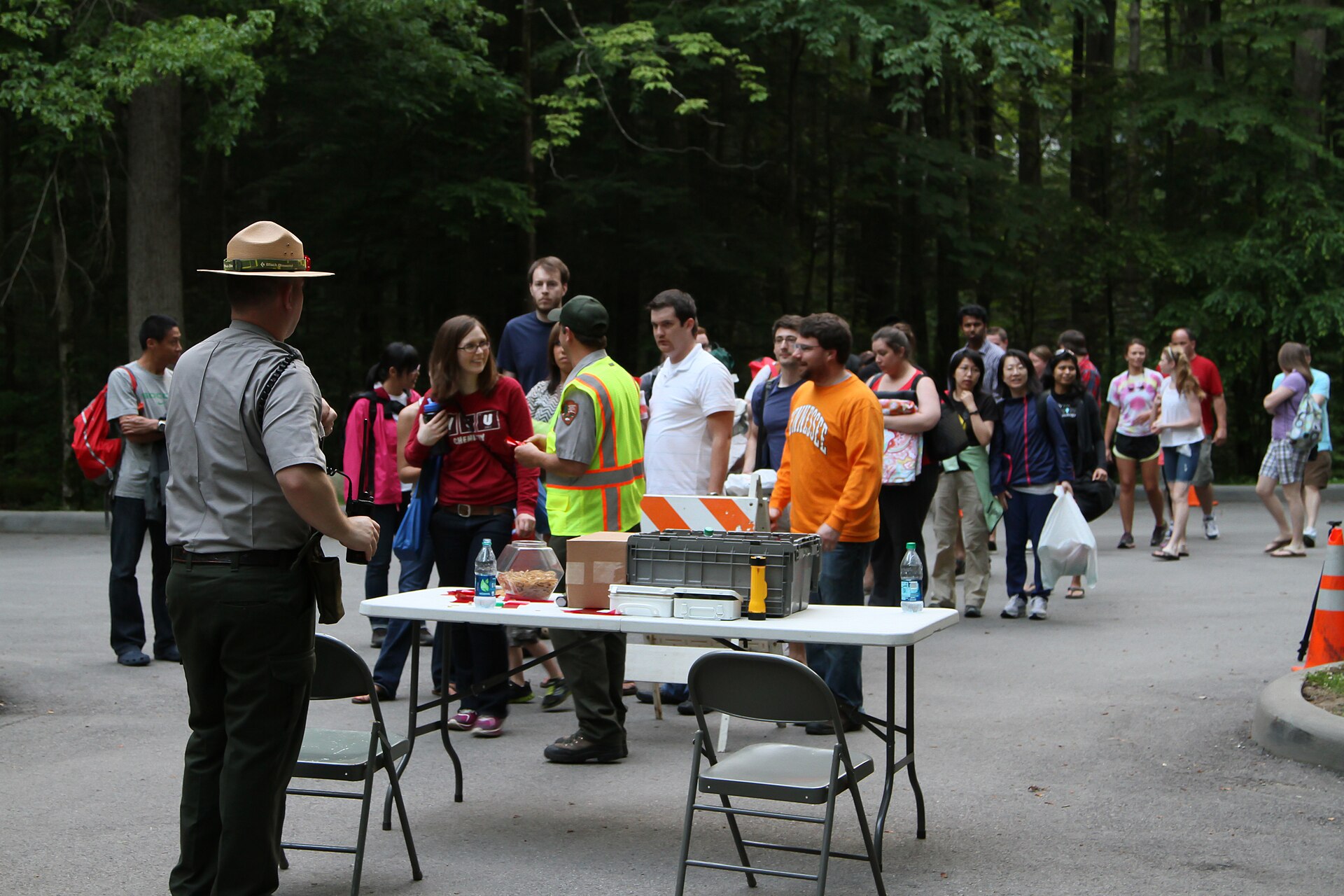
National Park Service rangers checking visitors in at a folding table beside a forest road at the Elkmont firefly viewing event
National Park Service rangers checking visitors in at a folding table beside a forest road at the Elkmont firefly viewing event, photographed in 2013. Access has been limited at Elkmont since 2006. Note that the shuttle era ended after 2019: since 2021 the reservation is for a vehicle you drive to the site yourself. “Synchronous Fireflies, June 2013--Warren Bielenberg (28337897949)” — Great Smoky Mountains National Park from Gatlinburg, TN — Public Domain
Advertisement
Outside the parks

The other two organised viewing events

Pennsylvania Firefly Festival

Tionesta, near the Allegheny National Forest. synchronous firefly and the Chinese lantern firefly (Photinus carolinus and others).

Free daytime festival. Guided night tours by lottery.

Not announced yet. The 2027 dates are not yet announced. The organiser has historically posted them in the first quarter of the year, with the lottery drawn in late March, at https://www.pafireflyevents.org/. Previous years have moved by more than two weeks, so they are a guide to the month rather than the day.

What has actually happened, year by year

YearLottery openViewing datesPassesFee
2026Drawn Mar 30Jun 26 and Jun 27, rain date Jun 2875 per night on the guided night toursDaytime events free

Read down the viewing column rather than across it: the dates move by more than two weeks, and the 2027 dates will appear here once the park announces them.

over fifteen different species of firefly in the Allegheny National Forest area

Tionesta, near the Allegheny National Forest
Worth correcting. Two details are widely mis-stated. The festival is in Tionesta, not Kellettville, which is where older guides still place it. And the daytime part is free and needs no ticket at all: only the guided night tours are lottery limited, at 75 places a night.

Grandfather Glows

Grandfather Mountain, North Carolina. synchronous fireflies, blue ghost fireflies and glowworms (Photinus carolinus, Phausis reticulata, Orfelia fultoni).

Ticket lottery

Not announced yet. The 2027 dates are not yet announced. The organiser has historically posted them in spring, at https://grandfather.com/fireflies/. Previous years have moved by more than two weeks, so they are a guide to the month rather than the day.

10 species of fireflies or luminous insects

Grandfather Mountain, North Carolina
Worth correcting. Grandfather Mountain is a private nonprofit attraction, owned and operated by the Grandfather Mountain Stewardship Foundation. It is a different entity from Grandfather Mountain State Park, and the event has nothing to do with the Blue Ridge Parkway. Dates and prices for Grandfather Glows are published by the organiser at grandfather.com; the figures for recent years found elsewhere come from news coverage rather than from the organiser.

Rules, in their words

  • “Pets are not allowed”
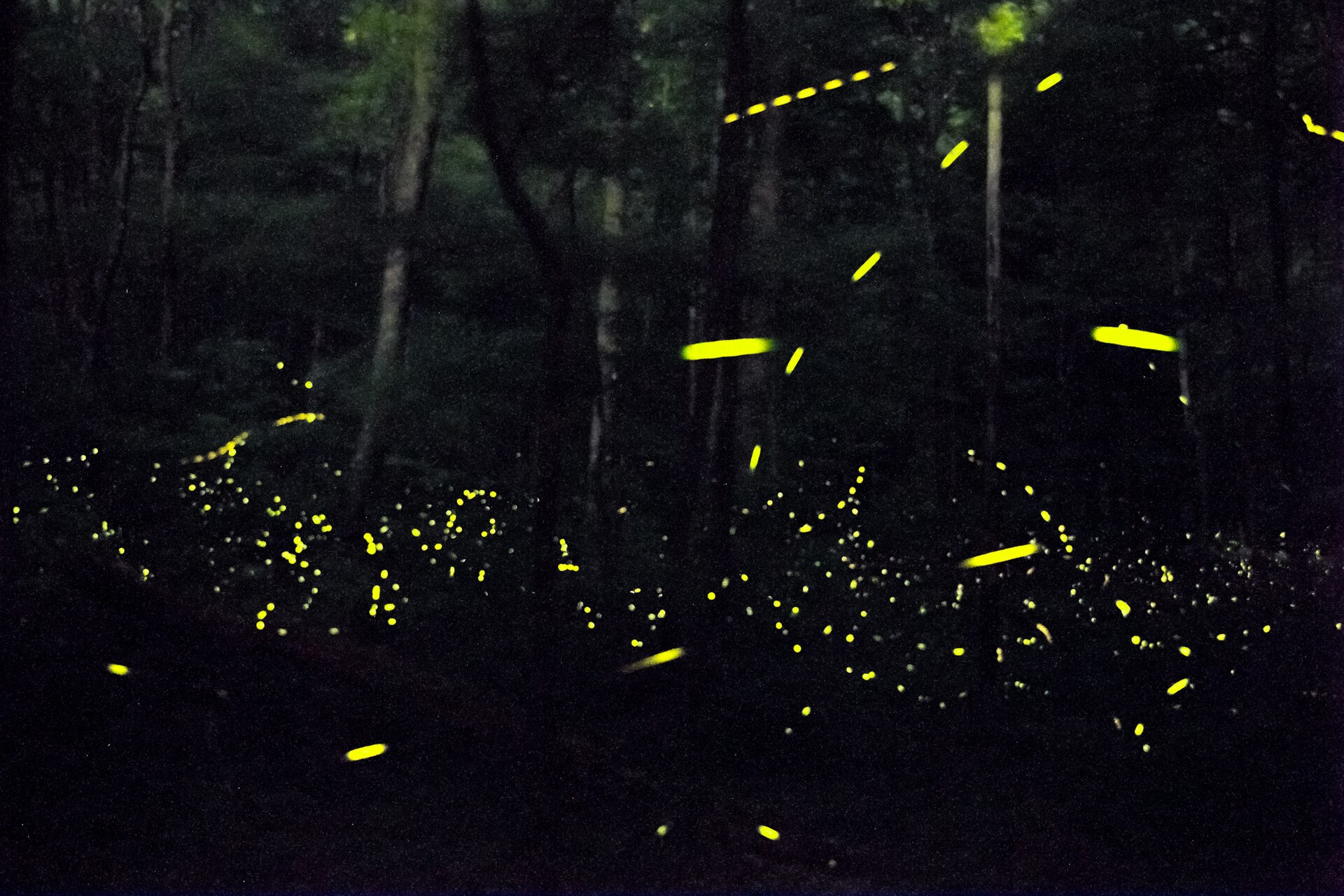
Long exposure photograph of synchronous fireflies in a dark forest in Great Smoky Mountains National Park, showing dashed yellow flight trails
Long exposure photograph of synchronous fireflies in a dark forest in Great Smoky Mountains National Park, showing dashed yellow flight trails. The dashes are the point: each male flashes five or six times, then the whole hillside goes dark together. “Photinus carolinus Great Smoky Mountains” by Niemand für Polyphemus, CC BY 2.0
Worth correcting

Places that are not synchronous firefly sites

These two come up constantly and both are wrong in a way that costs somebody a long drive.

DuPont State Recreational Forest, North Carolina. DuPont is famous for blue ghost fireflies, Phausis reticulata, which emit a steady blue white glow and do not flash in unison. It is not a synchronous firefly site and there is no managed viewing programme. The opposite is true: the North Carolina Forest Service closes trails at night during peak season to protect the insects.

Our mission is to protect all forest resources, including the Blue Ghost habitat, so that everyone can continue to enjoy and benefit from these unique insects.

Jason Guidry, DuPont State Recreational Forest Supervisor
Blue Ridge Parkway. No National Park Service firefly viewing programme is listed for the Blue Ridge Parkway. People are usually thinking of Grandfather Mountain, which is a separate private attraction near the Parkway and runs its own ticketed event.
Coverage

Which states have a firefly page

A state gets a page here when at least 150 research grade records of the flashing genera exist for it, roughly the point at which a peak week rather than a peak month can be resolved. 27 states clear that. The other 23 fall short for three different reasons, listed separately below.

The West, where fireflies do not flash

These states have fireflies, but not an evening flashing display to put a date on. The Xerces Society states that flashing species occur primarily east of the Mississippi and that the western fauna is dominated by glow-worms and daytime dark fireflies, and our own records agree: every qualifying California record is the California glowworm or the greater firefly, neither of which puts on an aerial show. The Firefly Atlas counts nineteen firefly species in the Pacific Northwest and finds that only four of them flash.

California, Oregon, Washington, Idaho, Nevada, Utah, Arizona, New Mexico, Colorado, Wyoming, Montana.

Arizona is the interesting exception and may get a page later. It has a genuine flashing firefly, the southwest synchronous firefly Photinus knulli, tied to a handful of riparian canyons, and its records peak in August with the monsoon rather than in June. That is a different page with a different season, not a line in this one.

No fireflies at all

Fireflies are recorded in 49 states. Hawaii is the one that is not, and Alaska has ten research-grade firefly records in the entire state.

Hawaii, Alaska.

The Firefly Atlas records over 170 firefly species from every US state and Canadian province except Hawaii and Nunavut.

Not enough records yet, which is not the same as not there

These states certainly have lightning bugs. What they lack is enough uploaded, research-grade records of the FLASHING genera to resolve a peak week. New England is the surprise here and worth naming out loud: Massachusetts has 5,527 research-grade firefly records and only 93 of them are flashing species, because the ones people photograph there are the day-active Winter Firefly and Black Firefly sitting still on bark in daylight. A blurry photograph of a flash at 9pm rarely reaches research grade. That is a statement about cameras, not about fireflies.

Massachusetts, Maine, Vermont, New Hampshire, Rhode Island, Louisiana, Mississippi, Florida, South Dakota, North Dakota.

Florida is the closest to qualifying, at 148 records against a floor of 150, and it would be the most interesting page of the lot: its records peak in the first week of May, six weeks before the Carolinas. If you record what you find in these states, you are directly why they will qualify next year.

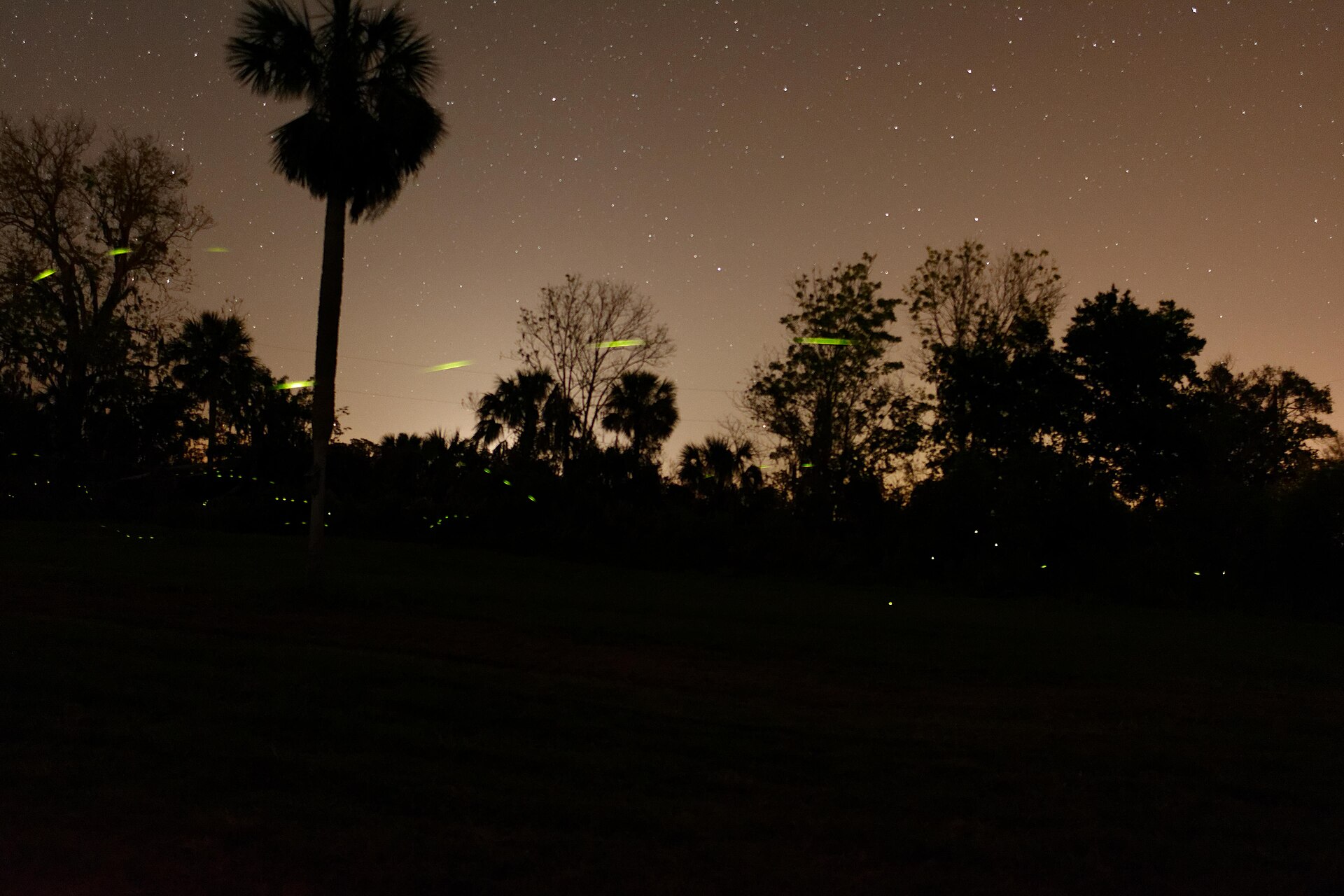
Fireflies leaving green streaks of light across a starry night sky above a dark treeline in coastal Georgia
Fireflies leaving green streaks of light across a starry night sky above a dark treeline in coastal Georgia. “Fireflies, Georgia, US, April 20, 2017” by Jud McCranie, CC BY-SA 4.0
The other twenty two months

What actually helps fireflies

Almost everything written about helping fireflies is about June, and almost everything that decides whether there are any is about the rest of the year. The Xerces Society states that fireflies “spend most of their lives, up to two years, in the larval stage, hunting for soft-bodied invertebrate prey at or near the soil surface”, and that this is true of the flashing species as well as the day active and glow-worm ones. The adult you are photographing is the last few weeks of a two year animal that has spent the rest of it in the leaf litter eating snails.

Which makes the useful advice unglamorous. Leave the leaves down. Mow higher and less. Leave the damp corner alone. Turn the outside lights off in summer, because Xerces reports that light pollution was identified as a threat to 79 firefly species in their Red List assessments, and a flash signal competes with whatever else is lit. And be careful with the two ordinary residential sprays that Xerces singles out, mosquito treatments and broadcast lawn treatments, noting that mosquito treatments may be applied at dusk when mosquitoes but also fireflies are most active. If you are timing mosquito control, our mosquito season pages are the other half of that decision.

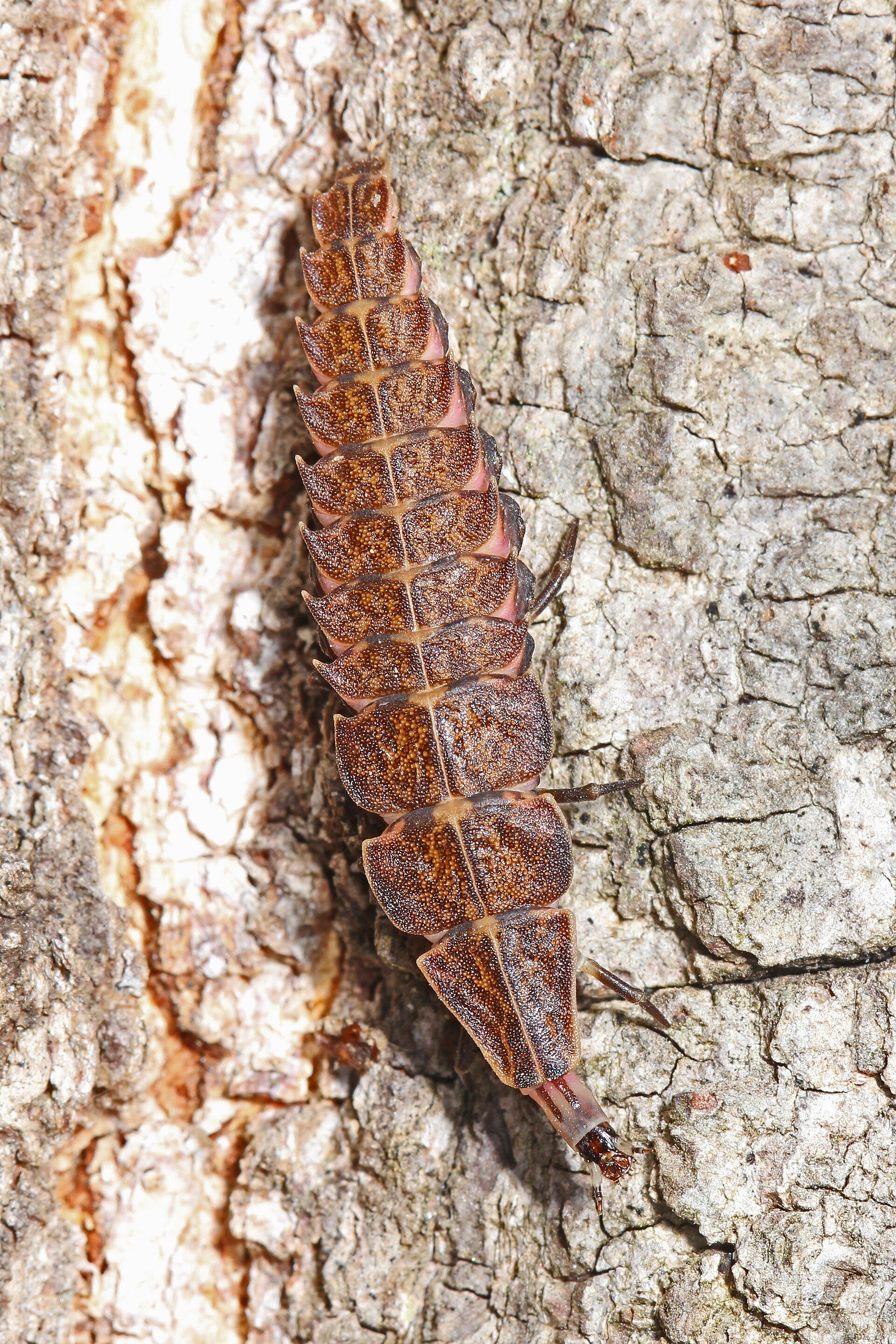
A firefly larva on pale tree bark, its brown armoured body plates overlapping like roof tiles
A firefly larva on pale tree bark, its brown armoured body plates overlapping like roof tiles. This is what a firefly is for most of its life, and it is living in your leaf litter. “Firefly larva - Pyractomena species, Julie Metz Wetlands, Woodbridge, Virginia” by Judy Gallagher, CC BY 2.0
Questions

Firefly season, answered

Advertisement