
Venomous Snakes by State: What Actually Lives Near You
Four states have none at all. Most of the rest have one to four species out of dozens of harmless ones. Pick your state for a live range map built from verified records, the real activity season, and the lookalikes that get killed by mistake.
Pick your state
Every state page lists the venomous species with verified records there, a live map of where each has actually been found, the monthly activity curve with an observer-effort correction, and the harmless snakes people mistake for them.
Baby copperhead season, finally shown rather than asserted
Every autumn, local news across the copperhead states runs a version of the same story: a second wave of young copperheads, more bites, watch your step. It is repeated constantly and, as far as we can find, never actually demonstrated with data.
Here it is. The chart below is every research-grade iNaturalist observation of Agkistrodon contortrix in the United States, grouped by the month it was recorded. The curve is bimodal: a large spring peak, a summer dip, and then a distinct second rise in which September runs above August.
Copperheads are viviparous: females give birth to live young in late August and September, typically four to eight at a time. Those neonates disperse immediately, hunt inexpertly, and turn up in gardens, garages, and mulch beds where an adult would not bother. That is a real pulse of snakes, arriving exactly when the curve turns back up.
What else moves the curve. Part of the rebound is people: August is hot and nobody is outside, September is pleasant and everybody is. Switch the chart above to the effort-adjusted view, which divides each month by all research-grade observations logged that month, and the September rise survives, but it is smaller. Both effects are present and the biology is the larger one, because the timing lines up with a known birthing season rather than with a holiday weekend.
And the part everyone gets wrong. Juvenile copperheads are not more venomous than adults and cannot “fail to control their venom”. They carry substantially less of it. They are simply small, well camouflaged, and abundant for a few weeks. The practical advice is a torch on the path in September, not fear.
Live range maps, not a redrawn JPEG
Pick a species. Coloured cells are places where somebody photographed one and an expert confirmed the identification. The last entry is a harmless watersnake, included so you can see how completely it overlaps with cottonmouth country, which is why it gets killed so often.
Coloured cells are verified Agkistrodon contortrix records on iNaturalist, brighter where more have been logged. This is where people have found and photographed the species, so it thins out over roadless country and thickens around parks and towns. It is a record map, not a drawn range boundary. See the underlying records.
Venomous species by state, A to Z
| State | Venomous species | Snake species | Which ones |
|---|---|---|---|
| Alabama | 7 | 47 | Northern cottonmouth, Timber rattlesnake, Eastern copperhead, Eastern diamondback rattlesnake, Pygmy rattlesnake, Florida cottonmouth, Eastern coral snake |
| Alaska | None | 0 | No venomous species recorded |
| Arizona | 14 | 60 | Western diamondback rattlesnake, Western black-tailed rattlesnake, Mojave rattlesnake, Sidewinder, Tiger rattlesnake, Rock rattlesnake, Arizona black rattlesnake, Southwestern speckled rattlesnake, Sonoran coral snake, Ridge-nosed rattlesnake, Prairie rattlesnake, Western rattlesnake, Twin-spotted rattlesnake, Western massasauga |
| Arkansas | 6 | 40 | Northern cottonmouth, Eastern copperhead, Timber rattlesnake, Pygmy rattlesnake, Western diamondback rattlesnake, Texas coral snake |
| California | 7 | 62 | Western rattlesnake, Red diamond rattlesnake, Southwestern speckled rattlesnake, Sidewinder, Mojave rattlesnake, Panamint rattlesnake, Western diamondback rattlesnake |
| Colorado | 3 | 30 | Prairie rattlesnake, Western massasauga, Western rattlesnake |
| Connecticut | 2 | 16 | Eastern copperhead, Timber rattlesnake |
| Delaware | 1 | 17 | Eastern copperhead |
| Florida | 7 | 65 | Florida cottonmouth, Pygmy rattlesnake, Eastern diamondback rattlesnake, Eastern coral snake, Eastern copperhead, Timber rattlesnake, Northern cottonmouth |
| Georgia | 7 | 47 | Eastern copperhead, Timber rattlesnake, Northern cottonmouth, Eastern diamondback rattlesnake, Florida cottonmouth, Pygmy rattlesnake, Eastern coral snake |
| Hawaii | None | 1 | No venomous species recorded |
| Idaho | 2 | 13 | Western rattlesnake, Prairie rattlesnake |
| Illinois | 4 | 38 | Northern cottonmouth, Eastern copperhead, Timber rattlesnake, Eastern massasauga |
| Indiana | 3 | 30 | Eastern copperhead, Timber rattlesnake, Eastern massasauga |
| Iowa | 4 | 26 | Timber rattlesnake, Eastern massasauga, Prairie rattlesnake, Eastern copperhead |
| Kansas | 7 | 41 | Eastern copperhead, Western massasauga, Prairie rattlesnake, Timber rattlesnake, Broad-banded copperhead, Western diamondback rattlesnake, Northern cottonmouth |
| Kentucky | 3 | 28 | Eastern copperhead, Timber rattlesnake, Northern cottonmouth |
| Louisiana | 5 | 44 | Northern cottonmouth, Eastern copperhead, Timber rattlesnake, Texas coral snake, Pygmy rattlesnake |
| Maine | None | 9 | No venomous species recorded |
| Maryland | 2 | 23 | Eastern copperhead, Timber rattlesnake |
| Massachusetts | 2 | 15 | Timber rattlesnake, Eastern copperhead |
| Michigan | 1 | 18 | Eastern massasauga |
| Minnesota | 1 | 17 | Timber rattlesnake |
| Mississippi | 5 | 44 | Northern cottonmouth, Eastern copperhead, Timber rattlesnake, Eastern diamondback rattlesnake, Pygmy rattlesnake |
| Missouri | 5 | 39 | Eastern copperhead, Timber rattlesnake, Northern cottonmouth, Pygmy rattlesnake, Western massasauga |
| Montana | 1 | 11 | Prairie rattlesnake |
| Nebraska | 4 | 28 | Prairie rattlesnake, Eastern copperhead, Western massasauga, Timber rattlesnake |
| Nevada | 6 | 27 | Western rattlesnake, Sidewinder, Panamint rattlesnake, Southwestern speckled rattlesnake, Mojave rattlesnake, Western diamondback rattlesnake |
| New Hampshire | 1 | 11 | Timber rattlesnake |
| New Jersey | 2 | 20 | Timber rattlesnake, Eastern copperhead |
| New Mexico | 11 | 56 | Western diamondback rattlesnake, Prairie rattlesnake, Mojave rattlesnake, Eastern black-tailed rattlesnake, Western black-tailed rattlesnake, Rock rattlesnake, Western massasauga, Sonoran coral snake, Arizona black rattlesnake, Ridge-nosed rattlesnake, Twin-spotted rattlesnake |
| New York | 3 | 19 | Timber rattlesnake, Eastern copperhead, Eastern massasauga |
| North Carolina | 4 | 40 | Eastern copperhead, Northern cottonmouth, Timber rattlesnake, Pygmy rattlesnake |
| North Dakota | 1 | 9 | Prairie rattlesnake |
| Ohio | 3 | 27 | Eastern copperhead, Timber rattlesnake, Eastern massasauga |
| Oklahoma | 8 | 47 | Northern cottonmouth, Broad-banded copperhead, Timber rattlesnake, Western diamondback rattlesnake, Pygmy rattlesnake, Eastern copperhead, Western massasauga, Prairie rattlesnake |
| Oregon | 1 | 18 | Western rattlesnake |
| Pennsylvania | 3 | 22 | Timber rattlesnake, Eastern copperhead, Eastern massasauga |
| Rhode Island | None | 11 | No venomous species recorded |
| South Carolina | 6 | 41 | Northern cottonmouth, Eastern copperhead, Timber rattlesnake, Eastern diamondback rattlesnake, Pygmy rattlesnake, Eastern coral snake |
| South Dakota | 1 | 15 | Prairie rattlesnake |
| Tennessee | 4 | 34 | Eastern copperhead, Timber rattlesnake, Northern cottonmouth, Pygmy rattlesnake |
| Texas | 12 | 86 | Western diamondback rattlesnake, Northern cottonmouth, Eastern copperhead, Broad-banded copperhead, Texas coral snake, Eastern black-tailed rattlesnake, Mojave rattlesnake, Timber rattlesnake, Prairie rattlesnake, Rock rattlesnake, Western massasauga, Pygmy rattlesnake |
| Utah | 5 | 29 | Western rattlesnake, Mojave rattlesnake, Sidewinder, Prairie rattlesnake, Southwestern speckled rattlesnake |
| Vermont | 1 | 10 | Timber rattlesnake |
| Virginia | 3 | 34 | Eastern copperhead, Timber rattlesnake, Northern cottonmouth |
| Washington | 1 | 13 | Western rattlesnake |
| West Virginia | 2 | 20 | Timber rattlesnake, Eastern copperhead |
| Wisconsin | 1 | 20 | Timber rattlesnake |
| Wyoming | 2 | 13 | Prairie rattlesnake, Western rattlesnake |
Counts are species with verified, photograph-backed iNaturalist records. A handful of states officially recognise one more species than appears here, because it is rare enough that nobody has logged a confirmed photo; those are called out on the individual state pages.
Four lookalikes worth knowing
Most bites in the United States happen to people trying to kill or move a snake. Most “venomous snake” sightings are a harmless species. Both problems have the same solution, and it is not a shovel.
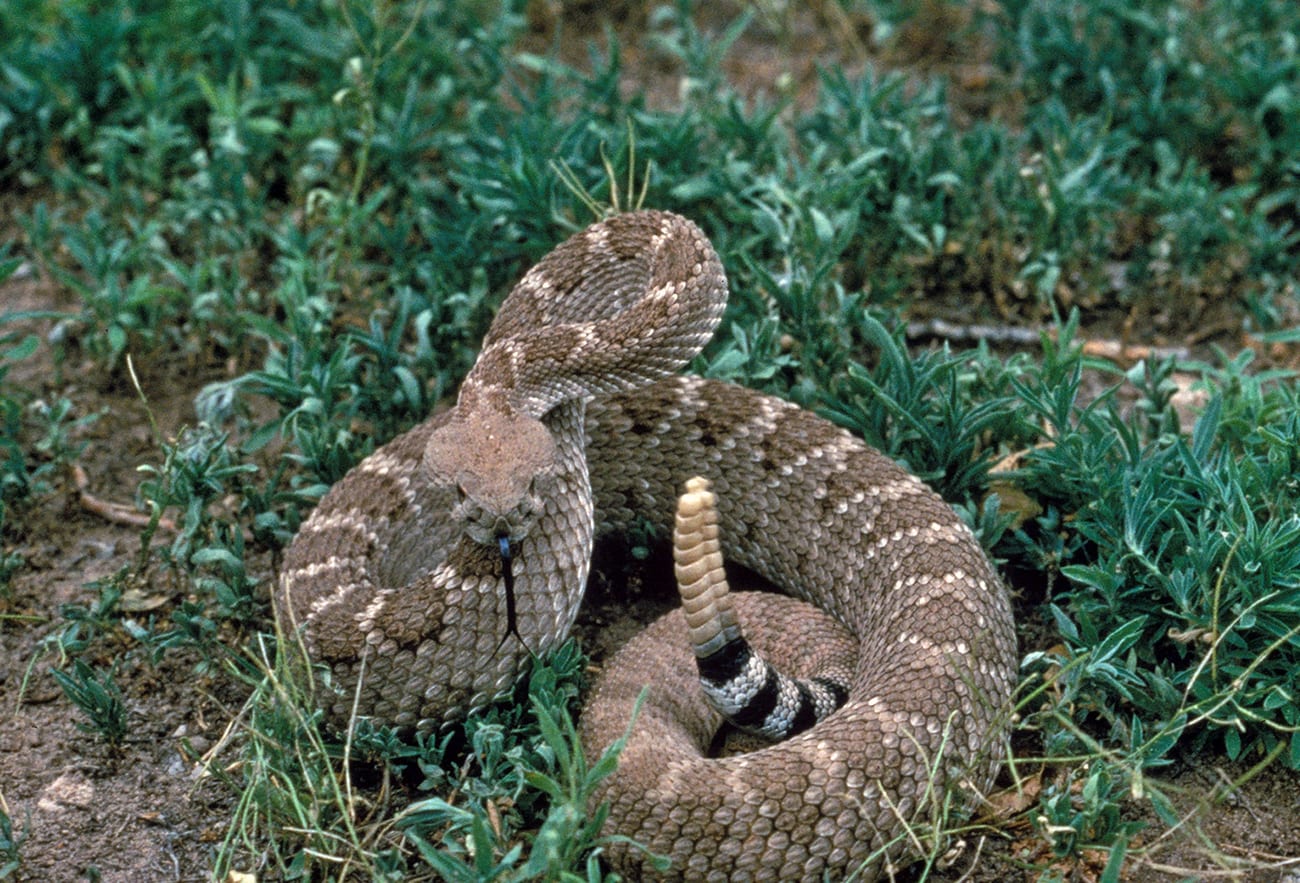
In the United States, a rattle is a rattle: if it has one, it is a rattlesnake. Coral snakes are the only banded red-yellow-black snake in the country where red touches yellow. Head shape and pupil shape are unreliable. Plenty of harmless snakes flatten their heads into a triangle when frightened, and you should never be close enough to a snake to check its pupils.
Cottonmouth vs watersnake
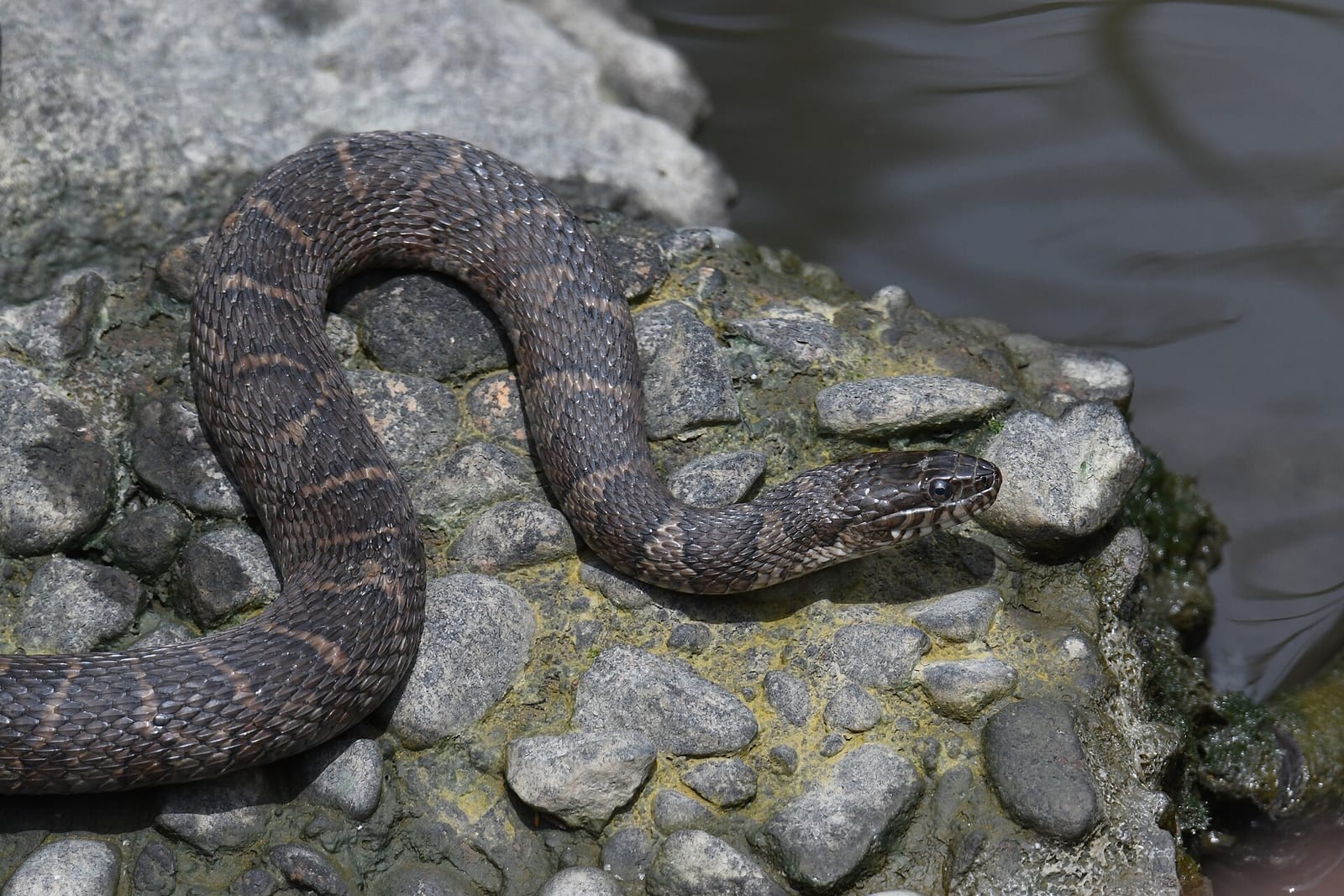
Northern watersnake
Nerodia sipedon
Swims with only its head out of the water and its body below the surface; a cottonmouth floats high, body and all. A watersnake will flatten its head and strike wildly when cornered, which is exactly why it gets killed by mistake.
Banded watersnake
Nerodia fasciata
Bands are widest across the back and narrow on the sides. A cottonmouth's bands do the opposite, wide on the sides and pinched over the spine, and it has a dark cheek stripe with a pale border above it.
Copperhead vs juvenile ratsnake and milk snake
Juvenile eastern ratsnake
Pantherophis alleghaniensis
Young ratsnakes are grey with dark blotches and get called copperheads constantly. Copperhead crossbands are chestnut, hourglass-shaped, and narrow across the spine; ratsnake blotches are grey-brown squares that are widest on the back.
Eastern milk snake
Lampropeltis triangulum
Blotches are outlined in black and the belly is a chequerboard. A copperhead has no black outlines and a plain, unmarked underside.
Northern watersnake
Nerodia sipedon
Dries to a dull brown and is the single most common copperhead misidentification near water. Its bands break up into blotches toward the tail; a copperhead's do not.
Coral snake vs scarlet kingsnake
Scarlet kingsnake
Lampropeltis elapsoides
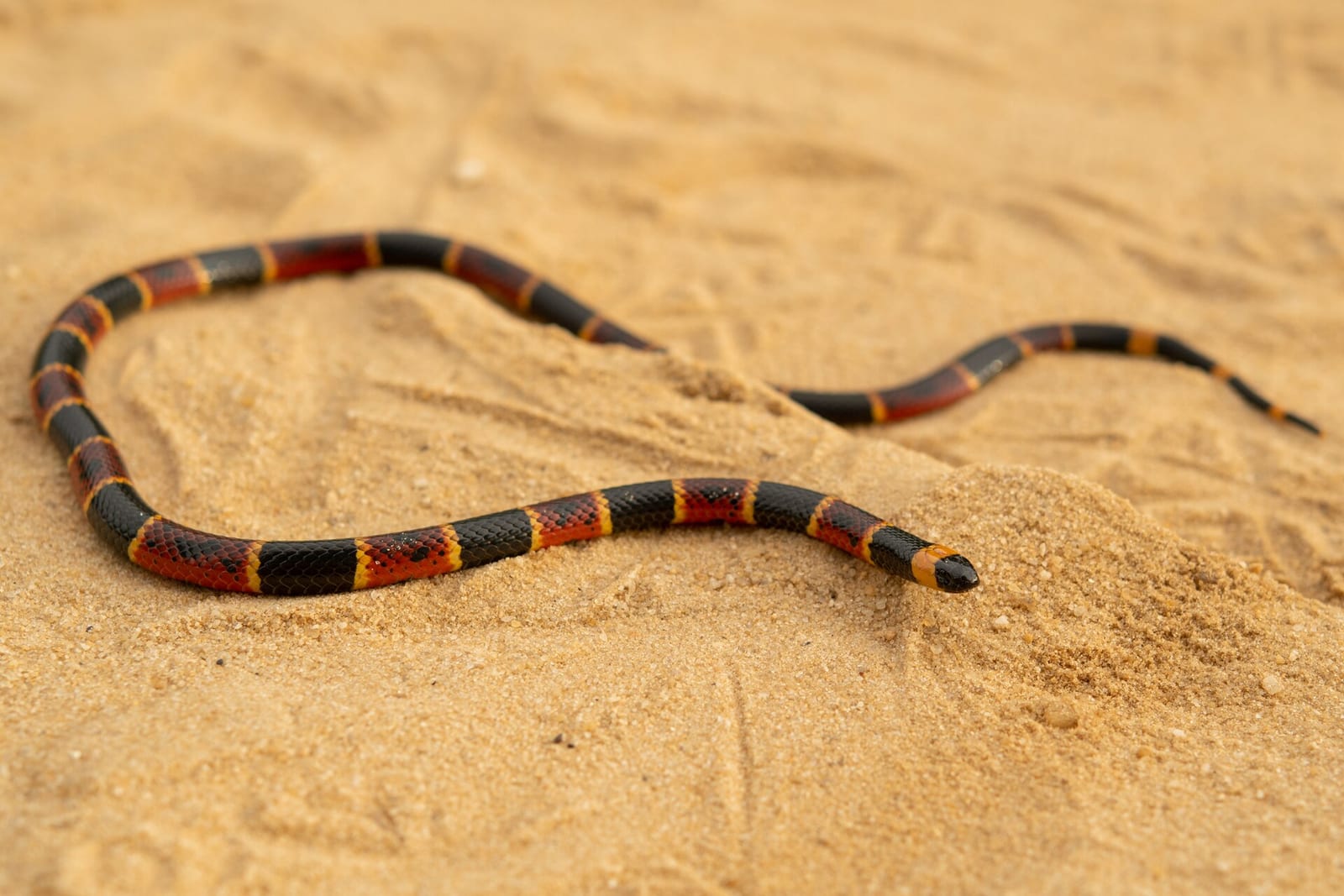
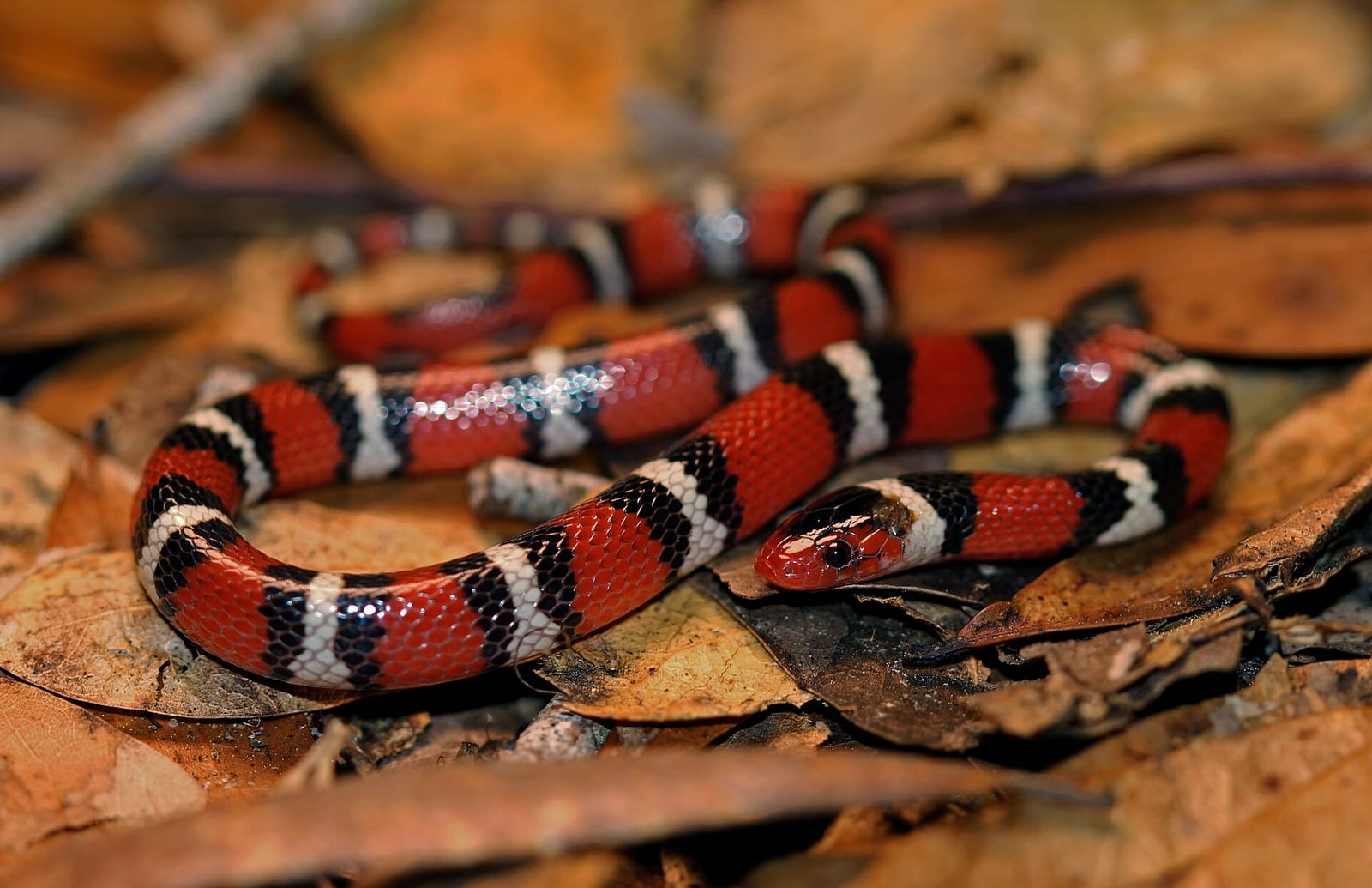
Red bands touch black bands, and the snout is red. On a coral snake the red bands touch yellow and the snout is black. The rhyme works in the United States and only in the United States.
Scarlet snake
Cemophora coccinea
Red saddles that do not wrap all the way around, over a plain white belly. Coral snake bands ring the whole body.
Rattlesnake vs the snakes that fake being one
Gopher snake or bullsnake
Pituophis catenifer
Hisses loudly, flattens its head into a triangle, and vibrates its tail in dry leaves to fake a rattle. It has no rattle, round pupils, and a much longer, more tapered tail.
Eastern hognose snake
Heterodon platirhinos
Flares its neck like a cobra, hisses, and then plays dead upside down with its tongue out. The upturned pig snout gives it away, and it has no rattle.
The snake year, month by month
February to April out of the dens
Southern snakes are moving by February and the whole eastern half is out by April. Spring is the single biggest peak in most states, because snakes bask in the open after months underground and are easy to see. In the desert Southwest this is a slow, quiet time by comparison.
May to July the high season
Peak everywhere east of the Rockies. As days get genuinely hot, activity shifts to dawn, dusk, and after dark rather than stopping. In Arizona and New Mexico the monsoon arrives in July and rattlesnake records jump several fold within weeks.
August to September the rebound
The August dip is real, and so is the September climb. Copperheads and cottonmouths give birth to live young in late summer, and rattlesnakes are moving back toward denning areas. In copperhead country September runs above August in the records.
October to January back underground
Snakes converge on den sites through October, which is why autumn produces a lot of sightings on rocky slopes and, in southern Illinois, an actual road closure so they can cross. By the first hard freeze the northern half of the country is done until spring. Florida, south Texas, and coastal Louisiana never fully stop.
Venomous snake FAQ
Species lists, record counts, and activity curves come from the iNaturalist API, research-grade observations only, read in your browser. They measure how often people find and photograph a species, not how many exist, and a species with no record in a state may still live there. Range maps are aggregated observation grid tiles from the same source. The national bite and death figures that circulate all trace back to a single agency page. If someone is bitten, go to a hospital and call Poison Control on 1-800-222-1222 on the way. Also worth checking before you go out: your state’s tick forecast and yellowjacket season, both of which affect far more people than snakes do.
Hero image: “Close up of coiled copperhead snake” — Ryan Hagerty — Public domain