Skip to content

Whale Watching Season: Which Whale, Which Coast, When

Four distinct US whale migrations, each with the season quoted from the agency that publishes it, plus where you can watch from land without paying for a boat.

1 of the four US whale migrations is running today: Humpbacks
Migrations
4
States covered
11
Species
7

The four US whale migrations, side by side

Agency windows, quoted
Dec to May
Gray whales, west coast
Southbound, then back north with calves
Nov to Apr
Humpbacks, Hawaii
Peak January through March
Nov to Apr
Right whales, Georgia and Florida
The only known calving ground
Apr to Oct
Humpbacks, New England
The Gulf of Maine feeding season

Every date on this page is quoted from NOAA Fisheries, a National Marine Sanctuary, the National Park Service or a state wildlife agency, with the wording and the link attached. Where two agencies describe the same animal differently, both are quoted.

Right now

What is running today

Whale watching is a commercial tour industry, and almost everything written about “whale watching season” is written by somebody selling a departure. That produces a specific, predictable distortion: a season described as longer than the animals are actually there, because a boat that runs in October would rather you did not know the whales left in September.

Below: the window each agency publishes, in that agency’s own words, where you can stand on land and watch for nothing, and today’s status for each of the four migrations.

Gray whales, California and Oregon

Later in the year

Southbound from December, northbound from mid-February into May

The one migration in the country you are genuinely expected to watch from a cliff. NOAA produces the federal population estimate for this species using shore-based observers south of Monterey.

California · Oregon · Washington

Humpbacks, Hawaii

Later in the year

November through April, peaking January through March

Roughly half the North Pacific humpback population spends the winter in Hawaiian water. The sanctuary says outright that you can see them from shore.

Hawaii

North Atlantic right whales, Georgia and Florida

Later in the year

Mid-November through mid-April

The only known calving ground on earth for a species down to a few hundred animals, and the strictest approach rule in US waters at 500 yards.

Georgia · Florida

Humpbacks, finbacks and minkes, New England

Happening now

Humpbacks arrive in April and stay in numbers through the summer

The Gulf of Maine feeding season, centred on Stellwagen Bank. Also the coast where agencies are most blunt that you will not see much from the beach.

Massachusetts · Maine · New York

Checking the most recent public whale record in the United States…

The animals

Which whale you are actually looking at

Almost every page about whale watching treats “whales” as one thing. They are not. The gray whale that passes a California headland in January and the humpback that feeds off Alaska in July are on opposite annual schedules, look nothing alike at distance, and are governed by different federal rules. Here is what separates them from a mile away, which is the distance you will usually be at.

Gray whale

Eschrichtius robustus

A low bushy blow about 10 to 15 feet high, often heart shaped from head on, then a knuckled ridge instead of a dorsal fin as the back rolls under. Gray whales travel close in, which is the entire reason they can be watched from land at all.

Status: The eastern North Pacific population was listed as endangered, recovered, and was delisted under the Endangered Species Act in 1994. The western North Pacific population is still listed as endangered. NOAA Fisheries, Gray Whale

Humpback whale

Megaptera novaeangliae

A tall columnar blow, a small dorsal fin on a hump, and the black and white underside of the tail as it dives. The only large whale that routinely breaches clear of the water.

Status: Humpbacks are managed as 14 distinct population segments. Four are listed as endangered under the Endangered Species Act, one is listed as threatened, and nine are not listed. NOAA Fisheries, Humpback Whale

North Atlantic right whale

Eubalaena glacialis

No dorsal fin at all, a broad black back, a V shaped blow from two separated blowholes, and rough white callosity patches on the head. If you think you have seen one, NOAA runs sighting hotlines: (866) 755-6622 from Maine to Virginia, (877) 942-5343 from North Carolina to Florida.

Status: Endangered throughout its range under the Endangered Species Act, and depleted under the Marine Mammal Protection Act. NOAA has listed right whales as endangered since 1970. NOAA Fisheries, North Atlantic Right Whale

Fin whale

Balaenoptera physalus

The second largest animal on earth, and a fast, low, straight-line traveller. A tall narrow blow and a dorsal fin that appears long after the blow, well down the back.

Status: Endangered throughout its range under the Endangered Species Act. NOAA Fisheries, Fin Whale

Minke whale

Balaenoptera acutorostrata

The smallest baleen whale here, with a pointed snout, a curved dorsal fin visible almost at the same moment as the blow, and often no visible blow at all. Maine says minkes come "closer to shore" than humpbacks or finbacks.

Status: Not listed under the Endangered Species Act, and protected under the Marine Mammal Protection Act. NOAA Fisheries, Minke Whale

Killer whale

Orcinus orca

Unmistakable: a tall black dorsal fin, up to six feet on an adult male, with a white eye patch and a grey saddle behind the fin.

Status: The Southern Resident population, which uses Washington inland waters, is listed as endangered under the Endangered Species Act. Other killer whale populations are not listed. NOAA Fisheries, Killer Whale

Blue whale

Balaenoptera musculus

A blow up to 30 feet, the tallest of any whale, and a mottled blue grey back so long that the tiny dorsal fin appears only as the animal finishes its dive. Mostly an offshore animal: NOAA's Monterey Bay sanctuary places blue whales in "the offshore waters of the sanctuary", so this is a boat species, not a headland species.

Status: Endangered throughout its range under the Endangered Species Act. NOAA Fisheries, Blue Whale

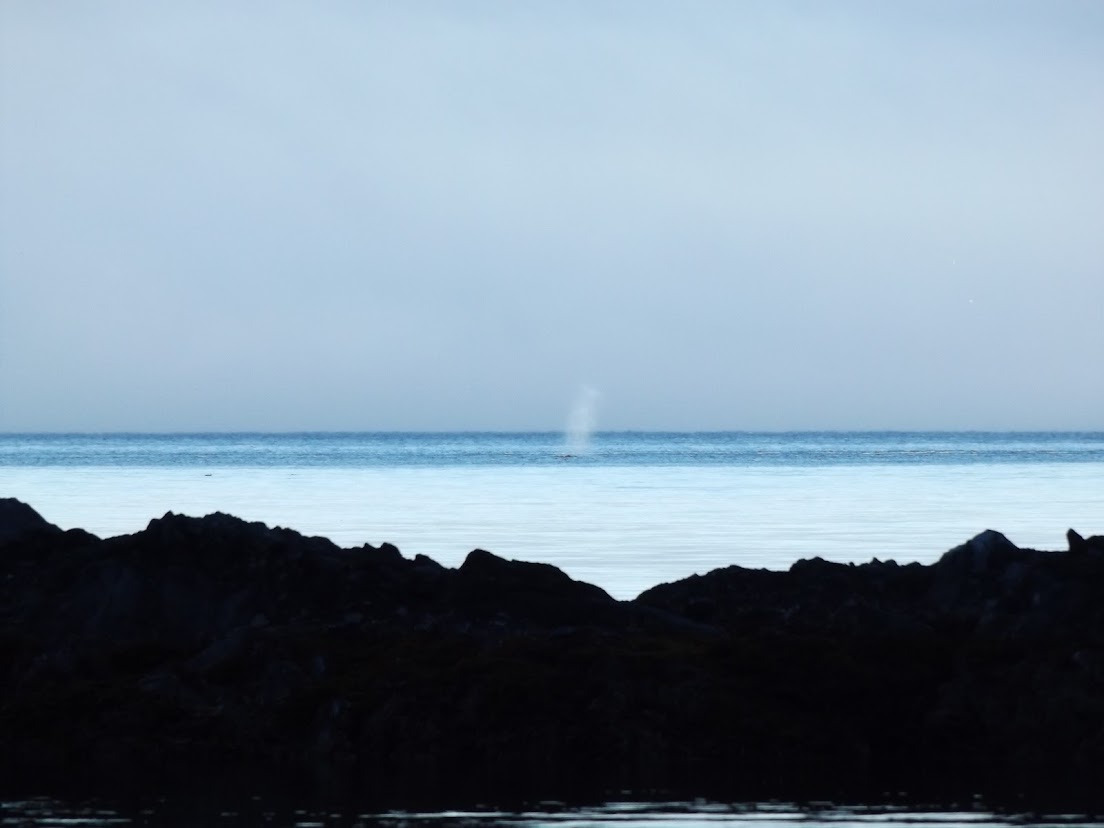
A distant white whale spout rising above a flat sea, seen over a dark rocky foreground from the shore
This is what shore-based whale watching actually looks like. Not a breach, not a fluke filling the frame: a blow on the horizon, seen over rock. Learning to spot the blow is the whole skill, and it is why every agency lookout on this page is on a headland rather than a beach. “Whale spout, Alaska” — Forest Service Alaska Region, USDA — Public Domain
From shore

Shore watching, coast by coast

On the Pacific coast, shore watching is not a budget substitute for a boat. It is the primary method, and the federal government uses it. NOAA’s abundance estimate for the entire eastern North Pacific gray whale population is produced by observers at the Granite Canyon field station south of Monterey, counting animals going past from land between December and February. The Hawaiian Islands Humpback Whale National Marine Sanctuary runs its Ocean Count from the shores of three islands. NOAA has written that “Watching whales from shore also avoids the impacts of boat noise and traffic” and that the Southern Resident killer whale recovery plan “includes encouraging land-based viewing to reduce vessel impacts”.

On the Atlantic coast, it mostly does not work, and two federal agencies say so in their own words. NOAA’s own Stellwagen Bank sanctuary writes that “since there is little land-based whale watching on the Cape, Stellwagen Bank is the ultimate destination”. The National Park Service writes of Acadia that it is “rare and unlikely to see a whale in the bay or from shore” and that whales there “are best viewed from whale watching tours and excursions”. There are exactly two agency-backed exceptions on the whole eastern seaboard: Race Point on Cape Cod in spring, where the Park Service says whales “can often be seen from shore”, and the Georgia and north Florida calving coast, where Florida’s wildlife agency writes that right whales are “often visible from the beach”.

No agency claims shore watching beats a boat, and California State Parks’ own guidance says the opposite: “Sightseeing boats offer the best vantage point”. What agencies do confirm is that whales are visible from land in specific named places; they name those places and charge no activity fee for them, and those are the places on these pages.

Elevated view north along the rocky Oregon coast from a stone-walled roadside overlook, with a paved path and two walkers below and a forested headland beyond
The roadside overlook at Cooks Chasm on the central Oregon coast, looking north toward Cape Perpetua. Oregon State Parks staffs 15 shore sites during its Whale Watch Weeks, and keeps year-round staff at a whale watching centre on the seawall at Depoe Bay. “Looking north from Cooks Chasm roadside” by Joe Mabel, CC BY-SA 4.0
Advertisement
The federal calendar

The federal right whale season, by area

There are about 384 North Atlantic right whales left. Because of that, the United States restricts vessel speed in five specific areas during five specific annual windows, under 50 CFR 224.105. NOAA’s wording: “Most vessels 65 feet or longer must travel at 10 knots or less in certain locations.”

These are shipping rules. They exist to stop whales being hit, not to help anybody find one. But look at what they are: five dated, mapped, federally maintained statements of when this species is expected in a given piece of water, updated by an agency with no commercial stake in the answer. That is a better seasonal calendar than any of them, and it is sitting in a regulation nobody reads.

November 15 to April 15Later in the year

Calving and Nursery Grounds

The southeast US calving area, off Georgia and northeast Florida

The only known calving ground for the species. NOAA defines the critical habitat that contains it as running "off the southeast U.S. coast from Cape Fear, North Carolina, to below Cape Canaveral, Florida".

November 1 to April 30Later in the year

Migratory Route and Calving Grounds

The mid-Atlantic: Block Island Sound, a 20 nautical mile radius around the entrances to the Port of New York and New Jersey, Delaware Bay, Chesapeake Bay and Morehead City, and a continuous 20 nautical mile coastal band from Wilmington, North Carolina to Brunswick, Georgia

The corridor pregnant females use to get south and back. It is why New Jersey, Delaware, Maryland, the Carolinas and Virginia all sit inside a federal right whale season even though none of them has an agency published viewing season.

January 1 to May 15Closed for this year

Cape Cod Bay

Cape Cod Bay, Massachusetts

The late winter and early spring feeding aggregation. This is the one place in the United States where a large fraction of the entire species can be in one bay at once.

March 1 to April 30Closed for this year

Off Race Point

The waters off Race Point, at the tip of Cape Cod

The federal window sits exactly on top of the one stretch of Atlantic sand where the National Park Service says whales can be seen from the beach.

April 1 to July 31Closed for this year

Great South Channel

The Great South Channel, east of Nantucket

Far offshore. Listed for completeness: there is no shore view of this one from anywhere.

Reproduced from NOAA Fisheries, Reducing Vessel Strikes to North Atlantic Right Whales. These are vessel speed restrictions, not viewing guidance; they are reproduced here because they are the United States government’s own dated, mapped statement of when right whales are expected in a given piece of water.

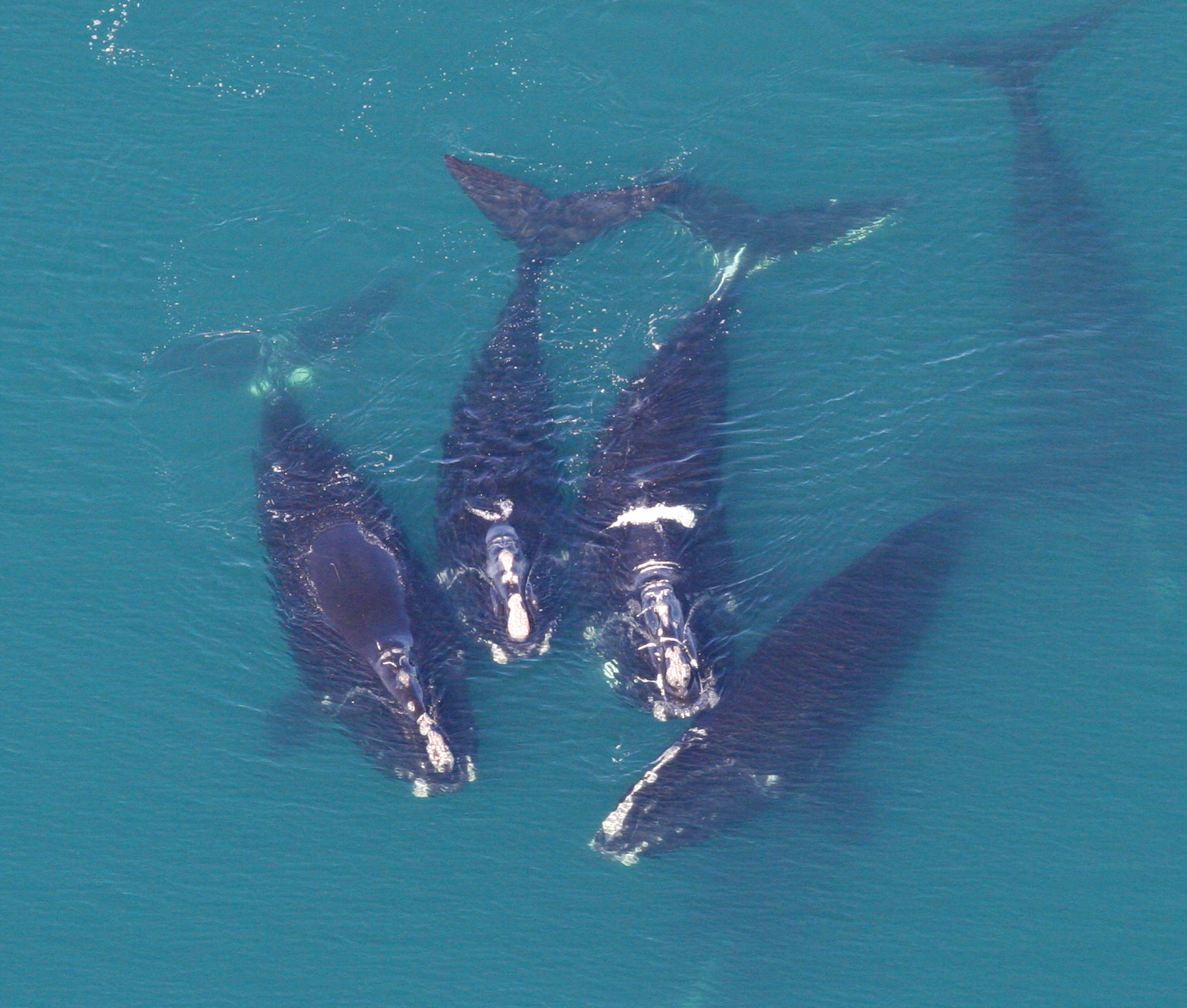
Aerial view straight down onto four North Atlantic right whales swimming in clear green water, their pale head callosities and broad flukes clearly visible
North Atlantic right whales photographed from the air over Gray’s Reef National Marine Sanctuary, off the Georgia coast. The sanctuary describes itself as sitting “within the critical habitat and only known calving ground” for the species. Note the pale callosity patches on the heads, the field mark that separates a right whale from anything else in the Atlantic. “North Atlantic right whales, Gray's Reef National Marine Sanctuary” — NOAA National Marine Sanctuaries — Public Domain
The law

How close you may legally get

This differs by species and by region, the differences are large, and getting it wrong is a federal offence rather than an embarrassment. Five hundred yards for a North Atlantic right whale anywhere in US waters. One hundred yards for a humpback in Hawaii or Alaska, which NOAA states applies “by land or sea”. Two hundred yards for killer whales in Washington inland waters under federal rules, but one thousand yards under Washington state law since January 1 2025, and the state number is the one that binds there. One hundred yards as general guidance for everything else.

Every rule below is quoted from the agency that issues it, with the species and the region attached.

Gray whaleEschrichtius robustus

“Remain at least 100 yards away, about the length of a football field, unless other rules apply.”

NOAA Fisheries, Marine Life Viewing Guidelines: Guidelines and Distances

Humpback whaleMegaptera novaeangliae

“In Hawaii and Alaska, it is illegal to approach a humpback whale within 100 yards, by land or sea. It is also illegal to approach humpback whales in Hawaii within 1,000 feet (333 yards) by air.”

NOAA Fisheries, Humpback Whale: Resources

Note the phrase "by land or sea". NOAA states this rule two different ways on two of its own pages: the species resources page says "by land or sea", while its general viewing guidelines page frames the same 100 yards as a requirement on vessels. Outside Hawaii and Alaska the 100 yards is guidance rather than a humpback-specific law.

North Atlantic right whaleEubalaena glacialis

“NOAA Fisheries has regulations that prohibit approaching or remaining within 500 yards (1,500 feet) of a right whale.”

NOAA Fisheries, North Atlantic Right Whale

This is five times the distance that applies to every other whale, and it is the strictest approach rule for any whale in US waters. NOAA words the restriction as applying to approaches "whether by vessel, aircraft or other means", and a separate line requires aircraft and drones to maintain a 1,500 foot minimum altitude over right whales. A drone launched from a beach is covered. No agency page states whether the rule reaches a person standing still on the sand. If a right whale comes to you, NOAA's instruction is to "immediately depart from the area at a slow, safe speed in a direction away from the whale."

Fin whaleBalaenoptera physalus

“Remain at least 100 yards away, about the length of a football field, unless other rules apply.”

NOAA Fisheries, Marine Life Viewing Guidelines: Guidelines and Distances

Minke whaleBalaenoptera acutorostrata

“Remain at least 100 yards away, about the length of a football field, unless other rules apply.”

NOAA Fisheries, Marine Life Viewing Guidelines: Guidelines and Distances

Killer whaleOrcinus orca

“Federal rules require vessels to remain 200 yards away from killer whales in Washington State inland waters. Washington state law is stricter and it is the one that binds in Washington waters.”

NOAA Fisheries, Marine Life Viewing Guidelines, and Washington Department of Fish and Wildlife

Washington: "As of Jan. 1, 2025, per RCW 77.15.740, motorized and non-motorized vessel operators (including kayakers and paddleboarders) in Washington waters must: Stay 1,000 yards away from Southern Resident killer whales." That is 1,000 yards under state law against 200 yards under the federal rule, and paddleboards and kayaks are named. Both rules bind vessels, not people standing on a beach.

Blue whaleBalaenoptera musculus

“NOAA asks people watching blue whales to "maintain a minimum distance of at least 100 yards and limit your observation time to 30 minutes or less".”

NOAA Fisheries, Blue Whale

Two things a shore watcher specifically needs to know. First, drones: NOAA requires aircraft and drones to maintain a 1,500 foot minimum altitude over North Atlantic right whales, and a drone launched from a beach is an aircraft. Second, no agency page states whether the 500 yard right whale rule reaches a person standing still on the sand. What NOAA does say, if a right whale comes to you, is to “immediately depart from the area at a slow, safe speed in a direction away from the whale”.

Recurring

Two agency-run shore events, every year

Both recur annually on a rule, and each agency announces the exact dates closer to the season. The rule and the agency page to check are below.

Whale Watch Weeks

Oregon State Parks

Twice a year, in late December and again in late March

Oregon State Parks writes that it "celebrates the migration twice per year during Whale Watch Weeks in late December and late March" and that "The program places volunteers at 15 whale watching sites in the winter and spring."

Oregon State Parks publishes each year’s dates when the season is announced; check the state parks page in late autumn for the winter week. Agency page

Sanctuary Ocean Count

Hawaiian Islands Humpback Whale National Marine Sanctuary

The last Saturday of January, February and March, from 8:00 am to 12:15 pm

The sanctuary describes it as a chance to "monitor humpback whales from the shores of Oahu, Hawaii and Kauai". It is a shore-based count, which is the same method NOAA uses to estimate gray whales on the other side of the ocean.

The recurrence rule is fixed; the specific Saturdays for a coming year are posted by the sanctuary closer to the time. Agency page

A cross-check

When people actually reported whales

Below is every research-grade humpback whale observation the public has logged in the United States, by month. It is not a measure of when humpbacks are present. It is a measure of when humpbacks were present multiplied by how many people were out with a camera, and the second term swamps the first every winter.

It is here because the places it disagrees with the agency calendar are informative. Oregon is the clearest case: the state’s gray whale record peaks in July and August, which are months in which Oregon State Parks says the migration is not happening. What that curve is measuring is the roughly 200 resident whales that stay all summer, plus the fact that people visit the Oregon coast in July and not in January. If you planned a trip from the crowd data you would arrive six months late.

The whale charts show raw counts. Other wildlife pages on this site divide a species count by total observations in the same place and month, to strip out how many people were outside; for whales the denominator for a whole state is almost entirely land records, which peak in summer, so dividing by it drags every marine peak into winter. Raw counts are the more faithful series here.

Reading the public observation record for Humpback whale in the United States…

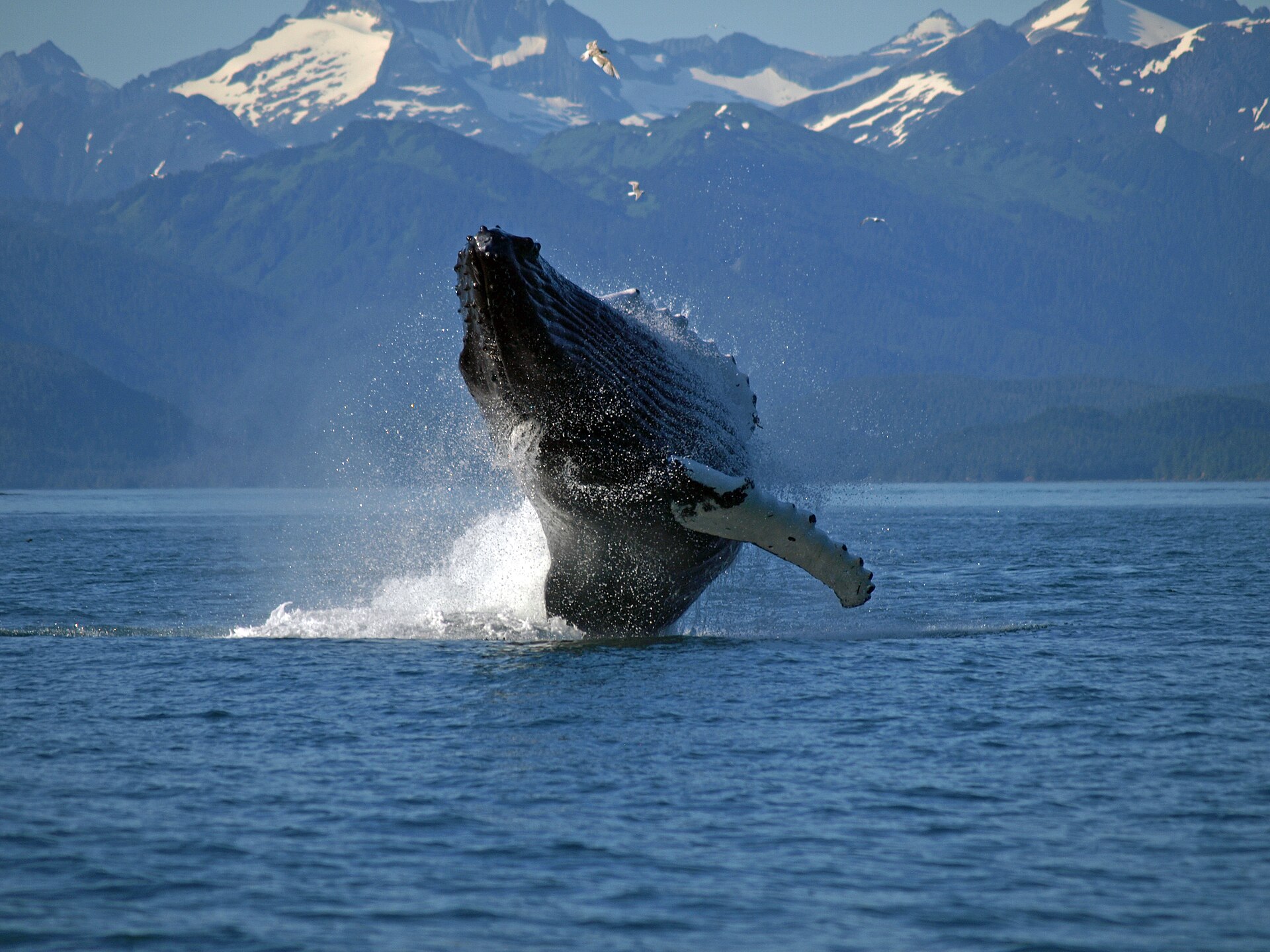
A humpback whale breaching clear of the water with its long white pectoral fin extended, snow-covered mountains behind
A humpback breaching in southeast Alaska. This is the photograph every whale watching page uses and almost nobody takes: it is a summer, boat-distance, right-place-right-second image. Set your expectations from the blow photograph further up this page instead. “Adult Humpback Whale breaching” by Gillfoto, CC BY-SA 3.0
Coverage

The 11 states with an agency published whale season

Thirty US states have an ocean or Great Lakes shoreline, and 11 of them have a federal or state agency that publishes a whale season. Those are the state pages. The other coastal states are named below with what the agencies say about their water.

The Gulf coast: Texas, Louisiana, Mississippi and Alabama

The Gulf has exactly one resident baleen whale, Rice's whale, and NOAA describes it as "the only species of baleen whale that regularly occurs in the Gulf". NOAA's most recent abundance estimate, from 2017 to 2018 surveys, "indicates there are approximately 50 individual Rice's whales", and the species is listed as endangered under the Endangered Species Act. Most sightings sit "in 100-400 meter water depths", which is far offshore. No agency describes any public viewing opportunity anywhere in the Gulf; with roughly 50 animals in deep water, there is no shore season to publish.

New Jersey, Delaware, Maryland, North Carolina and South Carolina

Right whales genuinely pass all five of these states. All of them sit inside the federal mid-Atlantic Seasonal Management Area, which restricts vessel speed from November 1 to April 30, and NOAA's designated critical habitat for the calving ground runs from Cape Fear in North Carolina south past Cape Canaveral. None of them has an agency published viewing season: the state wildlife agencies publish no whale season, and the National Park Service's Cape Hatteras pages mention whales only in the context of strandings. The federal right whale windows that cover their water are on the calendar above.

New Hampshire, Rhode Island and Connecticut

New Hampshire and Rhode Island boats work the same Gulf of Maine and Jeffreys Ledge water covered on the Maine and Massachusetts pages, and Connecticut sits behind Long Island in water no large whale routinely uses. No state agency in any of the three publishes a whale viewing season, and the most widely cited New Hampshire source is a nonprofit rather than an agency. Read Maine and Massachusetts instead: it is the same water and the same whales.

The Great Lakes states and everywhere inland

There are no whales in the Great Lakes and none in any inland state, so the whale season pages cover the ocean coasts only: the Pacific, Hawaii and the Atlantic.

By state

Whale watching season in every covered state

The Pacific coast and Hawaii

Where shore watching genuinely works, and where the season is a migration rather than a feeding aggregation.

The Atlantic coast

Where the whales are real, the boats are excellent, and the beach is mostly the wrong place to stand. Two exceptions, both named.

Common questions

Whale watching season FAQ

Advertisement

Every season, population figure and approach distance on this page is quoted from NOAA Fisheries, a NOAA National Marine Sanctuary, the National Park Service or a named state agency, with the wording and a link attached. Monthly observation counts are read live in your browser from the iNaturalist API and are a record of when people reported whales, not of when whales were present.
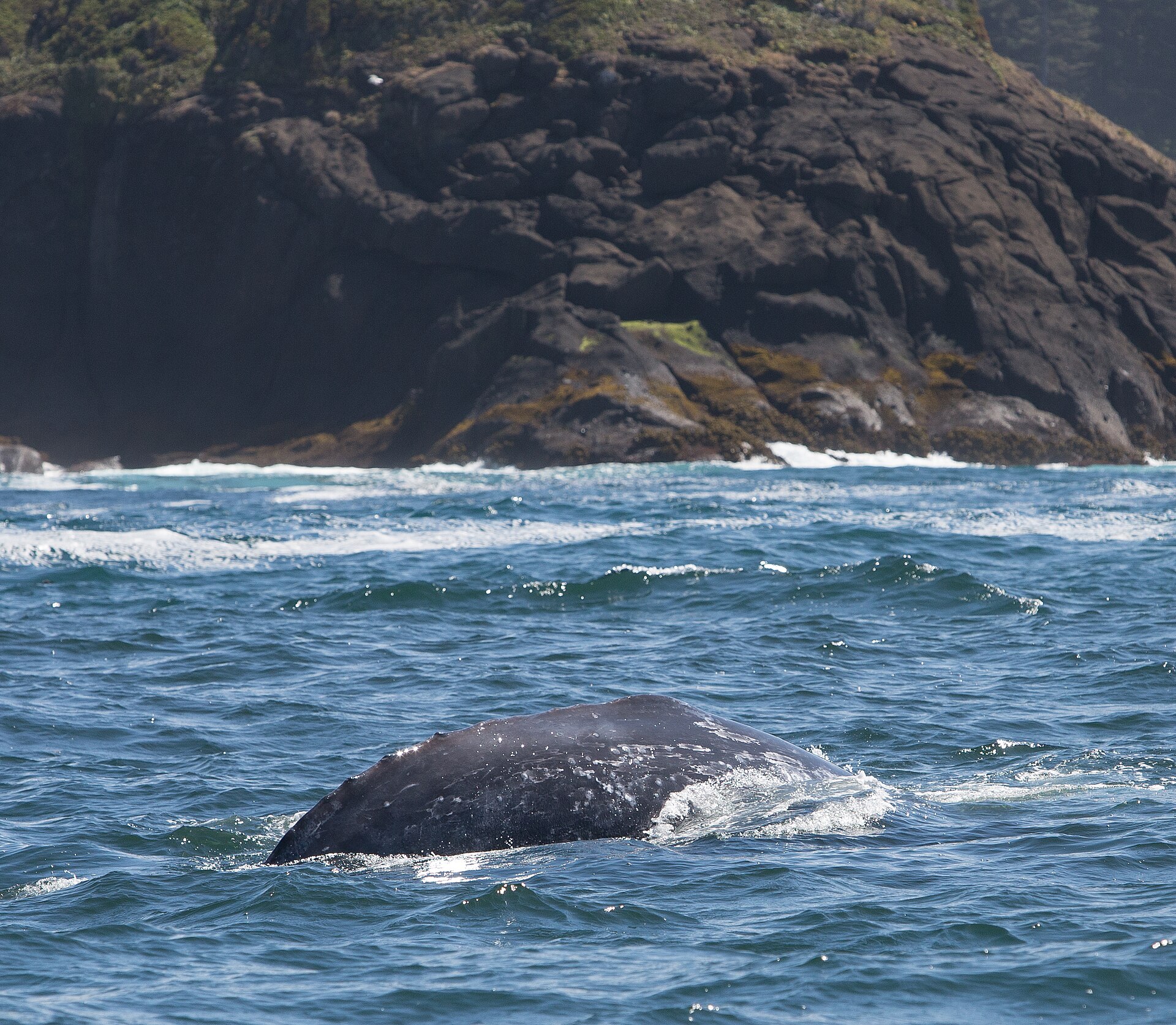
Hero image: “Gray whale, Depoe Bay OR” by Nicki Dugan Pogue, CC BY-SA 2.0