Skip to content

Winter Eagle Watching

When the lakes freeze, bald eagles compress into the open water below dams. These are the public viewing sites the agencies themselves designate, and what the record actually shows.

States with a page
19
Agency viewing sites
58
On federal land
25
Start here

Find a winter eagle viewing site near you

Eagle watching is a place question before it is a date question. Enter a ZIP and this names the county it sits in and sends you to that state’s page, which lists every agency designated viewing site in it and the water each one looks out over.

Find your state page by ZIP

Every agency site on one map

Three layers. The coloured pins are viewing sites an agency itself describes as somewhere the public goes to look at eagles. The small grey dots are US Army Corps of Engineers locks and dams, drawn underneath because on the interior rivers the viewing sites sit on the dams one after another and the pattern is worth seeing. The shaded grid is iNaturalist records, which is a map of where people have uploaded a photograph rather than a map of birds.

Style
Records
Size

Every pin is a public site named by the agency that runs it. The coloured grid is where people have uploaded a verified bald eagle record to iNaturalist in December, January and February, brighter where more have been logged. It is a map of reports, not of birds: it thickens around car parks, boardwalks and towns because that is where observers stand, and it thins over roadless country whether or not eagles are there. It shows past reports rather than birds present today. Pins are public viewing sites an agency itself describes; grey dots are US Army Corps of Engineers locks and dams, drawn because open tailwater below a dam is the reason most of these sites exist.

The mechanism

Why a hard freeze is the best thing that can happen to an eagle watcher

For most of the year a bald eagle is a bird you find by luck. A breeding pair holds a territory of several square miles and defends it, so the birds are spread thinly and predictably invisible. Winter takes that apart. Eagles that nested in Canada and the northern states come south ahead of the ice, and at the same time the water they are hunting starts to close over. A frozen lake is not a food source. A frozen river reach is not a food source. What is left is the handful of places where moving water refuses to freeze.

Those places are mostly artificial. Water dropping through a dam stays in motion and stays open in weather that seals everything upstream, and fish that pass through the turbines or over the spillway arrive at the bottom stunned or dead. A tailrace in January is therefore a heated, stocked canteen in the middle of a locked landscape, and every fish eating bird for miles knows it. The same logic puts birds at river confluences, at the tail ends of big reservoirs, and along the edge of the ice on a lake that has not quite closed.

It is the mechanism the US Fish and Wildlife Service sets out in its own management guidance, quoted here in the agency’s own words.

“Wintering bald eagles often congregate in large numbers along streams to feed on spawning salmon or other fish species, and often gather in large numbers in areas below reservoirs, especially hydropower dams, where fish are abundant. Wintering eagles also take birds from rafts of ducks at reservoirs and rivers, and congregate on melting ice shelves to scavenge dead fish from the current or the soft melting ice.”
US Fish and Wildlife Service, National Bald Eagle Management Guidelines, May 2007. A US government work, in the public domain, quoted exactly.

Two things follow, and they shape every page in this section. The first is that eagle watching is a place question far more than a date question: the sites barely move from year to year, while the timing swings with how hard the winter bites. The second is that a mild winter is a bad winter for watching. If nothing freezes, nothing concentrates, and the birds stay spread out across water that is still open everywhere. A reader who drives four hours in a warm January and sees two birds has not been unlucky. They have seen the mechanism fail to switch on.

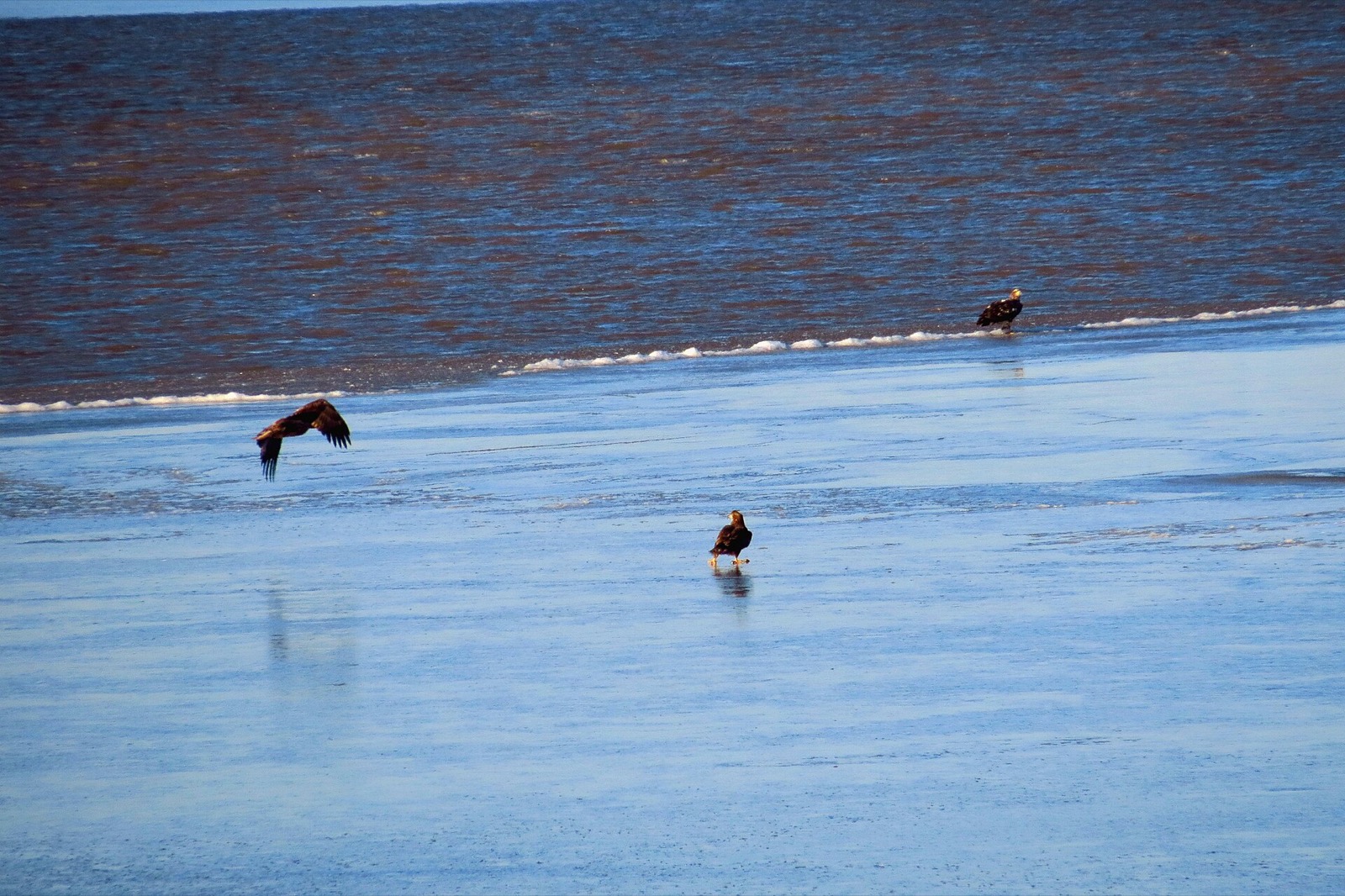
Three bald eagles at the edge of a frozen bay, one standing on the ice, one in low flight and one at the boundary between the ice sheet and dark open water
The sharp line where a sheet of ice gives way to dark open water, with birds standing on the edge of it. The eagles are not on the ice because they like ice. They are on it because it is the closest solid thing to the only water still holding fish. Watch the ice edge rather than the middle of a lake, and watch it in the first two hours of daylight. “Juvenile Bald Eagles sitting and fishing on the iced-over bay” by vastateparksstaff, CC BY 2.0
Advertisement
By state

Where there are agency designated winter viewing sites

A state has a page here when a federal or state agency publishes at least one public place it describes for eagle viewing. That is a higher bar than "eagles occur here", which is true of all fifty states, and a lower bar than "the agency guarantees birds", which no agency does. States without such a site are listed further down with the reason.

StateLead agencySitesWhat concentrates them
IllinoisIllinois Department of Natural Resources3The Illinois and Mississippi rivers, at the lock and dam pools
MissouriMissouri Department of Conservation6Mississippi River locks, big Corps reservoirs and refuge wetlands
WisconsinWisconsin Department of Natural Resources4The Wisconsin, Mississippi and Fox rivers below their dams
NebraskaNebraska Game and Parks Commission3Reservoir tailwaters on the Platte and the Missouri
MinnesotaMinnesota Department of Natural Resources4The Mississippi River towns below Lake Pepin
TennesseeTennessee Wildlife Resources Agency3Reelfoot Lake and the Tennessee River reservoirs
KentuckyKentucky Department of Fish and Wildlife Resources4Kentucky Lake and Lake Barkley, between the two dams
OklahomaOklahoma Department of Wildlife Conservation3Big reservoirs and two national wildlife refuges
AlabamaAlabama Department of Conservation and Natural Resources2Tennessee River reservoirs in the north of the state
PennsylvaniaPennsylvania Game Commission3The lower Susquehanna and the upper Delaware
VirginiaVirginia Department of Wildlife Resources3The tidal Potomac and the James
MarylandMaryland Department of Natural Resources2Chesapeake tidal marsh and the Susquehanna below Conowingo
WashingtonUSDA Forest Service, Mount Baker-Snoqualmie National Forest3The Skagit River, on the late chum salmon run
IdahoBureau of Land Management2Wolf Lodge Bay on Lake Coeur d'Alene, on the kokanee run
CaliforniaCalifornia Department of Fish and Wildlife4The Klamath Basin refuges and the southern reservoirs
ColoradoColorado Parks and Wildlife2Front Range reservoirs and refuge cottonwoods
UtahUtah Division of Wildlife Resources3Great Salt Lake wetlands, reservoirs and valley roosts
ArkansasArkansas Game and Fish Commission2Corps reservoirs, the Arkansas River and the Delta rice country
AlaskaAlaska Department of Natural Resources, Division of Parks and Outdoor Recreation2The Chilkat River, kept open by groundwater under an alluvial fan

Pere Marquette State Park State

Illinois River, near its confluence with the Mississippi

The state agency describes this park as the place it runs eagle programmes through the winter, on the stretch of the Illinois River just above where it joins the Mississippi. A park interpreter writing for the agency puts the best viewing in January and February, when birds move to open water to fish.

Run by Illinois Department of Natural Resources

Loess Bluffs National Wildlife Refuge south of Mound City Federal

Refuge wetlands in the Missouri River floodplain

A ten mile one way auto tour through wetlands, which is the ideal way to watch eagles because the car is the hide. The refuge names bald eagles among its key species and its staff run weekly waterfowl and bald eagle surveys from autumn through spring migration, published in the refuge library.

Run by US Fish and Wildlife Service

The Prairie du Sac overlook on Water Street State

Wisconsin River, below the Prairie du Sac dam

The state agency points visitors to a riverside overlook in the middle of town, below the dam that keeps this reach of the Wisconsin River open. It is also where agency staff and volunteers set up scopes for the annual watching days, so it is the one Wisconsin site where you may find somebody to ask.

Run by Wisconsin Department of Natural Resources

Lake Ogallala State Recreation Area State

Lake Ogallala, in the spillway below Kingsley Dam

The best equipped eagle site in the interior. The state agency describes a heated viewing building below the dam, run by the local public power district, open free of charge on winter weekends. A building matters more than it sounds: it lets people watch for an hour in weather that would otherwise send them back to the car, without pushing closer to the birds.

Run by Nebraska Game and Parks Commission

The city park at Red Wing State

Mississippi River

The state agency names the riverside park at Red Wing in both its late autumn and its midwinter viewing notes, which makes it the most consistently recommended spot in Minnesota. The river here stays open below the town in most winters.

Run by Minnesota Department of Natural Resources

Reelfoot National Wildlife Refuge Federal

The upper third of Reelfoot Lake

The refuge publishes a self guided eagle tour packet, which is the single most useful document any agency has produced for winter eagle watching: a numbered driving route with viewing towers, a wildlife drive and identification notes. There is also a three and a half mile auto tour route and several viewing towers.

Run by US Fish and Wildlife Service

Honker Lake and the Land Between the Lakes bays Federal

Kentucky Lake and Lake Barkley

The federal recreation area between the two lakes publishes a dedicated winter wildlife section naming Honker Lake, the northwestern bays and the two dam tailwaters, and gives the best piece of tactical advice in this whole inventory: on warm days look out toward the points of the bays, and on cold windy days look in the trees at the back of the bay.

Run by USDA Forest Service, Land Between the Lakes National Recreation Area

Sequoyah National Wildlife Refuge Federal

The Robert S. Kerr Reservoir on the Arkansas River

The refuge runs free eagle watch tours on a refuge bus from its headquarters, every Saturday across six weeks of late winter, with binoculars and spotting scopes provided and no booking needed. That is the most accessible offer of its kind in this inventory.

Run by US Fish and Wildlife Service

Lake Guntersville State Park State

Guntersville Reservoir, on the Tennessee River

The federal power authority that owns the reservoir names this park as best known for its large numbers of wintering bald eagles, which is a stronger statement than a state park usually gets from a federal landlord. The park has run eagle awareness weekends for about forty years.

Run by Alabama State Parks, on a Tennessee Valley Authority reservoir

The lower Susquehanna River State

Susquehanna River, from Chickies Rock down to the state line

The state agency calls this a major area for nesting, migration and wintering, and gives it the only all seasons rating on its list. It names a string of public access points and overlooks along the river, including county park overlooks and a boat launch, and says eagles may be spotted from any of them.

Run by Pennsylvania Game Commission

Joseph V. Gartlan Jr. Great Marsh Trail Federal

The Great Marsh, on the tidal Potomac

Three quarters of a mile, paved and accessible, ending at an observation platform over a 250 acre marsh. The refuge itself says this trail gives the best opportunity to see bald eagles and wintering waterfowl, and the accessibility matters: very few sites in this inventory can be reached without a walk over rough ground.

Run by US Fish and Wildlife Service, Elizabeth Hartwell Mason Neck National Wildlife Refuge

Blackwater National Wildlife Refuge Wildlife Drive Federal

Blackwater River tidal marsh

A 3.6 mile wildlife drive through tidal marsh with a visitor centre at the start. Unlike most of this inventory Blackwater is primarily a breeding story rather than a freeze concentration, and the refuge says so, describing one of the highest concentrations of nesting bald eagles on the Atlantic coast.

Run by US Fish and Wildlife Service

The State Route 20 roadside viewpoints between Concrete and Marblemount Federal

Skagit River

The Forest Service tells visitors to watch from roadside viewpoints along the highway between two named towns, which is about as simple as a viewing instruction gets. The birds are here for salmon carcasses rather than for a dam, which is why this is a river reach rather than a single point.

Run by USDA Forest Service, Mount Baker-Snoqualmie National Forest

Mineral Ridge Scenic Area and boat launch Federal

Lake Coeur d'Alene, at Beauty Bay and Wolf Lodge Bay

The federal land agency runs a staffed interpretive viewing programme here at the end of December, and publishes fixed annual dates for it, which almost nobody else does. The birds are on spawning kokanee salmon rather than on a dam tailwater.

Run by Bureau of Land Management

Tule Lake National Wildlife Refuge auto tour route Federal

Klamath Basin wetlands

One of the two refuges the federal agency names as carrying most of the daytime eagle use in the Klamath Basin. The birds roost across the state line in Oregon and commute here to feed, which is why the viewing and the roosting happen in different states.

Run by US Fish and Wildlife Service

Rocky Mountain Arsenal National Wildlife Refuge Wildlife Drive Federal

Refuge lakes on the shortgrass prairie

An eleven mile auto tour on a former weapons plant ten miles from downtown Denver, now prairie with cottonwoods along the lake edges. The refuge describes numerous bald eagles migrating from the north to shelter overnight in those cottonwoods, which makes this the most accessible winter roost setting in the country.

Run by US Fish and Wildlife Service

George S. and Dolores Doré Eccles Wildlife Education Center State

Farmington Bay, Great Salt Lake

A purpose built education centre looking out over a waterfowl management area on the Great Salt Lake, free to enter and open Tuesday to Saturday through the middle of the day. A heated building with a view over wetland is close to the ideal winter wildlife arrangement.

Run by Utah Division of Wildlife Resources

The Council Grounds pullouts on the Haines Highway State

Chilkat River, between highway miles 18 and 21

Four main pullouts along a few miles of highway, inside a 48,000 acre state preserve created for the eagles. One of them has a boardwalk and viewing platform with a telescope, a latrine and parking, and the state park agency asks people to use the pullouts rather than stopping on the road.

Run by Alaska Department of Natural Resources, Division of Parks and Outdoor Recreation

Which bird

The brown eagle you are looking at is probably not a golden

This is the single most useful thing on the page, because it is the mistake almost everybody makes on a first winter trip. A bald eagle does not hatch with a white head. It spends its first years in a heavy, mottled brown and white plumage that looks nothing like the bird on the seal, and at a concentration site a good share of the birds present are young ones. People see a big brown raptor with no white head, decide it is a golden eagle, and go home with the wrong list.

The federal guidance describes the change plainly, and two US Fish and Wildlife Service documents give slightly different figures for how long it takes.

“Juvenile bald eagles have mottled brown and white plumage, gradually acquiring their dark brown body and distinctive white head and tail as they mature. Bald eagles generally attain adult plumage by 5 years of age.”
US Fish and Wildlife Service, National Bald Eagle Management Guidelines, May 2007. A US government work, in the public domain, quoted exactly.
“A large raptor, the bald eagle has a wingspread of about seven feet. Adults have a dark brown body and wings, white head and tail, and a yellow beak. Juveniles are mostly brown with white mottling on the body, tail, and undersides of wings. Adult plumage usually is obtained by the sixth year.”
US Fish and Wildlife Service, species profile for the bald eagle. A US government work, in the public domain, quoted exactly.

Five years in one document, the sixth year in the other, from the same agency. Taken together: an animal takes about half a decade to change, and the exact figure depends on where you draw the line on a bird whose head whitens gradually.

In the field the reliable separations are not about colour at all. A golden eagle has feathered legs right down to the toes and a bald eagle has bare yellow lower legs. A golden eagle in the eastern half of the country is genuinely rare and is a bird of ridges and open country, not of a crowded dam tailrace. If you are standing below a lock on the Mississippi in January looking at fifty large raptors, essentially all of them are bald eagles at various ages.

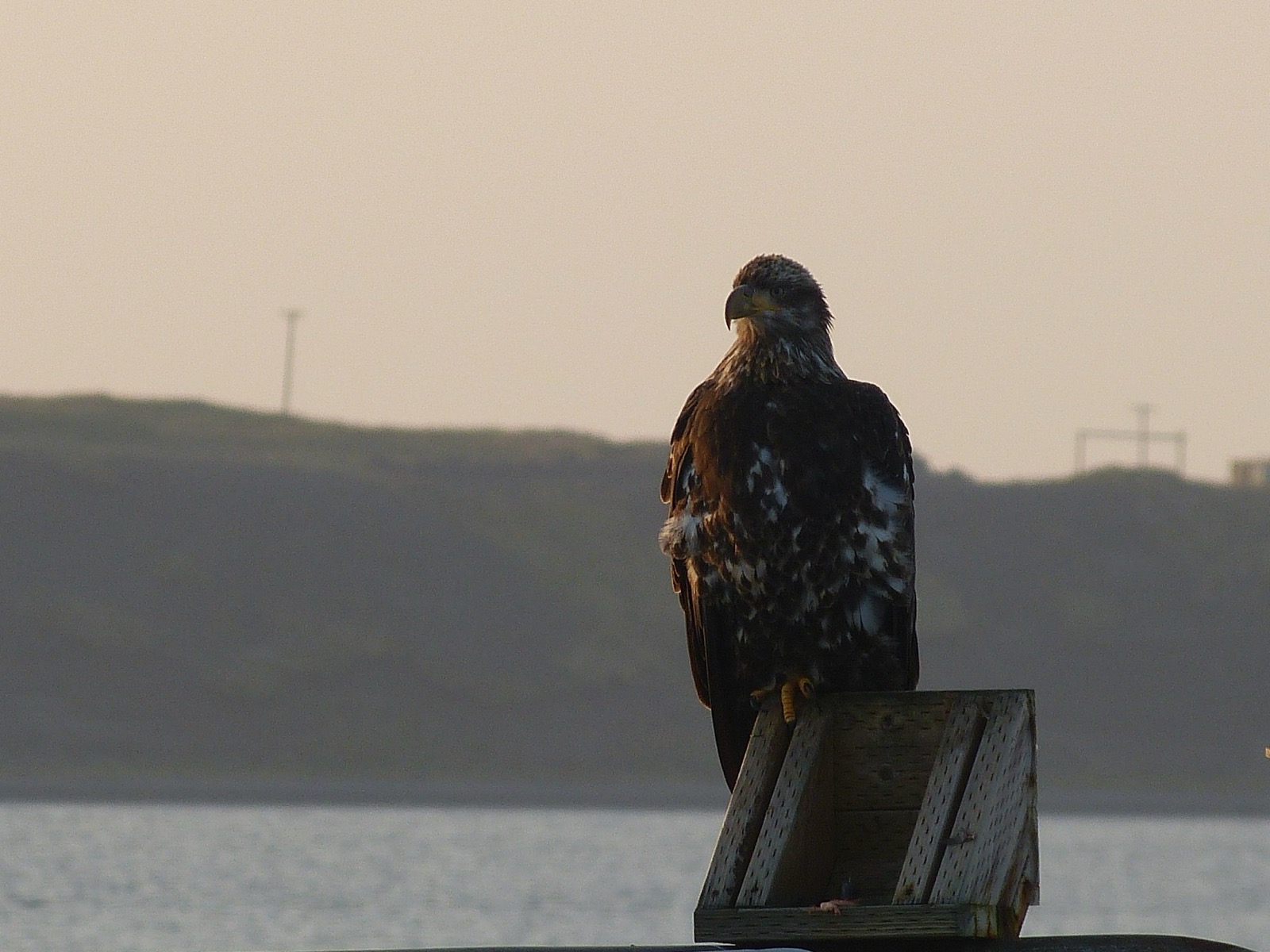
A young bald eagle perched by open water, its body heavily mottled brown and white, its head dusky rather than white and its bill dark with a pale base
A young bald eagle, and the bird most often reported as a golden. Note the messy white blotching through the body, the dusky head that is neither brown nor white, and the bill part way through turning yellow. Nothing about this bird is subtle once you have seen it beside an adult, and at a winter concentration you get that comparison for free. “Immature Bald Eagle”, USFWSAlaska, Public domain
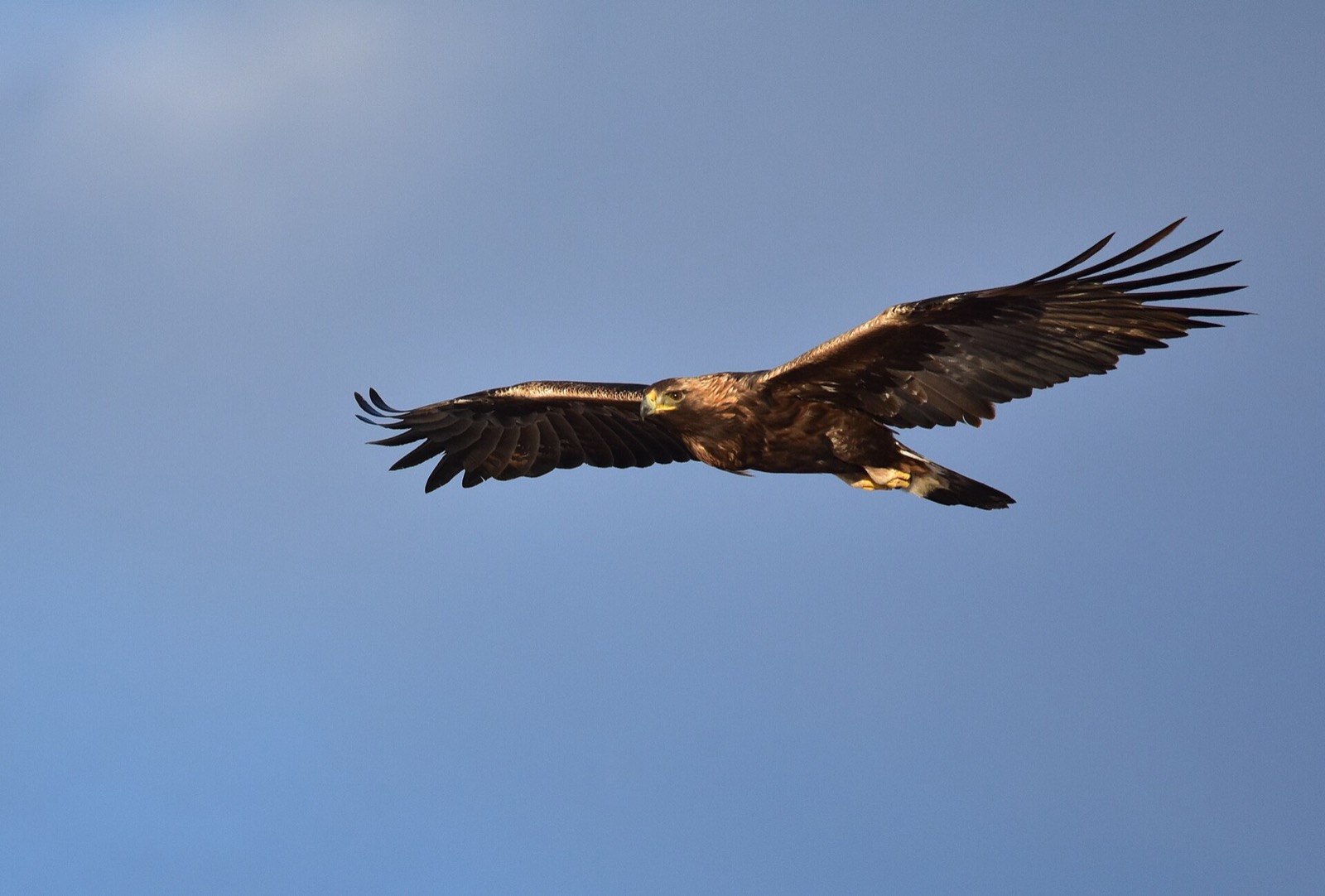
A golden eagle in flight against a blue sky, uniformly dark brown with a pale golden wash across the back of the head and neck, and no white anywhere on the head or tail
An actual golden eagle. Evenly dark with a warm golden wash on the nape, and crucially no white blotching anywhere. An immature bald eagle is messy; a golden eagle is clean. Goldens also hold their wings in a shallow V when soaring where a bald eagle holds them flat. “Golden eagle on Seedskadee National Wildlife Refuge”, USFWS Mountain-Prairie, Public domain
The law

What the eagle protection law means for a viewing trip

Eagles are protected by a statute of their own, and it is stricter than most people expect. It does not only prohibit shooting or collecting a bird. It prohibits disturbing one, and the regulations define disturbance in terms of the effect on the animal rather than the intent of the person.

“The Act defines "take" as "pursue, shoot, shoot at, poison, wound, kill, capture, trap, collect, molest or disturb." Regulations further define "disturb" as "to agitate or bother a bald or golden eagle to a degree that causes, or is likely to cause, based on the best scientific information available, 1) injury to an eagle, 2) a decrease in its productivity, by substantially interfering with normal breeding, feeding, or sheltering behavior, or 3) nest abandonment, by substantially interfering with normal breeding, feeding, or sheltering behavior".”
US Fish and Wildlife Service, Bald and Golden Eagle Protection Act. A US government work, in the public domain, quoted exactly.

Read the definition again and notice what it covers: substantially interfering with normal breeding, feeding or sheltering behaviour. A winter concentration site is a feeding and sheltering site. A crowd that pushes too close to a roost at dusk, or walks out onto the ice toward a group of birds, is doing the thing the regulation describes, whatever they intended. That is the practical reason the agencies build designated viewing areas with the sight lines already worked out, and the reason every page here sends you to one.

It is also why nest locations stay off these pages: a mapped nest is an invitation to stand under it, and nest abandonment is named in the regulation as one of the outcomes that constitutes disturbance. If you find an active nest yourself, the useful thing to do with it is tell your state wildlife agency, not the internet. Every site listed here is a place an agency has already decided the public should be.

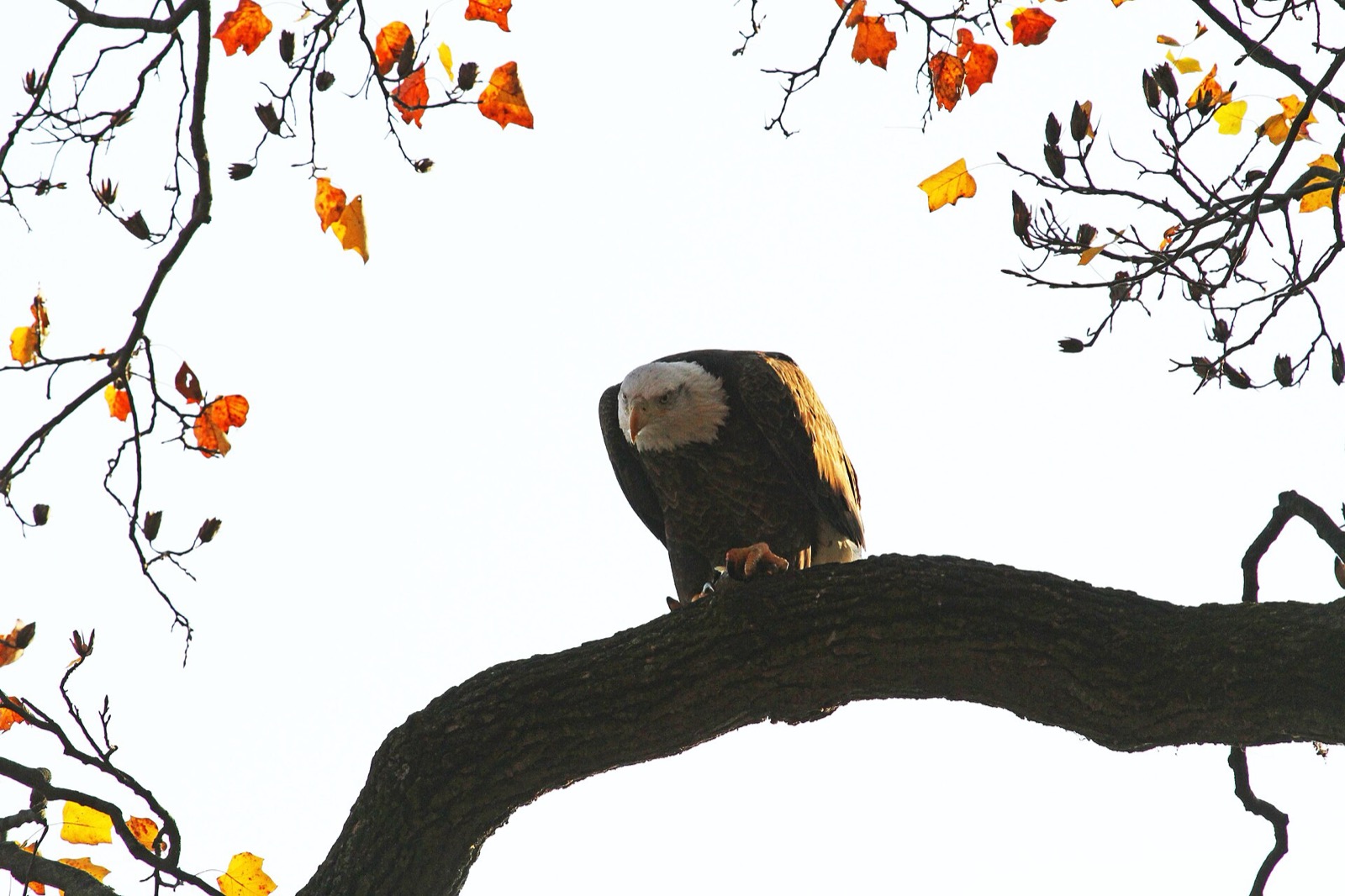
An adult bald eagle with a white head perched on a heavy bare branch, framed by orange and yellow leaves still on the tree
An adult below Conowingo Dam on the Susquehanna in Maryland, one of the most heavily watched eagle sites in the country. The reason a site like this works for photographers is the same reason it needs a designated viewing area: the birds are close, they are habituated to people standing in one known place, and that tolerance evaporates the moment somebody leaves it. “Bald Eagle - Haliaeetus leucocephalus, Conowingo Dam, Darlington, Maryland” by Judy Gallagher, CC BY 2.0
The record

What the national reporting record looks like

Below is every research grade bald eagle observation members of the public have uploaded to iNaturalist for the United States, by calendar month. It is a count of uploads: it measures how many people were outside with a camera and an internet connection as much as it measures birds, so the shape is informative and the absolute numbers are not.

Reading the the United States observation record from iNaturalist...

The interesting thing about this curve is that it rises in winter at all. Almost every other wildlife curve on this website peaks in June, because that is when people go outside. An animal whose reporting record climbs while the general observation record collapses is an animal that has genuinely become easier to find.

Other states

States without an agency designated viewing site

19 states have an agency designated winter viewing site and a page here. Bald eagles have recovered to the point of nesting in every state in the lower 48, so the other 31 states are not without eagles: they are states where no federal or state agency designates and describes a public place to go and watch a winter concentration. Where the reason is different, it is given below.

Iowa, which has the densest midwinter eagle count on the river and names no viewing site

This is the most surprising gap in the country. Iowa sits on the stretch of the Mississippi that its own survey shows carries more eagles per mile than any other river in the state, and its wildlife agency publishes a substantial bald eagle page, a decade of midwinter survey results and the best viewing etiquette guidance we found anywhere, including a specific instruction to stay several hundred yards from a perched bird and to keep away from feeding areas before nine in the morning. What that page does not contain is a single named place to go, so Iowa has no page here. The agency's bald eagle page is worth reading before you visit any state on this list.

Oregon, where the refuge built for wintering eagles is closed to the public

Oregon holds one of the most important bald eagle roosts in the lower 48, at a refuge established in 1978 specifically to protect a night roost that has held as many as 300 birds at once. It is closed to all public entry, and the federal agency that runs it says so and directs visitors instead to two refuges across the state line in California, which is where the birds spend the day. The state wildlife agency names no eagle viewing site of its own. So Oregon is not a state with no eagles; it is a state whose eagle place is deliberately shut, for the birds, and whose viewing happens in the next state along.

Montana, where the agencies put the eagle season in autumn

No Montana agency designates a named site for winter bald eagle viewing. The state parks and wildlife agency has a substantial bald eagle page covering biology, delisting and management with no viewing site and no season on it. The federal agencies point the other way entirely: the national park in the northwest corner publishes an eagle viewing page whose stated season is September to November on the fall migration, and a national wildlife refuge in the centre of the state lists bald eagles in its spring and autumn notes and leaves them out of its winter one. Presenting Montana as a December to February destination would contradict its own agencies.

Kansas, where one lake is named and nothing else is

The state wildlife and parks agency describes one reservoir as hosting a large influx of bald eagles in winter, which is a real agency statement about a real public place. It is also the only one: the agency's two other big Corps reservoir state parks mention no eagles at all. One named lake with no stated season is not enough for a page, so Kansas is listed here. The nature centre at that lake keeps a captive bald eagle and a captive golden eagle in its raptor exhibit, which is a different experience from watching wild birds and should not be confused with one.

Everywhere else

Bald eagles occur in every one of these states and nest in all of the mainland ones, and several of them hold winter concentrations that local people know well. None of them has a federal or state agency page naming a public place and tying it, in the agency's own words, to winter eagle viewing, which is the bar for a page here and a higher bar than the bird being present. The state wildlife agency is the source for viewing information in these states.

Questions people actually ask

Site inventory compiled 2026-09-04 from the agency pages linked throughout. Federal text is quoted exactly because a US government work is in the public domain; everything from a state agency, a state park system or a nonprofit is restated in our own words with the source named and linked.