
Skip to content

Winter Eagle Watching in Virginia

The first refuge in the country created for bald eagles, with a paved accessible trail to a marsh platform, plus tidal river sites the state agency picks out for winter.

Agency viewing sites
3
On federal land
1
Mapped
3
Where to stand

Public viewing sites in Virginia

Every place below is one an agency itself describes for eagle viewing, with that agency named and linked. Where a federal agency wrote something worth reading, its words are reproduced exactly, because a US government work is in the public domain. Where a state agency or a company is the source, the fact is in our own words with the source named.

Joseph V. Gartlan Jr. Great Marsh Trail Federal

The Great Marsh, on the tidal Potomac

Three quarters of a mile, paved and accessible, ending at an observation platform over a 250 acre marsh. The refuge itself says this trail gives the best opportunity to see bald eagles and wintering waterfowl, and the accessibility matters: very few sites in this inventory can be reached without a walk over rough ground.

Run by US Fish and Wildlife Service, Elizabeth Hartwell Mason Neck National Wildlife Refuge
Hog Island Wildlife Management Area State

James River

The state agency describes winter as perhaps the most interesting time to bird this site and lists large numbers of bald eagles among what winter brings, alongside snow geese and several duck species. A tidal river reach that never freezes is a different proposition from a midwestern tailwater, and it stays good for longer.

Run by Virginia Department of Wildlife Resources

Mason Neck State Park State

Belmont Bay and Kanes Creek, on the Potomac

The state park shares the same peninsula as the federal refuge and gives a second set of trails and a visitor centre on the same water. Between them the peninsula is the most concentrated public eagle viewing ground in the mid Atlantic.

Run by Virginia Department of Conservation and Recreation

“This trail affords the best opportunity to see bald eagles and wintering waterfowl”
US Fish and Wildlife Service, Elizabeth Hartwell Mason Neck National Wildlife Refuge. A US government work, in the public domain, quoted exactly.
The map

Virginia sites, dams and the reporting record

Style
Records
Size

Viewing sites in Virginia, with the Corps of Engineers locks and dams in the state drawn underneath. The coloured grid is where people have uploaded a verified bald eagle record to iNaturalist in December, January and February, brighter where more have been logged. It is a map of reports, not of birds: it thickens around car parks, boardwalks and towns because that is where observers stand, and it thins over roadless country whether or not eagles are there. It shows past reports rather than birds present today. Pins are public viewing sites an agency itself describes; grey dots are US Army Corps of Engineers locks and dams, drawn because open tailwater below a dam is the reason most of these sites exist.

Advertisement
When

What Virginia Department of Wildlife Resources says about timing

The window for Virginia is winter, which the state agency calls perhaps the most interesting time to bird its James River site, according to Virginia Department of Wildlife Resources. That is a pattern across past winters rather than a forecast: how well a given year matches it depends on whether the water upstream actually freezes. A mild winter keeps the river open everywhere, the birds stay spread out, and the concentration this page is about never forms.

Time of day is the more reliable lever in any case, and it is the one thing every agency agrees on. The federal management guidance describes when eagles feed, and it is not the middle of the day.

“Avoid recreational and commercial boating and fishing near critical eagle foraging areas during peak feeding times (usually early to mid-morning and late afternoon), except where eagles have demonstrated tolerance to such activity.”
US Fish and Wildlife Service, National Bald Eagle Management Guidelines, May 2007. A US government work, in the public domain, quoted exactly.

Read that as a viewing instruction rather than a boating one. The birds come off the roost hungry, fish hard in the first hours of light, and then spend the middle of the day sitting in a tree digesting, which looks exactly like an empty river to somebody who arrived at eleven. Late afternoon gives you a second, shorter window as they feed again before going back to roost.

Virginia has the strongest historical claim in this section: the refuge on Mason Neck was the first in the United States created specifically to protect bald eagle habitat, at a point in the 1960s when the species was collapsing. What makes it useful now is more prosaic. The Potomac here is tidal and brackish and it does not freeze, so the birds are not compressed into one pocket of open water the way they are on the Mississippi, and the viewing is steadier and less spectacular across a longer season. The refuge also demonstrates the tension built into every winter eagle site: part of one of its trails may be closed from December to the middle of June if eagles nest near it, which is the agency choosing the birds over the visitors, correctly.

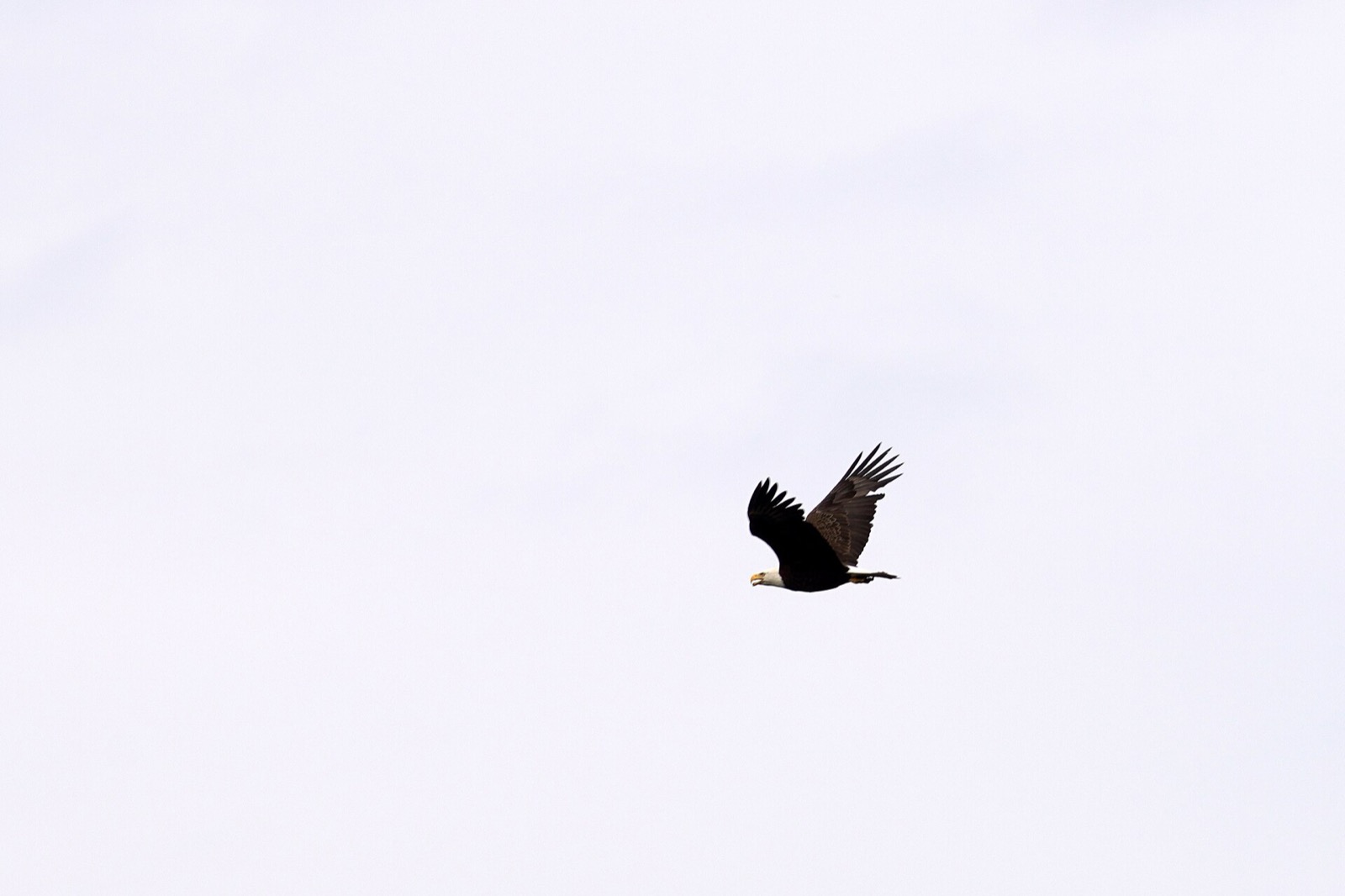
An adult bald eagle gliding on flat outstretched wings against a pale overcast sky, its white head and white tail clearly separated from the dark body
An adult in the flat winged glide that distinguishes a bald eagle from a golden at range, which holds its wings in a shallow V. In a state with a published window this is the bird the window describes; in a state without one it is still the bird, and the agency has simply not written the dates down. “Bald eagle in flight”, U.S. Fish and Wildlife Service - Midwest Region, Public domain
The record

What people have actually reported in Virginia

Below is a reading of a public platform rather than a survey. It counts the research grade bald eagle observations members of the public have uploaded to iNaturalist for this state, by calendar month, across every year the platform holds. It is a count of reports. It measures how many people were out with a camera as much as it measures birds, so the shape is worth reading and the absolute numbers are not.

Reading the Virginia observation record from iNaturalist...

Checking the most recent winter upload for Virginia...

Questions about Virginia

Inventory compiled 2026-09-04 from the agency pages linked above. Federal text is quoted exactly because a US government work is in the public domain; state agency, nonprofit and company material is restated in our own words with the source named and linked.