
Snow Goose Migration: Where the Flocks Are This Month
50 viewing sites in 27 states, the months each site’s manager gives for snow geese, the counts where a site posts them, and the spring conservation order dates.
Snow geese in October
From the refuges’ own pagesEach month and peak below comes from the site’s manager, quoted and linked with the day it was read. The counts are the managers’ own, and the reports are iNaturalist research grade sightings.
Where the snow geese are in October
- Dead Creek Wildlife Management Area, VermontPeak now. Snow geese Oct and Nov.
- Jocelyn Nungaray National Wildlife Refuge, TexasSnow geese Oct to Mar.
- Fir Island Farm Reserve Unit, Skagit Wildlife Area, WashingtonSnow geese Oct to Apr.
- Bombay Hook National Wildlife Refuge, DelawareSnow geese Oct to Mar, peak November.
- Edwin B. Forsythe National Wildlife Refuge, New JerseySnow geese Oct to Feb, peak November and December.
Your state, this month
Every snow goose site, month by month
Pick a month: the sites whose managers name it light up, and the grid underneath shows where people recorded snow and Ross’s geese that month.
5 of the 49 mapped sites have snow geese in October. Rainwater Basin Wetland Management District in Nebraska has no pin: its wetlands are scattered across many counties, with no single point to mark. A pin takes a color only in the months the refuge or agency that runs it gives for snow geese. The shaded grid is where people have logged a verified snow or Ross’s goose on iNaturalist in October, in any year, brighter where more have been logged; it maps reports, so it thickens where observers stand.
The sites in the order their peak comes
- Peak October and NovemberDead Creek Wildlife Management Area, VermontSnow geese Oct and Nov. Source: Vermont Fish & Wildlife Department. Peak now
- Oct to MarJocelyn Nungaray National Wildlife Refuge, TexasSource: U.S. Fish and Wildlife Service. In season now
- Oct to AprFir Island Farm Reserve Unit, Skagit Wildlife Area, WashingtonSource: Washington Department of Fish and Wildlife. In season now
- Peak November and DecemberSacramento National Wildlife Refuge, CaliforniaSource: U.S. Fish and Wildlife Service
- Peak NovemberBombay Hook National Wildlife Refuge, DelawareSnow geese Oct to Mar. Source: U.S. Fish and Wildlife Service. In season now
- Peak November and DecemberEdwin B. Forsythe National Wildlife Refuge, New JerseySnow geese Oct to Feb. Source: U.S. Fish and Wildlife Service. In season now
- Peak November and DecemberChincoteague National Wildlife Refuge, VirginiaSnow geese Nov to Feb. Source: U.S. Fish and Wildlife Service
- Nov to FebBlackwater National Wildlife Refuge, MarylandSource: U.S. Fish and Wildlife Service
- Nov to MarBitter Lake National Wildlife Refuge, New MexicoSource: U.S. Fish and Wildlife Service
- Nov to JanBosque del Apache National Wildlife Refuge, New MexicoSource: U.S. Fish and Wildlife Service
- Nov to FebPocosin Lakes National Wildlife Refuge, Pungo Unit, North CarolinaSource: U.S. Fish and Wildlife Service
- Nov and DecSequoyah National Wildlife Refuge, OklahomaSource: U.S. Fish and Wildlife Service
- Nov to FebHagerman National Wildlife Refuge, TexasSource: U.S. Fish and Wildlife Service
- Peak December and JanuaryBack Bay National Wildlife Refuge, VirginiaSource: U.S. Fish and Wildlife Service
- Jan and FebGunnison Bend Reservoir, UtahSource: Utah Division of Wildlife Resources (hosts the festival viewing event)
- Peak February and MarchGrand Pass Conservation Area, MissouriSnow geese Feb and Mar. Source: Missouri Department of Conservation
- Peak February to AprilKlamath Wildlife Area (Miller Island Unit), OregonSnow geese Feb to Apr. Source: Oregon Department of Fish and Wildlife
- Feb and MarMiddle Creek Wildlife Management Area, PennsylvaniaSource: Pennsylvania Game Commission. 600 counted on March 10, 2026. Season high 65,000 on March 6, 2026
- Feb to AprMontezuma National Wildlife Refuge, New YorkSource: U.S. Fish and Wildlife Service
- Peak MarchLoess Bluffs National Wildlife Refuge, MissouriSource: U.S. Fish and Wildlife Service
- Peak MarchFreezout Lake Wildlife Management Area, MontanaSource: Montana Fish, Wildlife & Parks. Last season’s high 63,500 on March 17, 2026
- MarCamas National Wildlife Refuge, IdahoSource: U.S. Fish and Wildlife Service
- Apr and MayGoose Bay State Game Refuge, AlaskaSource: Alaska Department of Fish and Game
- MigrationPalmer Hay Flats State Game Refuge, AlaskaSource: Alaska Department of Fish and Game
- Late fall and through winterBald Knob National Wildlife Refuge, ArkansasSource: U.S. Fish and Wildlife Service
- WinterGray Lodge Wildlife Area, CaliforniaSource: California Department of Fish and Wildlife
- Spring and fallLower Klamath National Wildlife Refuge, CaliforniaSource: U.S. Fish and Wildlife Service
- WinterSonny Bono Salton Sea National Wildlife Refuge, CaliforniaSource: U.S. Fish and Wildlife Service
- WinterThurston Reservoir State Wildlife Area, ColoradoSource: Colorado Parks and Wildlife
- Spring migrationMarket Lake Wildlife Management Area, IdahoSource: Idaho Department of Fish and Game
- Months not givenHorseshoe Lake State Fish and Wildlife Area, IllinoisSource: Illinois Department of Natural Resources
- Months not givenUnion County State Fish and Wildlife Area, IllinoisSource: Illinois Department of Natural Resources
- Late fall and winterDeSoto National Wildlife Refuge, IowaSource: U.S. Fish and Wildlife Service
- SpringFlint Hills National Wildlife Refuge, KansasSource: U.S. Fish and Wildlife Service
- SpringKirwin National Wildlife Refuge, KansasSource: U.S. Fish and Wildlife Service
- WinterCameron Prairie National Wildlife Refuge, LouisianaSource: U.S. Fish and Wildlife Service
- WinterLacassine National Wildlife Refuge, LouisianaSource: U.S. Fish and Wildlife Service
- FallDuck Creek Conservation Area, MissouriSource: Missouri Department of Conservation
- SpringBenton Lake National Wildlife Refuge, MontanaSource: U.S. Fish and Wildlife Service
- SpringRainwater Basin Wetland Management District, NebraskaSource: U.S. Fish and Wildlife Service
- Months not givenMattamuskeet National Wildlife Refuge, North CarolinaSource: U.S. Fish and Wildlife Service
- WinterPea Island National Wildlife Refuge, North CarolinaSource: U.S. Fish and Wildlife Service
- WinterWashita National Wildlife Refuge, OklahomaSource: U.S. Fish and Wildlife Service
- Spring and fallMalheur National Wildlife Refuge, OregonSource: U.S. Fish and Wildlife Service
- WinterSauvie Island Wildlife Area, OregonSource: Oregon Department of Fish and Wildlife
- MigrationSummer Lake Wildlife Area, OregonSource: Oregon Department of Fish and Wildlife
- Spring migrationSand Lake National Wildlife Refuge, South DakotaSource: U.S. Fish and Wildlife Service
- WinterPlaya Lakes Wildlife Management Area, Taylor Lakes Unit, TexasSource: Texas Parks and Wildlife Department
- WinterSan Bernard National Wildlife Refuge, TexasSource: U.S. Fish and Wildlife Service
- WinterLeque Island Unit, Skagit Wildlife Area, WashingtonSource: Washington Department of Fish and Wildlife
When people report snow geese
5,191 research grade snow and Ross’s goose reports from the United States in the twelve months to October 14, 2026.
Reading this month’s reports from iNaturalist.
Snow goose, Ross’s goose or blue morph
Look at the bill first. A snow goose’s pink bill has a dark “grinning patch” along it; a Ross’s goose is smaller, about the size of a mallard, with a shorter, stubbier bill and little or no grin; a blue morph is a snow goose with a dark body and a white face.
Snow goose
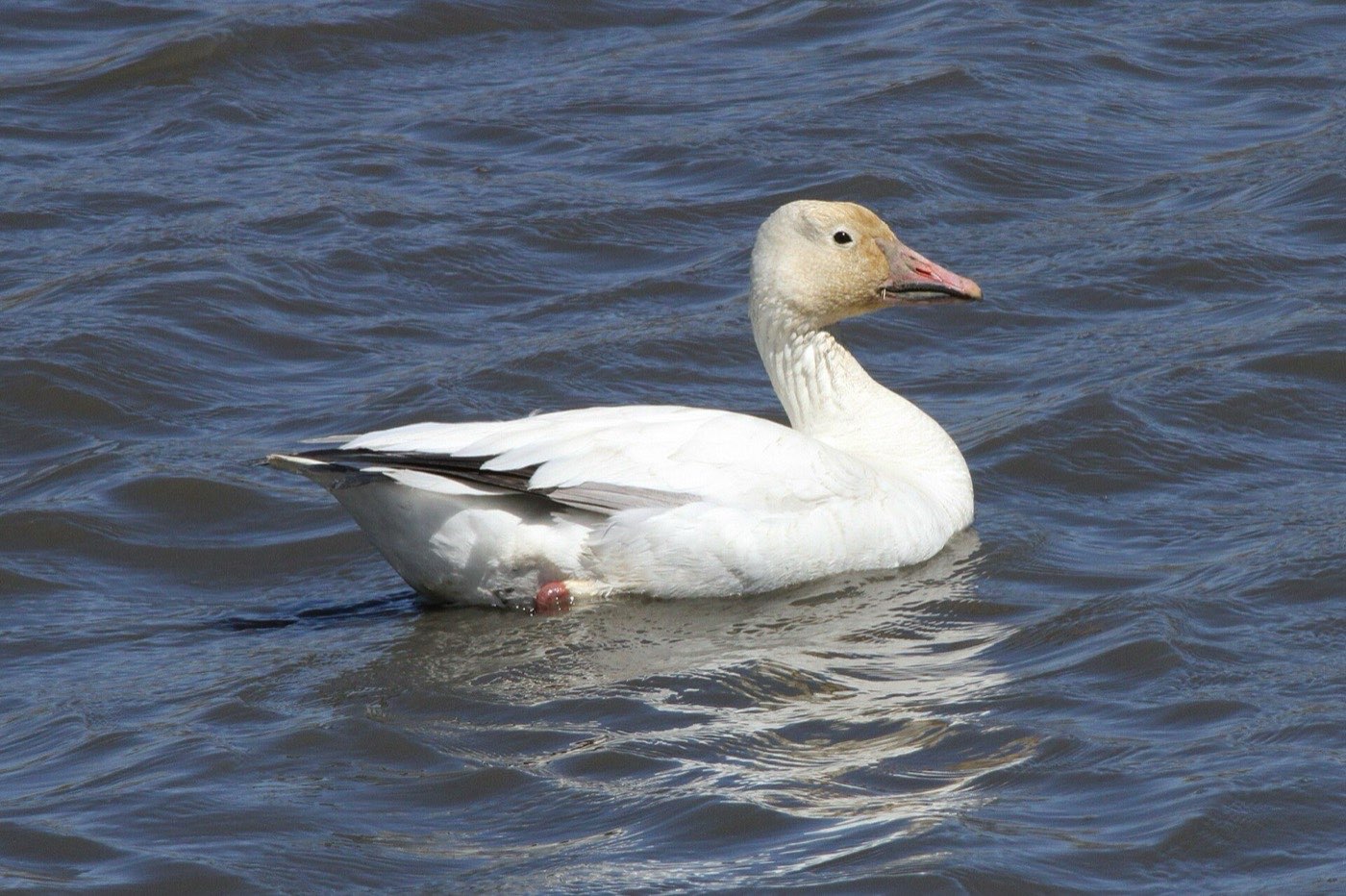
The pink bill has a dark line along it, often called a "grinning patch" or "black lips."Cornell Lab of Ornithology, read October 13, 2026. Read it at the source
Snow Geese typically give numerous nasal honks in flight.Cornell Lab of Ornithology, read October 13, 2026. Read it at the source
Ross’s goose
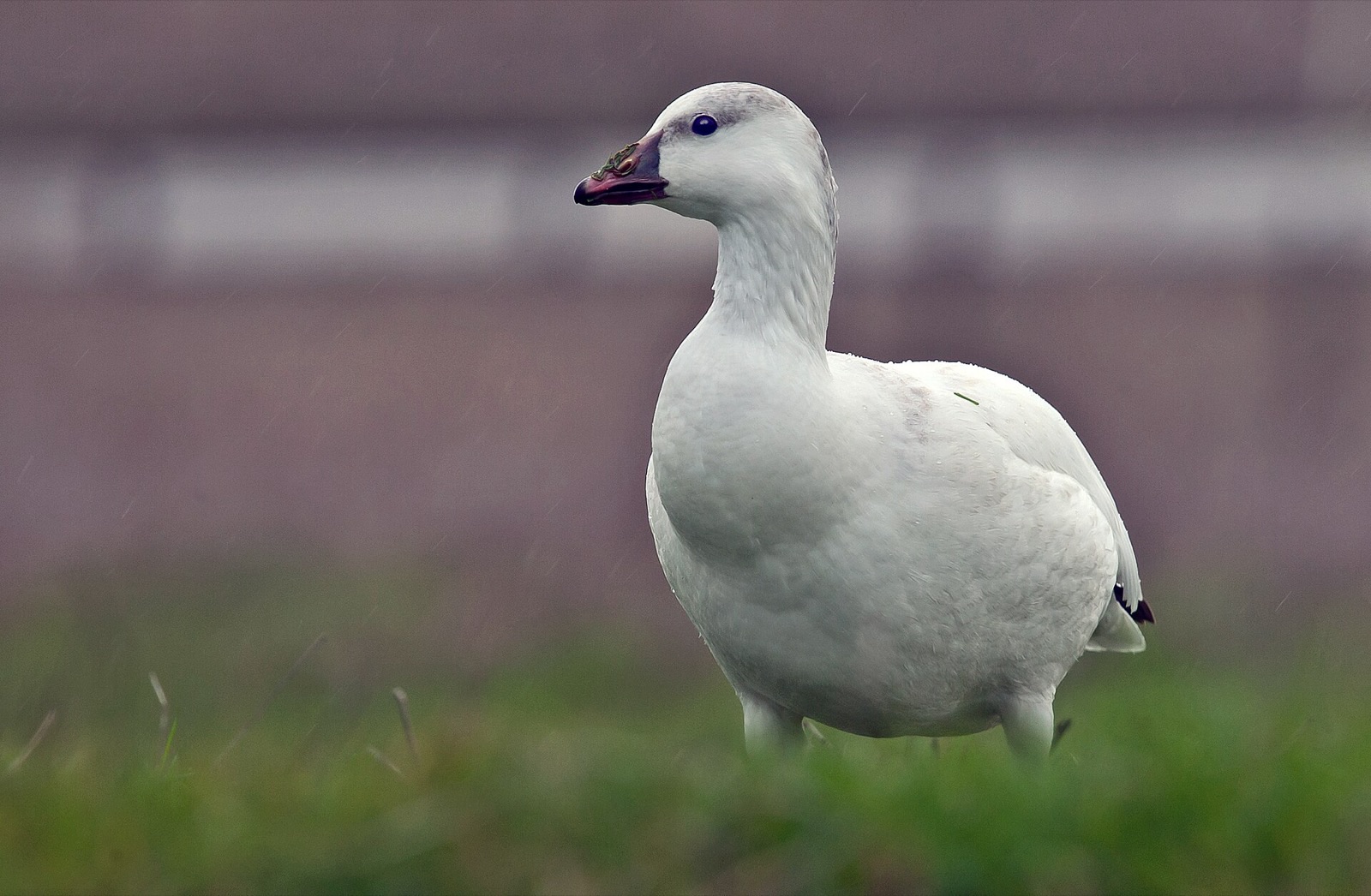
A diminutive version of the familiar Snow Goose, Ross’s Goose is also white with black wingtips but has a shorter neck and stubbier bill.Cornell Lab of Ornithology, read October 13, 2026. Read it at the source
The short pink bill is often marked with grayish caruncles at the base. The base of the bill is vertical instead of curved, and the grin patch is quite reduced in comparison to the large black grin patch shown by Snow Goose.Cornell Lab of Ornithology, read October 13, 2026. Read it at the source
Blue morph
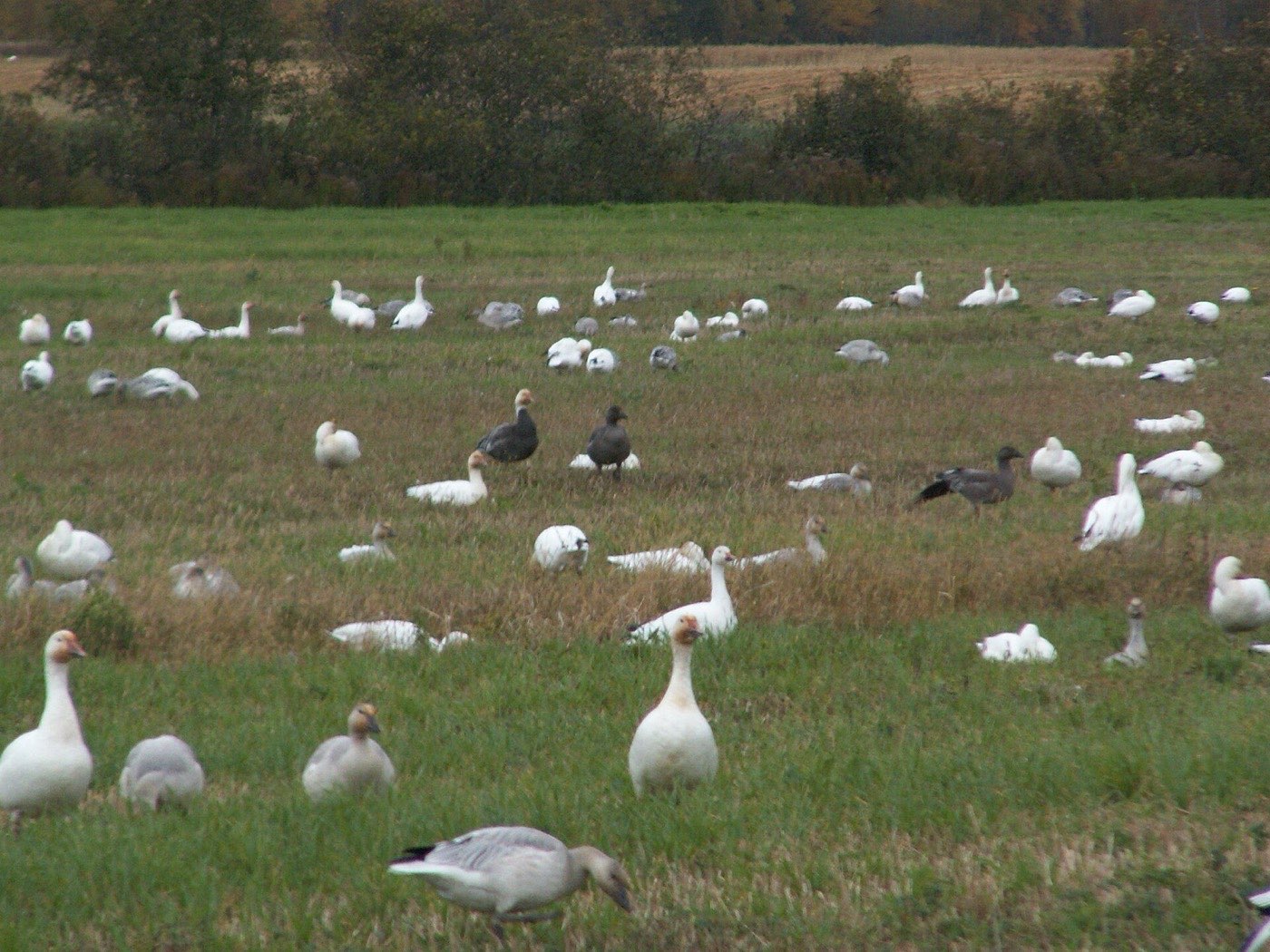
You may also see dark morph Snow Geese, or "Blue Geese," with a white face, dark brown body, and white under the tail.Cornell Lab of Ornithology, read October 13, 2026. Read it at the source
The blue morph is mostly grayish brown overall, with a white head and neck, and white on the underside of the wing.Missouri Department of Conservation, read October 13, 2026. Read it at the source
Often flocks together with larger Snow Geese. Plumage between white morph adults is identical, so size and structure are very important.Cornell Lab of Ornithology, read October 13, 2026. Read it at the source
The light goose conservation order
A spring season for snow and Ross’s geese, held after the regular waterfowl seasons close, to bring down populations grown large enough to damage their Arctic nesting grounds. The next to open on these pages is Louisiana, on December 7, 2026.
A conservation order is a special management action that is needed to control certain wildlife populations when traditional management programs are unsuccessful in preventing overabundance of the population.Electronic Code of Federal Regulations (National Archives and Records Administration), read October 13, 2026. Read it at the source
Scientists and managers from across North America agree that some populations of light geese have become so numerous that their Arctic and sub-Arctic nesting habitats cannot adequately support them.U.S. Fish & Wildlife Service, read October 13, 2026. Read it at the source
Populations of this species and Ross’s goose have increased to a historically high level. As a result they are overgrazing their arctic nesting range and degrading large areas of the arctic tundra where other species nest.Missouri Department of Conservation, read October 13, 2026. Read it at the source
The conservation order allows new methods of taking light geese, allows shooting hours for light geese to end one-half hour after sunset, and imposes no daily bag limits for light geese inside or outside the migratory bird hunting season frameworks as described in this section.Electronic Code of Federal Regulations (National Archives and Records Administration), read October 13, 2026. Read it at the source
The term light geese refers collectively to greater and lesser snow geese and Ross's geese.Electronic Code of Federal Regulations (National Archives and Records Administration), read October 13, 2026. Read it at the source
Control activities may be conducted only when all waterfowl (including light goose) and crane hunting seasons, excluding falconry, are closed.Electronic Code of Federal Regulations (National Archives and Records Administration), read October 13, 2026. Read it at the source
The Atlantic Flyway order in 2027
The order is suspended for 2027 in Delaware, Maryland, New Jersey, New York, North Carolina, Pennsylvania, Vermont and Virginia. Each state page has its agency’s notice: Delaware, Maryland, New Jersey, New York, North Carolina, Pennsylvania, Vermont, Virginia.
The Conservation Order has been suspended for 2027 after agreement from the eight participating hunt states, Quebec and Ontario.Maryland Department of Natural Resources, read October 13, 2026. Read it at the source
The states it covers, in the notice’s words: “As of 2026, eight states in the Atlantic Flyway held the Conservation Order including Vermont, New York, New Jersey, Delaware, Pennsylvania, Maryland, Virginia, and North Carolina.”
Texas ended its order
Texas ended its Light Goose Conservation Order. The Texas Parks and Wildlife Commission eliminated it in both the eastern and western zones, starting in spring 2025. Snow geese in Texas.
Eliminate the Light Goose Conservation Order from both eastern and western zones due to continuous declines of wintering light geese in Texas.Texas Parks and Wildlife Department, read October 13, 2026. Read it at the source
The states on these pages
| State | Spring order | Dates |
|---|---|---|
| Arkansas | Opens in 110 days | February 1 to 5, 2027 and February 8 to April 25, 2027 |
| Colorado | Opens in 124 days | February 15 to April 30, 2027 |
| Delaware | Suspended for 2027 | |
| Illinois | Opens in 105 days | North Zone, January 27 to April 30, 2027; Central Zone, February 1 to April 30, 2027; South Zone, February 1 to April 30, 2027 |
| Iowa | Opens in 102 days | January 24 to May 1, 2027 |
| Louisiana | Opens in 54 days | December 7 to 18, 2026 and February 8 to March 7, 2027 |
| Maryland | Suspended for 2027 | |
| Missouri | Opens in 116 days | February 7 to April 30, 2027 |
| Montana | Closed for the season | March 1 to May 15, 2026 |
| Nebraska | Opens in 119 days | Rainwater Basin Zone, February 10 to April 5, 2027; East Zone, February 10 to April 15, 2027; West Zone, February 10 to April 5, 2027 |
| New Jersey | Suspended for 2027 | |
| New Mexico | Opens in 110 days | February 1 to March 10, 2027 |
| New York | Suspended for 2027 | |
| North Carolina | Suspended for 2027 | |
| Oklahoma | Opens in 124 days | February 15 to March 30, 2027 |
| Pennsylvania | Suspended for 2027 | |
| South Dakota | Closed for the season | February 16 to May 15, 2026 |
| Texas | Ended, since spring 2025 | |
| Vermont | Suspended for 2027 | |
| Virginia | Suspended for 2027 |
Dates are the ones each state gives for the season ahead. Check the state’s regulations before you go: permits and zones change.
Why the order exists
In 1996, along a roughly 1,200-mile stretch of coastline along west Hudson Bay and James Bay, scientists estimated that 35 percent of the original habitat had been destroyed, 30 percent had been severely damaged and 35 percent overgrazed.U.S. Fish & Wildlife Service, read October 13, 2026. Read it at the source
When plants are removed by geese the soil is exposed and salts in the subsoil layers begin to accumulate at the ground surface, creating a saline environment where regrowth of most plants is virtually impossible.U.S. Fish & Wildlife Service, read October 13, 2026. Read it at the source
How many there are
Partners in Flight estimates a global breeding population of 16 million and rates them 8 out of 20 on the Continental Concern Score, indicating a species of low conservation concern.Cornell Lab of Ornithology, read October 13, 2026. Read it at the source
Partners in Flight estimates the global breeding population at 1.7 million.Cornell Lab of Ornithology, read October 13, 2026. Read it at the source
The U.S. Fish & Wildlife Service’s Waterfowl Population Status, 2025 gives each population its own index, in thousands of birds, each from its own survey and year:
- Midcontinent Population lesser snow geese: 7,993 thousand (2023)
- Western Arctic Population lesser snow geese: 1,007 thousand (2025)
- Wrangel Island Population lesser snow geese: 87 thousand (2023)
- Greater snow geese: 428 thousand (2025)
- Ross's geese: 3,409 thousand (2023)
Snow geese in 27 states, and where they are in October
| State | Right now | Months at the sites | Main site | Counts |
|---|---|---|---|---|
| Alaska | Due back in April | Apr and May | Goose Bay | |
| Arkansas | Bald Knob | |||
| California | Peak November and December | Sacramento Refuge | ||
| Colorado | Thurston Reservoir | |||
| Delaware | Arriving | Oct to MarPeak November | Bombay Hook | |
| Idaho | Due back in March | Mar | Camas | |
| Illinois | Horseshoe Lake | |||
| Iowa | DeSoto Refuge | |||
| Kansas | Kirwin Refuge | |||
| Louisiana | Lacassine | |||
| Maryland | Due back in November | Nov to Feb | Blackwater | |
| Missouri | Due back in February | Feb and MarPeak February and March | Loess Bluffs | |
| Montana | Peak March | Freezout Lake | 63,500Season high, March 17, 2026 | |
| Nebraska | Rainwater Basin | |||
| New Jersey | Arriving | Oct to FebPeak November and December | Edwin B. Forsythe Refuge | |
| New Mexico | Due back in November | Nov to Mar | Bosque del Apache | |
| New York | Due back in February | Feb to Apr | Montezuma Refuge | |
| North Carolina | Due back in November | Nov to Feb | Pocosin Lakes | |
| Oklahoma | Due back in November | Nov and Dec | Sequoyah Refuge | |
| Oregon | Due back in February | Feb to AprPeak February to April | Klamath | |
| Pennsylvania | Due back in February | Feb and Mar | Middle Creek | 600Latest, March 10, 202665,000Season high, March 6, 2026 |
| South Dakota | Sand Lake | |||
| Texas | Arriving | Oct to Mar | Jocelyn Nungaray Refuge | |
| Utah | Due back in January | Jan and Feb | Gunnison Bend Reservoir | |
| Vermont | Arriving | Oct and NovPeak October and November | Dead Creek | |
| Virginia | Due back in November | Nov to FebPeak November to January | Chincoteague | |
| Washington | Arriving | Oct to Apr | Fir Island Farm |
Snow goose festivals ahead
December 2 to 5, 2026
Festival of the Cranes
Bosque del Apache National Wildlife Refuge, New Mexico. Snow geese in New Mexico
January 28 to 31, 2027
Snow Goose Festival of the Pacific Flyway
Sacramento National Wildlife Refuge, California. Snow geese in California
February 27, 2027
Snow Goose Festival
Leque Island Unit, Skagit Wildlife Area, Washington. Snow geese in Washington
Waterfowl in the other 23 states
Each of these states has a duck migration page with the ducks and geese its refuges and wildlife areas hold through the fall and winter.
- AlabamaIn winter, snow geese are often seen at Limestone Bay on Wheeler National Wildlife Refuge; Alabama's winter waterfowl are on the duck migration page.Duck migration in Alabama
- ArizonaAt Cibola National Wildlife Refuge on the Colorado River, wildlife crops are grown as winter food for Canada and snow geese; Arizona's waterfowl are on the duck migration page.Duck migration in Arizona
- ConnecticutConnecticut's winter waterfowl are on the duck migration page.Duck migration in Connecticut
- FloridaFlorida's winter waterfowl are on the duck migration page.Duck migration in Florida
- GeorgiaGeorgia's winter waterfowl are on the duck migration page.Duck migration in Georgia
- HawaiiHawaii's waterfowl are on the duck migration page.Duck migration in Hawaii
- IndianaIndiana's snow geese gather mostly in the southwest, around Gibson County and Goose Pond; its waterfowl are on the duck migration page.Duck migration in Indiana
- KentuckyKentucky's snow geese winter in the far west, on hunting areas such as Ballard WMA, where the state counted 94,065 on February 6, 2026; Kentucky's waterfowl are on the duck migration page.Duck migration in Kentucky
- MaineMaine's winter waterfowl are on the duck migration page.Duck migration in Maine
- MassachusettsThe winter waterfowl of Massachusetts are on the duck migration page.Duck migration in Massachusetts
- MichiganMichigan's waterfowl are on the duck migration page.Duck migration in Michigan
- MinnesotaSnow geese cross Minnesota in spring mostly west of a line from Mankato to Fergus Falls; its waterfowl are on the duck migration page.Duck migration in Minnesota
- MississippiLight geese winter in large concentrations across the Mississippi Delta, by the state's own aerial surveys; Mississippi's waterfowl are on the duck migration page.Duck migration in Mississippi
- NevadaNevada's waterfowl are on the duck migration page.Duck migration in Nevada
- New HampshireNew Hampshire's winter waterfowl are on the duck migration page.Duck migration in New Hampshire
- North DakotaLight geese pass through North Dakota each spring and fall, and the 2026 spring conservation order ran statewide; North Dakota's waterfowl are on the duck migration page.Duck migration in North Dakota
- OhioSmall flocks of migrant snow geese often stop over at Mosquito Creek Wildlife Area in the fall; Ohio's waterfowl are on the duck migration page.Duck migration in Ohio
- Rhode IslandRhode Island's winter waterfowl are on the duck migration page.Duck migration in Rhode Island
- South CarolinaSnow geese are unusual winter visitors to South Carolina, seen most often along the coast; its winter waterfowl are on the duck migration page.Duck migration in South Carolina
- TennesseeTennessee's winter waterfowl are on the duck migration page.Duck migration in Tennessee
- West VirginiaWest Virginia's winter waterfowl are on the duck migration page.Duck migration in West Virginia
- WisconsinWisconsin's waterfowl are on the duck migration page.Duck migration in Wisconsin
- WyomingLight geese cross Wyoming's eastern plains in modest numbers each spring (hunters took an estimated 558 in 2026); Wyoming's waterfowl are on the duck migration page.Duck migration in Wyoming
More birds on the move
Snow goose migration questions
Snow geese by state
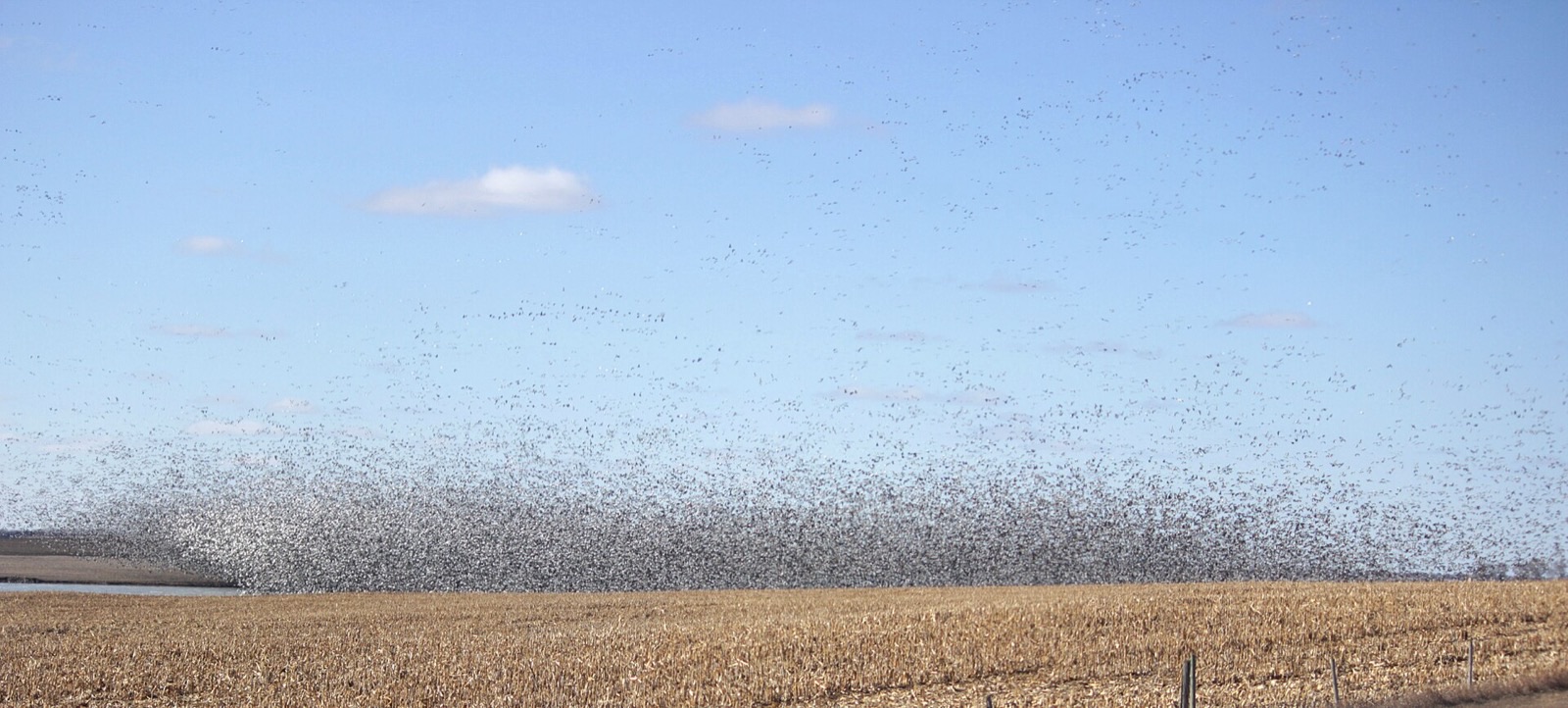
Every site, month, peak, count, festival and order date on this page is quoted from and linked to the refuge, state agency or organizer that published it, read between October 13 and 14, 2026. Tour routes and viewing areas close for weather, hunts and work, so check the site’s own page before you drive. The month curve and the reports are iNaturalist research grade records of snow and Ross’s geese (30,491 in ten years), which count sightings, not birds.