
Lake Algae Advisories, State by State
Blue-green algae in a lake is a toxin problem, not a bacteria problem, and the decision to post a lake belongs to your state. Enter your ZIP to see which agency owns it where you are, the concentration it acts at, and the page where it posts today's advisories.
45 states publish a freshwater cyanobacteria program. 32 publish a toxin action level and 13 post on visual assessment and cell counts insteadWho posts blue-green algae advisories where you are?
ZIP to county, county to state program, checked 2026-09-03This returns the agency, the toxin level it acts at and the page where it posts today’s advisories.
Most state advisory tables are indexed by county, which is why a ZIP resolves to counties here rather than to lakes: each state publishes its own set of monitored waterbodies in its own format, and the county is the key its listings use.
What it takes to post a lake varies by state
There is no single national number: EPA recommends one, and adopting it is each state's choice. In 2019 EPA published recreational criteria for the two cyanotoxins it considers best characterised, 8 micrograms per litre for microcystins and 15 for cylindrospermopsin:
US EPA, Recreational Water Quality Criteria and Methods“In 2019, the EPA issued final recommended recreational ambient water quality criteria or swimming advisories for two cyanotoxins, microcystins and cylindrospermopsin. The agency has identified recommended concentrations of these cyanotoxins at or below which human health is protected while swimming or participating in other recreational activities in and on the water.”
Adoption is optional, and that single fact explains most of what follows:
US EPA, Recreational Water Quality Criteria and Methods“States, territories, and authorized Tribes can consider adopting these recommended criteria into their water quality standards and using them for CWA purposes. Alternatively, they can use these values as the basis of swimming advisories for public notification purposes at recreational waters.”
So 32 of the 45 states here publish a recreational cyanotoxin number and 13 publish none at all. Among those that do, some sit exactly on EPA's recommendation, some act at a fraction of it, and some do not act until far above it. EPA compiles all of it in one place, and this is that table, plotted, each state at the lowest level it actually acts on:
- ColoradoDetect to 8Caution Value
- FloridaDetectHealth Notification Alert
- Pennsylvaniadetect to 8Recreation Advisory Value
- New Mexico>0.1HAB Watch
- California0.8Caution Value
- New Jersey2Advisory Value
- Kansas>4 to <8Watch Level Value
- Montana<4Tier 1 Caution Value
- Nevada4-8Watch
- New York4 - 20Confirmed Bloom Value
- Rhode Island4Single Tier Recreational Value
- Minnesota6Single Tier Recreational Value
- Vermont6Single Tier Recreational Value
- West Virginia>6Watch Value
- ArkansasEPA's 8Single Tier Recreational Value
- IdahoEPA's 8Single Tier Recreational Value
- IllinoisEPA's 8Single Tier Recreational Value
- Indiana8Advisory Value
- IowaEPA's 8Advisory Value
- Massachusetts8Single Tier Recreational Value
- NebraskaEPA's 8Health Alert
- North DakotaEPA's 8Criteria
- Ohio8Single Tier Recreational Value
- OregonEPA's 8Single Tier Recreational Value
- South CarolinaEPA's 8Criteria
- South DakotaEPA's 8Criteria
- Utah>8Warning Advisory Value
- VirginiaEPA's 8Single Tier Recreational Value
- WashingtonEPA's 8Warning (Advisory) Value (Guidance)
- WisconsinEPA's 8Single Tier Recreational Value
- WyomingEPA's 8Toxin Advisory Value
- Maryland10Single Tier Recreational Value
13 states that post on assessment rather than a published threshold
In these states the decision to post a waterbody rests on visual assessment, cell counts or professional judgement rather than on a published concentration, so there is no number to line up beside the others.
Every value is EPA’s, from its State and Tribal Toxin Thresholds compilation (146 rows, updated July 13, 2026), read on 2026-09-03. Where a state publishes several levels this shows the lowest one it acts on, skipping the bands that describe a waterbody with nothing posted and the separate, far lower values Indiana and Oregon publish for dogs. States are ordered by that number and the order is not a ranking: a low threshold means the state posts sooner, not that its lakes are worse or better than anyone else’s.
Read the chart as a map of how differently the country has organised the same problem, not as a league table. A low number means the state posts sooner, which is a policy choice about false alarms rather than a measurement of its lakes. A state with no published number has not given up: it is posting on visual assessment, cell counts or professional judgement instead, and several of those states run some of the most active programmes in the country.
Two details worth knowing before you compare any two rows. First, the same word means different things: a Watch in New Mexico begins above 0.1 micrograms per litre and a Watch in Kansas begins above 4. Second, EPA's table carries 7 Tribal nations as well, with their own criteria adopted into their own water quality standards; those rows are in EPA's table, linked below.
Summarised from EPA State and Tribal Toxin Thresholds in our own words.
What each state publishes
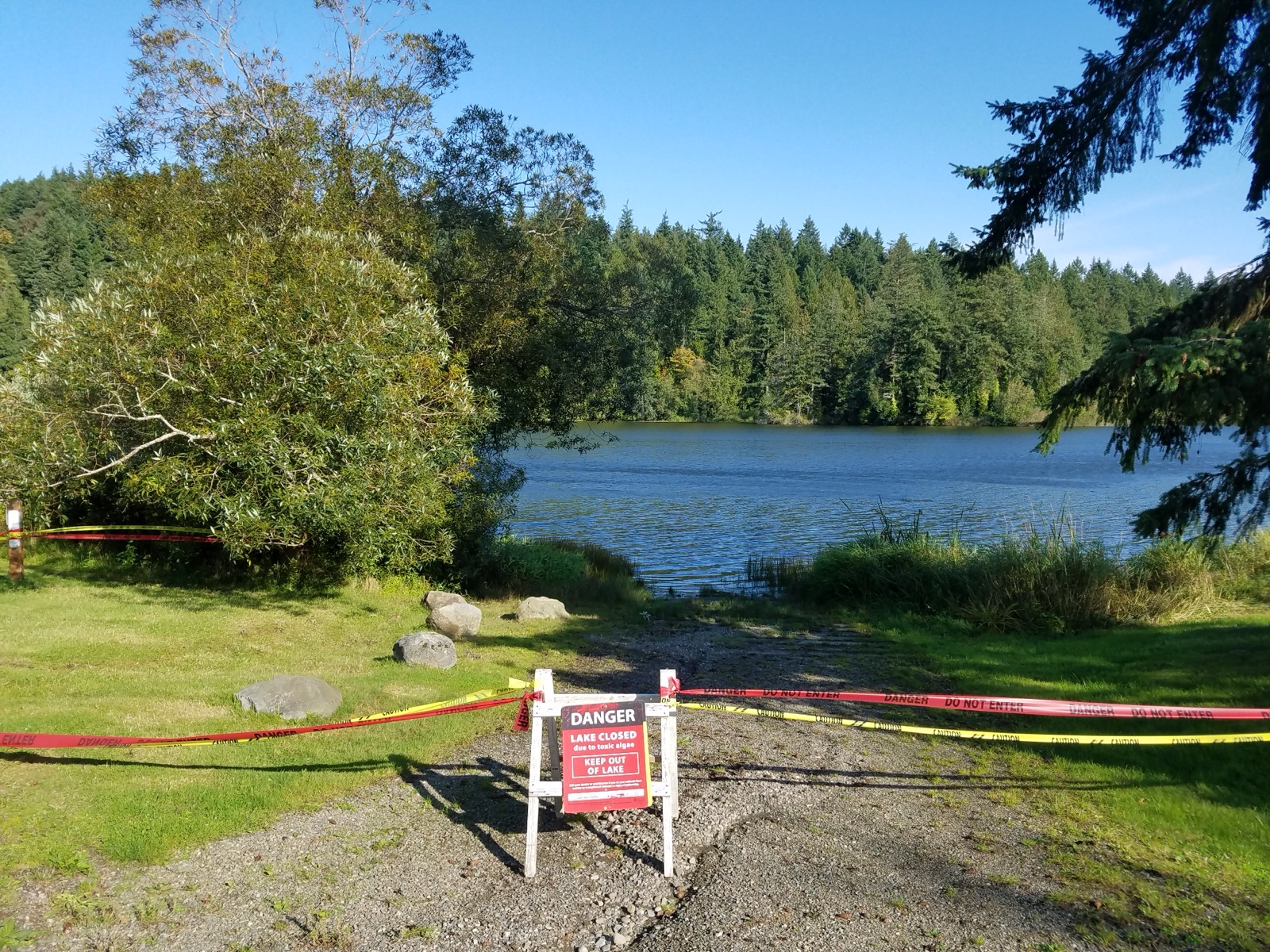
Each state falls into one of three shapes by what its own page carries, as checked on 2026-09-03. The shape describes publication, not the quality of the programme.
Publish current advisories
A list, table, map or dashboard of per waterbody status you can open today.
Map verified reports
A record of blooms the public reported and the agency confirmed, which the agency itself says is not a survey of the state.
Program, advisories issued locally
The programme, the guidance and the reporting route are published; the decision to post a beach belongs to a county, city or park.
The middle category deserves the most care, because a map of reported blooms looks exactly like a map of all blooms and is not one. Montana's health department says so on its own map page:
Montana Department of Public Health and Human Services“These are public reports of algal blooms. Reports do not represent a comprehensive list of all HABs. Therefore, this map does not show the full potential of waterbodies experiencing blooms, nor can we accurately know the health risk at any given time. Advisories (caution or closure) are issued by experts, but it is impossible to keep the status of each report perfectly up to date. Toxin production may occur or dissipate at any moment. Please use your best judgment to determine if a bloom is in the area, and if in doubt, stay out.”
An empty spot on a bloom map is an absence of reports. Colorado puts the same limit on its own data, on the same page as the data:
Colorado Department of Public Health and Environment“Some (but not all) water bodies in Colorado are monitored and tested for toxic algae to protect the health and safety of water users. Always look for caution or warning signs before allowing children, pets, or yourself to come into contact with water.”
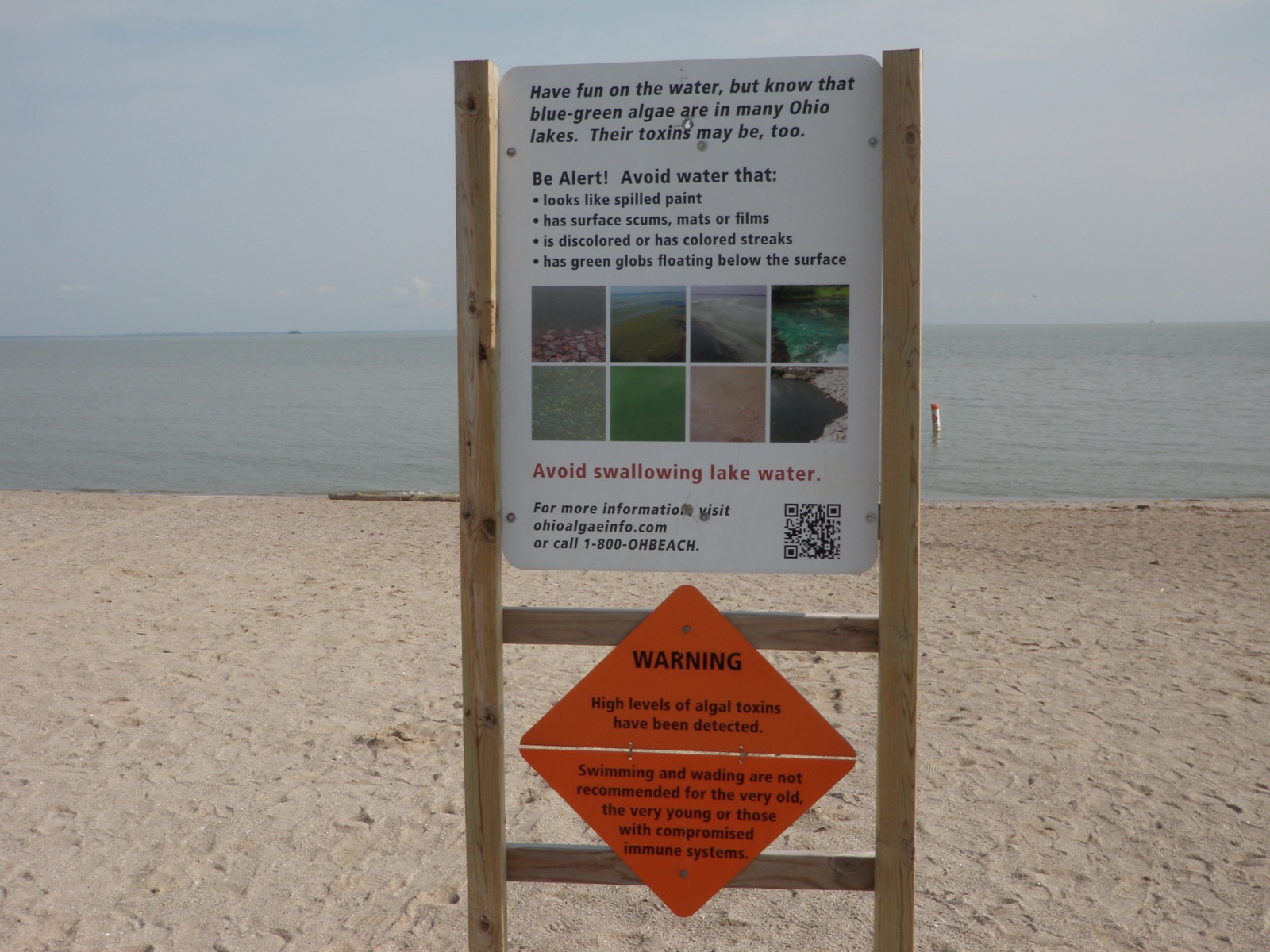
You cannot tell whether a bloom is toxic by looking
What it looks like, in the agencies’ words
- CDC“Harmful algal blooms can look like foam, scum, mats, or paint on the surface of the water. They can also grow underneath the water, making some harmful algal blooms hard to see.”
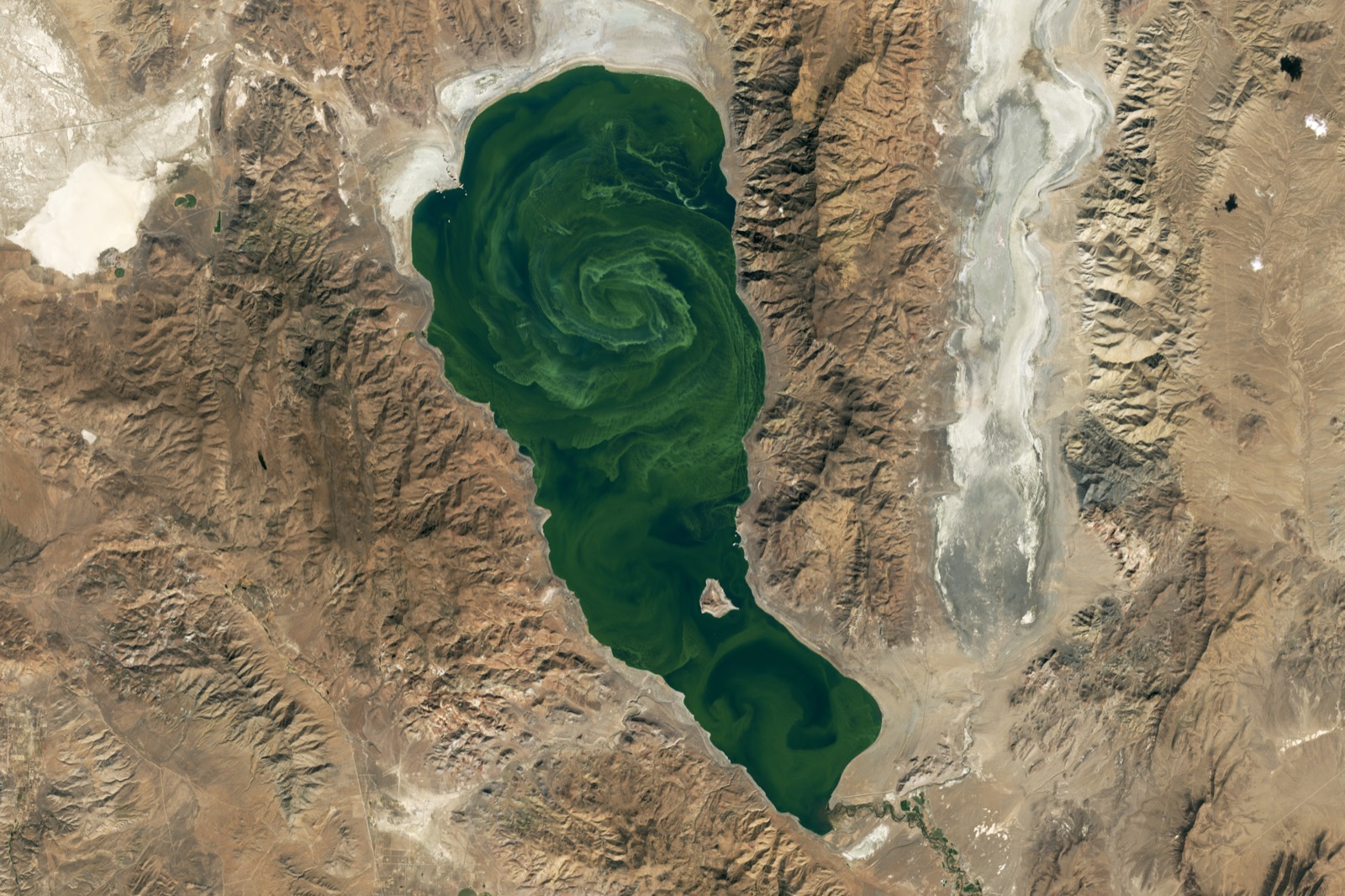
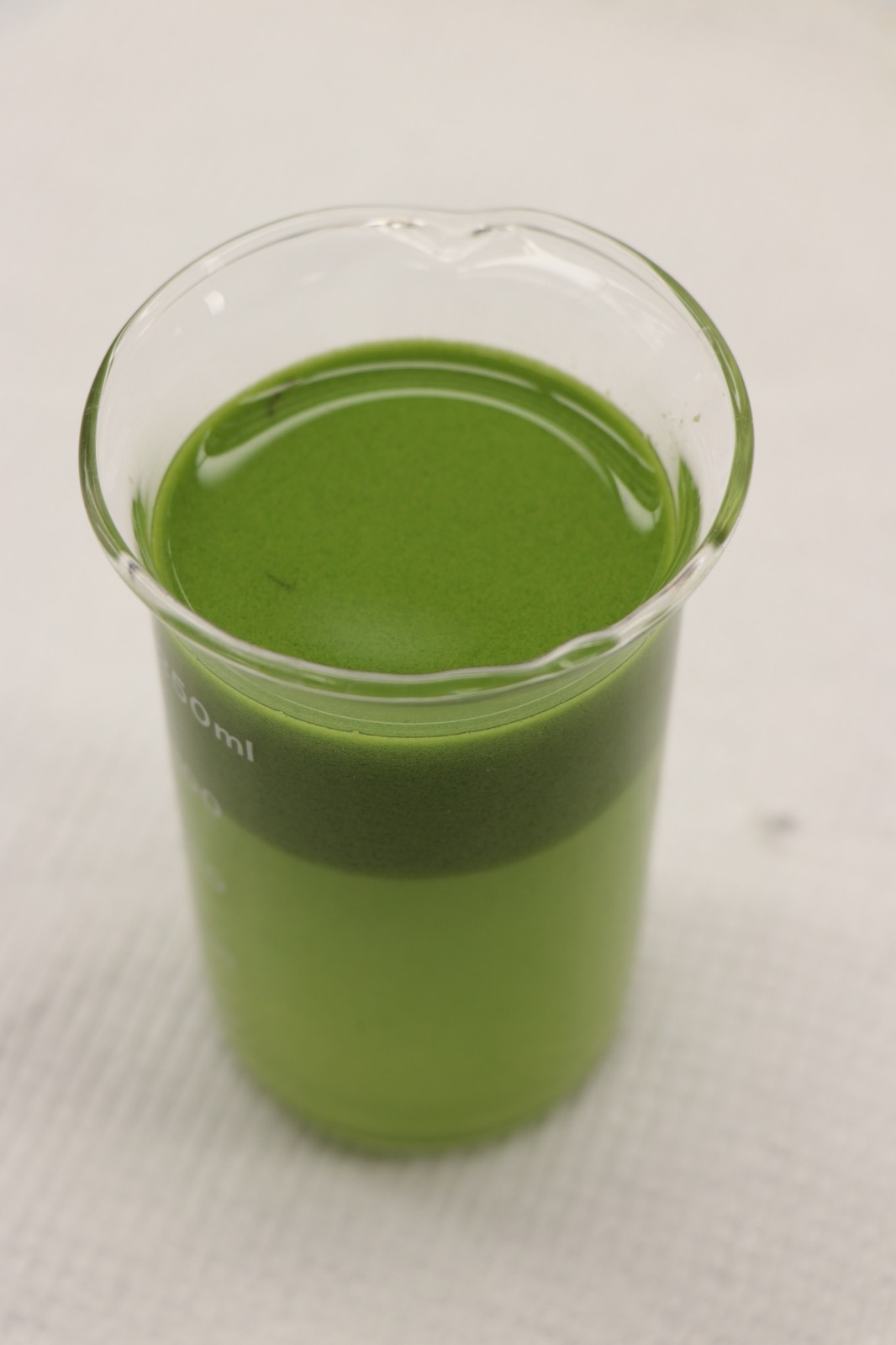
- EPA“Microcystis is the most common bloom-forming genus. Its blooms resemble a greenish, thick, paint-like (sometimes granular) material that accumulates along shores. Scums that dry on the shores of lakes may contain high concentrations of microcystin for several months, allowing toxins to dissolve in the water even when the cells are no longer alive or after a recently collapsed bloom.”
- CDC“Stay out of discolored, scummy, or smelly water and keep pets away.” “If you or your animal go in water with an algal bloom, rinse off with tap water right after.”
Two state agencies put the limit of your own eyes into one sentence each. Minnesota:
Minnesota Pollution Control Agency“Blue-green algae blooms are harmful when they produce toxins that can make humans and animals sick. Most blooms are not harmful. You can’t tell by looking at a bloom if it is harmful or not.”
Connecticut:
Connecticut Department of Energy and Environmental Protection“It is important to note that not all algal blooms are harmful algae blooms (HABs), however it is not possible to determine the level of toxins in the water without a more detailed evaluation. Out of precaution it is best to avoid direct contact with water experiencing a bloom.”
And the detail that catches out the most careful people, which is that the hazard outlives the visible bloom:
US EPA, Learn about Harmful Algae, Cyanobacteria and Cyanotoxins“Microcystis is the most common bloom-forming genus. Its blooms resemble a greenish, thick, paint-like (sometimes granular) material that accumulates along shores. Scums that dry on the shores of lakes may contain high concentrations of microcystin for several months, allowing toxins to dissolve in the water even when the cells are no longer alive or after a recently collapsed bloom.”
Dogs die of this faster than people do
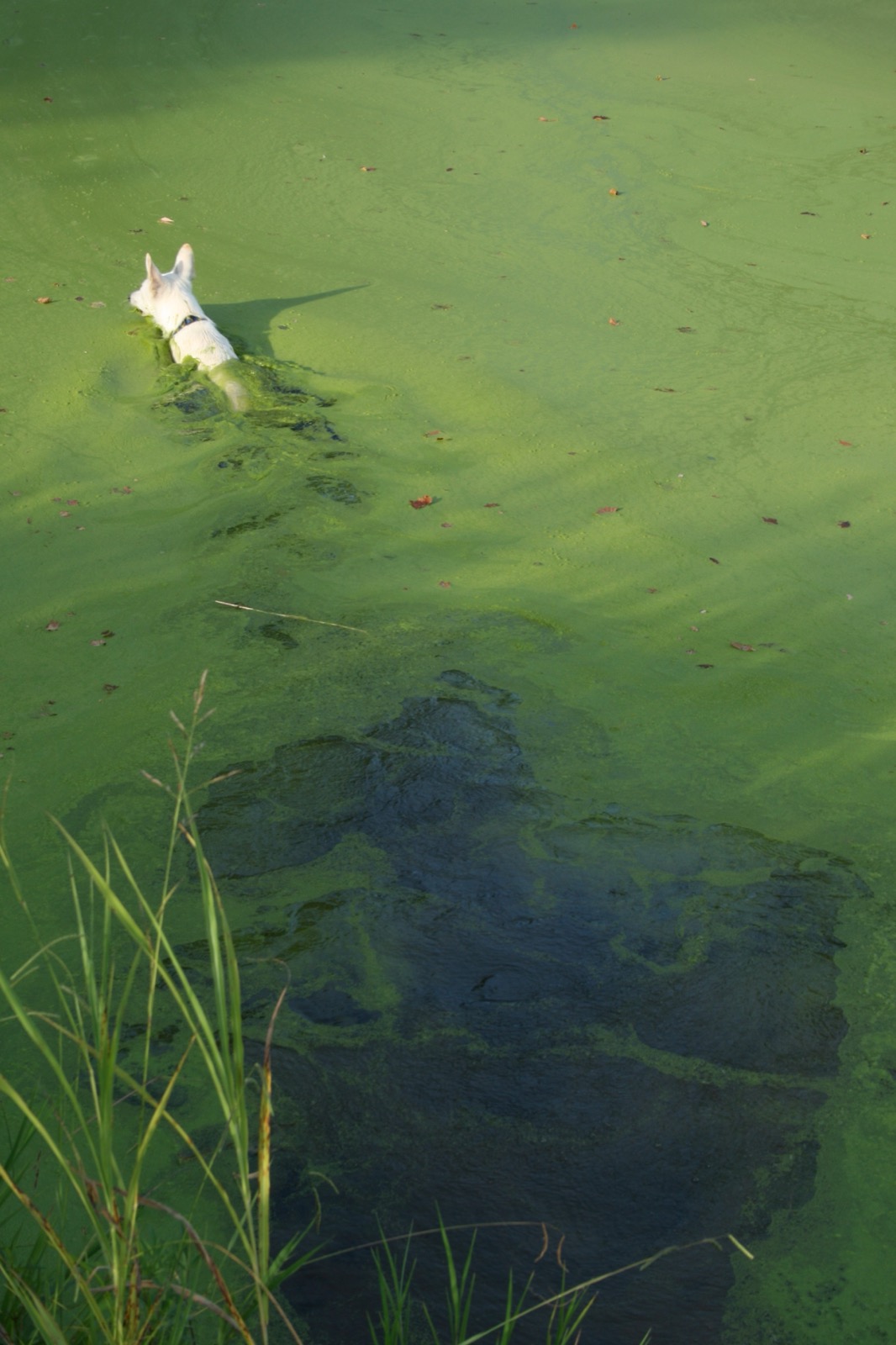
US CDC, Harmful Algal Blooms and Your Health“Contact a veterinarian immediately if your pets or livestock seem sick after going in or near water. Animals can get very sick or even die within hours of coming into contact with harmful algae or cyanobacteria.”
North Carolina's Division of Public Health explains the mechanism as plainly as any agency in the country:
North Carolina Department of Health and Human Services, Division of Public Health“By nature, dogs often play and wade in shallow areas of a pond or lake where algal blooms tend to concentrate due to wind and water currents, and where the toxins can become concentrated. Dogs usually become exposed to the toxins by drinking bloom waters or eating the algae. Algal toxins can be lethal to a dog.”
Two states in EPA's entire compilation publish separate cyanotoxin values for dogs. Indiana sets its dog recreation values at roughly a twentieth of its human ones, and Oregon publishes dog information values about forty times lower than its human recreational value. Everywhere else the published number is a human number, and the animal beside you is being protected by the same threshold as a person who weighs ten times as much and does not drink the water on purpose. That is a gap in the numbers, not evidence that dogs are safe. If an animal is unwell after being in or near water, CDC's instruction is a veterinarian, immediately.
US CDC, Harmful Algal Blooms and Your Health“If you think you have symptoms caused by a harmful algal bloom, contact a healthcare provider or the Poison Control hotline at 1-800-222-1222.”
Lake algae, red tide and beach bacteria are not the same
They get confused constantly, including in news coverage, and the confusion matters because a clean result in one programme says nothing about the others. EPA separates the organisms:
US EPA, Learn about Harmful Algae, Cyanobacteria and Cyanotoxins“Several different types of algae can produce toxic HABs. The most common algae associated with marine toxic HABs include the dinoflagellates (e.g., Florida red tide Karenia brevis) and diatoms (Pseudo-nitzschia) while those most associated with freshwaters are dominated by cyanobacteria (e.g., Microcystis).”
And federal law separates the agencies along the same line:
US EPA, Learn about Harmful Algae, Cyanobacteria and Cyanotoxins“Under the Harmful Algal Bloom and Hypoxia Research and Control Act (HABHRCA), the National Oceanic and Atmospheric Administration (NOAA) is primarily responsible for estuarine, marine, and Great Lake waterbodies, whereas the EPA bears primary responsibility for all other freshwaters.”
Freshwater cyanobacteria
Blue-green algae in lakes, ponds and reservoirs. Toxins, not bacteria. EPA and the states.
You are hereMarine red tide
Karenia brevis and shellfish biotoxins on the coast, plus the NOAA western Lake Erie bloom forecast.
OpenBeach bacteria
Fecal indicator bacteria at BEACH Act coastal and Great Lakes beaches. A different lab test entirely.
OpenThat statute is why the western Lake Erie bloom, which is cyanobacteria and would otherwise belong here, is a NOAA product and lives on our Ohio and Michigan red tide pages with the NOAA seasonal severity forecast. The Ohio and Michigan pages here are about inland lakes and reservoirs instead, which is where most of both states' blooms actually are.
Every state that publishes a blue-green algae program
| State | Agency | What its page carries | Rec. microcystins | Its own levels |
|---|---|---|---|---|
| Arizona | Arizona Department of Environmental Quality | Maps verified reports | none published | not named |
| Arkansas | Arkansas Department of Energy and Environment, Division of Environmental Quality | Publishes current advisories | EPA's 8 | not named |
| California | California State Water Resources Control Board | Publishes current advisories | 0.8 | Caution, Warning and Danger |
| Colorado | Colorado Department of Public Health and Environment | Maps verified reports | Detect to 8 | Caution and Warning |
| Connecticut | Connecticut Department of Energy and Environmental Protection | Program, advisories issued locally | none published | not named |
| Delaware | Delaware Department of Natural Resources and Environmental Control | Program, advisories issued locally | none published | not named |
| Florida | Florida Department of Environmental Protection | Publishes current advisories | Detect | Health Notification Alert |
| Georgia | Georgia Environmental Protection Division | Program, advisories issued locally | none published | not named |
| Idaho | Idaho Department of Environmental Quality | Publishes current advisories | EPA's 8 | Health Watch, Health Alert and Health Advisory |
| Illinois | Illinois Environmental Protection Agency | Publishes current advisories | EPA's 8 | not named |
| Indiana | Indiana Department of Environmental Management | Publishes current advisories | 8 | Advisory and Prohibited |
| Iowa | Iowa Department of Natural Resources | Publishes current advisories | EPA's 8 | not named |
| Kansas | Kansas Department of Health and Environment | Publishes current advisories | >4 to <8 | Watch, Warning and Hazard |
| Kentucky | Kentucky Energy and Environment Cabinet, Division of Water | Maps verified reports | none published | not named |
| Louisiana | Louisiana Department of Environmental Quality | Maps verified reports | none published | not named |
| Maine | Maine Department of Environmental Protection | Maps verified reports | none published | not named |
| Maryland | Maryland Department of the Environment | Publishes current advisories | 10 | not named |
| Massachusetts | Massachusetts Department of Public Health, Bureau of Climate and Environmental Health | Publishes current advisories | 8 | not named |
| Michigan | Michigan Department of Environment, Great Lakes, and Energy | Maps verified reports | none published | not named |
| Minnesota | Minnesota Pollution Control Agency | Program, advisories issued locally | 6 | not named |
| Missouri | Missouri Department of Natural Resources | Publishes current advisories | none published | not named |
| Montana | Montana Department of Public Health and Human Services | Maps verified reports | <4 | Tier 1 Caution, Tier 2 Caution and Tier 3 Consider Closure |
| Nebraska | Nebraska Department of Water, Energy, and Environment | Publishes current advisories | EPA's 8 | Health Alert |
| Nevada | Nevada Division of Environmental Protection | Publishes current advisories | 4-8 | Watch, Warning and Danger |
| New Hampshire | New Hampshire Department of Environmental Services | Publishes current advisories | none published | not named |
| New Jersey | New Jersey Department of Environmental Protection | Publishes current advisories | 2 | Advisory, Warning and Danger |
| New Mexico | New Mexico Environment Department, Surface Water Quality Bureau | Publishes current advisories | >0.1 | HAB Watch, HAB Warning and HAB Danger |
| New York | New York State Department of Environmental Conservation | Publishes current advisories | 4 - 20 | not named |
| North Carolina | North Carolina Department of Environmental Quality | Maps verified reports | none published | not named |
| North Dakota | North Dakota Department of Environmental Quality | Publishes current advisories | EPA's 8 | not named |
| Ohio | Ohio Department of Natural Resources | Publishes current advisories | 8 | not named |
| Oklahoma | Oklahoma Department of Environmental Quality | Program, advisories issued locally | none published | not named |
| Oregon | Oregon Health Authority, Public Health Division | Publishes current advisories | EPA's 8 | Advisory in effect and Precaution in effect |
| Pennsylvania | Pennsylvania Department of Health | Publishes current advisories | detect to 8 | Recreation Advisory and Avoid Primary Contact |
| Rhode Island | Rhode Island Department of Environmental Management | Publishes current advisories | 4 | not named |
| South Carolina | South Carolina Department of Environmental Services | Program, advisories issued locally | EPA's 8 | not named |
| South Dakota | South Dakota Department of Health | Program, advisories issued locally | EPA's 8 | not named |
| Tennessee | Tennessee Department of Environment and Conservation | Publishes current advisories | none published | not named |
| Utah | Utah Department of Environmental Quality | Publishes current advisories | >8 | Warning Advisory and Danger Advisory |
| Vermont | Vermont Department of Health | Publishes current advisories | 6 | not named |
| Virginia | Virginia Department of Health | Publishes current advisories | EPA's 8 | not named |
| Washington | Washington State Department of Health | Publishes current advisories | EPA's 8 | Warning and Danger |
| West Virginia | West Virginia Department of Health, Office of Environmental Health Services | Program, advisories issued locally | >6 | Watch and Warning |
| Wisconsin | Wisconsin Department of Natural Resources | Publishes current advisories | EPA's 8 | not named |
| Wyoming | Wyoming Department of Environmental Quality | Publishes current advisories | EPA's 8 | not named |
Jump to a state
States without a page
None of these reasons is that the state has no blooms. CDC settles that question for the whole country in one sentence:
US CDC, Harmful Algal Blooms and Your Health“Harmful algal blooms occur across the world. In the United States, they have been reported in all 50 states, Puerto Rico, and the U.S. Virgin Islands.”
In these 5 states no state agency publishes a freshwater cyanobacteria programme page. In four of the five, the only entry in EPA's own federal HAB directory is a marine or coastal bacteria programme, which our beach water pages cover. The people who can answer for a particular lake there are the local health department and whoever manages the water.
- Alabama. EPA’s own federal HAB programme directory lists exactly one Alabama entry, the ADEM and ADPH Coastal Alabama Beach Monitoring Program, which tests Gulf and bay beaches for fecal indicator bacteria and is covered on our beach water quality pages. EPA’s state threshold compilation lists Alabama as having no cyanotoxin threshold for either drinking water or recreation, and no state agency publishes a freshwater cyanobacteria programme page. Alabama has lakes and it has blooms; for a particular lake, the local health department and the body that manages the water are the ones to ask.
- Alaska. The only Alaska entry in EPA’s federal directory is the Alaska Harmful Algal Bloom Network, a research and monitoring consortium hosted by the Alaska Ocean Observing System and made up largely of Tribal and university monitoring programmes, whose subject is marine shellfish biotoxins and paralytic shellfish poisoning rather than freshwater cyanobacteria. No state agency publishes a freshwater cyanobacteria advisory programme, and EPA lists Alaska with no cyanotoxin threshold of any kind.
- Hawaii. Hawaii’s Department of Health Clean Water Branch runs the BEACH Act fecal indicator bacteria programme and publishes water quality advisories from it, covered on our beach water quality pages. The two Hawaii entries in EPA’s federal HAB directory are stinging seaweed disease and ciguatera fish poisoning, both marine and neither cyanobacteria in a lake. EPA lists Hawaii with no cyanotoxin threshold, and no state agency publishes a freshwater HAB programme page.
- Mississippi. The Mississippi entry in EPA’s federal directory is the MDEQ Beach Monitoring Program, which covers the Mississippi Sound coast and is a bacteria programme covered on our beach water quality pages, alongside a Mississippi State University Extension publication, which is a university document rather than a state record. MDEQ publishes no freshwater HAB programme page, and EPA lists Mississippi with no cyanotoxin threshold.
- Texas. Texas Parks and Wildlife publishes status reports for golden alga, red tide and brown tide, none of which is freshwater cyanobacteria, and the state’s cyanobacteria document is a 2022 Department of State Health Services guide for public health response that assigns the advisory decision to local health authorities and river authorities rather than to a state office. EPA’s compilation carries Texas recreational values from that guide, so Texas has thresholds; the advisory decision for a particular lake rests with the local health authority or river authority, and no statewide page lists where advisories are in force.
Lake algae FAQ
The rest of the water picture
Every threshold on this site is EPA's, from its State and Tribal Toxin Thresholds compilation (146 rows, last updated July 13, 2026), read on 2026-09-03; the programme directory is EPA's too, last updated July 15, 2026. Both are US Government works in the public domain. ZIP to county resolution uses the Census Bureau's ZCTA relationship file. EPA's CyAN satellite estimates are published on EPA's own portal. In EPA's words: "State, Tribal and local governments may issue advisories for water bodies with HABs." 29 of those states publish that decision as a list you can open today, and every state page here links it.