
Stargazing Forecast Tonight
Hour-by-hour cloud cover from 8 pm to 5 am, the moon, humidity and darkness, rolled into one 0 to 10 score for your ZIP, with 20 dark-sky sites to drive to below.
What makes a night good for stargazing
Cloud cover, hour by hour
The average from 8 pm to 5 am drives the score, but the hourly strip matters more for planning — many nights clear after midnight.
The moon
Costs up to 4 points at full. A crescent that sets early is nearly free; check the phase name for which.
Transparency
High humidity means haze, dew on optics, and a soft sky near the horizon. Dry post-frontal air is what astronomers wait for.
Hours of darkness
Full darkness starts about 90 minutes after sunset. June nights in the north barely get there; December gives 14 hours.
20 dark-sky sites, ranked by estimated Bortle class
These are the darkest entries on our list — the publicly accessible sites named on the 50 state northern-lights pages — ranked by estimated Bortle class, with certified DarkSky places breaking ties. The list leans toward the northern tier; the desert Southwest holds many of the country’s darkest skies and is thinly represented. Coordinates link to the state page for directions, tonight’s cloud cover at the site, and the aurora threshold.
| # | Site | State | Est. Bortle | Certification | Why |
|---|---|---|---|---|---|
| 1 | Big Bend National Park 29.25, -103.25 | Texas | 1 | DarkSky Park | A DarkSky Park since 2012, with the least light pollution of any National Park unit in the lower 48 — superb for the Milky Way. |
| 2 | Boundary Waters Canoe Area Wilderness 47.95, -90.85 | Minnesota | 1 | DarkSky Sanctuary | A DarkSky Sanctuary since 2020 and, at about a million acres, the second largest in the world after Oregon Outback — with no roads or lights inside it. |
| 3 | Central Idaho Dark Sky Reserve, Stanley 44.22, -114.93 | Idaho | 1 | DarkSky Reserve | The first DarkSky Reserve in the US (2017), Gold tier — the Sawtooths under a pristine sky. |
| 4 | Chaco Culture National Historical Park 36.06, -107.96 | New Mexico | 1 | DarkSky Park | Certified DarkSky Park with its own observatory and night-sky program. |
| 5 | Cosmic Campground, Gila National Forest 33.48, -108.92 | New Mexico | 1 | DarkSky Sanctuary | The first DarkSky Sanctuary in the United States (2016). |
| 6 | Death Valley National Park 36.46, -116.87 | California | 1 | DarkSky Park | Gold-tier DarkSky Park; world-class Milky Way, rarely aurora. |
| 7 | Dinosaur National Monument, Canyon Visitor Center 40.24, -108.97 | Colorado | 1 | DarkSky Park | The Colorado side of a DarkSky Park that straddles the state line; the Canyon Visitor Center and Harpers Corner Road are very dark and very remote. Coordinates approximate. |
| 8 | Dinosaur National Monument, Quarry Visitor Center 40.44, -109.31 | Utah | 1 | DarkSky Park | The Utah side of the DarkSky Park that straddles the Colorado line, near Jensen. |
| 9 | Great Basin National Park 39.01, -114.22 | Nevada | 1 | DarkSky Park | Certified DarkSky Park with an astronomy festival each September. |
| 10 | Massacre Rim Wilderness Study Area 41.65, -119.70 | Nevada | 1 | DarkSky Sanctuary | DarkSky Sanctuary (2019) in the far northwest — one of the darkest places in the lower 48. |
| 11 | Medicine Rocks State Park 46.05, -104.47 | Montana | 1 | DarkSky Sanctuary | A DarkSky Sanctuary (2020) of sandstone pillars in the southeast corner. |
| 12 | Natural Bridges National Monument 37.60, -110.00 | Utah | 1 | DarkSky Park | The world's first DarkSky Park (2007); the Milky Way here is as good as it gets. |
| 13 | Oregon Outback International Dark Sky Sanctuary, Lake County 42.55, -120.30 | Oregon | 1 | DarkSky Sanctuary | The largest DarkSky Sanctuary in the world (2024) — 2.5 million acres of high desert. |
| 14 | Agate Fossil Beds National Monument 42.42, -103.73 | Nebraska | 1 | — | High-plains monument in the panhandle with a clean 360° horizon. |
| 15 | Black Mesa State Park 36.86, -102.88 | Oklahoma | 1 | — | Oklahoma's highest and darkest point, home of the Okie-Tex Star Party. |
| 16 | Black Rock Desert playa 40.90, -119.10 | Nevada | 1 | — | A flat 360° horizon with no lights — outside Burning Man week. |
| 17 | Crater Lake National Park 42.94, -122.10 | Oregon | 1 | — | A 7,000-ft rim with a pristine sky; the north rim faces away from the caldera. |
| 18 | Denali National Park, Park Road 63.73, -148.92 | Alaska | 1 | — | Denali's autumn aurora season runs from late August; the Savage River area is accessible by car. |
| 19 | Eagle Lake, Allagash region 47.05, -68.62 | Maine | 1 | — | Deep in the North Woods; about as dark as the eastern US gets. |
| 20 | Fort Peck Lake 48.00, -106.42 | Montana | 1 | — | Hi-Line prairie reservoir with nothing north but Saskatchewan. |
The Bortle scale in plain language
| Class | Sky | What you see |
|---|---|---|
| 1 | Excellent dark sky | Zodiacal light and airglow visible; the Milky Way casts shadows. Big Bend, the Nebraska Sandhills, Massacre Rim. |
| 2 | Typical truly dark site | Milky Way richly structured; clouds appear as dark holes. Most certified DarkSky Parks and Sanctuaries. |
| 3 | Rural sky | Some light domes on the horizon; Milky Way still detailed overhead. Most state parks an hour from a mid-size city. |
| 4 | Rural / suburban transition | Milky Way visible but washed out low down; fine for meteor showers and bright aurora. |
| 5–6 | Suburban | Milky Way faint or absent; only bright meteors and strong aurora show. |
| 7–9 | Urban | Planets, the moon and the brightest stars. Drive. |
Bortle classes on this site are estimates from light-pollution atlases and certification tiers, not measurements.
What's up, season by season
Summer: the Milky Way core
July–August evenings put Sagittarius and the galactic core due south, and the Perseids peak August 12–13. Check the meteor calendar for the moon phase in a given year — it decides the night.
Autumn: aurora season + showers
Equinox storms bring the northern lights to the northern tier; the Orionids (Oct 21), Leonids (Nov 17) and early-dark evenings make it the busiest season.
Winter: the clearest nights
Orion, the Pleiades and the richest showers of all — the Geminids (Dec 13–14) and Quadrantids (Jan 3–4). Dry arctic air gives the best transparency of the year.
Stargazing forecast FAQ
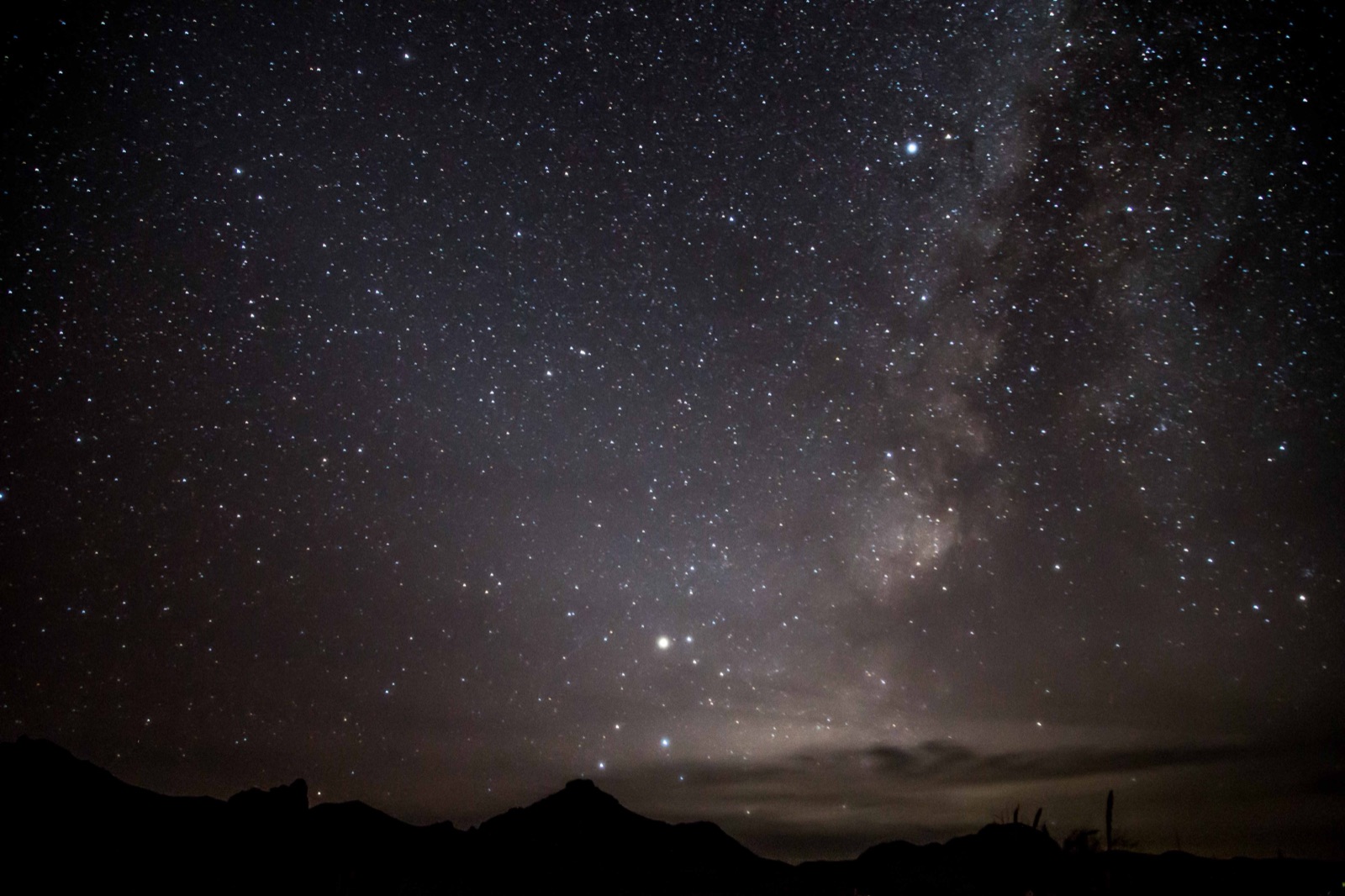
Cloud cover, humidity and sun times from Open-Meteo, read live in your browser; moon computed locally. Bortle classes shown here are estimates, not measurements. Hero image: “Night Sky Over Chisos Mountains (de3b5b2d-7015-4ca5-871b-4da5a8858774)” — NPS Photo — Public domain. Related: meteor shower tonight · northern lights tonight · aurora forecast by state.