
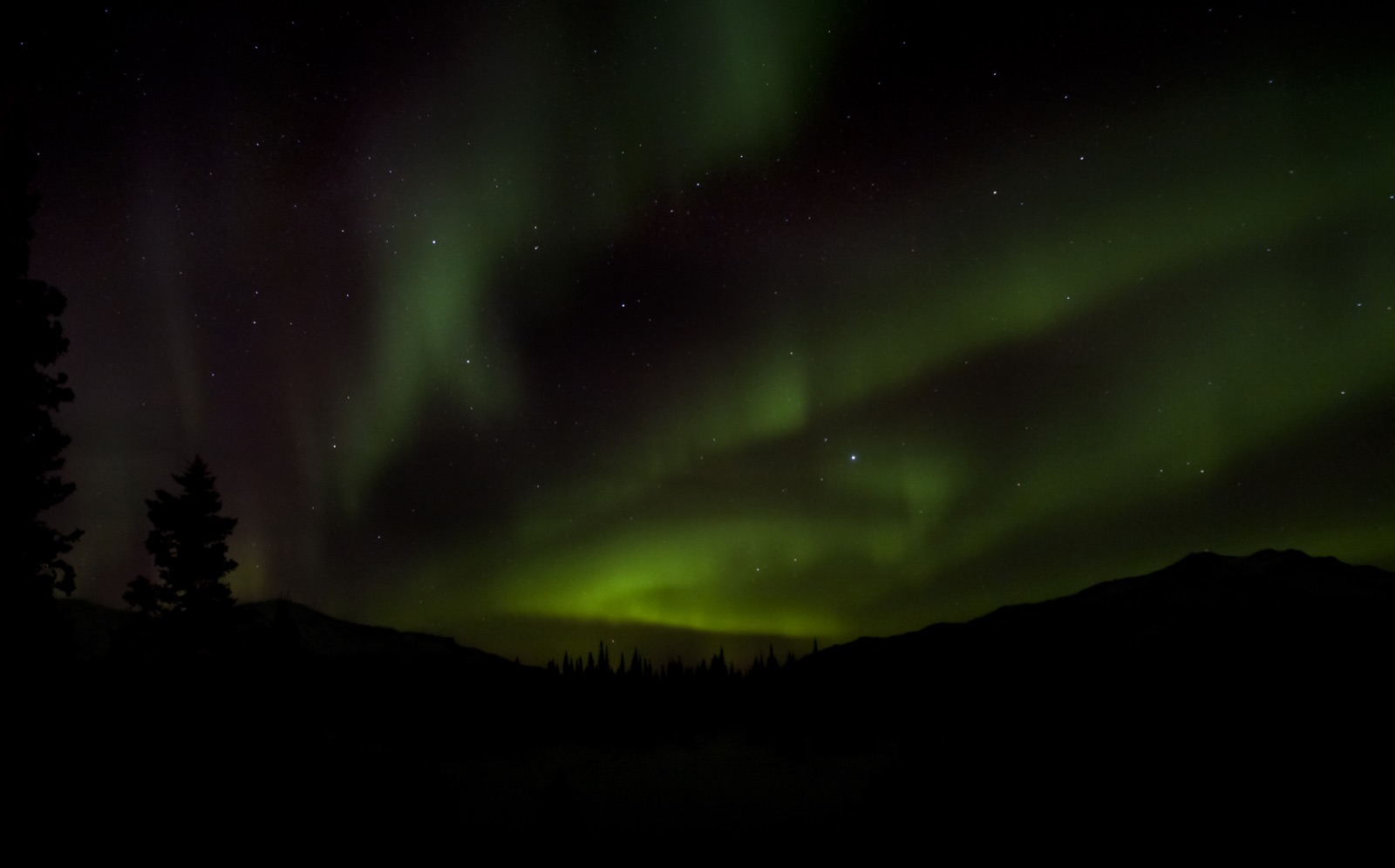
Northern Lights in Alaska: Tonight's Aurora Forecast
Alaska needs about Kp 2 on the northern horizon. Live NOAA Kp, tonight's cloud cover and moon, the aurora oval map, and the darkest places to watch from.
Aurora season is open — equinox weeks bring the most stormsThe Alaska aurora season at a glance
Live · NOAA SWPCThe University of Alaska Fairbanks Geophysical Institute, which runs the state's aurora forecast, estimates Fairbanks visitors who stay three clear nights have about a 90% chance of seeing the aurora.
Can you see the northern lights tonight in Alaska?
The verdict below combines NOAA SWPC's planetary Kp forecast with the Kp 2 that Alaska's darkest northern spots need, tonight's cloud cover from Open-Meteo at Chena Lakes Recreation Area, the moon, and the hours of full darkness. Then each city and dark-sky site gets its own cloud reading — the sky often clears inland when the lakeshore or coast is socked in.
Reading NOAA SWPC and Open-Meteo for Chena Lakes Recreation Area · Alaska tonight…
Tonight, city by city and site by site
| Location | Cloud tonight | Kp tonight | Verdict |
|---|---|---|---|
| Anchorage, AK city | … | … | … |
| Fairbanks, AK city | … | … | … |
| Juneau, AK city | … | … | … |
| Chena Lakes Recreation Area, Fairbanks est. Bortle 3 | … | … | … |
| Murphy Dome est. Bortle 2 | … | … | … |
| Cleary Summit, Steese Highway est. Bortle 2 | … | … | … |
| Denali National Park, Park Road est. Bortle 1 | … | … | … |
| Glen Alps Trailhead, Anchorage est. Bortle 4 | … | … | … |
Cloud is the 9 pm–3 am average from Open-Meteo for each point; Kp is NOAA SWPC's maximum forecast for tonight. City rows use a city-center location — drive to a dark northern horizon for the real thing.
The aurora oval over Alaska right now
NOAA's OVATION model maps where aurora is likely overhead in the next 30–90 minutes. Green cells mean a small chance, red a strong one. The map opens on Chena Lakes Recreation Area; enter a ZIP to recenter, and widen the span to see the whole oval across Canada.
Loading the NOAA OVATION aurora forecast…
Best places to see the northern lights in Alaska
Fairbanks sits directly under the auroral oval — on a clear night between late August and mid-April, the odds of seeing something are better than 80% if you stay out from 10 pm to 2 am. Anchorage needs Kp 3+; Juneau Kp 4+. The best of the year is late February through March: long nights, less cloud.
Chena Lakes Recreation Area, Fairbanks
Twenty minutes from Fairbanks with a flat, open northern horizon — the local standard.
Murphy Dome
A 2,900-ft summit road above the Fairbanks ice fog with a 360° view.
Cleary Summit, Steese Highway
The classic Fairbanks aurora pull-off, above the valley inversion.
Denali National Park, Park Road
Denali's autumn aurora season runs from late August; the Savage River area is accessible by car.
Glen Alps Trailhead, Anchorage
Chugach foothills above the city, facing north over Anchorage to the Alaska Range.
When to see the northern lights in Alaska
September – November autumn season
The equinox weeks around September 22 are statistically the most geomagnetically active of the year, and nights are long again. In Alaska this is prime time — a Kp 2 night shows an arc on the northern horizon, and clear, dry autumn air helps.
December – February long dark nights
Fewer storms than the equinoxes but 14+ hours of darkness and often the clearest, driest air of the year. Dress for it — the best displays come after midnight.
March – April spring season
The March equinox brings the second annual peak in geomagnetic storms. Nights are still long in March, and Alaska's snow cover makes the landscape glow under even a faint display. By late April the late sunsets start to cut into viewing time.
May – August short nights
Short nights and twilight — in the far north there is barely any full darkness in June. Big storms still punch through: NOAA rated the 10–11 May 2024 event G5, the top of its scale, and it was seen across most of the lower 48.
How to see — and photograph — the aurora from Alaska
Kp, geomagnetic latitude, and solar cycle 25
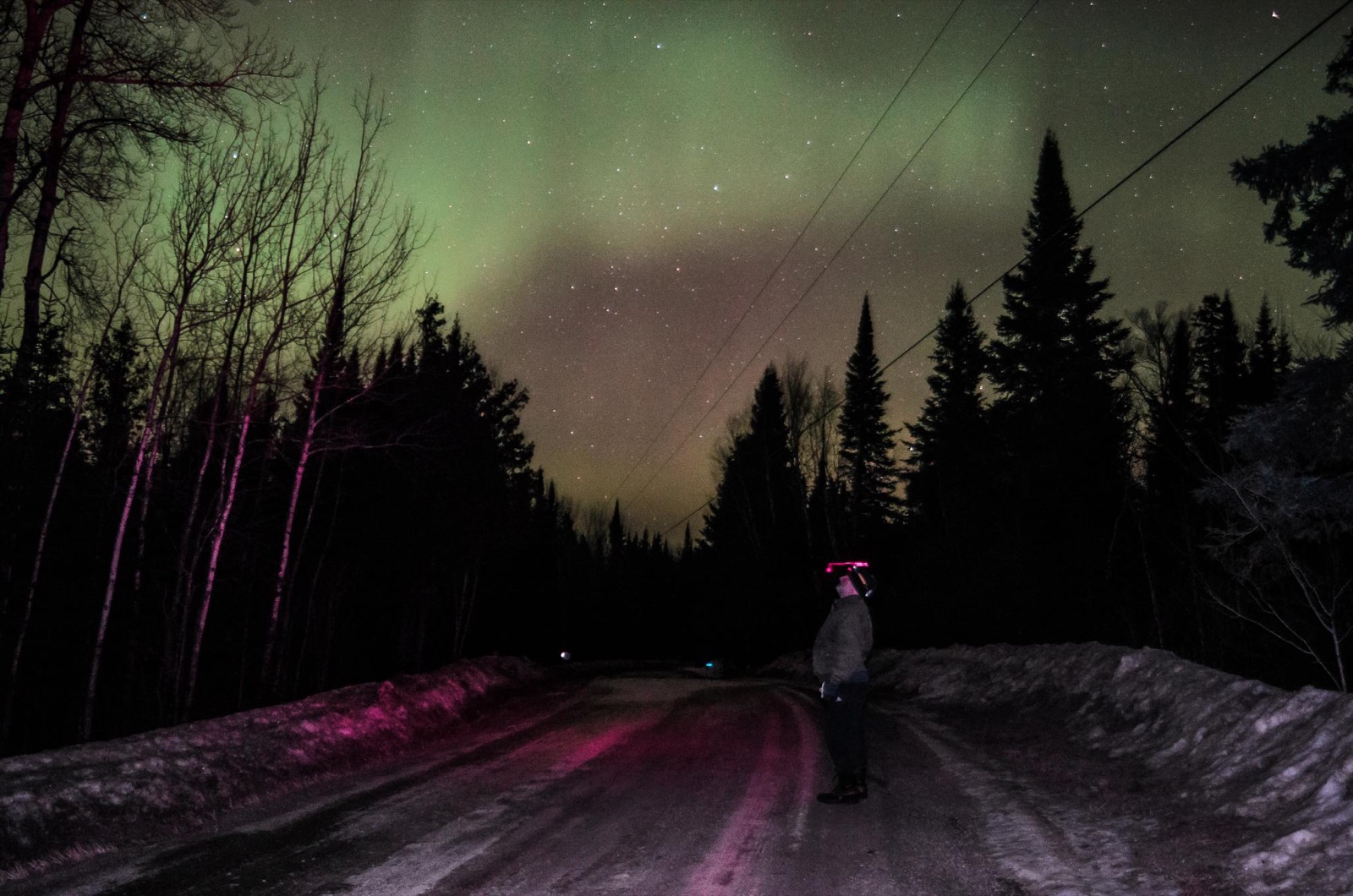
The aurora forms in an oval around the geomagnetic pole, which sits over northern Canada rather than at the geographic pole. That tilt is why the eastern United States is magnetically "further north" than the West: Alaska is at about 65° geomagnetic latitude. The planetary K-index (Kp, 0–9) measures how disturbed Earth's magnetic field is; as Kp rises, the oval expands toward the equator by roughly 2° of latitude per step. From Alaska's darkest northern areas, Kp 2 brings the oval's edge into view on the horizon; Kp 4 puts it overhead.
NOAA's G-scale is a simpler label on the same thing: G1 (Kp 5) minor, G2 (Kp 6) moderate, G3 (Kp 7) strong, G4 (Kp 8) severe, G5 (Kp 9) extreme. Solar cycle 25 reached its maximum in 2024–2025 — NOAA rated the 10–11 May 2024 storm G5, the top of its scale — and the declining phase of a cycle historically produces the biggest individual storms, so 2026 and 2027 remain good years to watch. Storms also cluster near the equinoxes, which is why September–October and March–April are "aurora season" everywhere in the lower 48.
Alaska northern lights FAQ
More Alaska nights and seasons
More West northern lights forecasts
Live Kp, NOAA scales and the OVATION aurora model are read in your browser from NOAA's Space Weather Prediction Center (services.swpc.noaa.gov); cloud cover and sunrise/sunset from Open-Meteo. Kp thresholds are climatological rules of thumb for a dark northern horizon, not guarantees, and Bortle classes are estimates. Hero image: “Aurora in Denali (98bfa86a-4e3a-4cec-b641-9dccd7377fab)” — NPS Photo / Tim Rains — Public domain. National picture: which states can see the aurora tonight → · check your ZIP →