
Sandhill Crane Migration: Where and When to See Them
54 viewing sites in 29 states, the months each refuge names, the counts they publish, and the sunrise and sunset that decide when to be standing there.
The first count of the fall is in
The Indiana DNR counted 540 sandhill cranes at Jasper-Pulaski Fish & Wildlife Area on October 6, 2026, the first of its weekly fall counts. Last fall the count peaked at 16,400 on December 2, 2025. Across the 4 full seasons published, the peak landed around November 30.
Sandhill cranes are beginning to stage in the area, and we will expect to see more migrants coming down in the coming weeks. We typically see peak numbers of cranes sometime around the last week in October!Crex Meadows Wildlife Area, October 7, 2026, read October 8, 2026. Read it at the source
Starting around September 29, 2026, construction work will begin on water control infrastructure around the Tour Loop. Road closures may be necessary for visitor and staff safety.Bosque del Apache National Wildlife Refuge, before you go, read October 8, 2026. Read it at the source
Crane viewing sites, month by month
Pick a month. The colored pins are the sites whose managers name that month for cranes; the shading underneath is where people logged a confirmed sandhill crane on iNaturalist in the same month. 51 of the 54 sites have a pin; the rest are listed on their state pages without one. Each pin opens the site’s state page, with its quotes, its counts and today’s fly in times.
13 of the 51 mapped sites name October. A pin is colored only when the refuge or agency that runs it prints that month. The shaded grid is where people have logged a verified sandhill crane on iNaturalist in October, in any year, brighter where more have been logged; it maps reports, so it thickens where observers stand.
The crane year, September to August
The count peaks are the days the published counts usually top out, worked out from every season each publisher has printed. The festivals are the organizers’ own dates.
October
- FestivalKids Crane Fest, ColoradoOctober 10, 2026, Monte Vista National Wildlife Refuge.
- FestivalCraneFest XXXI, MichiganOctober 10 to 11, 2026, Bernard W. Baker Sanctuary and Kiwanis Youth Conservation Area (Big Marsh Lake).
- FestivalSandhill Crane Saturdays, IndianaOctober 17 to December 19, 2026, Jasper-Pulaski Fish & Wildlife Area.
November
- FestivalThe Lodi Sandhill Crane Festival 2026, CaliforniaNovember 6 to 8, 2026, Woodbridge Ecological Reserve (Isenberg Sandhill Crane Reserve).
- Count peakPhyllis Haehnle Memorial Sanctuary, MichiganThe count usually peaks around November 16, the median of 19 seasons. The highest count in the series is 8,177, on November 19, 2012.
- Count peakJasper-Pulaski Fish and Wildlife Area, IndianaThe count usually peaks around November 30, the median of 4 seasons. The highest count in the series is 32,938, on November 28, 2023.
December
- FestivalFestival of the Cranes, New MexicoDecember 2 to 5, 2026, Bosque del Apache National Wildlife Refuge.
- Count peakHiwassee Wildlife Refuge, TennesseeThe count usually peaks around December 28, the median of 10 seasons. The highest count in the series is 35,505, on December 15, 2016.
January
- FestivalWings Over Willcox Birding & Nature Festival, ArizonaJanuary 14 to 17, 2027, Willcox Playa Wildlife Area (and AEPCO Apache Station and Cochise Lake roosts).
- FestivalSandhill Crane Festival, TennesseeJanuary 16 to 17, 2027, Hiwassee Refuge.
- Count peakBarren River Lake Wildlife Management Area, KentuckyThe count usually peaks around January 19, the median of 8 seasons. The highest count in the series is 22,225, on January 21, 2025.
February
- Count peakHop-In Refuge, TennesseeThe count usually peaks around February 1, the median of 11 seasons. The highest count in the series is 13,500, on February 16, 2021.
March
- FestivalMonte Vista Crane Festival, ColoradoMarch 5 to 7, 2027, Monte Vista National Wildlife Refuge.
- Count peakCentral Platte River Valley, NebraskaThe count usually peaks around March 18, the median of 11 seasons. The highest count in the series is 736,000, on March 18, 2025.
- Festival29th Annual Othello Sandhill Crane Festival, WashingtonMarch 18 to 21, 2027, Othello area, Columbia Basin (Columbia National Wildlife Refuge).
Sandhill crane festivals, 2026 and 2027
October 10, 2026
Kids Crane Fest
Monte Vista National Wildlife Refuge, Colorado. Colorado crane page
October 10 to 11, 2026
CraneFest XXXI
Bernard W. Baker Sanctuary and Kiwanis Youth Conservation Area (Big Marsh Lake), Michigan. Michigan crane page
As the organizer prints it: “October 10 & 11, 2026 | Bellevue, MI”
October 17 to December 19, 2026
Sandhill Crane Saturdays
Jasper-Pulaski Fish & Wildlife Area, Indiana. Indiana crane page
As the organizer prints it: “Saturdays from 5:30-7:30 p.m. ET from Oct. 17 - Dec. 19, 2026 (excluding Halloween and Thanksgiving weekends)”
November 6 to 8, 2026
The Lodi Sandhill Crane Festival 2026
Woodbridge Ecological Reserve (Isenberg Sandhill Crane Reserve), California. California crane page
As the organizer prints it: “November 6-8, 2026”
December 2 to 5, 2026
Festival of the Cranes
Bosque del Apache National Wildlife Refuge, New Mexico. New Mexico crane page
As the organizer prints it: “December 2–5, 2026”
January 14 to 17, 2027
Wings Over Willcox Birding & Nature Festival
Willcox Playa Wildlife Area (and AEPCO Apache Station and Cochise Lake roosts), Willcox Community Center, 312 Stewart Street, Willcox, Arizona. Arizona crane page
As the organizer prints it: “January 14-17, 2027”
January 16 to 17, 2027
Sandhill Crane Festival
Hiwassee Refuge, Tennessee. Tennessee crane page
As the organizer prints it: “January 16-17, 2027”
March 5 to 7, 2027
Monte Vista Crane Festival
Monte Vista National Wildlife Refuge, Colorado. Colorado crane page
As the organizer prints it: “March 5-7, 2027”
March 18 to 21, 2027
29th Annual Othello Sandhill Crane Festival
Othello area, Columbia Basin (Columbia National Wildlife Refuge), Washington. Washington crane page
As the organizer prints it: “March 18-21, 2027”
The Platte River in March
Every spring the cranes of the middle of the continent stop on one stretch of the Platte in central Nebraska. The Crane Trust flies it each week and publishes the count: 736,000 on March 18, 2025, the highest of the 11 springs charted below, with the peak usually around March 18.
March 2025 on the Platte has two published figures from two surveys. The Crane Trust’s 736,000 is the peak of its weekly flights over the river, the week ending March 18, 2025. The U.S. Fish and Wildlife Service’s 1,415,088 is its March photo corrected survey of the Central Platte River Valley, the figure it reports for the whole Mid-Continent Population. The methods differ, so the two numbers are not expected to match.
The sandhill cranes of the MCP are counted during spring migration when a majority gather along the Platte River Valley in Nebraska.Central Flyway Council, read October 8, 2026. Read it at the source
A total of 16 surveys since October allowed us to record the largest group of overwintering Sandhill Cranes on the Platte in recorded history (35,000)Crane Trust, read October 8, 2026. Read it at the source
The bars are the Crane Trust’s published season peaks; the latest flight it published was 15,000 on April 6, 2026. Sandhill cranes in Nebraska
Sunrise and sunset are the show
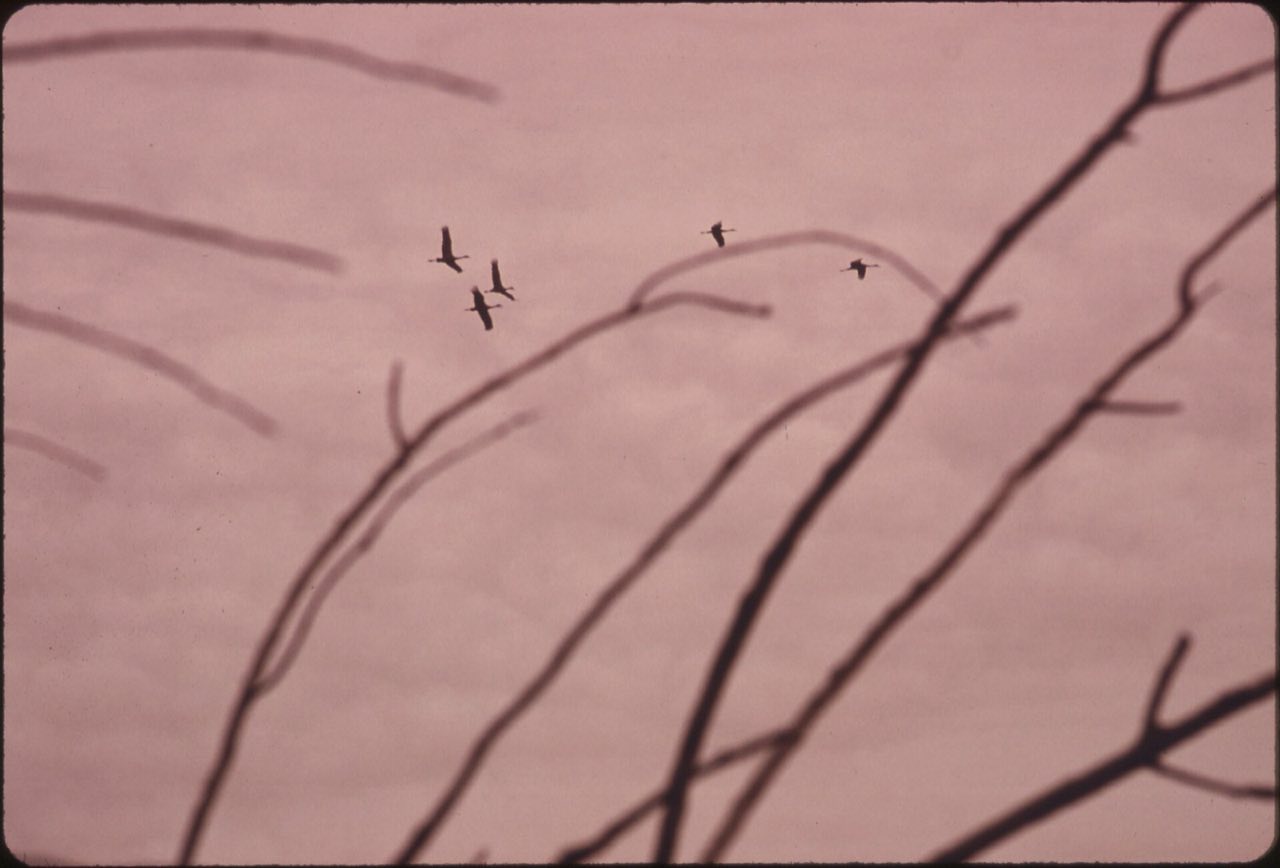
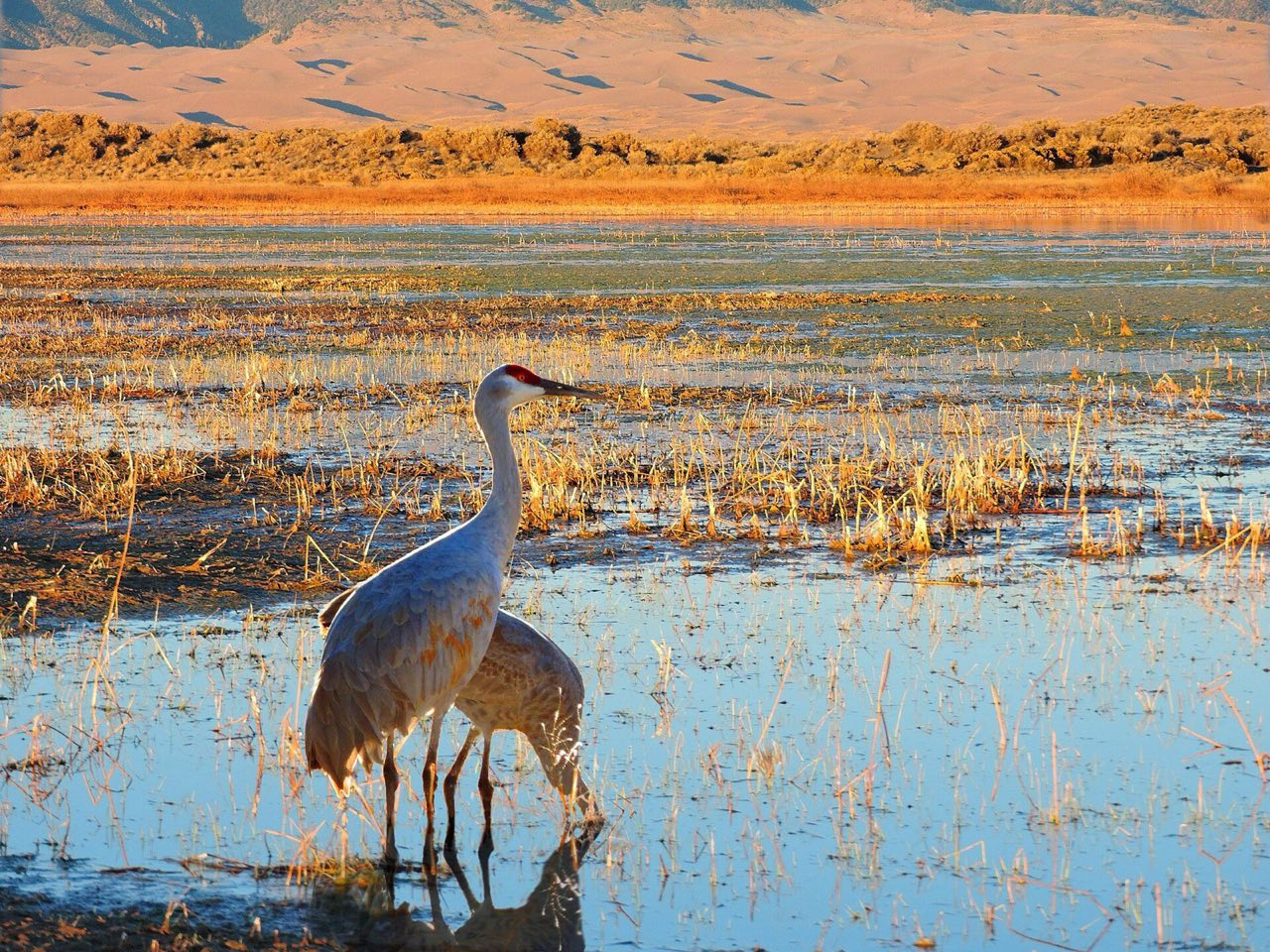
Cranes spend the night standing in shallow water and the day in the fields around it. They leave the roost around sunrise and come back in the last hour of light, so the refuges time their tours and platforms to those two moments. Every site on the state pages shows today’s sunrise and sunset for its own coordinates, and turns a refuge’s “one hour before sunset” into a clock time.
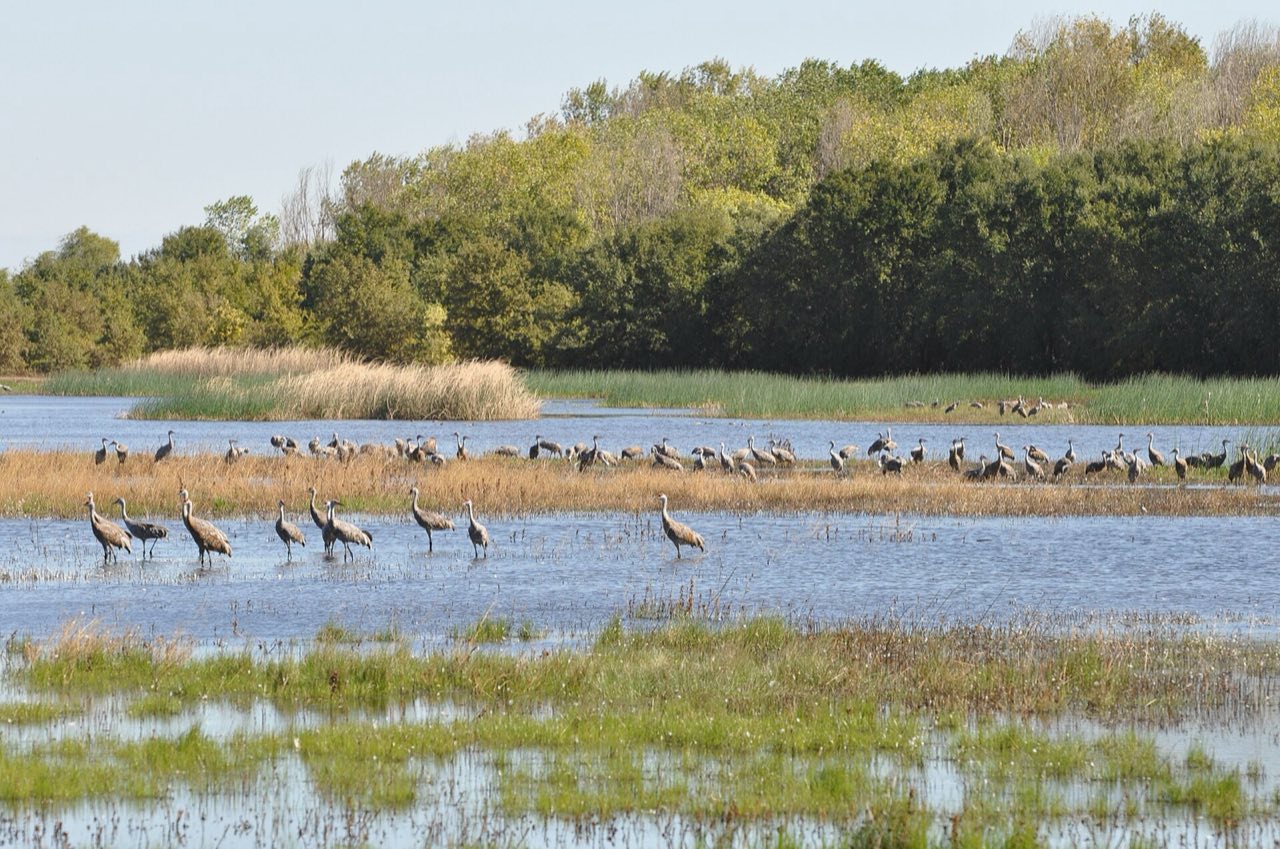
Thousands of snow geese, Ross’s geese, and sandhill cranes spend the night in water to protect themselves from predators. Near dawn, the geese take off in a group in search of fields throughout the Middle Rio Grande Valley to feed in for the day.USFWS, Bosque del Apache National Wildlife Refuge, read October 8, 2026. Read it at the source
Smaller groups of sandhill cranes then leave the safety of the water for the same reason. Check the sunrise time and stop in our visitor center to learn the most recent roosting and feeding sites, as they can change through the winter.USFWS, Bosque del Apache National Wildlife Refuge, read October 8, 2026. Read it at the source
Blind tours are offered in the early morning while the cranes roost on the river and in the evening when the birds return to the river to roost for the night.Crane Trust, read October 8, 2026. Read it at the source
Cranes are most reliably roosting on the river at sunrise, making them easier to count before they disperse.Crane Trust, read October 8, 2026. Read it at the source
29 states with crane viewing sites
| State | When, and months at the sites | Sites | Latest count | Next festival | Reports, last 12 months |
|---|---|---|---|---|---|
| Alabama | Winter | 1 | 199 | ||
| Alaska | Passing through, BreedingSep and May | 2 | 339 | ||
| Arizona | WinterSep to Mar | 2 | Wings Over Willcox Birding & Nature FestivalJanuary 14, 2027 | 140 | |
| California | WinterSep to Mar | 4 | The Lodi Sandhill Crane Festival 2026November 6, 2026 | 786 | |
| Colorado | Fall staging, Spring staging, Passing throughOct and Mar | 2 | Kids Crane FestOctober 10, 2026 | 203 | |
| Florida | Winter, BreedingDec to Feb | 1 | 3,461 | ||
| Georgia | Winter, Passing through, Breeding | 1 | 66 | ||
| Idaho | Passing through, Breeding | 1 | 196 | ||
| Illinois | Passing through, Breeding | 1 | 541 | ||
| Indiana | Fall staging, Passing throughOct to Dec | 1 | 540October 6, 2026 | Sandhill Crane SaturdaysOctober 17, 2026 | 257 |
| Kansas | Winter, Passing through | 2 | 9 | ||
| Kentucky | Winter, Passing through | 1 | 12,767February 9, 2026 | 21 | |
| Michigan | Fall staging, Passing through, BreedingOct to Nov | 2 | 33October 5, 2026 | CraneFest XXXIOctober 10, 2026 | 1,091 |
| Minnesota | Fall staging, Passing through, Breeding | 1 | 546 | ||
| Mississippi | Winter, Breeding | 1 | 114 | ||
| Nebraska | Winter, Spring stagingMar to Apr | 2 | 15,000April 6, 2026 | 151 | |
| Nevada | Fall staging, Passing through, Breeding | 2 | 20 | ||
| New Mexico | Winter, Passing throughOct to Jan | 3 | Festival of the CranesDecember 2, 2026 | 353 | |
| Ohio | Passing through, Breeding | 4 | 368 | ||
| Oklahoma | Winter, Passing through | 2 | 29 | ||
| Oregon | Fall staging, Winter, Passing through, BreedingSep to Mar | 2 | 210 | ||
| South Carolina | Winter | 1 | 18 | ||
| South Dakota | Passing through | 1 | 9 | ||
| Tennessee | Winter, Passing throughOct to Mar | 2 | 750February 2, 2026 | Sandhill Crane FestivalJanuary 16, 2027 | 97 |
| Texas | WinterSep and Dec to Feb | 1 | 370 | ||
| Utah | Passing throughMar | 2 | 216 | ||
| Washington | Spring staging, Passing through, BreedingSep to Oct | 3 | 29th Annual Othello Sandhill Crane FestivalMarch 18, 2027 | 164 | |
| Wisconsin | Fall staging, BreedingOct to Nov | 2 | 1,345 | ||
| Wyoming | Fall staging, Spring staging, Passing through, BreedingOct | 4 | 242 |
Months are the ones the site managers print. Counts are the latest each publisher printed, with the date. Reports are iNaturalist research grade records from October 8, 2025 to October 8, 2026.
The populations, in their counters’ words
Sandhill cranes are counted flock by flock rather than all at once, so each figure below belongs to the group that published it.
POPULATION: 1,460,000 ±230,000International Crane Foundation, read October 8, 2026. Read it at the source
The U.S. Fish and Wildlife Service publishes one survey figure a year for each of the populations it manages. These are its latest, each from its own survey, so they are not added together here.
- 1,415,088Mid-Continent PopulationMarch 2025 photo-corrected count, Central Platte River Valley, Nebraska
- 91,485Eastern Population2024 survey
- 24,909Rocky Mountain Population2024 survey
- 2,927Lower Colorado River Valley Population2025 survey
The spring 2025 estimate of abundance for sandhill cranes in the Central Platte River Valley (CPRV), Nebraska, corrected for visibility bias, was 1,415,088 birds, which was 236% greater than the 2024 estimate of 420,840, and 12% greater than the 2023 estimate of 1,259,199 birds.USFWS, Status and Harvests of Sandhill Cranes 2025, read October 8, 2026. Read it at the source
The Eastern Population (EP) sandhill crane fall survey index for 2024 (91,485) was a 17% decrease from the previous year, and well above the objective of 30,000 cranes for this population.USFWS, Status and Harvests of Sandhill Cranes 2025, read October 8, 2026. Read it at the source
The fall 2024 pre-migration survey for the Rocky Mountain Population (RMP) counted 24,909 cranes, 9% lower than the count from 2023. The 3-year average was 23,603 sandhill cranes, which exceeds the established population objective of 17,000–21,000 for the RMP.USFWS, Status and Harvests of Sandhill Cranes 2025, read October 8, 2026. Read it at the source
The survey counted 2,927 cranes in 2025, a 43% decrease from the previous year’s count of 5,156 cranes (Table 11, Fig. 20). The recent 3-year average for the winter count is 4,267 cranes.USFWS, Status and Harvests of Sandhill Cranes 2025, read October 8, 2026. Read it at the source
The two migratory subspecies (Lesser and Greater) are distributed across a broad breeding range in the northern U.S. and Canada as well as eastern Siberia, with wintering grounds in the southern United States and northern Mexico.International Crane Foundation, read October 8, 2026. Read it at the source
The three non-migratory subspecies (Mississippi, Cuban and Florida) have restricted ranges in the southern United States and Cuba.International Crane Foundation, read October 8, 2026. Read it at the source
When people log sandhill cranes, month by month
12,269 research grade sandhill crane reports from the United States in the twelve months to October 8, 2026.
Reading the last thirty days of reports from iNaturalist.
Reports from 19 more states
Research grade sandhill crane reports in the last twelve months from the states without a page of their own here yet. Each number opens the list on iNaturalist.
- Arkansas1Fall migration
- Connecticut7Fall migration
- Delaware62Fall migration
- Iowa26Fall migration
- Louisiana14Fall migration
- Maine19Fall migration
- Maryland22Fall migration
- Massachusetts56Fall migration
- Missouri29Fall migration
- Montana159Fall migration
- New Hampshire1Fall migration
- New Jersey29Fall migration
- New York114Fall migration
- North Carolina34Fall migration
- North Dakota3Fall migration
- Pennsylvania92Fall migration
- Vermont13Fall migration
- Virginia22Fall migration
- West Virginia5Fall migration
Sandhill crane questions
Sandhill cranes by state
Sites, months, counts and festival dates read October 8, 2026 from the refuge, agency, sanctuary and festival pages linked beside each one. Counts are published by the Indiana DNR, the Kentucky Department of Fish and Wildlife Resources, the Tennessee Wildlife Resources Agency and the Crane Trust; a refuge’s own page is the one to check before a long drive, since tour loops and platforms close for weather and work. Sunrise and sunset are computed for each site’s coordinates. Report tallies are iNaturalist research grade records, which count sightings, not birds.