
Fall Home Invaders 2026: When They Come Inside
Every autumn the same four insects stop feeding, gather on sunlit walls and look for somewhere to spend the winter. Everyone tells you they do it. Nobody tells you when. Here is the date for your state, the trigger conditions in this week’s forecast, and the exclusion deadline you actually need to hit.
Is this the week they come into your house?
Enter a ZIP for your state’s typical entry week, your sealing deadline, and the next seven days from the National Weather Service scored against the documented flight trigger: a warm afternoon following a cool night.
Every state, by where its entry window stands today
Coming in nowInside the typical massing and entry window today
Starting soonEntry window opens within about three weeks
No seasonNo freeze, so no overwintering flight
Entry timing, every state A to Z
Dates are computed from day length at each state’s reference city and that city’s median first freeze in the NOAA 1991 to 2020 normals. They are climatological typicals rather than a forecast, and any single year runs a week or two either side. The stink bug column is somebody else’s work: the state’s category on the StopBMSB status map, edition dated 10 March 2021.
| State | Seal by | Main entry week | Leading species | Stink bug status | Today |
|---|---|---|---|---|---|
| Alabama | September 9 | October 17 | Asian lady beetle | Agricultural and nuisance | Coming in now |
| Alaska | August 13 | September 20 | Cluster fly | Not on the map | Coming in now |
| Arizona | August 14 | September 21 | Boxelder bug | Detected only | Coming in now |
| Arkansas | September 8 | October 16 | Asian lady beetle | Nuisance only | Coming in now |
| California | September 24 | November 1 | Asian lady beetle | Agricultural and nuisance | Coming in now |
| Colorado | August 22 | September 29 | Asian lady beetle | Detected only | Coming in now |
| Connecticut | August 24 | October 1 | Asian lady beetle | Agricultural and nuisance | Coming in now |
| Delaware | September 2 | October 10 | Asian lady beetle | Severe | Coming in now |
| Florida | September 17 | October 25 | Asian lady beetle | Nuisance only | Coming in now |
| Georgia | September 11 | October 19 | Asian lady beetle | Agricultural and nuisance | Coming in now |
| Hawaii | None | None | None | Detected only | No season |
| Idaho | August 25 | October 2 | Asian lady beetle | Detected only | Coming in now |
| Illinois | September 1 | October 9 | Asian lady beetle | Agricultural and nuisance | Coming in now |
| Indiana | August 28 | October 5 | Asian lady beetle | Agricultural and nuisance | Coming in now |
| Iowa | August 26 | October 3 | Asian lady beetle | Nuisance only | Coming in now |
| Kansas | September 3 | October 11 | Asian lady beetle | Detected only | Coming in now |
| Kentucky | September 3 | October 11 | Asian lady beetle | Agricultural and nuisance | Coming in now |
| Louisiana | September 29 | November 6 | Asian lady beetle | Detected only | Starting soon |
| Maine | August 21 | September 28 | Asian lady beetle | Detected only | Coming in now |
| Maryland | September 6 | October 14 | Asian lady beetle | Severe | Coming in now |
| Massachusetts | September 2 | October 10 | Asian lady beetle | Agricultural and nuisance | Coming in now |
| Michigan | August 30 | October 7 | Asian lady beetle | Severe | Coming in now |
| Minnesota | August 23 | September 30 | Asian lady beetle | Agricultural and nuisance | Coming in now |
| Mississippi | September 9 | October 17 | Asian lady beetle | Detected only | Coming in now |
| Missouri | September 1 | October 9 | Asian lady beetle | Nuisance only | Coming in now |
| Montana | August 18 | September 25 | Seed bug | Detected only | Coming in now |
| Nebraska | August 27 | October 4 | Asian lady beetle | Detected only | Coming in now |
| Nevada | August 19 | September 26 | Asian lady beetle | Detected only | Coming in now |
| New Hampshire | August 14 | September 21 | Asian lady beetle | Nuisance only | Coming in now |
| New Jersey | September 6 | October 14 | Asian lady beetle | Severe | Coming in now |
| New Mexico | September 4 | October 12 | Boxelder bug | Detected only | Coming in now |
| New York | September 10 | October 18 | Asian lady beetle | Severe | Coming in now |
| North Carolina | September 7 | October 15 | Asian lady beetle | Severe | Coming in now |
| North Dakota | August 17 | September 24 | Asian lady beetle | Detected only | Coming in now |
| Ohio | August 29 | October 6 | Asian lady beetle | Agricultural and nuisance | Coming in now |
| Oklahoma | September 7 | October 15 | Asian lady beetle | Detected only | Coming in now |
| Oregon | September 14 | October 22 | Asian lady beetle | Severe | Coming in now |
| Pennsylvania | September 6 | October 14 | Asian lady beetle | Severe | Coming in now |
| Rhode Island | August 29 | October 6 | Asian lady beetle | Nuisance only | Coming in now |
| South Carolina | September 9 | October 17 | Asian lady beetle | Agricultural and nuisance | Coming in now |
| South Dakota | August 20 | September 27 | Asian lady beetle | Not on the map | Coming in now |
| Tennessee | September 4 | October 12 | Asian lady beetle | Severe | Coming in now |
| Texas | September 15 | October 23 | Asian lady beetle | Detected only | Coming in now |
| Utah | August 27 | October 4 | Boxelder bug | Agricultural and nuisance | Coming in now |
| Vermont | August 20 | September 27 | Asian lady beetle | Nuisance only | Coming in now |
| Virginia | September 3 | October 11 | Asian lady beetle | Severe | Coming in now |
| Washington | September 15 | October 23 | Asian lady beetle | Agricultural and nuisance | Coming in now |
| West Virginia | August 30 | October 7 | Asian lady beetle | Severe | Coming in now |
| Wisconsin | August 29 | October 6 | Asian lady beetle | Agricultural and nuisance | Coming in now |
| Wyoming | August 15 | September 22 | Boxelder bug | Not on the map | Coming in now |
Nuisance tier, our own composite of how much of a problem the autumn invasion is in an average house, runs 0 to 4 and is shown on each state page. 7 states sit at the top tier: New Jersey, Pennsylvania, Delaware, Maryland, Virginia, West Virginia, Ohio.
Outdoors they vanish in winter. The questions do not.
Two curves, same species, same twelve months. One is where the insect actually is: research-grade iNaturalist observations, which are photographs of a real animal in a real place, verified by other people. The other is where the attention is: English Wikipedia pageviews for that species article.
For the brown marmorated stink bug, outdoor sightings peak in Sep and lookups peak in Oct. The interesting number is not the peak, it is the winter. Set December through February against June through August: outdoor sightings are 59% lower in winter, while lookups are 1.7 times the summer level. People are asking about an insect that is, as far as the outdoor record is concerned, not there. It is indoors, in their house, being noticed one at a time.
A correction we owe you, because the tidy version of this story is wrong: the lookups do not peak in midwinter. For all five species they peak in October or November, with the entry event itself, and every single year of the record does the same. What is true, and is the real finding, is that winter attention stays far above the summer trough while outdoor presence has gone to nearly nothing. The divergence is in the winter plateau, not in a January spike.
Each curve is scaled to its own maximum: the two series are in different units and the comparison is between shapes. Sightings are research-grade iNaturalist observations in the United States, all years, aggregate counts only. Lookups are English Wikipedia pageviews for the species article, summed by calendar month over 2016 to 2025, from the Wikimedia pageviews API. Pageviews are a proxy for attention, not for abundance, and are not limited to the United States.
The five insects on the wall
Brown marmorated stink bug
Halyomorpha halys
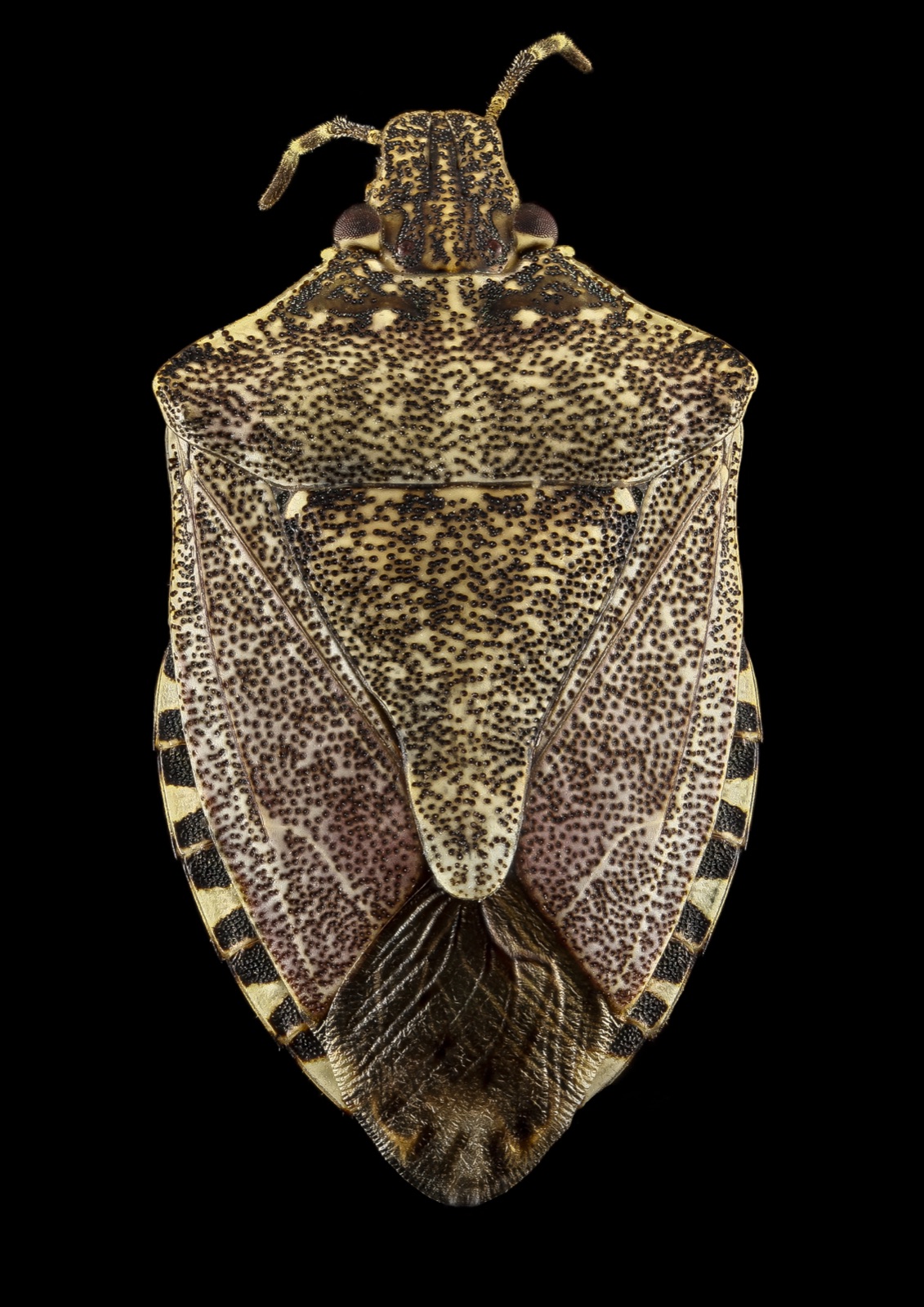
Shield shaped and mottled brown, with white bands on the antennae and along the edge of the abdomen. Native to East Asia, first found in North America in Pennsylvania in the 1990s. It does not bite, does not breed indoors and does not damage the building. It smells when crushed.
Boxelder bug
Boisea trivittata
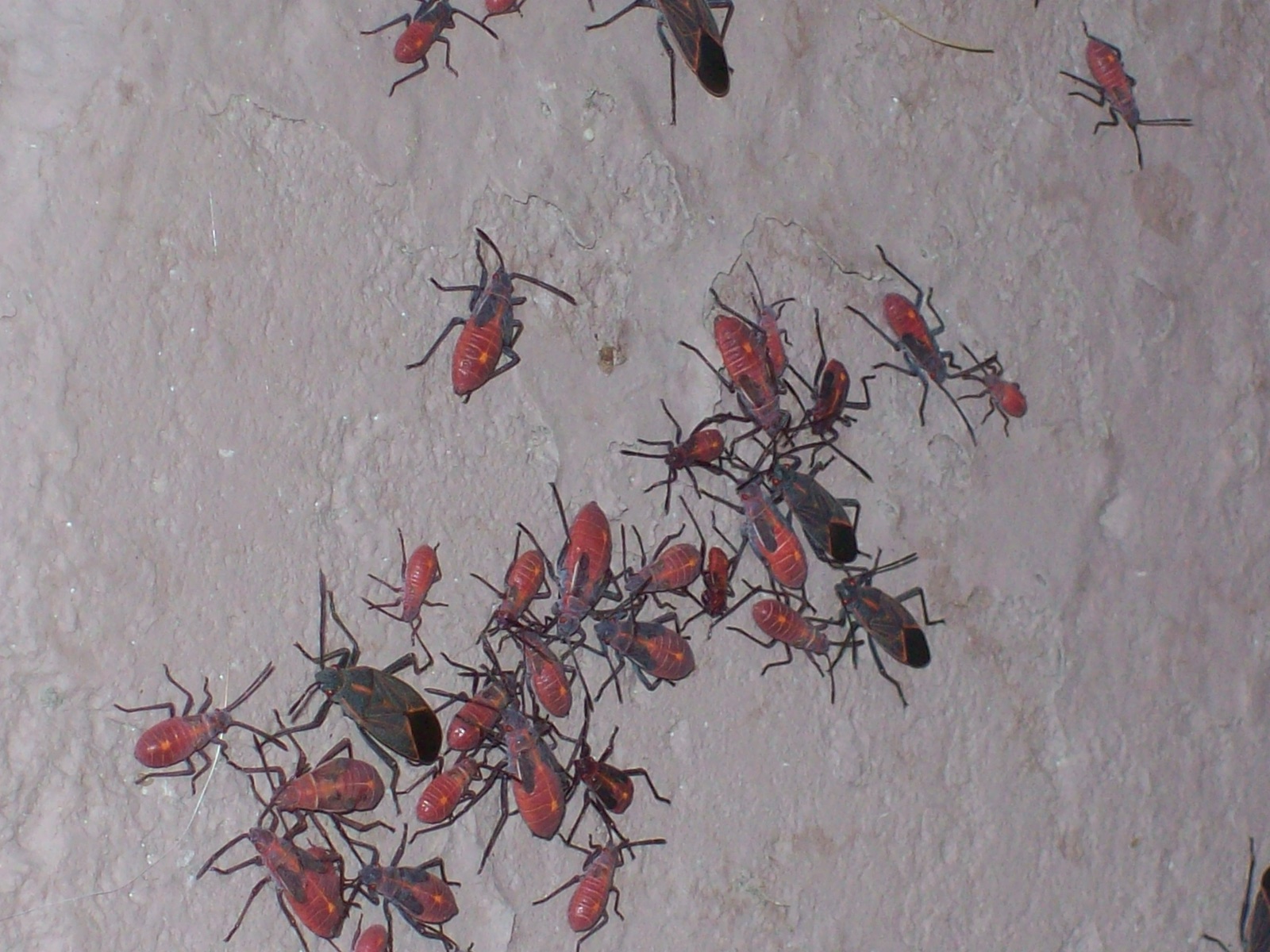
Black with three red lines on the thorax and red edged wings. It feeds on the seeds of female boxelder trees, and on maple and ash, and is drawn to buildings with a large southern or western exposure. Its droppings stain fabric.
Asian lady beetle
Harmonia axyridis
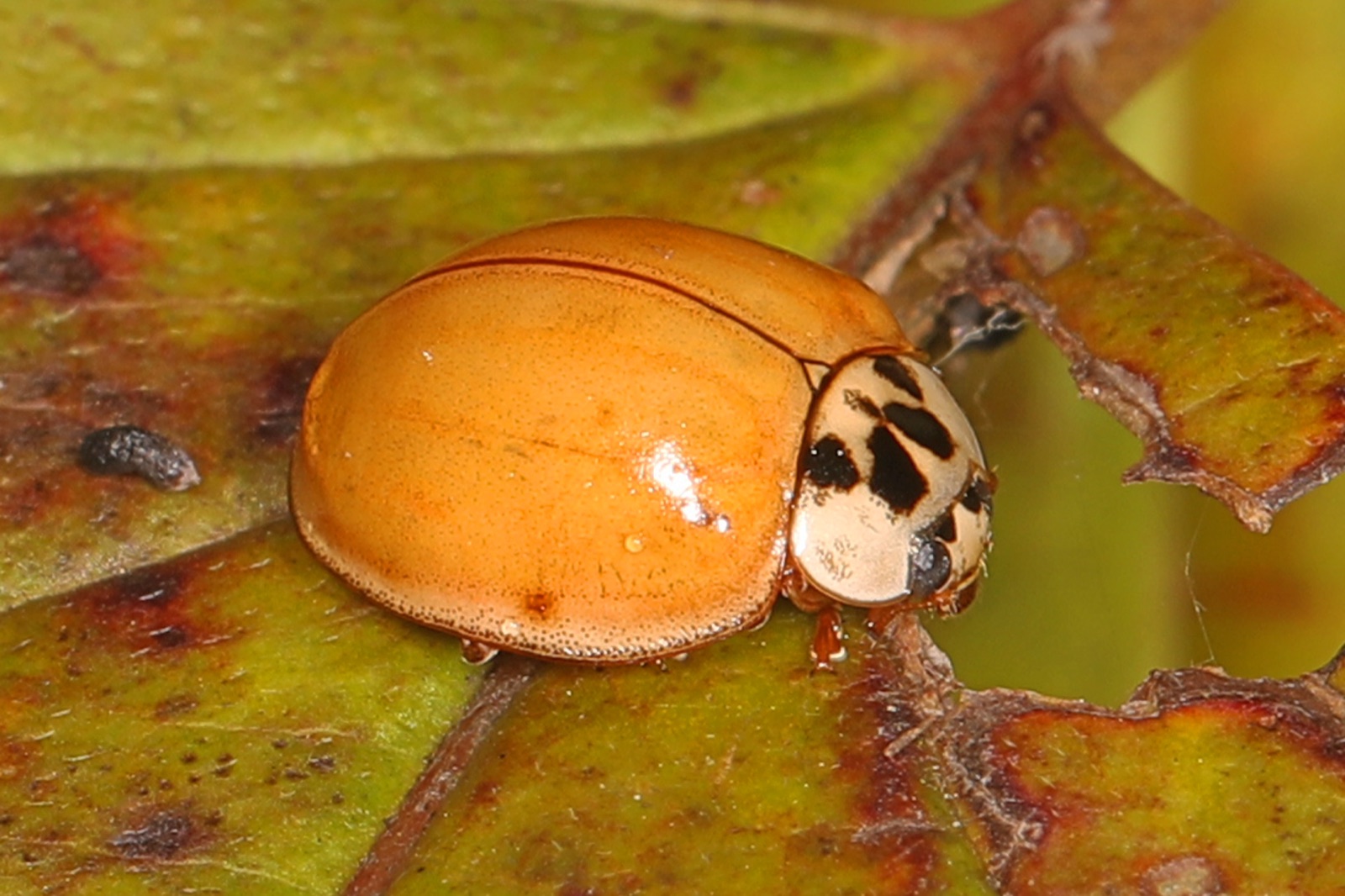
The one people mistake for a ladybug. Anywhere from zero to nineteen spots, pale yellow to deep red, with a white shield behind the head marked with a black M. It can pinch, and it bleeds a yellow staining fluid when handled.
Cluster fly
Pollenia spp.
A slow dark fly with golden hairs on the thorax. Its larvae are parasites of earthworms, so unlike house flies it has nothing to do with waste and carries no disease of medical importance. It overwinters in attics and appears at windows on warm winter days.
Western conifer seed bug
Leptoglossus occidentalis
A long brown bug with flared, leaf shaped hind legs, native to the West and now across the northern states. It feeds on conifer seeds, does not bite, and is the insect most often misreported as a stink bug.
Asian lady beetle or native ladybug?
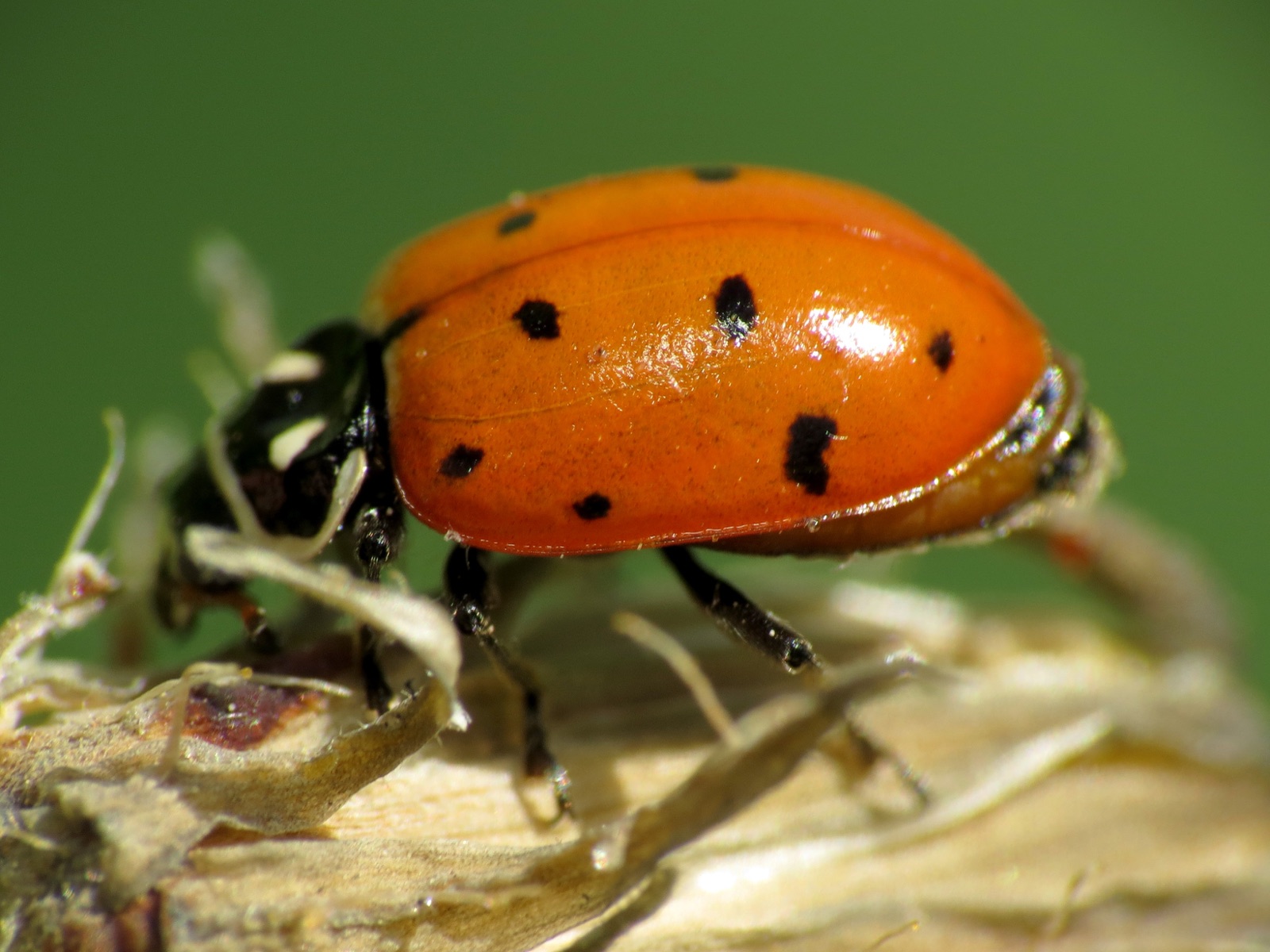
The most searched confusion of the subject, and the answer is never the spots. A single Harmonia axyridis can carry none or nineteen, and the colour runs from pale straw to deep red within one cluster. The identification is the whitish shield behind the head and the black M on it, described by Ohio State Extension as an M or a W depending on which end you look from.
| Asian lady beetle | Native ladybugs | |
|---|---|---|
| Shield behind the head | Whitish with a black M or W | Dark, with pale spots or converging marks |
| Spots | Zero to nineteen, unreliable | Fixed for the species |
| Colour | Yellow through orange to deep red | Consistent within a species |
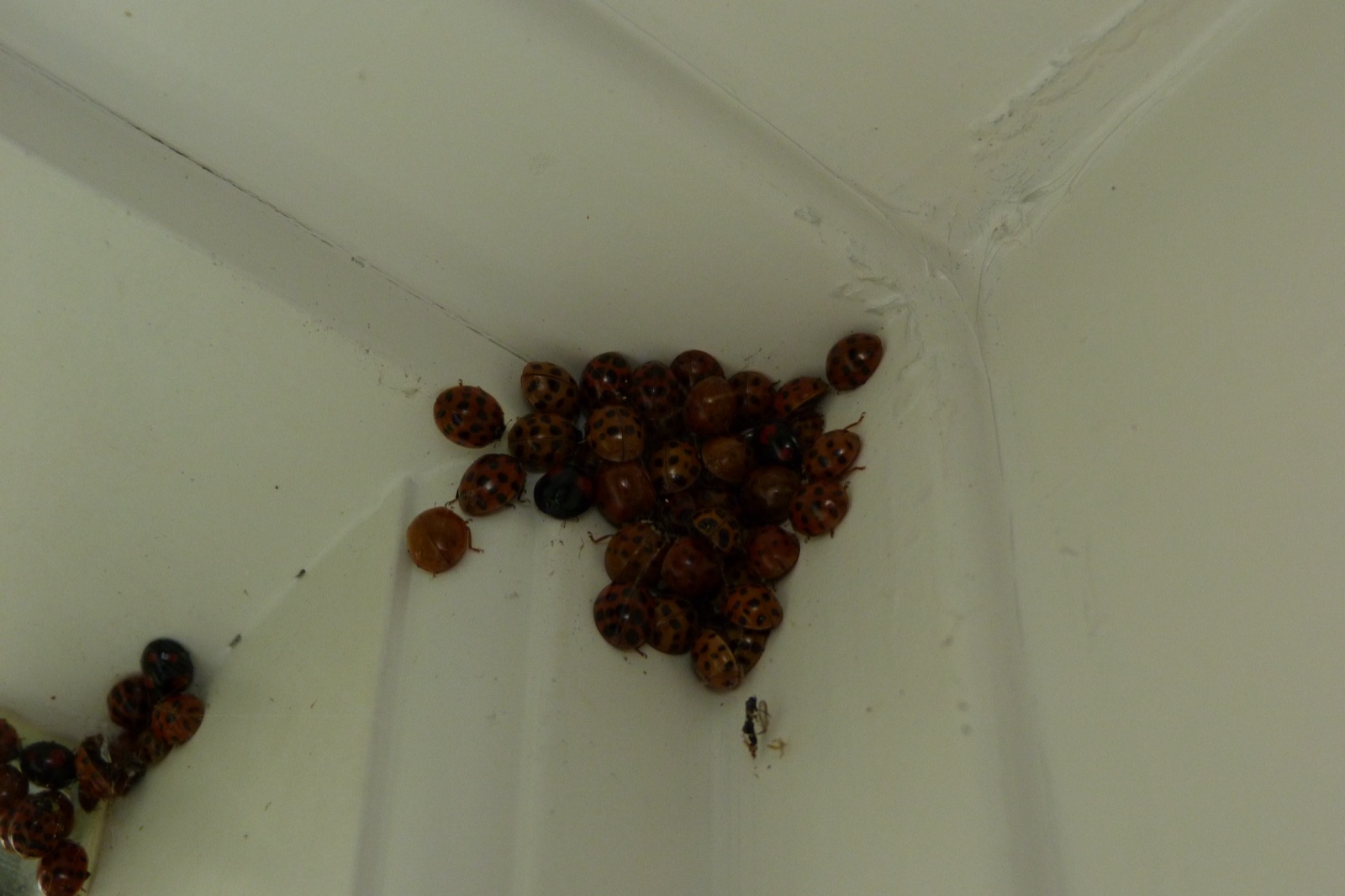
| Autumn behaviour | Aggregates on buildings and moves indoors | Overwinters outdoors, in leaf litter and under bark |
| Bites | Can pinch, and does so readily | Very rarely |
| Reflex bleeding | Yellow fluid from the leg joints, stains permanently | Also bleeds, but rarely in numbers indoors |
How the season runs, nationally
August seal now
Nothing is happening on the walls yet, which is exactly why this is the month that matters. Minnesota Extension puts the boxelder bug sealing deadline before the end of August; New Hampshire puts the general one before early September. Caulk, screen the vents, fit door sweeps.
September massing begins
The northern tier goes first. Brown marmorated stink bugs mass on New England and upper Midwest buildings in the first three weeks; boxelder bugs start about the same time. The mid Atlantic follows late in the month. Nothing is indoors in numbers yet.
October the flights
The heaviest month almost everywhere. Asian lady beetles arrive here rather than in September, on one or two specific afternoons: a cold night, then a mild sunny day. The mid Atlantic, Ohio Valley and Upper South all peak now, and the South follows in the second half.
November the door shuts
The northern half is finished. The Deep South, Texas and interior California are still moving. Once nights are consistently cold, insects still outside do not make it in, and what is inside stops arriving and starts sitting still.
December to February the curtain months
The half of the year everyone actually experiences, and the half nobody writes about. No new insects are arriving. The ones in the walls wake in ones and twos on mild days and walk out toward the light. Vacuum them. Do not spray, and do not squash.
March to April they leave
Above about 63°F the survivors become active and head back outdoors to feed and breed. Some navigate badly and end up in the living room on the way out. A brief second wave of sightings, then it is over until the next autumn.
How to keep them out, and what not to try
Caulk in late summer
Window and door frames, siding joints, utility penetrations, behind chimneys, under the fascia. West Virginia University points at openings of a sixteenth to an eighth of an inch. Silicone or silicone latex, not expanding foam.
Mind the mesh size
Kentucky found ordinary quarter and half inch screening does not stop adult stink bugs, and that about a sixth of an inch or finer is needed. Minnesota notes Asian lady beetles fit through an eighth of an inch.
Door sweeps first
The gap under an exterior door is the most productive entry point in most houses and the cheapest to close. Torn window screens are next: one small tear turns a barrier into a funnel.
Vacuum, never swat
A shop vacuum, or a knee high stocking over the hose end held with a rubber band so nothing reaches the canister. Not a direct fan vacuum, which passes everything through the impeller, and not a bug zapper.
Nothing inside the walls
Penn State, Kentucky, Ohio State, Cornell, Maryland and Minnesota all say the same: do not treat wall voids or attics. Dead insects feed carpet beetles, which then attack woollens and stored dry goods.
Leave the tree alone
Minnesota Extension says removing boxelder trees is not a good way to manage boxelder bugs. They fly a long way, and the tree in your yard is rarely the source of what is on your wall.

Fall home invader FAQ
Biology, exclusion advice and the flight threshold come from published extension and land grant guidance: Penn State Extension, Ohio State University Extension and Ohioline, University of Kentucky Entomology, University of Minnesota Extension, University of Maryland Extension, Cornell and the New York State IPM Program, University of New Hampshire Extension, West Virginia University Extension, Wisconsin Horticulture, and the USDA NIFA funded StopBMSB working group. Allergy findings are from Nakazawa and colleagues, Journal of Allergy and Clinical Immunology, 2007. Entry dates are ours, computed from day length and NOAA 1991 to 2020 first freeze normals, and are climatological typicals rather than a forecast. The weekly panel is modelled in your browser from the National Weather Service gridpoint forecast and is not an official product. Observation counts are research-grade records from iNaturalist, aggregate counts only, no photographs used. Related timing: first frost dates and termite swarm season.
Hero image: “Box Elder bugs” by RedRue, CC BY 3.0