
Fall Home Invaders in Alaska: 2026 Timing
Cluster flies head indoors here around September 20. Seal up by August 13, and see whether this week's weather is moving them.
Inside the Alaska entry window now, main week around September 20The Alaska indoor season at a glance
Computed · checked dailyMedian first freeze September 20, from NOAA 1991 to 2020 normals. Day length here drops through 12.5 hours around September 21.
The StopBMSB working group put Alaska in this category on their map edition of 10 March 2021. It covers the brown marmorated stink bug only.
Research-grade iNaturalist observations of the five species in Alaska, all years. 2 of them are brown marmorated stink bug.
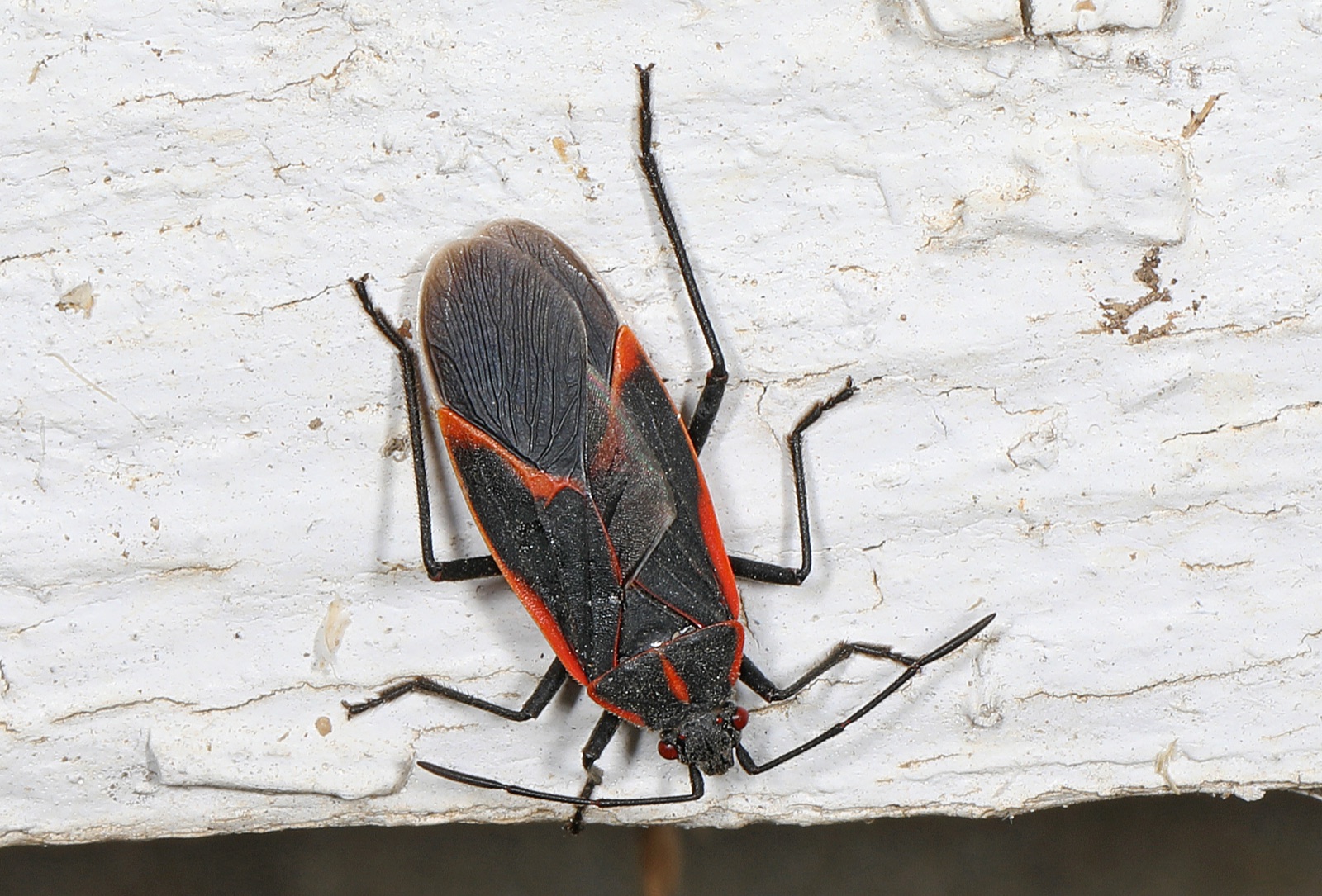
Alaska has no established brown marmorated stink bug, boxelder bug, or Asian lady beetle populations, so the only real fall invader here is the cluster fly.
Is this the week they come in?
The flights happen on specific afternoons, not on a date. Ohio State University Extension describes the trigger for the Asian lady beetle precisely: adults are prompted to look for overwintering sites “on the first day over 64°F after a significant drop in temperature, usually to near freezing.” The University of Kentucky and the University of Minnesota describe the same pattern in the mid 60s.
So we read the National Weather Service gridpoint forecast for Alaska’s three reference cities in your browser and flag every day whose afternoon high reaches 64°F after a night at or below 50°F. The 64°F is Ohio State’s. The 50°F night is ours, our reading of “a significant drop”, and this panel is a model rather than an official product.
What a flight day looks like from the kitchen window
Cold night, then a still, sunny afternoon in the sixties. By two o’clock the sunlit wall is covered. Within a couple of hours the ones that found a gap are inside it, and you will not see them again until a warm day in January.
The Alaska cast
There is not enough evidence to rank the species here. Across all years there are 20 research-grade iNaturalist records of these five species in Alaska, which is too few to say anything useful about which of them is commonest.
Cluster flyPollenia spp.
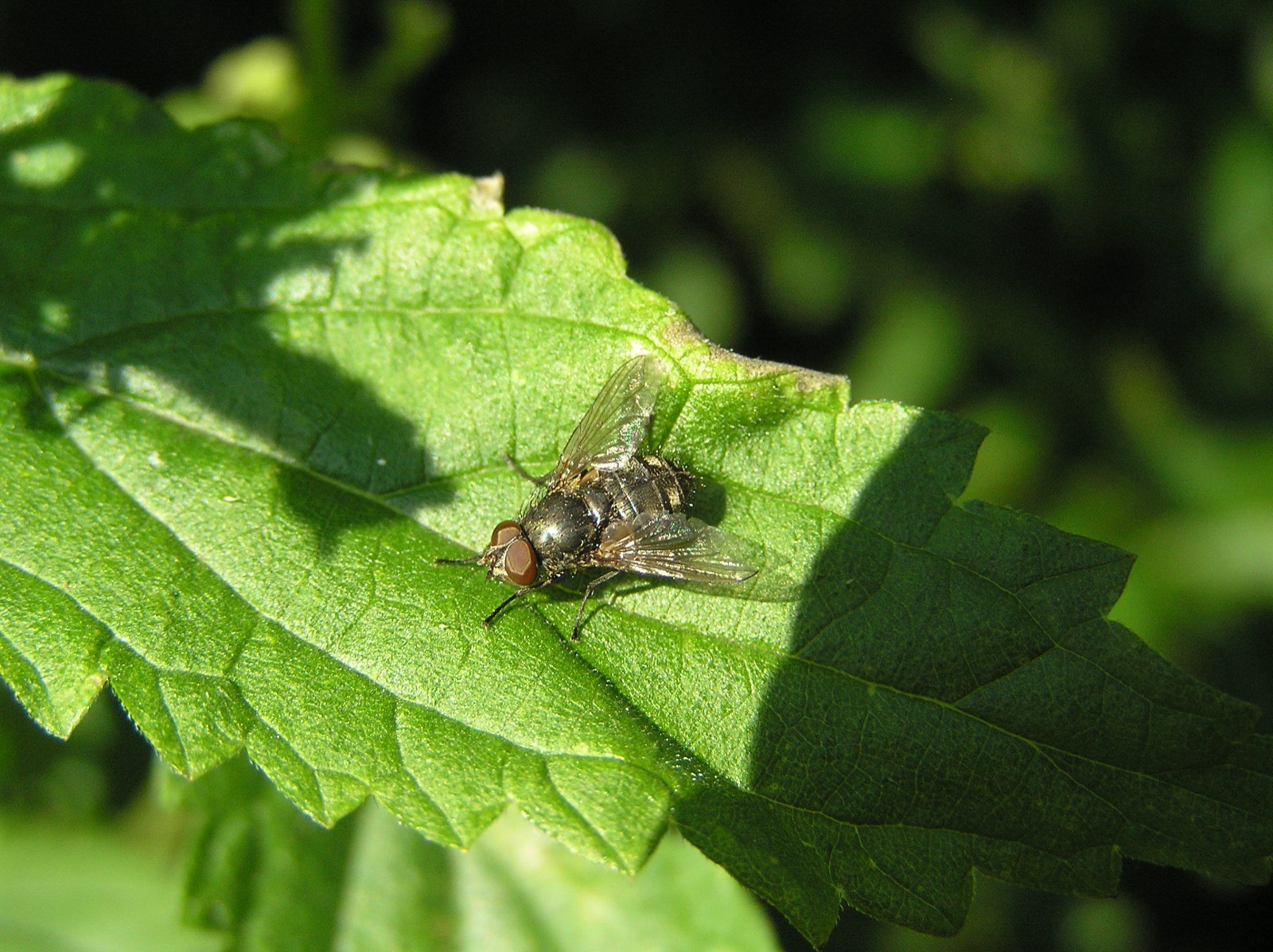
A slow, dark fly a little larger than a house fly, with golden hairs on the thorax. Its larvae are parasites of earthworms, so it has nothing to do with garbage. It is the one that turns up dead on the windowsill in February.
65% of records · 13Where Alaska sits on the national stink bug map
The StopBMSB working group, funded through USDA NIFA, maintains the reference status map for the brown marmorated stink bug. On its most recent edition, dated 10 March 2021, Alaska is in the “Not shaded on the map” category: The state is not shaded in any category on the 2021 map edition.
That map is five years old, and this is where the observation record is useful. There are now 2 research-grade iNaturalist records of the species in Alaska. The two broadly agree.
Why there is one on your curtain in January
Cluster fly sightings outdoors collapse in winter. Verified observations nationally peak in Mar and bottom out in Jan. Nobody is finding one on a plant in January, because there are none on plants in January.
Public attention does not follow that curve. English Wikipedia pageviews for the species peak with the autumn entry, then stay high all winter, at roughly double the midsummer level, at exactly the time outdoor sightings are near zero. That gap is the whole phenomenon: the insects are indoors, being noticed one at a time, by people who have no idea when they got in.
Left axis is not shared. Each curve is scaled to its own maximum, because the two series are in different units and the comparison is between their shapes. Sightings are research-grade iNaturalist observations of Pollenia spp.; lookups are English Wikipedia pageviews for that species article, summed by calendar month over 2016 to 2025, from the Wikimedia pageviews API. Pageviews measure attention, not abundance, and they are not restricted to Alaska or to the United States.
What your house looks like to them
In Alaska the houses that collect them are houses with cold, vented attics in the Southcentral and Interior valleys. The pattern is not random, and for two of the four species the preference is well documented.
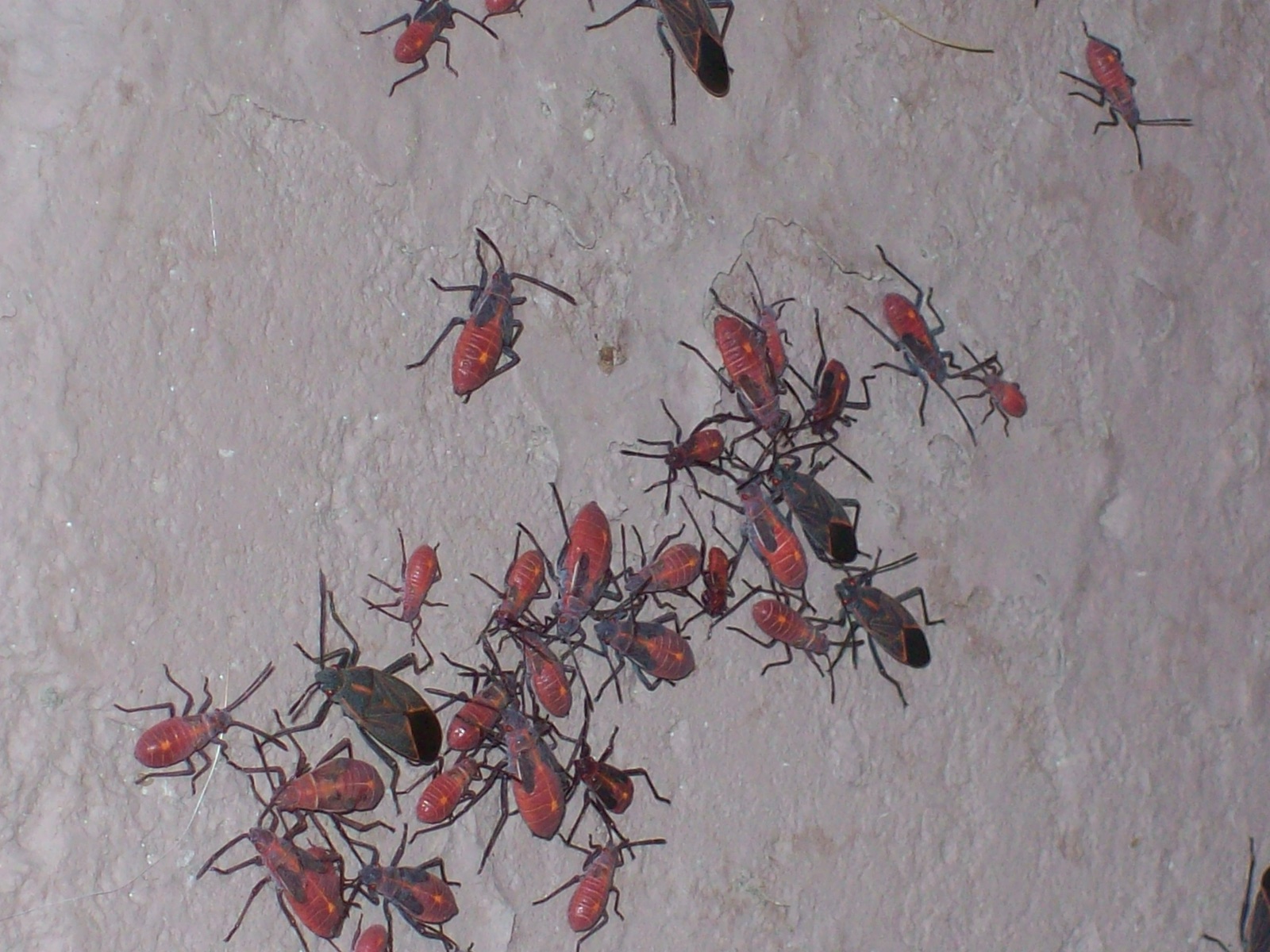
Asian lady beetles and boxelder bugs go for the warm side. The University of Kentucky puts lady beetles on “the sunnier, southwest sides of buildings illuminated by afternoon sun”, and adds that contrasting light and dark features attract them: dark shutters on a light wall, or the reverse. Cornell notes a preference for light coloured, particularly white, houses standing in open fields, and links it to the species’ habit of flying to rock outcrops in its native range. Minnesota says boxelder bugs are drawn to buildings with a large southern or western exposure. Wisconsin says west or southwest.
For the brown marmorated stink bug, the published guidance disagrees with itself, and we would rather say so than pick the version that makes a tidier sentence. The Northeastern IPM Center reports a preference for darker house colours, natural materials such as wood, stone and brick over vinyl, and the north and east sides of buildings. The University of New Hampshire says colour does not seem to matter at all, and that what predicts a bad year is proximity to woodland. If you want the definitive answer, the citizen-science study to read is Hancock and colleagues, 2019, in Agricultural and Forest Entomology.
The practical version of all of this: go outside on a mild afternoon in August and look. Whichever wall they are sitting on is the wall to work on, and that beats any rule of thumb.
Sealing a Alaska house, in order
There is no spray, no trap and no plug in device that solves this. Exclusion does, and only if it is finished before they arrive. In Alaska that deadline is about August 13.
Four things that make it worse
These are not opinions, they are published extension guidance
- Do not spray or dust insecticide into wall voids or the attic. Penn State: “It is not advisable to use an insecticide inside after the insects have gained access to the wall voids or attic areas.” It kills hundreds or thousands of them, and then carpet beetles arrive to feed on the bodies and move on to woollens and stored dry goods. Kentucky, Ohio State, Cornell, Maryland and Minnesota all say the same. Indoor foggers and bug bombs are specifically discouraged.
- Do not squash them indoors. Ohio State’s BYGL puts it plainly: smashing them can do more damage than leaving them alone, because the fluids inside can permanently stain furniture, carpet and walls. Stink bugs add the smell, and Asian lady beetles bleed a yellow fluid from their leg joints that stains.
- Do not seal the house in October and call it done. Caulking after they are already in the voids traps them inside, where they will still find their way into the living space through light fittings and window frames all winter. Seal in late summer, then vacuum through the winter.
- Do not cut down the tree. Minnesota Extension says removing boxelder trees is not a good way to manage boxelder bugs, and spraying them on the outside of the house in spring is unnecessary because they are leaving, not entering. Insects arriving on a wall have often flown a long way to get there.
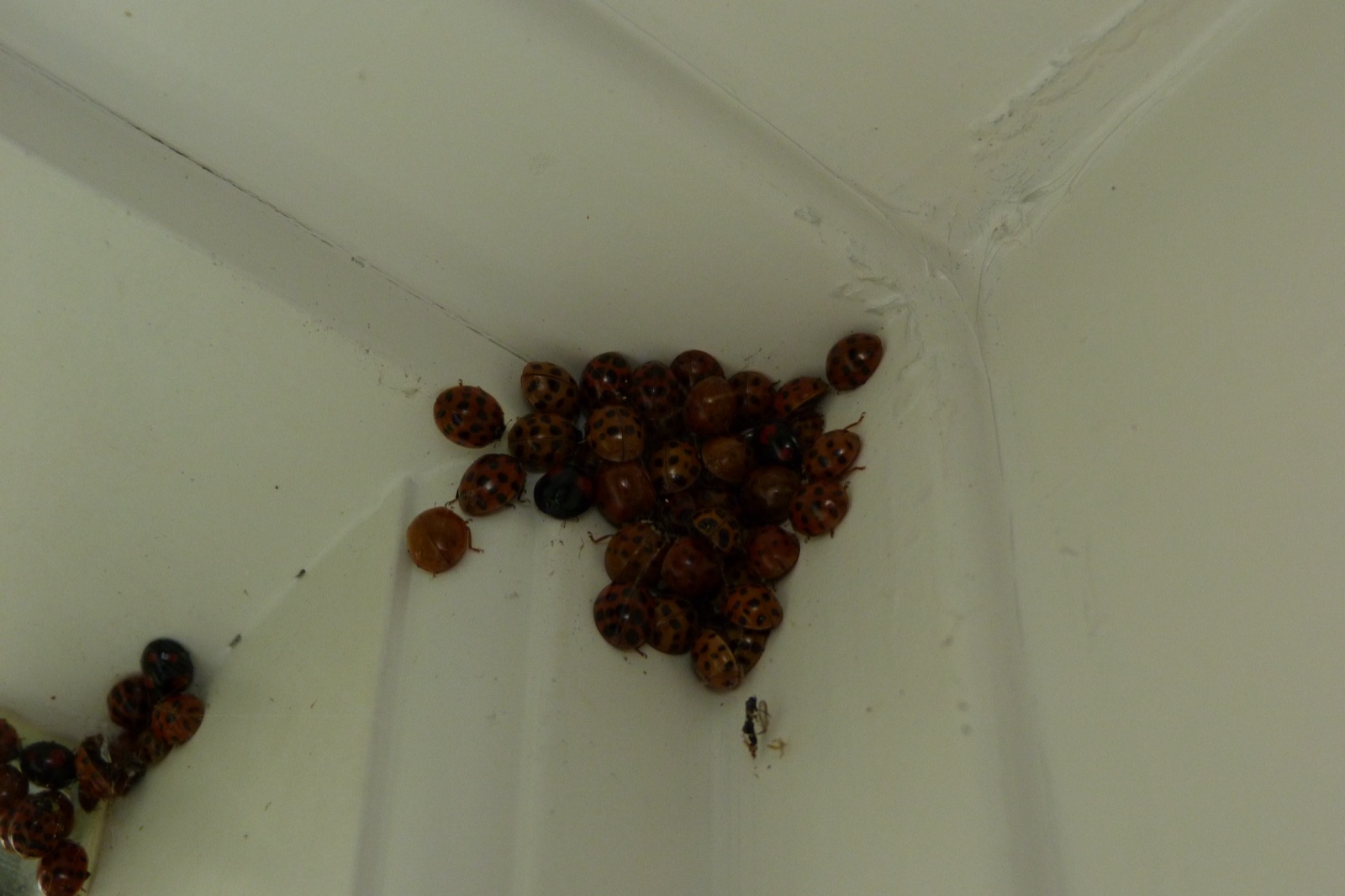
Asian lady beetle or native ladybug?
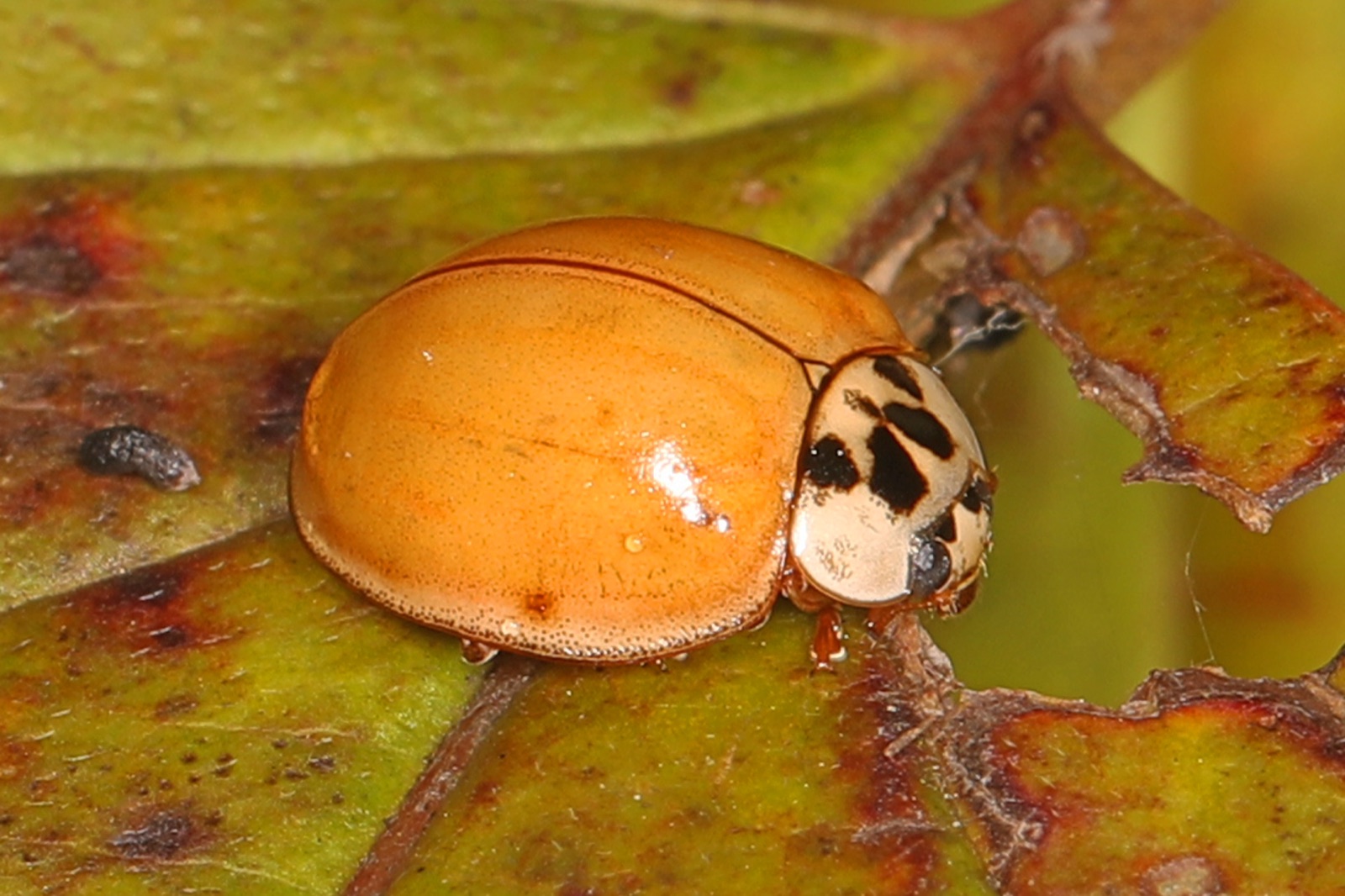
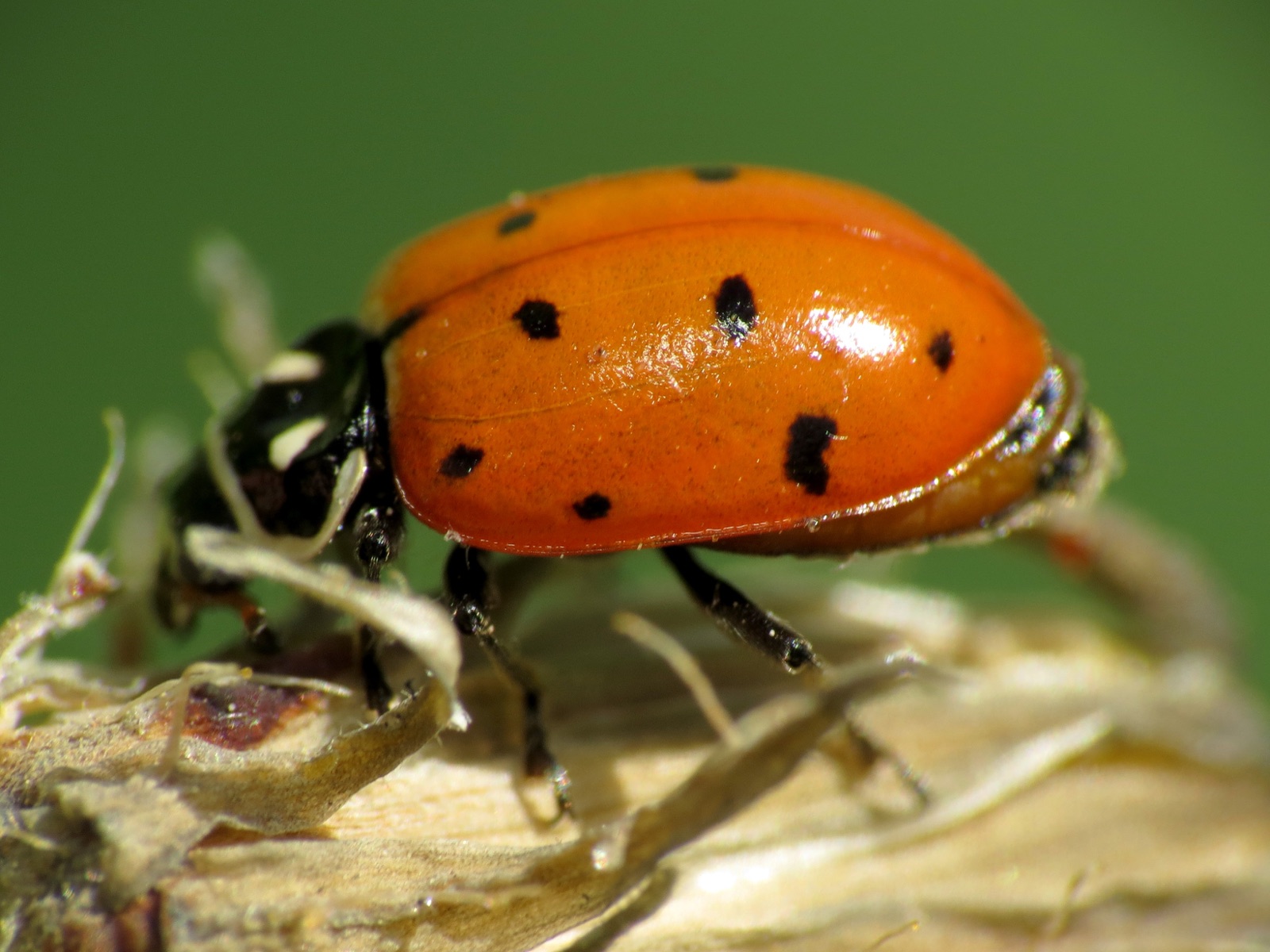
This is the single most common confusion of the whole subject, and the answer is not the spots. One Harmonia axyridis can have none and the next nineteen, and the colour runs from pale straw through orange to deep red. Look behind the head instead.
| Asian lady beetle | Native ladybugs | |
|---|---|---|
| Shield behind the head | Whitish, with a black M, or a W if you look at it the other way up | Dark, often with two pale spots or converging pale marks, never a white field with an M |
| Spots | Zero to nineteen, unreliable | Usually a fixed number for the species: seven for the seven spotted, thirteen for the convergent |
| Colour | Pale yellow to orange to deep red, varies within one cluster | Consistent within a species |
| Size | Slightly larger, noticeably more domed | Slightly smaller and flatter |
| Comes indoors in autumn | Yes, in large aggregations | Rarely, and not in numbers |
| Bites | Can pinch, and does so more readily than native species | Very rarely |
And the brown ones
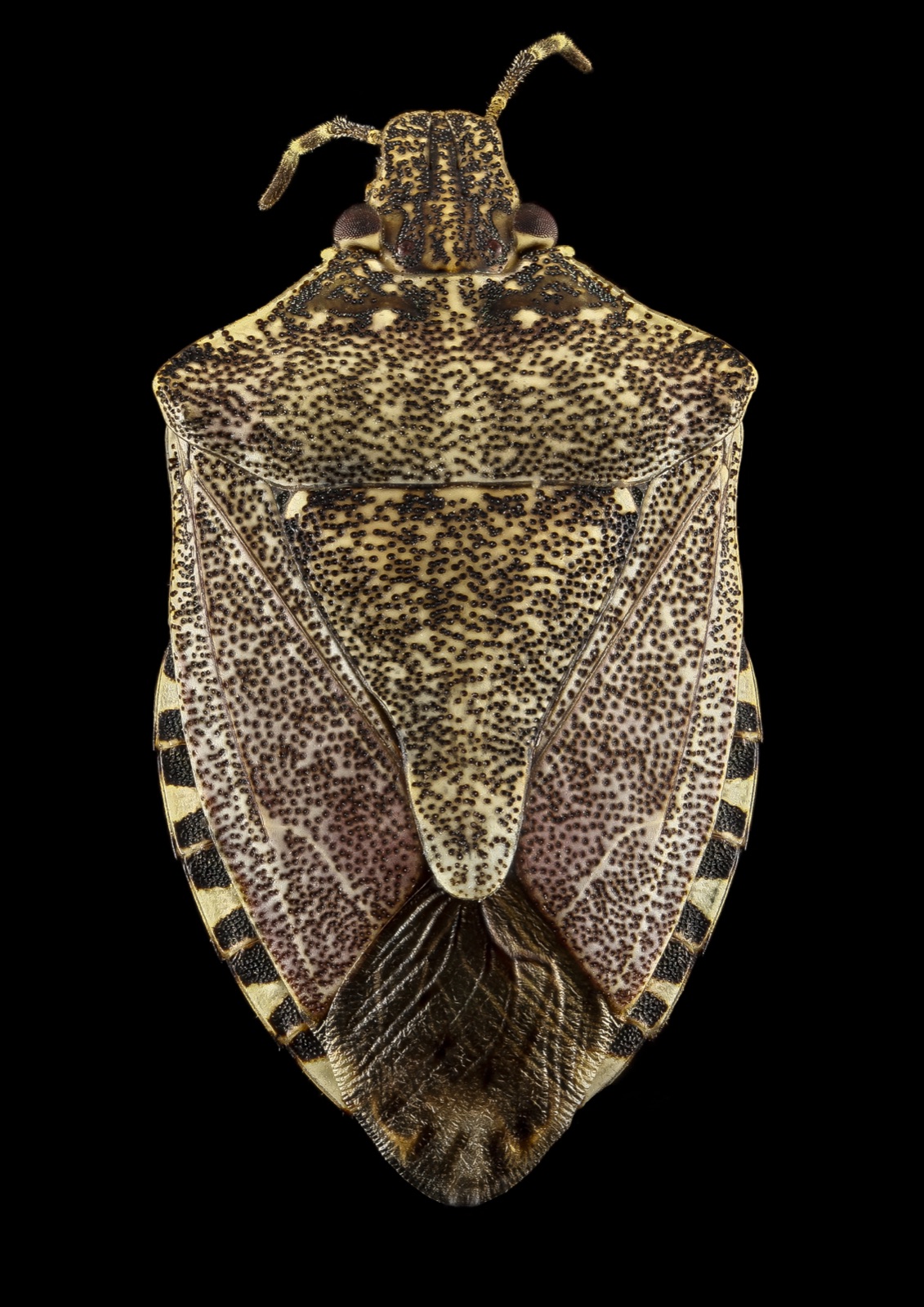
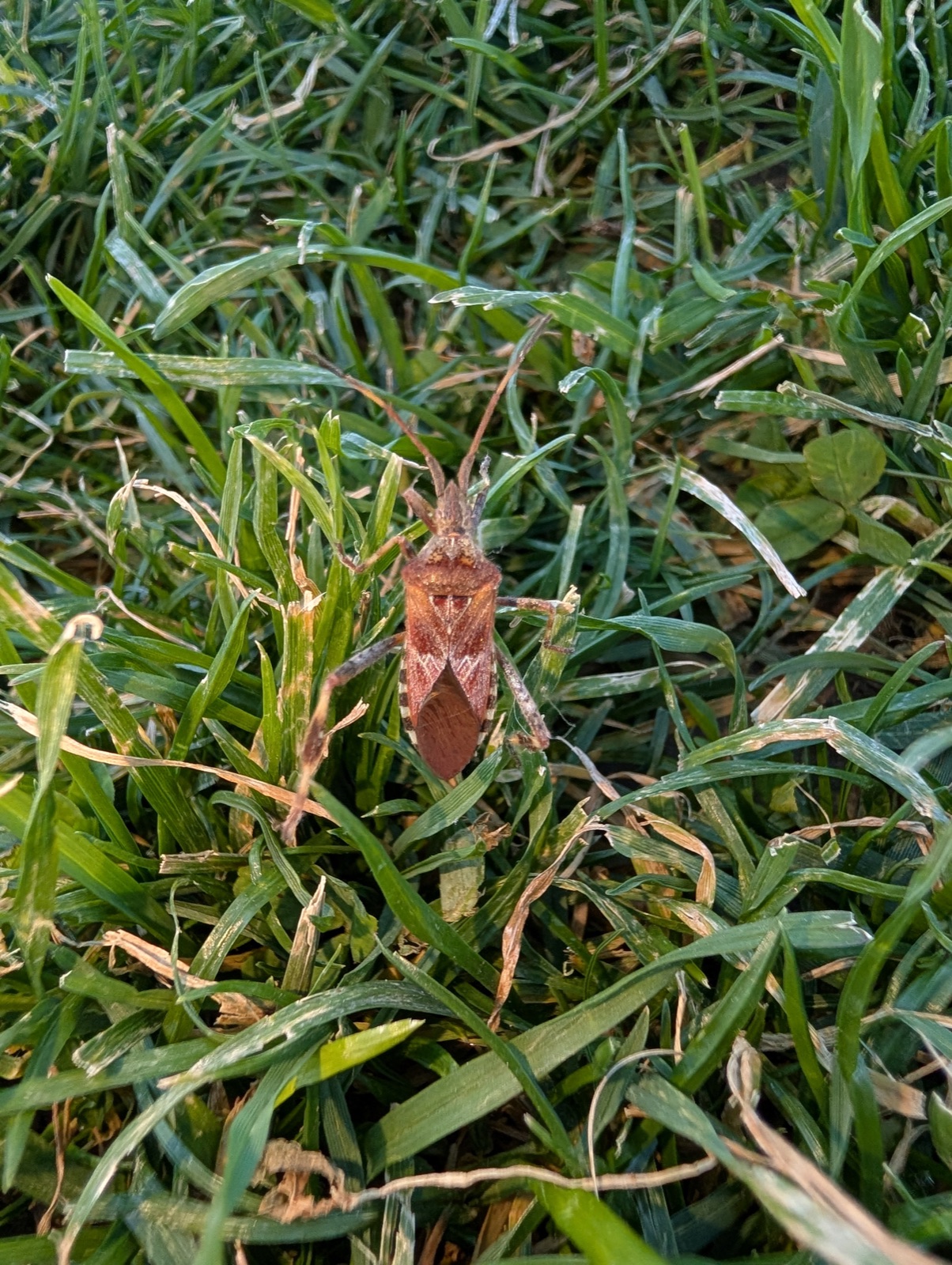
A brown shield shaped bug is a stink bug, but not necessarily the stink bug. The brown marmorated has white bands on its antennae and alternating light and dark bands along the exposed edge of the abdomen. A long brown bug with flattened, leaf shaped hind legs is a western conifer seed bug, which is native, harmless, and by the observation record the commonest autumn nuisance in several northern and western states. Neither bites.
How the Alaska season unfolds
Seal up · by August 13 the only step that works
Exclusion is the whole game, and it only works before they arrive. Every extension service that publishes on this says the same thing: caulk, screen and sweep in late summer, not in October when they are already on the wall. In Alaska that means finishing about two weeks before the insects start massing.
Massing · from August 27 on the walls
They stop feeding and gather on sunlit exterior walls, fences and tree trunks. Nothing is indoors yet. This is the last useful moment to close a gap, and the best time to see which side of your house is the problem: watch where they sit on a mild afternoon.
Main entry week · around September 20 they come in
The heaviest movement into buildings. Brown marmorated stink bugs and boxelder bugs tend to lead; Asian lady beetles come later, in one or two concentrated afternoons. Ohio State Extension describes the lady beetle flight as starting on the first day over 64°F after a sharp drop toward freezing, which is exactly the pattern the forecast panel above looks for.
Stragglers · to October 14 winding down
Numbers on the walls fall away. Anything still outside when it turns properly cold does not make it in. What is already in the wall voids and the attic is now settled for the winter, and no longer arriving from outside.
Winter · December to February the curtain phase
This is when most people go looking for answers, and it is not a new invasion. They are not feeding, not breeding and not multiplying. A warm spell, or simply the heat of the room next to the wall they are in, wakes a few of them up, and those few walk out into the living space toward the light. That is why they show up on the curtain, the lampshade and the TV screen.
Spring exit · around May 4 they leave
Once outdoor temperatures pass roughly 63°F, the survivors become active and head back out to find food and mates. Some get the direction wrong and end up indoors on the way. The StopBMSB working group gives that 63°F figure for brown marmorated stink bug reactivation; the others follow a similar cue.
Today falls inside the Alaska window, between the start of massing and the spring exit.
Alaska fall invader FAQ
The rest of the Alaska calendar
More West fall invader timing
Biology, exclusion advice and the flight threshold on this page come from published extension and land grant guidance: Penn State Extension, Ohio State University Extension and Ohioline, University of Kentucky Entomology, University of Minnesota Extension, University of Maryland Extension, Cornell and the New York State IPM Program, University of New Hampshire Extension, Wisconsin Horticulture, and the USDA NIFA funded StopBMSB working group. The dates are ours: computed from day length at Anchorage and NOAA 1991 to 2020 first freeze normals, and they are climatological typicals rather than a forecast. The weekly panel is modelled in your browser from the National Weather Service gridpoint forecast and is not an official product. Observation counts are research-grade records from iNaturalist, aggregate counts only. National picture: when fall invaders come indoors across the US →
Hero image: “Harmonia axyridis (8104645257)” by Donald Hobern, CC BY 2.0