
Skip to content

Space station, Tiangong and Hubble passes for your ZIP

Satellites Tonight: When to See the Space Station

Enter a ZIP for the next 7 days of visible passes: the minute each one rises, which way to face, how high it climbs, how bright it is and whether the sky should be clear.

Your next pass appears here: the minute it rises, where to look and how bright.

TryNew YorkChicagoHoustonDenverSeattleAtlanta

Behind: the space station over Sedona, Arizona, just after sunset. “Space Station over Sedona” by AlphaTangoBravo / Adam Baker, CC BY 2.0

What the pass list runs on

CelesTrak orbits, checked against Heavens-Above
20
Satellites checked
the two space stations, Hubble and 17 of the brightest from CelesTrak’s visual list
16 of 16
Passes matched
against Heavens-Above for Columbus, Ohio, to within 1.2 seconds
7
Days ahead
every visible pass, morning and evening, with the sky forecast
16
Station orbits a day
NASA’s count; a few cross your sky each week

Before this page went up we ran the engine for Columbus, Ohio and set it beside Heavens-Above’s tables: all 7 visible space station passes from 13 to 18 October 2026 and all 9 visible Tiangong passes from 9 to 14 October, every start, peak and end within about a second, with the same directions and the same peak heights. The orbits are CelesTrak’s, read when you visit, and the sky cover is the National Weather Service forecast.

Tonight

How to spot the space station

The station is the brightest of the 20 satellites in the list: a steady light that crosses from one side of the sky to the other in a few minutes. NASA has it “orbiting Earth about every 90 minutes” and says: “In 24 hours, the space station makes 16 orbits of Earth, traveling through 16 sunrises and sunsets.” Only a few of those orbits cross your sky in the right light each week, which is what the list above finds.

  1. Go out a few minutes early

    Passes come in the hours around dusk and dawn. NASA: “All International Space Station sightings will occur within a few hours before or after sunrise or sunset.”

  2. Face the direction it starts

    The list gives the compass point where each pass begins and its highest point in degrees. “The horizon is at zero degrees, and directly overhead is 90 degrees.”

  3. Look for a steady, fast light

    “The space station appears similar to an airplane or a very bright star moving across the night sky, except it does not have flashing lights or change direction.” It moves fast, too: “airplanes fly at about 600 mph (965 kph); the space station flies at 17,500 mph (28,000 kph).”

  4. Watch it fade

    Many evening passes end in midair, as it slips into the earth’s shadow. “Satellites are only visible when they are lit by the sun, but the observer on the ground is already in darkness.”

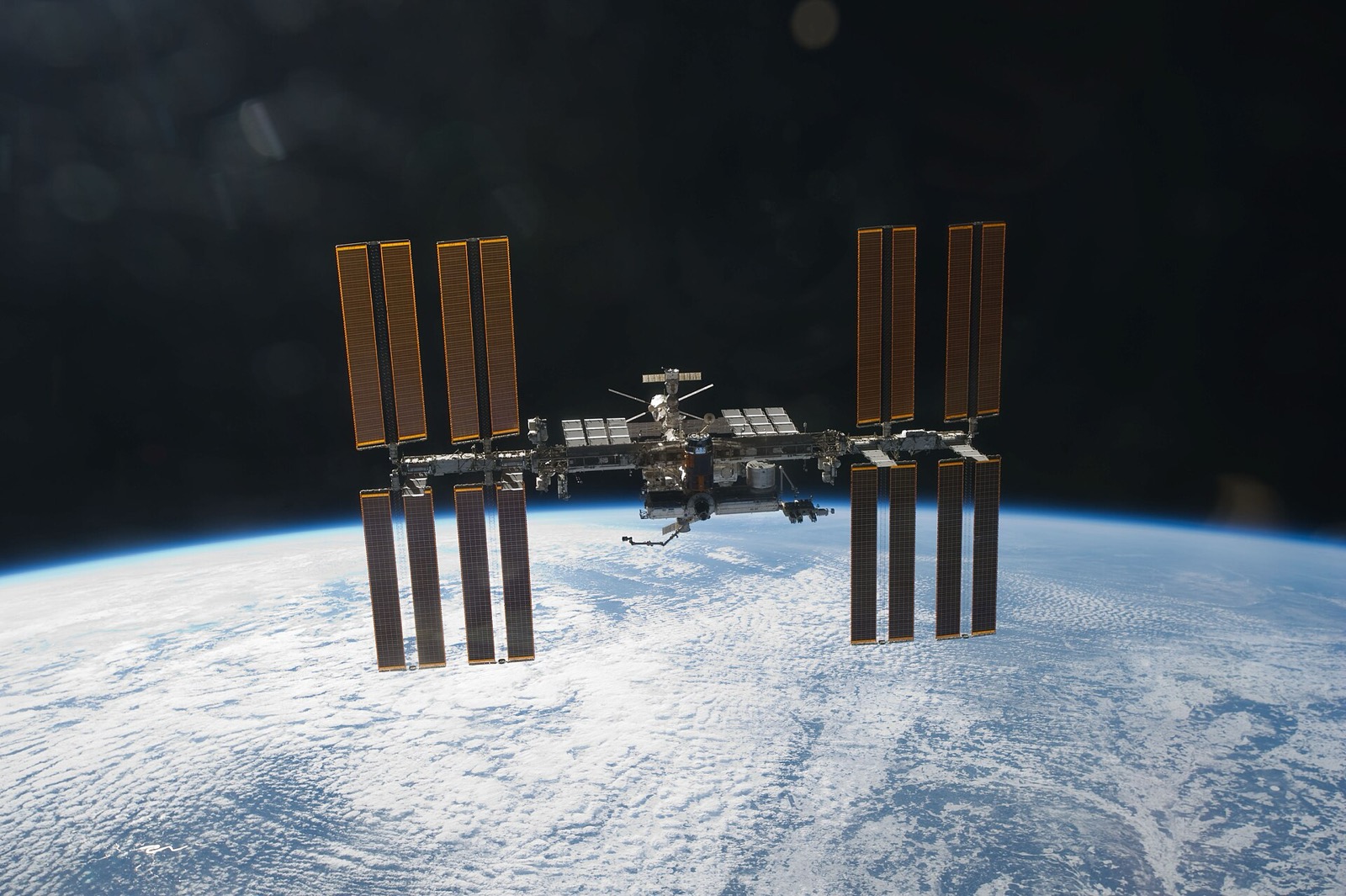
The International Space Station seen from a departing space shuttle, its eight long gold solar wings spread above a white, cloud covered Earth and a black sky
The International Space Station from the shuttle Discovery as the two separated on March 7, 2011. Those wide solar wings are what you see from the ground: NASA notes that the station’s acre of solar panels is why it can be seen at dawn or dusk, "even if you live in a big city." “STS-133 International Space Station after undocking 1”, NASA, Public domain
The other lights

What else is up there

Tiangong, China’s space station

The second station in the list orbits 41.5 degrees to the equator, about 386 km up, against the International Space Station’s 51.6 degrees and 420 km. It is smaller and fainter, but still easy to see: Heavens-Above rates it about 1.8 magnitudes fainter than the ISS at the same distance. With the lower tilt it can pass straight overhead only south of about 41.5 degrees north.
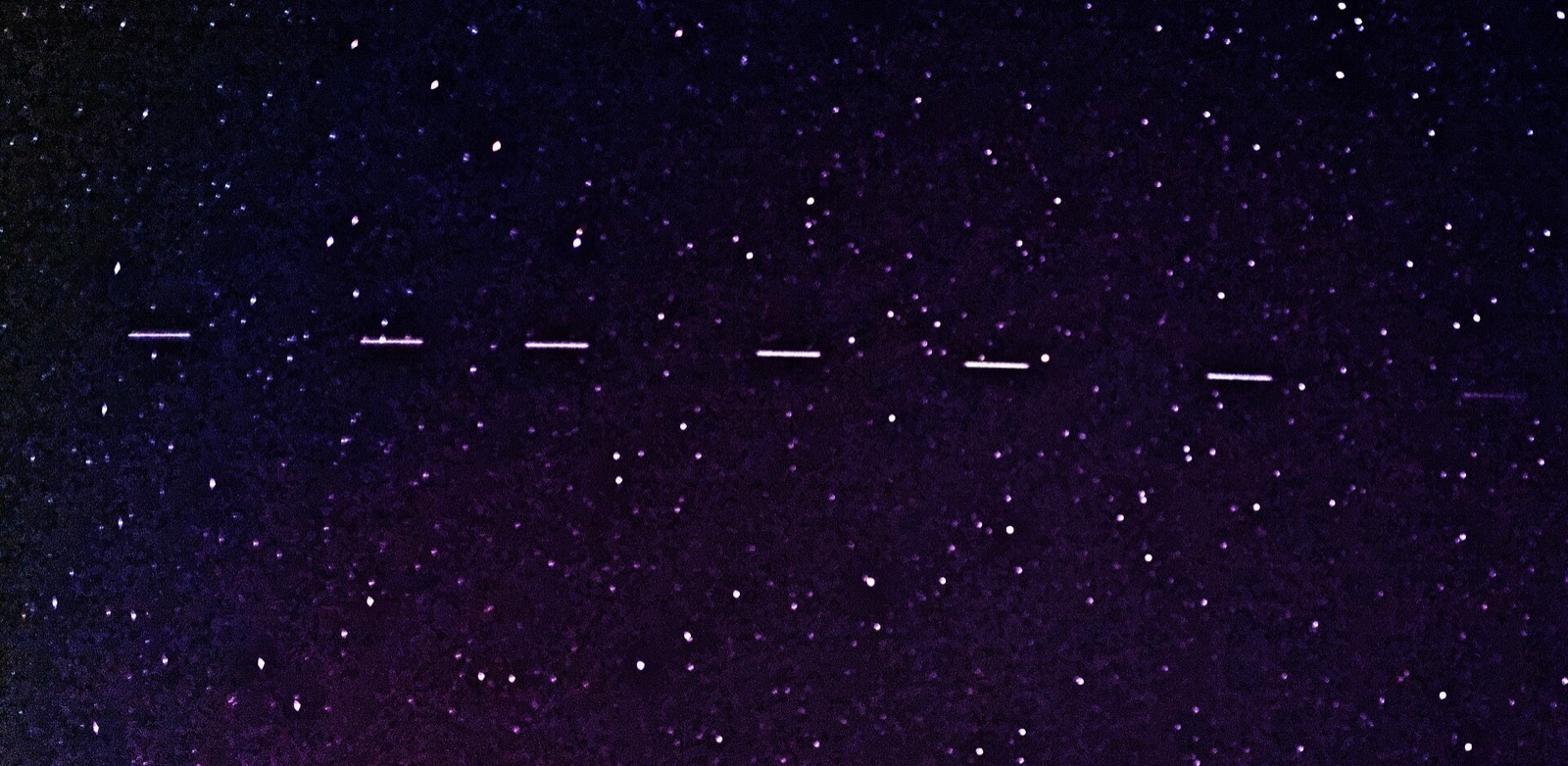
The Hubble Space Telescope

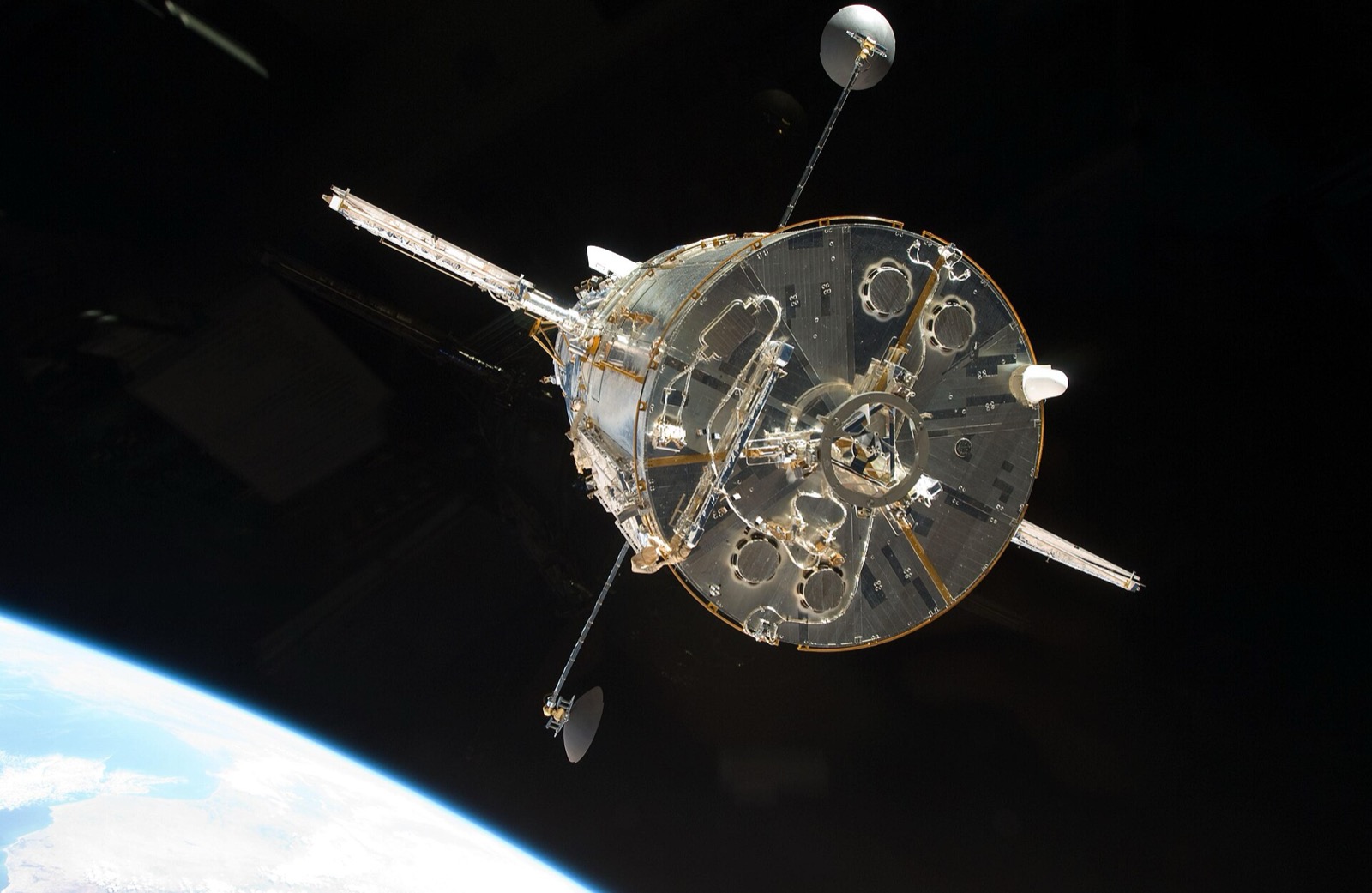
NASA dates Hubble from “its launch and deployment by the space shuttle Discovery in 1990” and gives its orbit as a “Low-Earth Orbit altitude of about 300 miles (261 nautical miles, or 483 km), inclined 28.5 degrees to the equator.” That low tilt keeps it in the southern sky over the northern states, which is why each state page shows how high it gets from three cities. It looks like a faint, steady star moving west to east.

Spent rocket stages

14 of the 20 are rocket bodies, spent upper stages left in orbit, 11 of them SL-16 stages. They are fainter than the stations, so the list keeps them, with ACS3 solar sail, Terra and ADEOS 2, one tap down unless a pass is brighter than magnitude 1.5.

The Hubble Space Telescope, a silver cylinder with antennas and folded solar arrays, floating against black space with the blue curve of Earth at the lower left
Hubble on May 19, 2009, photographed from the shuttle Atlantis as the two separated after the final servicing mission. It orbits about 300 miles up on a path tilted 28.5 degrees to the equator, so it rides low in the southern sky from the northern states and passes high over the South. “Hubble Released 2009”, NASA on The Commons, Public domain
Advertisement

Satellite and space station questions

Sources

Pass times are computed in your browser with the SGP4 orbit model from CelesTrak’s element sets. Brightness and cloud are forecasts and can miss.

Advertisement