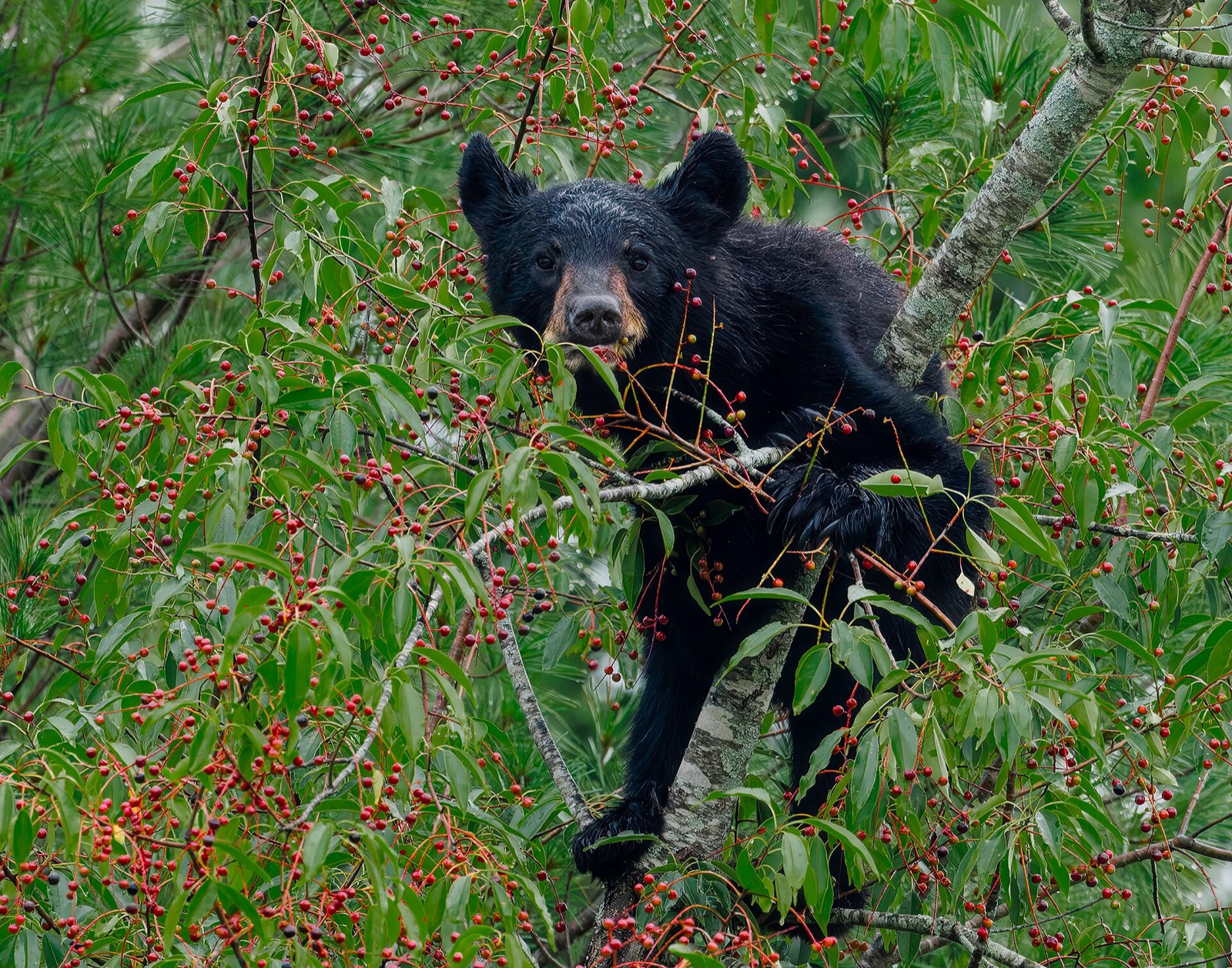
| MaineMaine Department of Inland Fisheries and Wildlife | And during the fall, bears shift to seeking out hard mast like acorns and beechnuts in forested areas, and other available soft mast. They consume around 20,000 calories per day during this period of excess eating (referred to as hyperphagia) in preparation for denning again in the winter. Source | In late fall, cubs enter dens with their mother and enter a state of torpor (lowering their body temperature and slowing their metabolism to conserve energy) and live off of their summer and fall fat reserves. When they emerge from their winter den as yearling bears, they remain with their mother until she goes into estrus in the spring/early summer. Source | Our bears are most active between April 1 and November 1. When natural foods are scarce, especially in the spring or dry summers, bears will venture into backyards and fields in search of easily accessible food such as bird feeders, garbage, grills and pet foods. Source |
| New HampshireNew Hampshire Fish and Game Department | Hard mast -- beechnuts, acorns, and hickory nuts -- are the staple fall food source. When natural foods are not abundant, black bears will seek alternative foods such as agricultural crops, bees from commercial hives, garbage, suet and sometimes livestock. Source | In New Hampshire, bears typically enter dens between mid-October and late November and emerge from dens during late March or early April. During periods of winter thaws, male bears may occasionally get up and move around until cold weather returns. Source | The Granite State's black bears are emerging from their winter dens and beginning to actively search for any available food sources. Because of the limited menu of options during this time of the year, bears will be easily enticed by a wide variety of human-produced food sources, especially bird feeders, backyard poultry, and unsecured garbage. Source |
| VermontVermont Fish and Wildlife Department | By late August, bears seek foods with the highest nutritional value. In an effort to store as much energy as possible, they will eat up to 24 hours a day. If beechnuts and acorns are plentiful, bears will move into productive beech and oak stands and consume high quantities of the nuts. Source | Food supplies are the most critical factor determining when bears den in the fall. When foods are abundant, bears will continue eating throughout the snows of November and into December. When fall foods are scarce, most bears den by mid-November. Source | The Vermont Fish and Wildlife Department is receiving reports of bears coming out of their dens and is urging Vermonters to remove their birdfeeders and take additional steps now to prevent conflicts with bears over the spring and summer. Source |
| MassachusettsMassachusetts Division of Fisheries and Wildlife (MassWildlife) | In summer, they take advantage of ripening berries and can often be found in thick regenerating forest stands where berries are often found. Ripened corn and stands of oak, beech, and hickory trees are favored foods in the fall. Source | Depending on food availability and snow cover, bears will den between mid-November and early December and exit between early March and mid-April. Source | It is not unusual for bears to use residential areas, and they are often attracted to yards by bird feeders and unsecured trash. Bears have excellent long-term memory and can remember the location of food sources years after the first visit. Source |
| ConnecticutConnecticut Department of Energy and Environmental Protection | Mature forests provide soft and hard mast (e.g., acorns) in late summer and fall. Wetlands are particularly important in spring when emerging plants are one of the few available foods. Source | In Connecticut, most bears den from late November through mid-March. Females tend to remain in the den for a longer period of time than males. Source | Black bears are increasingly common in Connecticut. Reports of bear sightings, even in heavily populated residential areas, are on the rise. The Wildlife Division has also seen an increase in the number of reported conflicts with black bears. Source |
| Rhode IslandRhode Island Department of Environmental Management, Division of Fish and Wildlife | Black bears will actively seek out foods high in protein or fat, such as birdseed, pet food, livestock feed and garbage. This leads to larger bears, higher birth rates, and higher cub survival rates. Source | In the northeast, winter denning usually takes place between November and March and females that are pregnant or with cubs enter the den earlier and spend longer periods in the den than males. Source | Young bears either leave or are driven away by their mother in the spring following their second winter. Young male bears, away from their mother for the first time, often travel great distances looking for food and unoccupied territories. These young males often venture into residential backyards looking for food. Source |
| New YorkNew York State Department of Environmental Conservation | In late summer and early fall bears eat assorted berries, jewelweed, choke cherries, black cherries, wild apples, beechnuts, acorns, and crops such as corn. Beechnuts, black cherries and acorns are commonly referred to as hard mast foods. The quantity, quality and distribution of these foods vary tremendously from year to year. Places where food is abundant, such as stands of mast producing trees, will often attract bears from surrounding areas. Source | Bears may den later in the season during a good mast year, unless there is deep snow cover. They also may den earlier in the fall in years with a poor mast crop. Source | Bears will readily utilize human-created food sources and repeat access can make bears bolder. This can lead to an increase in human-bear conflicts around homes and residential areas, especially when natural food sources are scarce. Source |
| New JerseyNew Jersey Department of Environmental Protection Fish and Wildlife | By fall, their diet will consist mostly of hard mast items, such as acorns, beechnuts and hickory nuts. Throughout late summer and fall, black bears need to consume a minimum of 20,000 calories a day to prepare for the winter den season. Source | Black bears begin entering their winter dens in the fall to avoid periods of food shortage and severe weather. Impregnated females typically enter dens first, during the last week in October. Males may not enter dens until December. Source | Black bears actively forage for food in the spring after they emerge from dens and in the fall when they are actively feeding to prepare for the winter den period. Black bears are also very active throughout the summer breeding season. These are the times of year when black bear/human encounters are most common, due to bears searching for food. Source |
| PennsylvaniaPennsylvania Game Commission | In autumn, bears eat heavily to fatten themselves for winter. Source | Bears enter hibernation late in the fall, with pregnant females being the first to enter dens, typically during mid to late November. Males den several weeks later. Onset of hibernation can vary from year to year depending on the availability of fall foods, with poor food years resulting in earlier denning. Source | Bears that become accustomed to people can be attracted into backyards if food is present. Bird feeders, garbage cans and backyard grills all can draw bears. Bears that learn to forage on human-provided foods often become nuisances, causing property damage and increasing the risk of a human-bear encounter. Source |
| MarylandMaryland Department of Natural Resources, Wildlife and Heritage Service | Largely vegetarian, common foods include berries, cherries, other fruits, acorns, beechnuts, hickory nuts, insects, roots, grasses, reptiles, amphibians, and carrion. Acorns remain the single most important natural food for bears in Maryland. As the opportunity arises, bears will also eat garbage, agricultural crops, and bird food. Bears feed heavily during the fall months in order to increase fat reserves for the upcoming winter. Source | Prior to denning, black bears will consume up to 20,000 calories per day and will increase their mass by 30-35%. Black bears are not true hibernators, but they do slow down their heart rate and breathing while denning. Typically, Maryland black bears den in late November through December, pending on the weather. Source | Trash and bird feeders are the most common attractants responsible for luring bears to human dwellings. Pet food, charcoal grills, fruit trees and gardens may also attract bears. Once a bear finds food around your home it will likely return. Source |
| VirginiaVirginia Department of Wildlife Resources | Bears may feed up to 20 hours per day, accumulating fat (energy) prior to winter denning. An adult male can gain over 100 pounds in a few weeks when acorn production is heavy. Source | Depending on weather and food conditions, black bears enter their winter dens between October and January. In Virginia, most bears in mountainous areas den in large, hollow trees. Source | Residential bear problems may occur at any time of year, but are more common when natural food supplies are limited, usually in the spring or in years when natural nut and berry production is low, but human-related foods are available. Source |
| West VirginiaWest Virginia Division of Natural Resources | Bears typically rely on the soft mast of summer (blackberries, raspberries, blueberries) until hard mast (acorns, hickory nuts, beech nuts) is available in the fall. Source | While they do spend most of the winter sleeping, they never enter true hibernation, which requires an animal to depress its metabolic rate, body temperature and breathing. Still, bears and their cubs emerge from their dens in the early spring. Source | Bears prefer natural food when it is available, which is why nuisance activity usually subsides in the fall. Source |
| North CarolinaNorth Carolina Wildlife Resources Commission | Bears put on additional weight in autumn to prepare for winter denning. Source | In North Carolina, den entry can occur as early as November or as late as January, though male bears in the coastal plain region may be active throughout the winter. Source | Reports of bear sightings spike from Memorial Day weekend through early summer. Source |
| South CarolinaSouth Carolina Department of Natural Resources | Finally, late fall marks the time when bears are searching for food to create fat stores to last them through the winter. Source | Gestation is 235 days and cubs are born in January or February while the female is hibernating. Source | Most bear problems in residential areas are temporary and usually occur in the spring, summer, and late fall months. Source |
| GeorgiaGeorgia Department of Natural Resources, Wildlife Resources Division | Bears in the southern Appalachians rely heavily on oak acorns to build fat reserves prior to the winter denning season. Understanding fall mast crops, which are highly variable from year to year, helps to predict where hunters are more likely to find bears during the hunting season. Source | Bears in Georgia use hollow trees, excavated holes in the ground, brush piles, rock crevices or other places that offer protection as winter dens. The breeding season is in July and cubs are born in the den in late January or February. Source | Removing attractants is critical in resolving conflicts between people and bears. It may take several days for the bear to learn that it will no longer find a free meal. Usually, the bear will move on when the food source is gone. Source |
| FloridaFlorida Fish and Wildlife Conservation Commission | But as fall begins bears start preparing for winter by going through a process of increased feeding called hyperphagia. Source | In Florida, while males and females that are not pregnant may den in dense vegetation for only a few weeks or a month, pregnant females must den for the winter to have cubs. Source | Any accessible food source, such as unsecured garbage, pet food or bird seed, can be enticing to a hungry bear preparing for the winter, potentially drawing them into conflict with people. Source |
| AlabamaAlabama Department of Conservation and Natural Resources, Wildlife and Freshwater Fisheries Division | In the colder regions, black bears attempt to put on as much fat as possible to sustain them through hibernation. Source | The bears have put on the fat for the winter and rarely travel far from the den area until spring. Source | During the spring and summer months, adult males increase their ranges dramatically in search of receptive females and young subadult bears are dispersing from their mothers territory. These two situations will most likely be responsible for the majority of sightings during this time of the year. Source |
| TennesseeTennessee Wildlife Resources Agency | Although listed as a carnivore, black bears are primarily omnivorous feeding on seasonally abundant foods. Bear diets include berries, fruits, nuts, insects, roots, grasses, small rodents, bird eggs and carrion. Acorns comprise much of and are a significant food source in the late season diet of black bears in Tennessee. Bears, like many other wild animals, are opportunistic and look for effortless calories. Source | Denning starts as early as November and ends as late as May. Females tend to begin hibernation earlier than males. In years of high mast production, bears can enter dens later. Source | The expansion of human-populated areas has resulted in an increase in bear sightings around people. A bear being in an area is not a cause for alarm, but proper measures should be taken to reduce the risk of bears lingering due to attractants. The best approach to prevent unwanted bear encounters is to secure attractants that bring bears near homes and populated areas. Source |
| KentuckyKentucky Department of Fish and Wildlife Resources | Deer, bears, wild turkeys, ruffed grouse, squirrels, small mammals, and other species depend on nutritious hard mast to bulk up before winter and for sustenance during winter when few other foods are available. Animal movement in fall and winter is related to the availability of high-energy hard mast foods. In years when little to no mast is available from oaks, hickories, or beech trees, wildlife may move more often and/or greater distances in search of limited food supplies. Source | Black bears typically den during the winter months and emerge in late March or early April. When they come out of their dens, natural food sources are scarce, which often leads bears to be attracted by the smell of human-related foods. Source | In many areas of Kentucky, it is fairly common for bears to be near human dwellings. Bears have an incredible sense of smell and are likely being lured by some type of food attractant. These attractants typically include garbage, birdfeeders and pet food. The best thing to do is identify the attractant and remove the source. Source |
| OhioOhio Department of Natural Resources, Division of Wildlife | Bears are omnivores, meaning they will eat a wide variety of foods. Depending on the season, their diet may include grasses, forbs, berries, mast from oak, hickory, and beech trees, carrion, and insect larvae. Bears will also consume agricultural crops, if available. Source | Typically, cubs weigh between 25 and 65 pounds by September and may, provided high quality food is readily available, weigh nearly 70-80 pounds by the time they enter the overwinter den with the sow in early November. Source | The Ohio Division of Wildlife does not relocate bears just because one is present in an area. Bears live in Ohio year round. They will continue to come back to a location if food sources are available to them. Source |
| MichiganMichigan Department of Natural Resources | Greatly increase food consumption during fall to prepare their body for winter. Source | Female black bears typically produce offspring every two years, giving birth to two to three cubs in January or February while still in their winter dens. Black bear cubs typically stay with their mother for 16-18 months. Source | Eliminating access to food and other attractants is the most effective method for reducing bear problems. Bears have an excellent memory of where food occurs and may teach their cubs to frequent those locations too. Source |
| WisconsinWisconsin Department of Natural Resources | Black bears' diet follows the seasons. These seasonal foods include forbs and grasses in spring, berries and insect colonies in summer, and apples and acorns in fall. Source | Most bears enter their dens sometime in October and emerge in late March or early April. Den sites may be in rock outcroppings, hollow logs or stumps, excavated holes in the ground or in exposed "nests" above ground. Source | Black bears are commonly found in Wisconsin's hardwood and conifer forests, where they eat plants, insects, berries and nuts. When these natural food sources become scarce or overlap with human food sources such as bird feeders and trash cans, conflict can occur. Source |
| MinnesotaMinnesota Department of Natural Resources | Bears often roam long distances in the fall, looking for food-rich areas (especially acorns) where they can fatten for winter. Source | The fertilized egg implants in November and the cubs are usually born in January, while the mother is denning. They leave the den usually in early April and remain with the mother for 17 months, hibernating with her when they are 1 year old. Source | Conflicts between people and bears have increased as more people build homes and cabins and recreate in northern and central Minnesota. Conflicts can arise when bears interact with domestic pets, tip over garbage cans, or damage bird feeders, personal property, beehives, livestock and agricultural crops. Source |
| MississippiMississippi Department of Wildlife, Fisheries, and Parks | Hard mast species are vital in the fall, as this is the time of year bears exhibit their most weight gain in preparation for the winter. Hard mast is rich in fat and carbohydrates and is vital for bears in producing fat reserves that will ensure the bears enter the denning period in good health. Source | Mississippi black bears typically have a shorter denning period and show greater winter activity than in other regions. This shorter duration is believed to be a function of greater food availability during winter months. Pregnant females typically will be the first to den, followed by females with young from that year, solitary females, and finally males. Source | Black bear sightings in Mississippi have been on the rise in the last few years, especially during the early summer when yearling bears are dispersing to establish a home range and breeding season for the adult bears occurs. Source |
| LouisianaLouisiana Department of Wildlife and Fisheries | During autumn (September–November), black bears enter a period of hyperphagia, often quadrupling their caloric intake to create a fat reserve in preparation for winter when food is scarce. Source | Louisiana black bears enter dens between November and early January, depending on latitude, food availability, gender, age, reproductive status, and climatic conditions (Weaver 1990, Hightower et al. 2002). Adult female bears that are expected to give birth to cubs generally enter dens first, followed by adult females with yearlings, female subadults, male subadults, and finally adult males (Pelton 2003). Source | Property damage, for instance, is reported annually with peak damage reports occurring during the fall when bears exhibit wide-ranging movements in search of food (U.S. Geological Survey et al. 2014). The majority of damage complaints have been by hunters that use game feeders or ATVs. Source |
| ArkansasArkansas Game and Fish Commission | They don't have a rut during the fall like deer, but are about to go into their den cycle so they're focused on one thing – eating." Means will help hunters use this knowledge to increase their chances of harvesting a bear, with tactics developed for private and public land hunters. "We'll cover baiting sites and how to pattern bears on private land," Means said. "But we'll also cover public land hunting, where baiting is not allowed." Finding bears on public land still revolves around finding food sources, but it requires much more work in scouting. Means says if acorns and other foods are plentiful, the bears will not need to move much to eat. During low mast years, they'll move more and focus harder on particular trees that may still be producing acorns. Source | Black bears emerge from their winter dens beginning in late March in Arkansas. When they do, they do what bears do best: look for food. Source | "Most of the calls we get about bears getting too close to towns and cities come during a few months in summer and they're almost always young males," Myron Means, large carnivore program coordinator for the Arkansas Game and Fish Commission, said. "They've overwintered with their mother twice and now it's time for them to find new homes." Source |
| TexasTexas Parks and Wildlife Department | Black bears are native to Texas and part of the state's natural heritage and ecosystem. Guided by an excellent sense of smell, their behavior is driven largely by appetite. Fall provides their last opportunity to feast before denning up for the winter. Source | Denning can start as early as November and continue until late May. Bears den in large, hollow trees, brush piles, thickets, rock crevices and caves. Denning bears go into a deep sleep but can be aroused if disturbed. Source | There are no resident populations of black bears in East Texas, and TPWD has not and does not stock bears in East Texas. However, all of our neighboring states have established breeding populations of bears. This time of year, young bears are leaving their mothers and may end up in unusual places. Source |
| OklahomaOklahoma Department of Wildlife Conservation | In September, acorns start to ripen and become the main source of food, when available. Where acorns are abundant, bears feed and fatten on them in preparation for hibernation. Source | Bears in Oklahoma start searching for dens in early October, and most have denned by late December. They spend the winter in dens located in rock crevices, in underground burrows, under tree roots, in hollow trees, in brush piles, or simply on open-ground beds. Source | May is typically when bear reports begin coming in. These reports are weighted toward yearling, male bears that have just been kicked away from their mom and are trying to avoid mature males, find their own home range, and keep their bellies full too. June & July may see a small drop in the number of calls because natural soft mast like blueberries & blackberries is becoming abundant. August is typically a high month for reports as soft mast sources diminish and grasses and other vegetation dry out or become unpalatable. Source |
| MissouriMissouri Department of Conservation | "Black bears are super-focused on finding food in the fall," said Bowersock. "The quest for calories keeps bears active and foraging up to 20 hours a day. When the eating is good, a bear can put on two to three pounds a day. By hibernation time, many bears will have added about four inches of fat and gained between 20% and 50% of their summer body weight." This annual feeding frenzy is called "hyperphagia" and is driven by bears' ticking biological clocks counting down to hibernation, when most bears in colder climates retire for the winter and live off the fat they're working so hard now to accumulate. Source | After this developmental hiatus (called delayed implantation), the eggs continue development about the time that bears enter hibernation, in October or November. Young are born in late January or February — while the mother is still hibernating. Black bears have 1 to 4 cubs a year, but the average is 2 cubs. Winter inactivity usually extends into April, when bears leave their winter quarters and feed heavily. Source | In the early spring, they emerge from their dens very hungry at a time when natural foods are scarce. Spring is also when family groups break up and breeding season begins. Most of the black bears that cause nuisance problems in Missouri are yearling males that have been driven away by their mother, or threatened or attacked by older males. In their search for food, these young males often come into contact with humans and cause problems. Source |
| North DakotaNorth Dakota Game and Fish Department | Not stated on the agency pages read | Not stated on the agency pages read | Black bears are seldom aggressive and rarely injure people, however there are some basic steps you should take to avoid dangerous interactions with bears. Source |
| MontanaMontana Fish, Wildlife & Parks | During the fall, they eat more than usual to gain body fat to sustain them through their winter "hibernation," which is not a true hibernation, but rather a deep sleep from which they can awaken quickly. When food is abundant, they will eat up to 45 lbs. a day and put on 5 lbs. per day in preparation for winter. Source | Bears den in winter due to a seasonal shortage of food, low environmental temperatures, and snow cover on the ground. In Montana, bears typically den for 5 to 6 months during wintertime (approximately November-March). Bears begin emerging from their dens in springtime, typically March-April. Source | Bears are curious, and food driven. Feeding bears puts people and bears at risk. Securing attractants will greatly reduce the chances of a conflict with a bear. Source |
| WyomingWyoming Game and Fish Department | Bears are currently entering hyperphagia, a biologically-driven period in late summer and fall where they begin to forage and build fat reserves for winter. Source | Bears begin to emerge from their dens as early as March, groggily in search of spring's early green grasses and winter-killed ungulates to eat. Source | Commonly reported conflict areas include Story, Big Horn, Dayton, the outskirts of Buffalo and Sheridan, but residents throughout northeast Wyoming should secure attractants now through November. Source |
| ColoradoColorado Parks and Wildlife | In the fall, bears enter a period of compulsive overeating (hyperphagia). They start feeding for 22 hours a day to gain the 20,000 calories a day they need to survive hibernation. Source | Most Colorado bears are active from mid-March through early November. Source | In late summer through fall hyperphagia, bears will eat up to 20,000 calories per day to sustain themselves through the winter torpor period. CPW receives the most sightings and conflict reports during this time because bears are more active and visible in human spaces. Source |
| New MexicoNew Mexico Department of Wildlife | They eat a great deal of acorns, pinon nuts and juniper berries in the fall to store fat for the approaching winter. Source | A pregnant female bear will begin hibernation around mid-October, give birth to her cubs in the den around January or February, and will remain there until about mid-April, ending hibernation weeks later than males or females without newborn cubs. Source | During drought conditions, as many as 25 sub-adult bears have wandered into Albuquerque and surrounding communities in late summer and fall in search of food. Source |
| WashingtonWashington Department of Fish and Wildlife | When preparing for hibernation in the fall and after waking in the spring, bears look for high-calorie, easy-to-find food sources. Source | Black bears are beginning to emerge from winter dens across the state, prompting state wildlife managers to remind residents how to avoid possible conflicts with hungry animals looking to scavenge an easy meal. Source | Bears may opportunistically seek food in human-occupied areas when natural foods are scarce. This occurs annually in early spring before natural foods become available and in late fall as bears prepare for hibernation. Source |
| OregonOregon Department of Fish and Wildlife | Now that autumn weather has replaced hot summer days, bears have begun their annual fall eat-a-thon, known as hyperphagia, to prepare for winter. Source | Typically bears begin emerging early March and become fully active around the first or second week of April. Source | Most bear problems can be easily avoided by taking some appropriate precautions, especially in spring and fall. Source |
| CaliforniaCalifornia Department of Fish and Wildlife | In the fall, an adult bear can consume 20,000 to 24,000 calories a day and can gain multiple pounds per day. Source | They generally enter their dens (which may be under fallen logs, in vegetation thickets, high up trees, in crevices, or even under decks and patios) from October-December and will remain there from a few weeks to several months depending on local climate and other conditions. Source | Human-black bear conflict is reported in urban, rural, and mountain communities through much of California. Source |
| IdahoIdaho Department of Fish and Game | As bears prepare for hibernation, they enter a period of intense feeding known as hyperphagia. During this time, a bear may consume 20,000 calories or more each day as it builds fat reserves for the winter. Source | In Idaho, black bears will enter dens from mid-October through November and emerge in mid-April to May (Beecham and Rohlman 1994). Source | Throughout the state, most conflicts with bears occur from July through September. Source |
| UtahUtah Division of Wildlife Resources | Bears feed heavily on hard and soft mast in the fall, prior to denning, and are physiologically capable of immense weight gains in a few weeks. Source | Female denning typically peaks in late October while male denning peaks in mid-November. Source | As a result, bears have been seeking alternate food sources in other areas this year, which has led them to migrate into lower-elevation areas, including several neighborhoods across Utah. Source |
| NevadaNevada Department of Wildlife | During the fall, Black Bears go through a period called hyperphagia. During this time, their appetites go into hyper drive. They can consume 8,000 to 20,000 calories each day in order to put on enough fat to hibernate. Source | If a winter is particularly mild or there is enough food in their territory, Black Bears do not have to hibernate. They can also wake during hibernation and move about their den or give birth. Source | More than 90 percent of black bear conflict calls in western Nevada involve unsecured garbage or other human food sources. Once bears begin finding easy meals around homes and neighborhoods, they can lose their natural wariness of people and repeatedly return, increasing the likelihood of property damage and public safety concerns. Source |
| ArizonaArizona Game and Fish Department | In spring, they consume emerging plants and carcasses of animals that have died during the winter. Fruits dominate the diet in summer, and both fruit and mast, especially acorns, constitute most of the fall diet. Black bears need to store enough fat to last through the winter season when food is scarcer. On average, they consume about 20,000 calories each day during the fall. Source | Most Arizona black bears hibernate from November through March, during which time they reduce body temperature, heart rate and metabolic function while still remaining somewhat alert in the winter den. Source | Most human-bear conflicts are the result of people unintentionally feeding bears, most often by allowing them access to household/campsite garbage, bird feeders, or pet food. They raid dumpsters, garbage cans, grills, and campsites looking for an easy meal. Source |
| AlaskaAlaska Department of Fish and Game | In fall, brown and black bears are most commonly found on large rivers for salmon and associated riparian forest areas for roots, late berries and fruits. In the Interior, bears focus on alpine and subalpine berry patches. Source | Bears enter this dormancy period in the fall, after most food items become hard to find. They emerge in the spring when food is again available. Occasionally, in the more southern ranges, bears will emerge from their dens during winter. In the northern part of their range, bears may be dormant for as long as seven to eight months. Source | Living in a state with large predators comes with responsibilities. In order to maintain healthy bear populations and reduce conflicts with bears, certain precautions should be taken. Whether it is keeping the garbage at your home secure, or maintaining a clean campsite, your behavior often dictates the bear's behavior. Source |