Skip to content
The next seven mornings, from the live National Weather Service forecast

Turkey Hunting Forecast: Which Mornings Birds Gobble

Each morning rated Slow, Fair, Good, Great or Prime for gobbling, from the barometer, the wind, the rain, the temperature at first light and the stage of spring where you hunt, with the study behind every point.

Your week

Rate the next seven mornings where you hunt

Enter a ZIP code. The forecast reads the hourly weather for that spot through the gobbling window, half an hour before sunrise to two and a half hours after, compares each morning’s barometer with the morning before, places the date in the stage of spring at that latitude, and returns a rating, the real first light time and the reasons.

49
States with a rated week
44 with a published spring opening date to count the stage of spring from
116
Agency numbers quoted word for word
24 brood surveys, 32 harvest reports, 33 population statements
38
Research findings behind the weights
from 4 recorder studies of gobbling, quoted below with the sentence each one rests on
7
Mornings rated per ZIP
each with its first light, its window and its points
The research

What makes a morning gobble

Autonomous recorders have taken the guesswork out of this. Researchers hang a recorder in the woods, leave it through the spring, and count the gobbles on every morning against the weather that morning. Across five recorder sites in Georgia and South Carolina, listened to from the first of March to the end of May over five springs, Wightman and colleagues found rain the heaviest brake on gobbling, wind the next, warm mornings quieter than cool ones, and a barometer that had risen since the morning before the one reading that reliably helped.

So those four readings move the score, and the weights below are the ones their numbers support. Humidity came out at nothing and is not scored. The moon phase and the sky cover appear on each morning card as conditions, and add nothing, because the studies that measured the weather over the gobbling window did not report moon phase at all.

Rain is the worst thing on the forecast

Minus 18 when rain is likely, minus 8 when it is possible. A likely rain also caps the morning at Good.

  • “Results from the state‐space model indicated the occurrence of rain most impacted (negatively) gobbling activity”

    Wightman et al. 2022, results Rain is the heaviest weather penalty in the score, because it was the largest effect in the model.

  • “Where the mean expected number of daily gobbles would be 21 (CrI = 15, 30) without rain, compared to 12 (CrI = 7, 22) if rain occurred.”

    Wightman et al. 2022, results Rain roughly halved the gobbles heard in a morning, which is why a wet morning cannot rate above Good.

  • “Our findings suggest rainfall, greater wind speeds, and greater temperatures negatively affected gobbling activity, whereas increasing barometric pressure positively affected gobbling activity.”

    Wightman et al. 2022, abstract Four of the five weather variables this forecast reads come straight from this sentence.
Wind above six miles an hour

Plus 3 under 5 miles an hour, flat to 6, then minus 5, minus 11 and minus 16 as the wind builds past 10 and 15.

  • “by greater wind speed with the largest effect occurring when wind speeds exceeded 10 kilometers per hour”

    Wightman et al. 2022, results The wind penalty starts where the study found the effect, at ten kilometers an hour, about six miles an hour.

  • “We suspect males may be less inclined to gobble as wind speeds increase because the desired outcome from calling may be limited by the ability of receptive females to hear the call and because predation risk may increase.”

    Wightman et al. 2022, discussion Wind works on both ends: fewer gobbles, and less chance a bird hears your call.

A barometer higher than yesterday

Plus 11 when the morning pressure is up on yesterday morning, flat when it holds, minus 7 falling and minus 12 falling hard.

  • “we observed an increase in barometric pressure from one day to the next resulted in increased gobbling activity”

    Wightman et al. 2022, discussion A barometer higher than yesterday morning is the single best thing the weather can hand you.

  • “For barometric pressure (mb), we calculated the mean for each morning and then subtracted it from the prior morning to get a change in barometric pressure.”

    Wightman et al. 2022, methods The score reads pressure the same way, morning against the morning before, not the raw reading.

  • “we conclude that this relationship is best explained by turkeys gobbling more in weather conditions not associated with storm systems.”

    Wightman et al. 2022, discussion A falling barometer is a storm arriving, which is what the penalty is really reading.

Heat, not cold

Minus 3 from 55 degrees, minus 7 from 60, minus 12 from 70. A cold morning costs nothing.

  • “We found gobbling activity was negatively influenced by increased temperatures”

    Wightman et al. 2022, results A warm morning scores lower than a cool one.

  • “Wild turkeys at southern latitudes may reduce gobbling at higher temperatures, but we offer that the pattern may not be similar at northern latitudes.”

    Wightman et al. 2022, discussion Only the warm end of the range costs points. Nothing in the research says a cold morning suppresses gobbling.

The window is the same every morning

Shown, not scored. Half an hour before sunrise to two and a half hours after, with most of the gobbling in the first ninety minutes.

  • “In general, gobbling activity was highest 30 min prior to sunrise until 150‐min post‐sunrise (hereafter; daily gobbling activity) and fluctuated considerably from one morning to the next”

    Wightman et al. 2022, methods Every page gives the window in local time: half an hour before sunrise to two and a half hours after.

  • “Most (64%) gobbling on the Webb WMA Complex occurred between 30 minutes prior to and 60 minutes after sunrise with 80% of gobbling occurring between 30 minutes prior to and 150 minutes after sunrise.”

    Wightman et al. 2019, results Four gobbles in five fall inside that window, and most of them in its first ninety minutes.

  • “72–84% of gobbling occurred 30 minutes before sunrise until 60 minutes after sunrise and 16–28% occurred between 60 and 150 minutes after sunrise.”

    Wightman et al. 2019, results The first ninety minutes carried three quarters of the gobbling on two of the three study areas.

The readings the gobbling models measured

Shown, not scored. The gobbling models measured temperature, humidity, wind, pressure and precipitation over the gobbling window. Humidity came out at nothing. Sky cover and the moon phase ride along on the card as conditions.

  • “We calculated mean daily values from 15‐min weather recordings from 30 min prior to 150 min after sunrise for temperature (C°), relative humidity percentage, and wind speed (kph).”

    Wightman et al. 2022, methods Temperature, humidity, wind, pressure and precipitation are the variables with published effect sizes on gobbling, measured over the gobbling window itself.

  • “Humidity had no effect on the average predicted rate of change in gobbles across all study sites and years”

    Wightman et al. 2022, results Humidity is left out of the score because the study that measured it found nothing.

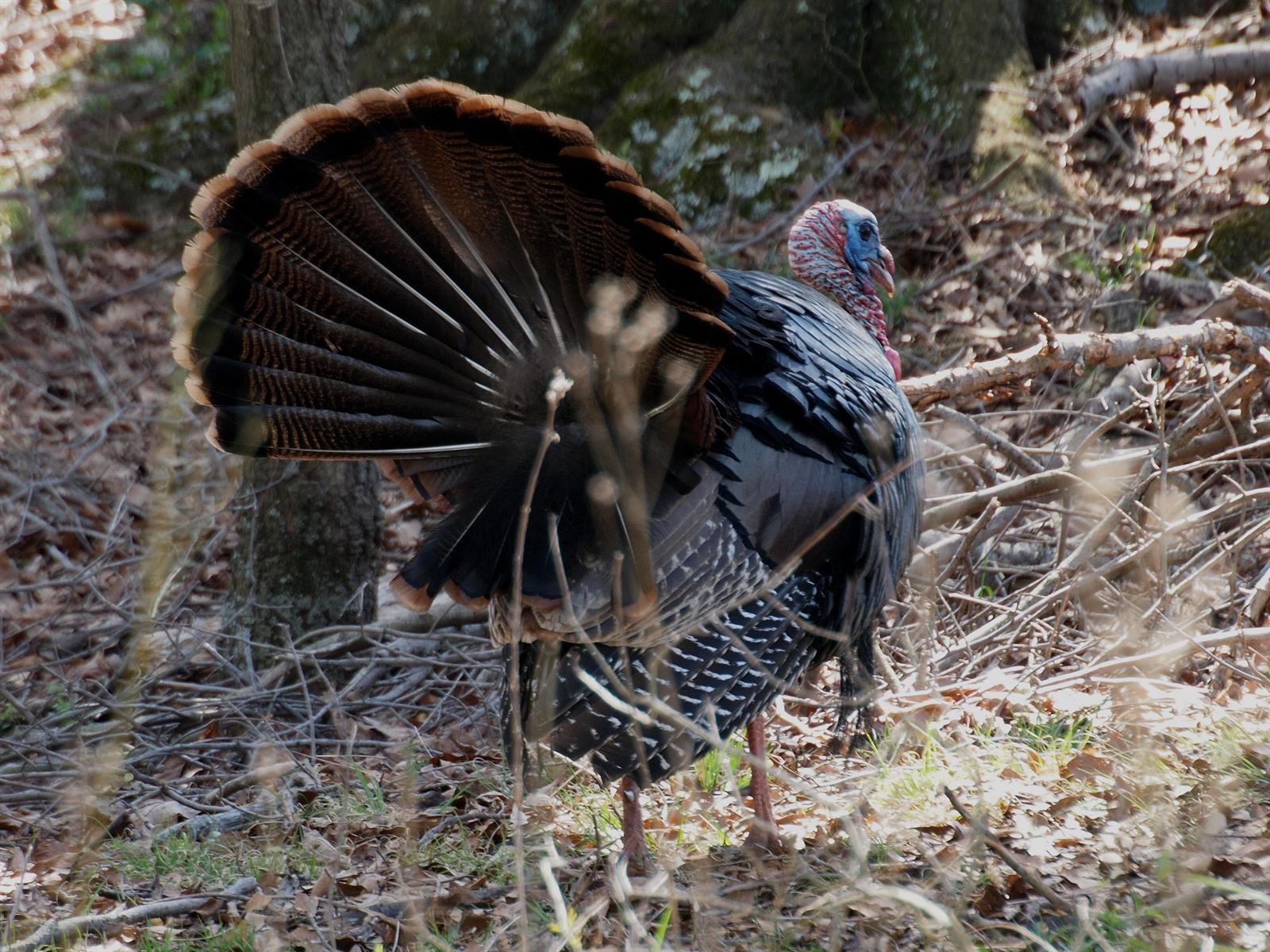
A wild turkey gobbler in full strut with his tail fanned, standing in open hardwoods on brown leaf litter among bare branches
A gobbler strutting in open hardwoods before the leaves are out. This is the stretch of spring the forecast is built around: hens are on the ground with him, the woods still carry sound, and whether he answers a call at daylight comes down to the barometer, the wind and the rain in the first two hours. “Wild Turkey-27527-3”, Ken Thomas, Public domain

The studies

The spring

Where gobbling sits across the spring

Hunting lore puts a peak week on the calendar, usually around the time the hens go to nest. Three recorder datasets went looking for that week and did not find it. South Carolina reported no clear evidence of well defined unimodal or bimodal peaks. North Carolina recorded four springs and found that the year-to-year swing in gobbling activity was much larger than any difference between its mountains, its piedmont and its coast. Moscicki and colleagues, working across ecoregions, reported gobbling that was neither bimodal nor consistent against nesting.

What does hold is the order of the spring and the latitude it runs on. Flocks break up, gobbling builds, hens begin incubating and gobblers are left looking, and leaves thicken until you cannot hear much of what is left. Each state page marks that sequence against its own published opening date rather than naming a week to book.

Where the morning sits in spring

The base score, 30 to 66 points, from the stage of spring at your latitude. Highest once hens start nesting and gobblers are left looking.

  • “It is generally recognized that gobbling activity varies with respect to latitude in North America, with gobbling occurring earlier in southern latitudes. In some cases, peak gobbling activity may vary by as much as two weeks within individual states [15].”

    NCWRC 2021, background Latitude is the one geographic shift the literature accepts, and it is the only one this forecast applies.

  • “of gobbles were detected in Week 5 (March 29-April 4) in the mountain region (Figure 5B), in Week 7 (April 12-18) in the piedmont region (Figure 5C), and in Week 6 (April 5-11) in the coastal region (Figure 5D).”

    NCWRC 2021, results The published weeks for the three North Carolina regions are the anchor the latitude shift works from.

  • “Nest incubation initiation dates were similar among years and across ecoregions, supporting photoperiod as the main driver of nesting chronology.”

    Moscicki et al. 2025, abstract Day length sets nesting, so the stage of spring is read off the calendar and the latitude, not the weather.

  • “Wild turkey research conducted in North Carolina has provided some information about nesting chronology, with information indicating peak female incubation dates occurring in late April”

    NCWRC 2021, background Hens going to nest in late April is what opens the late season window for a lonely gobbler.

  • “We found no clear evidence of well-defined unimodal or bimodal peaks in daily or weekly gobbling activity.”

    Wightman et al. 2019, abstract No single peak week, and no double peak. The week ahead is forecastable; a peak date is not.

How long the woods have been hunted

Plus 3 on the first days of the state season, flat through the first two weeks, minus 4 after that.

  • “We noted distinct differences in predicted numbers of gobbles between hunted sites and an unhunted site, suggesting that hunting may be an important determinant of gobbling activity.”

    Wightman et al. 2019, abstract Pressure is a real factor, not folklore, so days deep into a season score lower than opening days.

  • “Across sites, <44% of gobbling activity occurred during legal hunting seasons in South Carolina, with between 30% and 48% of gobbling activity occurring after legal hunting seasons.”

    Wightman et al. 2019, abstract Close to half the spring gobbling in South Carolina happened after the season closed.

  • “60.0 percent of all gobbling activity across the state occurred during the period in which the turkey hunting seasons occurred, while 25% and 15% of gobbling activity occurred before and after this time period, respectively.”

    NCWRC 2021, results Three fifths of North Carolina gobbling fell inside the season, a quarter of it before opening day.

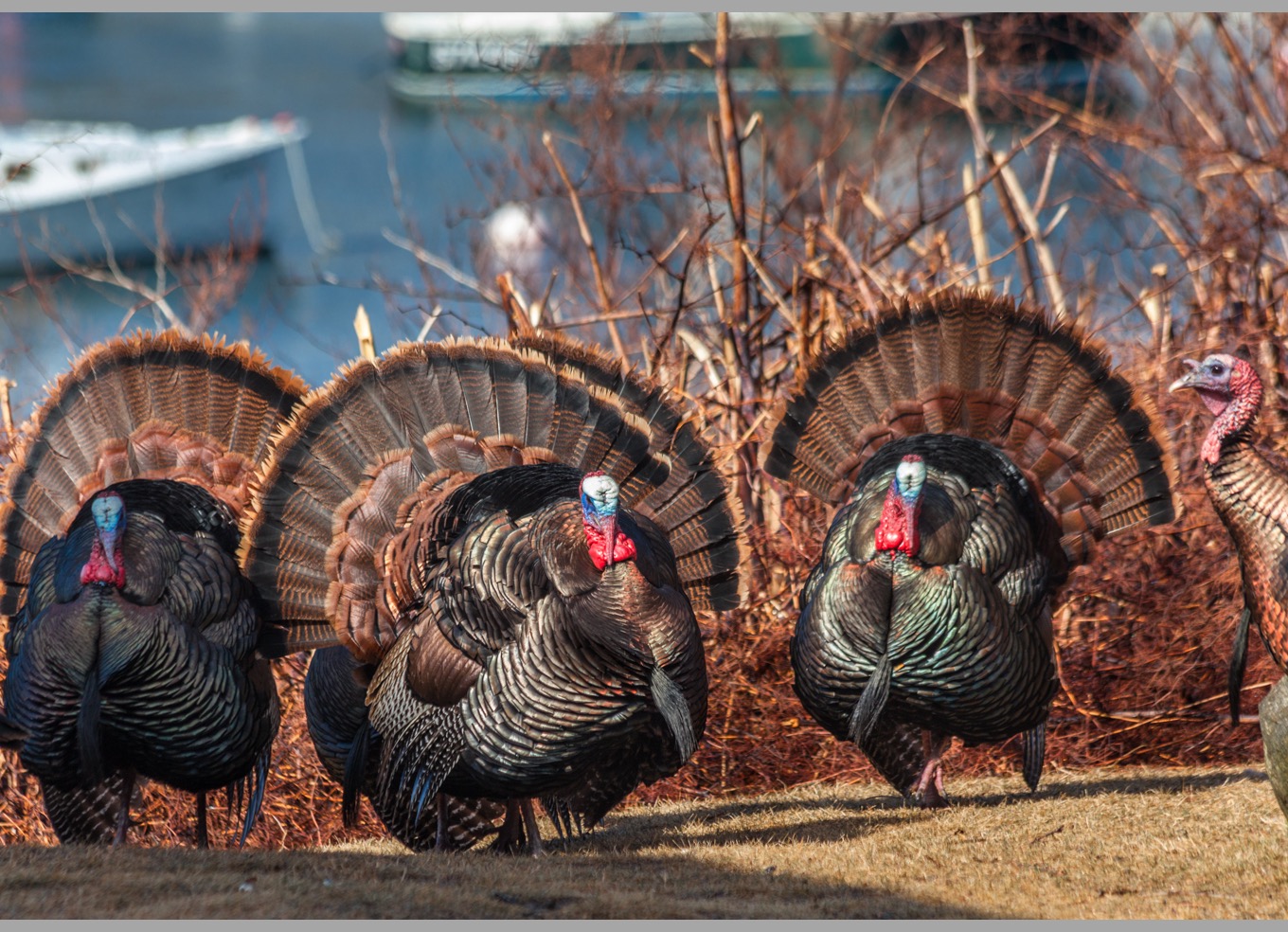
Three wild turkey gobblers side by side with tails fanned on dry winter grass, a fourth bird at the right, with a pond and moored boats behind them
Three gobblers displaying together while the ground is still brown. Birds strut long before the hens scatter to nest, and gobbling recorded through a whole spring rises and falls more than once, so a quiet week in late April is not the season closing. “Leader Of The Pack” by Paul VanDerWerf, CC BY 2.0
This year’s hatch

How the hatch is counted, state by state

Every summer, agency staff and volunteers write down the turkeys they see: how many hens, how many poults with them. Divide one by the other and you get poults per hen, the number that tells you whether there will be two-year-old gobblers to hunt in two springs. A wet, cold stretch during the weeks the poults hatch shows up in that figure, and then in the woods a couple of seasons later.

Vermont publishes the arithmetic itself, so the whole table row is worth reading: hens counted, poults counted, and the ratio that comes out.

“2026 5,692 1,287 399 3,661 518 3.23 2.84”

Vermont Fish and Wildlife Department, 2026 The row for 2026 in the published brood survey table.

24 of the 49 state pages carry their agency’s most recent brood figure in the agency’s own sentence, with the report it came from:

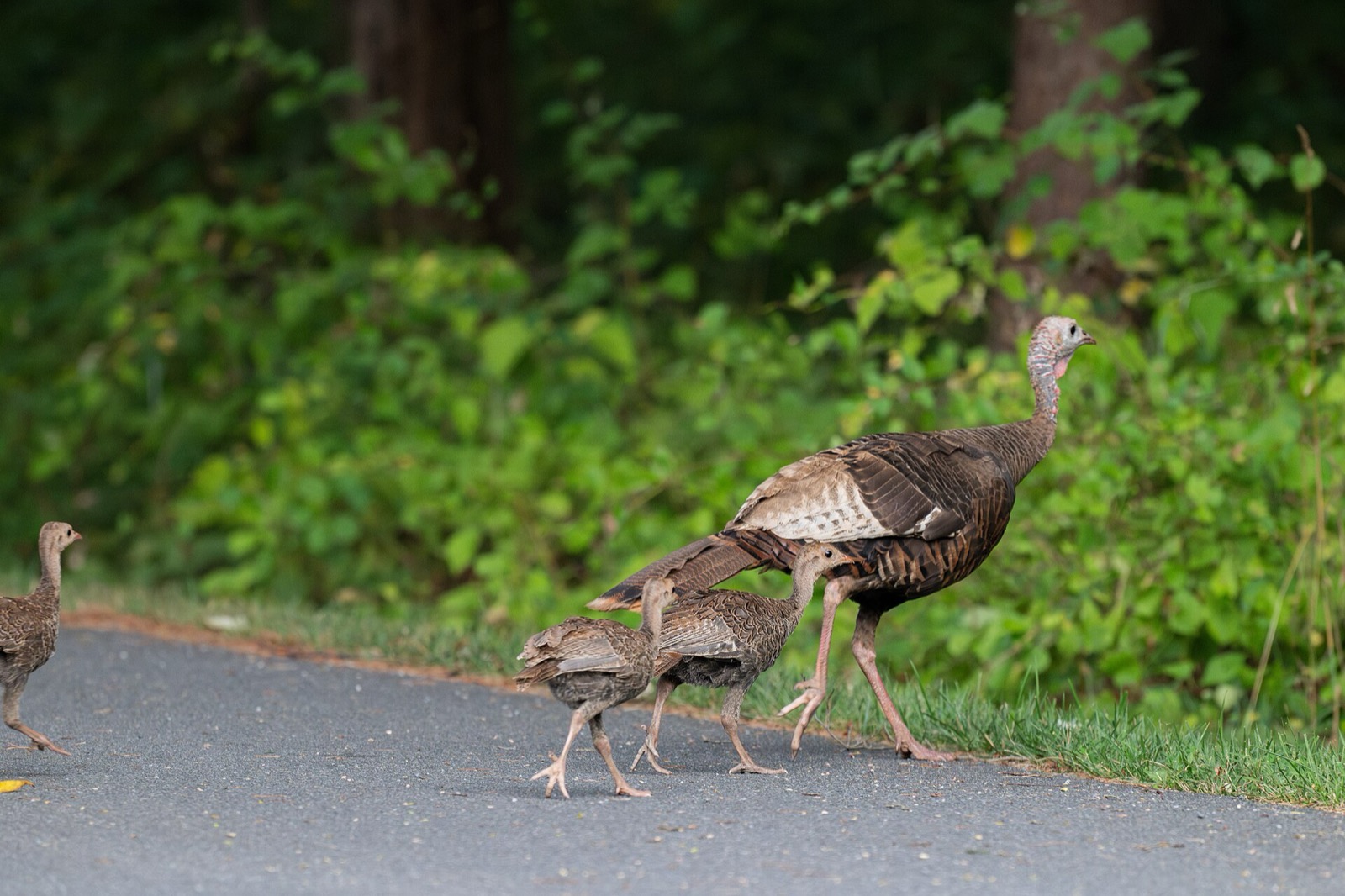
A wild turkey hen crossing a paved road with three young poults following her, green summer woods behind
A hen and her poults in midsummer. This is what a state brood survey counts: observers log hens and the young with them through July and August, and the poults per hen that comes out of it is the number that tells you what the woods will hold two springs from now. “Wild turkeys (hen with poults)”, ShenandoahNPS / Luca Pfeiffer, Public domain
The birds themselves

Five subspecies, five different hunts

A gobbler in an Alabama creek bottom and a gobbler on a Montana coulee rim are different birds with different habits, and the state calendars follow them rather than a national one. The agencies name them themselves.

South Dakota

“The 5 subspecies of wild turkeys occurring in the wild are the eastern (M. g. silvestris), Florida (M. g. osceola), Merriam's (M. g. merriami), Rio Grande (M. g. intermedia), and the Gould's (M. g. mexicana). Eastern wild turkeys historically inhabited woodlands of southeastern South Dakota with their range stretching northwest to the mouth of the Cheyenne River (Smith 1953).”

South Dakota Game, Fish and Parks

Illinois

“The eastern wild turkey is one of five recognized subspecies of turkey in the United States and is the only subspecies found in Illinois.”

Illinois Department of Natural Resources

Florida

“Florida is home to two subspecies of wild turkey — the eastern wild turkey (Meleagris gallopavo silvestris) and the Osceola or Florida wild turkey (M.g. osceola).”

Florida Fish and Wildlife Conservation Commission

Texas

“Rio Grande turkey are distributed throughout the central portion of Texas from the northern high plains to the southern gulf coastal prairies. The occurrence of this species becomes less frequent as they approach far west Texas and they are not found in deep east Texas.”

Texas Parks and Wildlife Department

Montana

“Merriam's wild turkeys are the predominant turkey species in Montana.”

Montana Fish, Wildlife and Parks

27 state pages carry their own agency’s sentence on which birds live there and where in the state to find them. Gould’s is the rarest of the five in the United States and holds on in the mountains of southeastern Arizona and southwestern New Mexico.

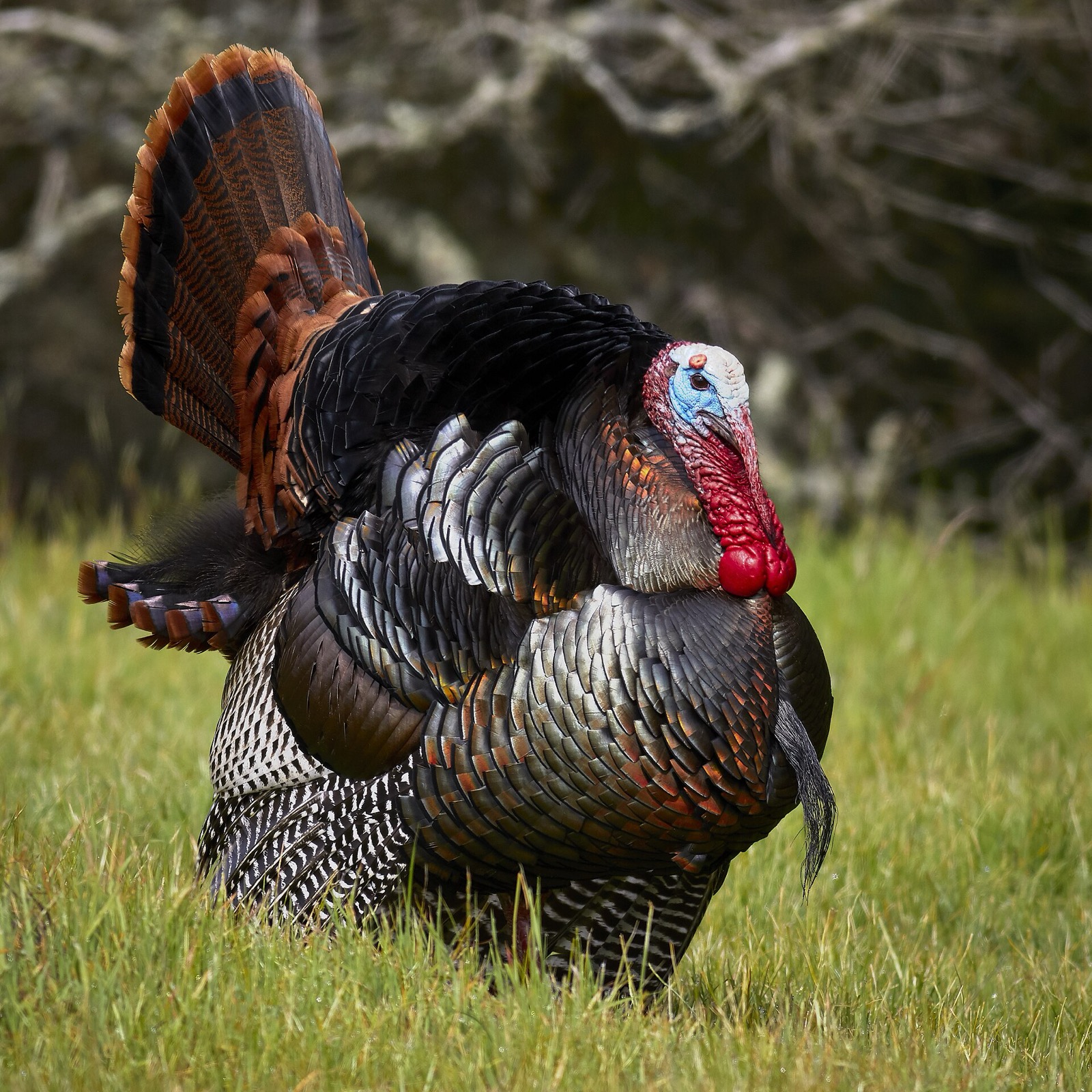
A close view of a wild turkey gobbler in full strut on green grass, head white and blue, wattles bright red, with mossy oak branches behind
A strutting gobbler in green grass under coast live oak. Five subspecies are hunted across the country and they do not share a calendar: the states carry their own opening dates, and the forecast reads each morning against the spring the birds in that place are actually having. “Male wild turkey (Meleagris gallopavo) strutting” by Frank Schulenburg, CC BY-SA 4.0
Advertisement
49 states

Turkey hunting forecasts by state

Each state page opens with the rated week for a reference town, then the agency’s own numbers on the hatch, the harvest and where the population is heading, and where the state’s season falls in the spring. Enter a ZIP on any of them for your own ground.

RegionStateReference townSpring opens about
NortheastMaineFarmingtonMay 4
New HampshireKeeneMay 1
VermontRutlandMay 1
MassachusettsWorcesterApril 27
ConnecticutTorringtonApril 29
Rhode IslandChepachetApril 29
New YorkOleanMay 1
New JerseyFlemingtonApril 26
PennsylvaniaState CollegeMay 1
SoutheastDelawareGeorgetownApril 10
MarylandFrederickApril 19
VirginiaCharlottesvilleApril 10
West VirginiaElkinsApril 19
North CarolinaSiler CityApril 17
South CarolinaColumbiaApril 3
GeorgiaAlpharettaMarch 27
FloridaOcalaMarch 6
AlabamaSelmaMarch 20
TennesseeCrossvilleApril 3
KentuckyBowling Green–
MississippiJacksonMarch 15
LouisianaAlexandriaApril 3
ArkansasMenaApril 5
MidwestOhioAthens–
IndianaBloomingtonApril 21
IllinoisCarbondaleApril 6
MichiganJackson–
WisconsinWausauApril 21
MinnesotaRochester–
MissouriRollaApril 20
IowaDecorahApril 12
KansasManhattanApril 5
NebraskaValentineMarch 25
South DakotaCusterApril 10
North DakotaBismarckApril 11
SouthwestTexasStephenvilleMarch 20
OklahomaTahlequahApril 16
New MexicoRuidosoApril 15
ArizonaPayson–
RockiesMontanaLewistownApril 15
WyomingSundanceApril 1
ColoradoTrinidadApril 11
IdahoOrofinoApril 8
UtahPriceApril 10
NevadaElkoMarch 27
WestWashingtonColvilleApril 15
OregonRoseburgApril 15
CaliforniaReddingMarch 27
HawaiiWaimeaMarch 1

Turkey gobbling questions

Every ZIP code

The forecast works wherever turkeys are hunted

The 49 state pages cover every state with a managed spring turkey season. A ZIP code anywhere in them gets the full seven mornings. One state is outside that:

  • Alaska: Alaska has no established wild turkey population and holds no managed spring turkey season. ADF&G classifies wild turkey as a feral non-native game bird, which in Units 1 to 26 may be taken with no limit and no closed season, with special area restrictions in Unit 14C. Alaska Department of Fish and Game

Season dates, zones and bag limits are on the turkey season pages, which quote each agency, and the rules the agency publishes are the ones that govern. The gobbling window used here runs from 30 minutes before sunrise to 150 minutes after, which is the window the recorder studies measured; legal shooting hours are set by each state and in several of them the morning ends at noon.

More for spring turkey season

Advertisement