
Skip to content
Spring season opens about March 15 in Mississippi

Mississippi Turkey Hunting Forecast

The next seven mornings in Jackson rated Slow to Prime for gobbling, from the barometer, the wind, the rain, the temperature at first light and the stage of spring, with Mississippi Department of Wildlife, Fisheries, and Parks’s own numbers on this year’s hatch.

March 15
Spring season opens about
the 2027 spring opening date published by Mississippi Department of Wildlife, Fisheries, and Parks
2022
Brood survey on file
Mississippi Department of Wildlife, Fisheries, and Parks in its own words, below
4
Agency numbers quoted
the hatch, the harvest, the population, the birds
7
Mornings rated
Jackson below, or any Mississippi ZIP code on the forecast
3 hours
The gobbling window
30 minutes before sunrise to 150 minutes after, which is the window the recorders measured
This week

Which Mississippi mornings birds gobble this week

Rated from the National Weather Service forecast for the hours that matter, half an hour before sunrise to two and a half hours after. Open a morning for every factor and its points. For your own ground, enter a ZIP code on the forecast.

Jackson

Spring season opens about March 15

Reading the National Weather Service forecast for Jackson, MS.

Mississippi Department of Wildlife, Fisheries, and Parks

How the Mississippi hatch and harvest are running

Two springs from now you will be hunting the poults that hatched this summer, so the brood count is the number worth watching. Here it is in the agency’s own words, with the report it came from.

This year’s brood count

“With a recorded value of two-and-a-half poults per hen, the 2022 hatch was the third best recorded for the region since MDWFP's summer brood survey began in 1994.”

Mississippi Department of Wildlife, Fisheries, and Parks, 2022

Last spring’s harvest

“The Mississippi Department of Wildlife, Fisheries, and Parks (MDWFP) announced a record harvest for the 2026 spring turkey season, with Mississippi hunters reporting 17,907 birds through Game Check. This surpassed the previous record of 15,498 birds set in 2024 and is the highest number that has been reported since the state implemented mandatory harvest reporting in 2019.”

Mississippi Department of Wildlife, Fisheries, and Parks, 2026

Where the population is heading

“With another strong hatch recorded during the summer of 2025, Mississippi's turkey population is at one of its highest levels in a generation.”

Mississippi Department of Wildlife, Fisheries, and Parks

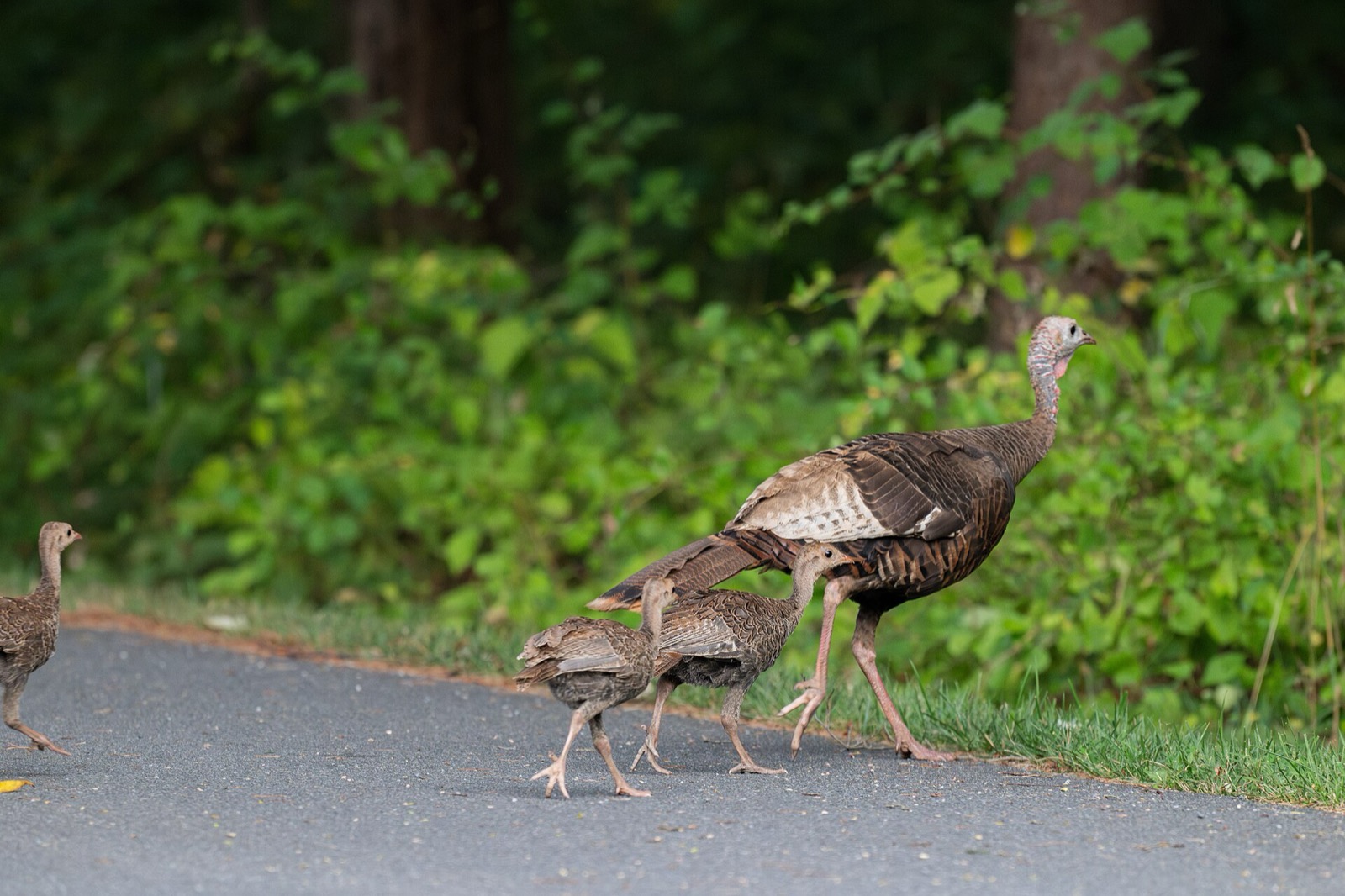
A wild turkey hen crossing a paved road with three young poults following her, green summer woods behind
A hen and her poults in midsummer. This is what a state brood survey counts: observers log hens and the young with them through July and August, and the poults per hen that comes out of it is the number that tells you what the woods will hold two springs from now. “Wild turkeys (hen with poults)”, ShenandoahNPS / Luca Pfeiffer, Public domain
The birds

Which turkeys live in Mississippi

Five subspecies are recognised in the wild in North America, and they do not behave alike or run on one calendar. Mississippi Department of Wildlife, Fisheries, and Parks says which ones are here.

In Mississippi Department of Wildlife, Fisheries, and Parks’s words

“While there are five species of wild turkeys, Mississippi is home to the Eastern wild turkey, which is the most abundant.”

Mississippi Department of Wildlife, Fisheries, and Parks

Advertisement
The spring

Where the Mississippi season falls in the spring

Recorders hung in the woods for whole springs found no single peak week to aim at, in South Carolina, in North Carolina or across ecoregions. What they did find is a sequence: flocks break up, gobbling builds, hens start incubating and gobblers are left looking for company, and then the leaves come in and swallow the sound.

So the stages below are counted from the Mississippi spring opening date rather than from a date to book, and the rating uses the same count. The zone-by-zone dates and the limits are on the Mississippi turkey season page.

  1. Until January 28Winter flocksWinter flocks are still together. Birds gobble on a warm still morning and go quiet for a week after.
  2. January 29 to February 25Flocks breaking upFlocks are breaking up and the first gobbling of the year is turning up on recorders.
  3. February 26 to March 10Early gobblingGobbling is building. Birds are with hens, so a gobbler answers and then goes back to his flock.
  4. March 11 to March 25Heaviest gobblingThe heaviest gobbling of the spring at this latitude, read off the published chronology.Season opens about March 15
  5. March 26 to April 16Hens on nestsHens are going to nest, so a gobbler left alone at fly down has a reason to answer a call.
  6. From April 17Late springLate spring. Gobbling thins out and leaves cut what you can hear of it.

Bands run from the Mississippi spring opening date, which is the 2027 spring opening date published by Mississippi Department of Wildlife, Fisheries, and Parks. Three recorder studies looked for a peak week and a double peak in the gobbling and found neither, so these are stages of spring rather than a date to hunt.

The research

What moves the score, and by how much

These four readings do most of the work in the week above, and each weight traces to a sentence quoted from the study that set it. The forecast hub has all eight, including the light, the hunting pressure and what the recorders did not measure.

Rain is the worst thing on the forecast

Minus 18 when rain is likely, minus 8 when it is possible. A likely rain also caps the morning at Good.

  • “Results from the state‐space model indicated the occurrence of rain most impacted (negatively) gobbling activity”

    Wightman et al. 2022, results Rain is the heaviest weather penalty in the score, because it was the largest effect in the model.

  • “Where the mean expected number of daily gobbles would be 21 (CrI = 15, 30) without rain, compared to 12 (CrI = 7, 22) if rain occurred.”

    Wightman et al. 2022, results Rain roughly halved the gobbles heard in a morning, which is why a wet morning cannot rate above Good.

  • “Our findings suggest rainfall, greater wind speeds, and greater temperatures negatively affected gobbling activity, whereas increasing barometric pressure positively affected gobbling activity.”

    Wightman et al. 2022, abstract Four of the five weather variables this forecast reads come straight from this sentence.
Wind above six miles an hour

Plus 3 under 5 miles an hour, flat to 6, then minus 5, minus 11 and minus 16 as the wind builds past 10 and 15.

  • “by greater wind speed with the largest effect occurring when wind speeds exceeded 10 kilometers per hour”

    Wightman et al. 2022, results The wind penalty starts where the study found the effect, at ten kilometers an hour, about six miles an hour.

  • “We suspect males may be less inclined to gobble as wind speeds increase because the desired outcome from calling may be limited by the ability of receptive females to hear the call and because predation risk may increase.”

    Wightman et al. 2022, discussion Wind works on both ends: fewer gobbles, and less chance a bird hears your call.

A barometer higher than yesterday

Plus 11 when the morning pressure is up on yesterday morning, flat when it holds, minus 7 falling and minus 12 falling hard.

  • “we observed an increase in barometric pressure from one day to the next resulted in increased gobbling activity”

    Wightman et al. 2022, discussion A barometer higher than yesterday morning is the single best thing the weather can hand you.

  • “For barometric pressure (mb), we calculated the mean for each morning and then subtracted it from the prior morning to get a change in barometric pressure.”

    Wightman et al. 2022, methods The score reads pressure the same way, morning against the morning before, not the raw reading.

  • “we conclude that this relationship is best explained by turkeys gobbling more in weather conditions not associated with storm systems.”

    Wightman et al. 2022, discussion A falling barometer is a storm arriving, which is what the penalty is really reading.

Heat, not cold

Minus 3 from 55 degrees, minus 7 from 60, minus 12 from 70. A cold morning costs nothing.

  • “We found gobbling activity was negatively influenced by increased temperatures”

    Wightman et al. 2022, results A warm morning scores lower than a cool one.

  • “Wild turkeys at southern latitudes may reduce gobbling at higher temperatures, but we offer that the pattern may not be similar at northern latitudes.”

    Wightman et al. 2022, discussion Only the warm end of the range costs points. Nothing in the research says a cold morning suppresses gobbling.

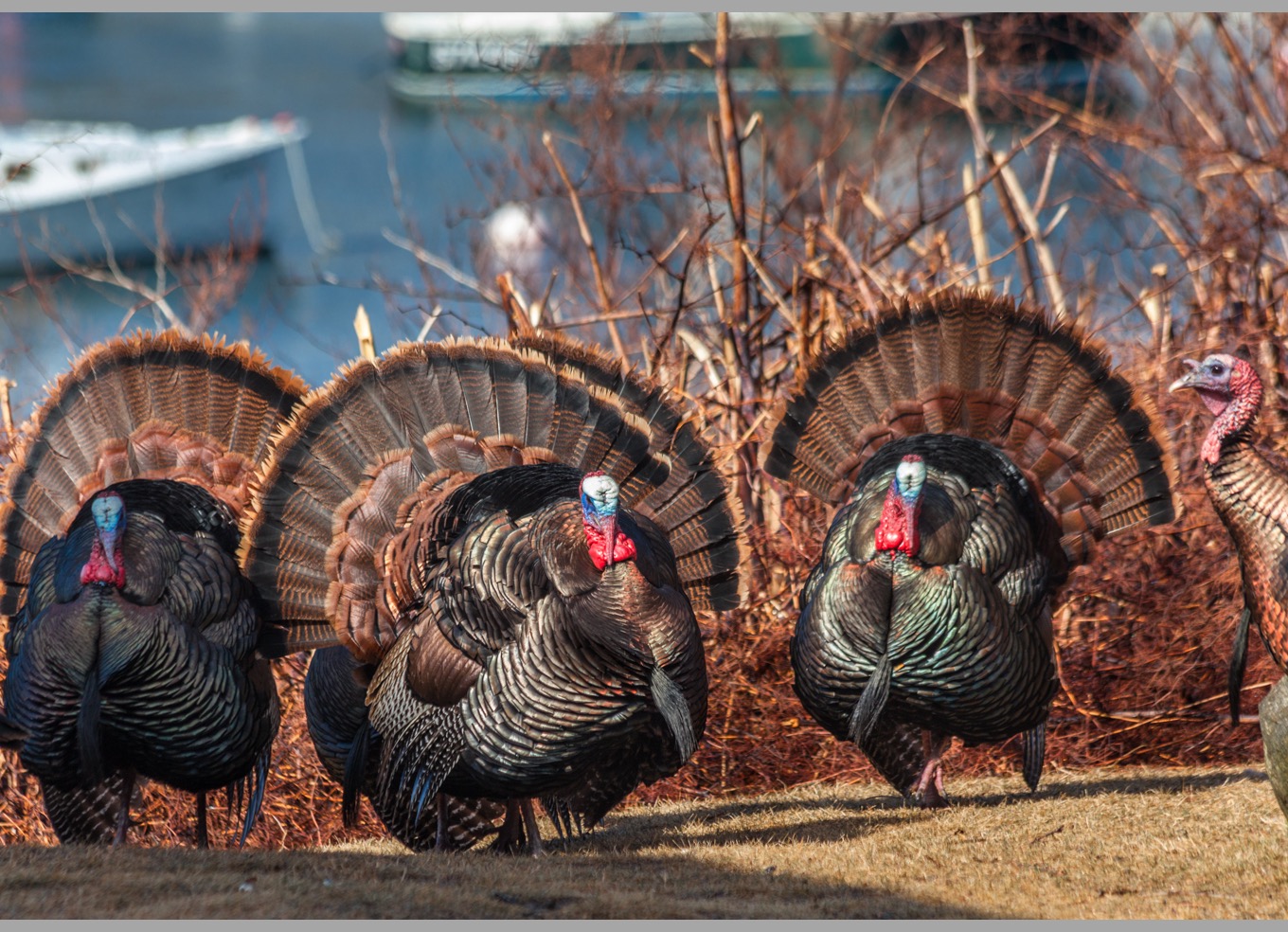
Three wild turkey gobblers side by side with tails fanned on dry winter grass, a fourth bird at the right, with a pond and moored boats behind them
Three gobblers displaying together while the ground is still brown. Birds strut long before the hens scatter to nest, and gobbling recorded through a whole spring rises and falls more than once, so a quiet week in late April is not the season closing. “Leader Of The Pack” by Paul VanDerWerf, CC BY 2.0

Mississippi turkey hunting questions

Advertisement