Tundra swans and snow geese by the tens of thousands on the Albemarle-Pamlico peninsula refuges from November, and September hawk flights over the Blue Ridge and the Sauratown outliers.
Agency viewing sites
6
Species documented
4
Mapped
5
Where to stand
Public viewing sites in North Carolina
Every place below is one an agency itself describes for watching the fall passage, with the agency named and linked, the species it documents there, the months it names as the peak, and the facility that exists: a tour route, a platform, a tower, a visitor centre. Where the agency wrote a sentence worth reading, it is quoted exactly.
Pocosin Lakes National Wildlife Refuge, Pungo Unit (Duck Pen Wildlife Trail and North Lake viewing area) FederalMarquee site
Pungo Lake, moist-soil impoundments and farm fields on the Albemarle-Pamlico peninsula, off Highway 45 south of Plymouth
Snow gooseTundra swan
JanFebMarAprMayJunJulAugSepOctNovDec
The refuge calls the Pungo Unit its most popular area for wildlife observation and names swans, snow geese and other waterfowl among what is watched there; it says more than a hundred thousand ducks, geese and swans congregate on the refuge in winter. The Duck Pen Wildlife Trail (0.55 miles, gravel, no dogs) ends at a photography blind over Pungo Lake, and the 0.15 mile North Lake Field Road Trail reaches a viewing area at the lake's north end. The unit's 44 miles of roads are dirt; some are closed to vehicles from November through February to reduce disturbance to waterfowl, the western part of the North Pungo Lake Access Road Trail is closed to all entry November to February, and the unit may be closed on certain Fridays and Saturdays in September and October for permit-only hunts. The Walter B. Jones Sr. Center for the Sounds at 205 South Ludington Drive, Columbia, is the visitor center.
“The Duck Pen Wildlife Trail passes through swamp forest to a photography blind overlooking Pungo Lake, where thousands of swans and geese rest during the winter.”
Mattamuskeet National Wildlife Refuge, Wildlife Drive and Highway 94 causeway FederalMarquee site
Lake Mattamuskeet, North Carolina's largest natural lake, with managed wetland impoundments along the entrance road at New Holland
Snow gooseTundra swan
JanFebMarAprMayJunJulAugSepOctNovDec
The refuge writes that it attracts more than 200,000 ducks, geese and swans from November through February and that most of North Carolina's wintering tundra swans can be found at and near the refuge; its species page lists the blue goose, the dark form of the snow goose, among its highlighted birds. Viewing is described as particularly good along the Highway 94 causeway across the lake and along the entrance road and the Wildlife Drive, a 3-mile loop off the main entrance road with several observation platforms over the largest impoundment. Some areas are closed to the public in winter and boating is closed from November 1 to February 28. The refuge office is at 85 Mattamuskeet Road, Swan Quarter.
“Most of North Carolina's wintering tundra swans can be found at and near Mattamuskeet National Wildlife Refuge.”
Pea Island National Wildlife Refuge, North Pond Wildlife Trail and tower Federal
Barrier island ponds and salt flats on the north end of Hatteras Island, Outer Banks
Snow gooseTundra swan
JanFebMarAprMayJunJulAugSepOctNovDec
The refuge was established for greater snow geese and other migratory waterfowl, and its visitor pages put the best birding in fall and winter, when thousands of migratory ducks, geese and swans rest and refuel there. The half-mile North Pond Wildlife Trail starts near the visitor center at 14500 NC Highway 12, Rodanthe, and ends at a two-level tower over the ponds; the shorter Salt Flats Wildlife Trail has an overlook, and the visitor center (9 am to 4 pm, seven days) keeps scopes trained on North Pond. The refuge closes particular areas seasonally to protect nesting sea turtles and birds.
“The best birding is during the fall and winter, when thousands of migratory ducks, geese, and swans rest and refuel on the refuge.”
Blue Ridge Parkway, Mills River Overlook (Milepost 404.5) Federal
Paved ridgetop overlook on the Blue Ridge Parkway south of Asheville, with open views into the valleys on both sides
Broad-winged hawk
JanFebMarAprMayJunJulAugSepOctNovDec
The National Park Service lists hawk watching at this overlook as a free self-guided activity, describing it as an excellent place to observe the autumn hawk migration because little tree canopy blocks the view. Its page puts the best time of year in the last two weeks of September and the first week of October and the best hours from mid-morning to late afternoon, once thermals have formed. Watching is possible from vehicles, the sidewalk or the adjacent grass; there is a single step up to the sidewalk. The page names hawks, falcons, eagles and vultures collectively rather than individual species, so the broad-winged hawk key here rests on the September timing rather than on a species named by the Park Service.
“The best time of year to observe migrating hawks on the Parkway tends to be the last two weeks in September and the first week in October.”
Pilot Mountain State Park, Little Pinnacle Overlook hawk watch Public platform
Quartzite knob of the Sauratown Mountains rising about 1,400 feet above the Piedmont, 30 miles southeast of the Blue Ridge
Broad-winged hawk
JanFebMarAprMayJunJulAugSepOctNovDec
Forsyth Audubon members have counted the fall migration of broad-winged hawks and other raptors from the Little Pinnacle Overlook, at 2,221 feet, since 1973, and the HawkCount profile gives a count season of September 15 to October 15 with daily totals posted to HawkCount. The overlook is a public viewpoint inside the state park. The state parks event listings for the hawk watch returned an access-denied page when read for this record, so the count details here come from the HawkCount profile.
The tallest living dune system on the Atlantic coast, at Nags Head on Bodie Island
Sharp-shinned hawk
JanFebMarAprMayJunJulAugSepOctNovDec
A park-staff hawk count on the open dunes of this 426-acre state park, with a HawkCount fall season of September 1 to November 30 and a spring season as well. Sharp-shinned hawk is the most numerous hawk in the profile, averaging 96 a season with a season high of 239 in 2020 and daily highs in the third week of October; American kestrels, ospreys and turkey vultures make up most of the rest. The park's own activity pages read for this record do not describe the count, so its details come from the HawkCount profile, which lists the park as the site operator.
North Carolina sites, refuges and the reporting record
Style
Records
Layers
Federal viewing siteState viewing siteHawkwatch or other public platformNational wildlife refugeObservation grid
Viewing sites in North Carolina, with the national wildlife refuges in the state drawn underneath. The coloured grid is where people have uploaded a verified sandhill crane record to iNaturalist in September, October, November and December, brighter where more have been logged. It is a map of reports rather than of birds: it thickens around refuges, car parks and towns because that is where observers stand, and it shows past reports rather than birds present today. Pins are public viewing sites an agency itself describes; grey dots are US Fish and Wildlife Service refuges and hatcheries, drawn because the refuge system is where most of the staging happens.
Advertisement
When
When the passage peaks in North Carolina
US Fish and Wildlife Service, Mattamuskeet National Wildlife Refuge puts the North Carolina peak at November through February for swans and geese on the coastal refuges. That describes a pattern across past autumns. The week itself swings with the weather: a cold front to the north moves cranes and geese south in a single night, and a warm spell holds them for weeks. Dawn and the last hour before dusk are when cranes and geese move between the fields and the water, and that movement is the spectacle the platforms are built for.
North Carolina winters more tundra swans than any other East Coast state: the Wildlife Resources Commission says roughly 65,000 to 75,000 of the Eastern Population arrive in the northeast of the state each fall for the lakes, sounds and farm fields of the Albemarle-Pamlico peninsula, and it tracks them through the early-January mid-winter waterfowl inventory. The federal refuges are where that concentration is put on public view: Mattamuskeet's Wildlife Drive and causeway, the Pungo Unit blind and viewing area at Pocosin Lakes, and the North Pond tower at Pea Island, with the refuges closing roads and units from November to protect the birds they are showing. Inland, the Blue Ridge and the Sauratown outliers carry the September hawk passage, which the National Park Service dates to the last two weeks of September and the first week of October along the Parkway and which Forsyth Audubon has counted from Pilot Mountain since 1973.
Below, one curve per species the agencies document in North Carolina: every research grade observation members of the public have uploaded to iNaturalist for the state, by calendar month across every year the platform holds, with September to December shaded. Counts of uploads, so they measure observers as well as birds, and the shape is worth reading where the absolute numbers are not.
Snow goose
JanFebMarAprMayJunJulAugSepOctNovDec
270 research grade snow geese observations have been uploaded to iNaturalist for North Carolina across every year the platform holds, and 44 percent of them fall in the four shaded autumn months. The busiest month in the record is December. An autumn month carries about 1.6 times as many uploads as an average month outside autumn. People upload most of everything in April, so a bar that rises after that is the stronger signal. Counts of what people reported, measuring observers as well as birds. See the autumn records.
Tundra swan
JanFebMarAprMayJunJulAugSepOctNovDec
814 research grade tundra swans observations have been uploaded to iNaturalist for North Carolina across every year the platform holds, and 46 percent of them fall in the four shaded autumn months. The busiest month in the record is December. An autumn month carries about 1.72 times as many uploads as an average month outside autumn. People upload most of everything in April, so a bar that rises after that is the stronger signal. Counts of what people reported, measuring observers as well as birds. See the autumn records.
Broad-winged hawk
JanFebMarAprMayJunJulAugSepOctNovDec
408 research grade broad-winged hawks observations have been uploaded to iNaturalist for North Carolina across every year the platform holds, and 16 percent of them fall in the four shaded autumn months. The busiest month in the record is April. An autumn month carries about 0.37 times as many uploads as an average month outside autumn. People upload most of everything in April, so a bar that rises after that is the stronger signal. Counts of what people reported, measuring observers as well as birds. See the autumn records.
Sharp-shinned hawk
JanFebMarAprMayJunJulAugSepOctNovDec
186 research grade sharp-shinned hawks observations have been uploaded to iNaturalist for North Carolina across every year the platform holds, and 49 percent of them fall in the four shaded autumn months. The busiest month in the record is December. An autumn month carries about 1.92 times as many uploads as an average month outside autumn. People upload most of everything in April, so a bar that rises after that is the stronger signal. Counts of what people reported, measuring observers as well as birds. See the autumn records.
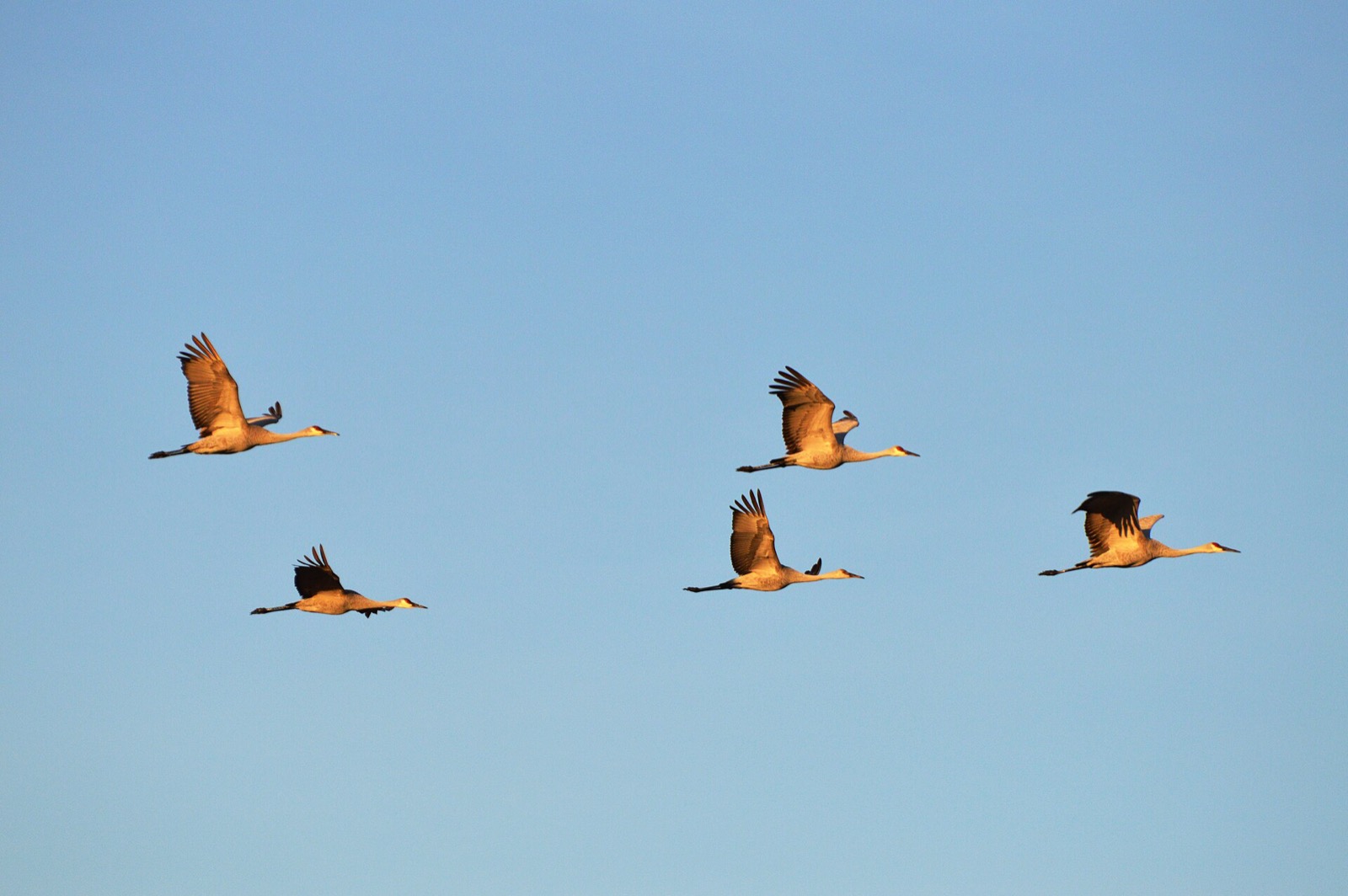
Sandhill cranes crossing a refuge on the morning flight. The movement is watched from the designated pullout or platform: the birds settle on shallow water for the night, and the roost itself is the one place a viewing site is never placed. “Sandhill cranes flying over Sherburne National Wildlife Refuge (24542820818)” by USFWS Midwest Region from United States, CC BY 2.0
Latest reports
What people have reported in North Carolina lately
The most recent research grade autumn observation of each species that anyone has uploaded to iNaturalist for North Carolina, as a date and the platform’s own coarse locality. Evidence that people do find snow goose and tundra swan here. Each is one bird on one past day: the flocks move with the weather, so where they are this week is what the agency page and its counts answer.
Checking the most recent autumn uploads for North Carolina on iNaturalist...
A staffed event is the easiest introduction to this: somebody has already found the birds, set up a scope and can say what is in view. Most organisers publish the dates only weeks ahead, so what follows names the organiser and the recurrence, and the organiser’s page carries this year’s date.
Wings Over Water Wildlife Festival
annual, October, with an Encore weekend in early December
A festival of birding, paddling, photography and natural history trips hosted across six national wildlife refuges and six counties of northeastern North Carolina, Mattamuskeet among them; the 2026 dates are October 13 to 18 with an Encore December 4 to 6.
Other states with agency designated migration viewing
Advertisement
Questions about North Carolina
North Carolina has 6 agency designated viewing sites in this inventory, 4 of them on federal land: Pocosin Lakes National Wildlife Refuge, Pungo Unit (Duck Pen Wildlife Trail and North Lake viewing area), Mattamuskeet National Wildlife Refuge, Wildlife Drive and Highway 94 causeway and Pea Island National Wildlife Refuge, North Pond Wildlife Trail and tower and others. Every one is a place North Carolina Wildlife Resources Commission or another public agency itself describes for wildlife viewing, listed above with the facility that exists there, the months the agency names and a link to the agency page. Tundra swans and snow geese by the tens of thousands on the Albemarle-Pamlico peninsula refuges from November, and September hawk flights over the Blue Ridge and the Sauratown outliers.
US Fish and Wildlife Service, Mattamuskeet National Wildlife Refuge puts the North Carolina peak at November through February for swans and geese on the coastal refuges. That describes a pattern across past autumns, and the week itself swings with the weather: a cold front to the north moves cranes and geese south in a single night, and a warm spell holds them for weeks. The months named site by site above are the agency's own for each place, and the agency page carries what it says about this season.
Snow geese at 3 sites, tundra swans at 3 sites, broad-winged hawks at 2 sites and sharp-shinned hawks at 1 site. The species listed for each site are the ones the agency itself documents there in the fall, so a site may hold other migrants the agency page happens to leave out. The month curves further down show when people have reported each of these species in North Carolina, as a count of uploads to iNaturalist across every year the platform holds.
A sighting is never certain. Migrating birds move with weather fronts, so a staging area that held thousands on Tuesday can be nearly empty on Saturday after a front passes, and a warm autumn holds birds to the north for weeks. The sites above are the places where an agency has recorded enough birds often enough to build viewing provision, which is the best odds available anywhere. Arrive at first light or in the last hour before dusk, when cranes and geese move between the fields and the water, bring more magnification than you think you need, and stay on the platform, road or tour route the agency designates.
North Carolina Wildlife Resources Commission, linked from the note on this page and from each site above. Its pages carry the things that change: refuge road and auto tour status, seasonal closures of units, festival dates, and in several states a dated crane or goose count from the refuge staff. Those change faster than any third party page can follow, so the agency page is the one to read before you travel.
North Carolina Wildlife Resources Commission mid-winter waterfowl inventory, tundra swan trend charts, published annual, low-level aerial survey in early January, with trend charts on the species page. A count is a reading of one day at one place, and the totals can double or halve between one week and the next as fronts pass, so the trend across the season is the useful reading rather than any single figure. The count page is linked from this page.
Wings Over Water Wildlife Festival, run by Wings Over Water Wildlife Festival, which supports refuge conservation and education through the Coastal Wildlife Refuge Society; Mattamuskeet NWR lists it on its events page. Wings Over Water Wildlife Festival runs annual, October, with an Encore weekend in early December. A festival of birding, paddling, photography and natural history trips hosted across six national wildlife refuges and six counties of northeastern North Carolina, Mattamuskeet among them; the 2026 dates are October 13 to 18 with an Encore December 4 to 6. Dates are published by the organiser each year The organiser's page, linked above, carries this year's dates.
Inventory compiled 2026-09-19 from the agency pages linked above. Agency text is quoted exactly with its source named and linked; the observation curves and latest reports are counts and dates from public uploads to iNaturalist.