
Skip to content

Fall Bird Migration in Mississippi

Fall migration in Mississippi is a Delta story: refuges built as links in the Mississippi Flyway wintering chain fill with geese and ducks from late fall, and the state agency flies its counts over the Delta from November to January.

Agency viewing sites
2
Species documented
2
Mapped
2
Where to stand

Public viewing sites in Mississippi

Every place below is one an agency itself describes for watching the fall passage, with the agency named and linked, the species it documents there, the months it names as the peak, and the facility that exists: a tour route, a platform, a tower, a visitor centre. Where the agency wrote a sentence worth reading, it is quoted exactly.

Yazoo National Wildlife Refuge, Holt Collier Boardwalk and Observation Tower and the Wildlife Drive FederalMarquee site

Delta lakes, cypress brakes and moist soil impoundments five air miles east of the Mississippi River

Snow goose

The refuge describes itself as one of the links in a chain of refuges that provide for the wintering needs of ducks and geese in the Mississippi Flyway, puts its wintering total at over 50,000 geese and 100,000 ducks, and names snow geese and Canada geese among the birds that rest and feed here from late fall to early spring. Visitors are pointed to two dedicated wildlife observation areas, one of them the quarter mile Holt Collier Boardwalk out to an observation platform on Lizard Lake, and to the Wildlife Drive. The refuge, its roads, parking areas and boat ramps close from an hour and a half after sunset until 4 am. Street address 595 Yazoo Refuge Road, Hollandale.

“Yazoo NWR has over 50,000 overwintering geese and 100,000 ducks by providing much needed foraging, loafing, and cover opportunities for waterfowl.”
US Fish and Wildlife Service, Yazoo National Wildlife Refuge, quoted exactly.

Run by US Fish and Wildlife Service

Mississippi Sandhill Crane National Wildlife Refuge, visitor center observation deck and guided crane tours Federal

Wet pine savanna near Gautier, Jackson County, on the Gulf Coast

Sandhill crane

This is the one place the Service names for viewing the Mississippi sandhill crane, a subspecies its recovery plan describes as nonmigratory, so the roughly 200 birds here are year round residents rather than fall arrivals; the population was 30 to 35 birds when the refuge was established in 1975. The refuge runs its own guided crane tours, which it says generally run from late fall to late winter depending on staffing, with availability confirmed at the visitor center desk at 7200 Crane Lane, Gautier, open Thursday and Friday mornings. The visitor center has an observation deck over the savanna, and the C.L. Dees and Fontainebleau trails are open sunrise to sunset.

“One popular seasonal option are our guided crane tours, which generally run from Late Fall – Late Winter (staffing dependent).”
US Fish and Wildlife Service, Mississippi Sandhill Crane National Wildlife Refuge, quoted exactly.

Run by US Fish and Wildlife Service

The map

Mississippi sites, refuges and the reporting record

Style
Records
Layers

Viewing sites in Mississippi, with the national wildlife refuges in the state drawn underneath. The coloured grid is where people have uploaded a verified sandhill crane record to iNaturalist in September, October, November and December, brighter where more have been logged. It is a map of reports rather than of birds: it thickens around refuges, car parks and towns because that is where observers stand, and it shows past reports rather than birds present today. Pins are public viewing sites an agency itself describes; grey dots are US Fish and Wildlife Service refuges and hatcheries, drawn because the refuge system is where most of the staging happens.

Advertisement
When

When the passage peaks in Mississippi

US Fish and Wildlife Service, Yazoo National Wildlife Refuge puts the Mississippi peak at late fall through early spring. That describes a pattern across past autumns. The week itself swings with the weather: a cold front to the north moves cranes and geese south in a single night, and a warm spell holds them for weeks. Dawn and the last hour before dusk are when cranes and geese move between the fields and the water, and that movement is the spectacle the platforms are built for.

Mississippi sits at the lower end of the Mississippi Flyway, and the fall movement the agencies document is waterfowl settling into the Delta rather than birds passing overhead. The Service's Delta refuges were established as a chain of wintering links, with Yazoo NWR putting its wintering total at over 50,000 geese and 100,000 ducks and naming snow geese among them; Noxubee, in the east central prairie, notes waterfowl numbers building in November. The state agency publishes no viewing page for migration but does publish what it counts: MDWFP biologists fly aerial waterfowl surveys of the Delta from November to January, with each flight written up as a report, plus a weekly waterfowl report in season. The Gulf Coast crane refuge is included because the Service runs public crane tours there in the late fall to late winter window, with the caveat that its cranes are a nonmigratory subspecies.

Below, one curve per species the agencies document in Mississippi: every research grade observation members of the public have uploaded to iNaturalist for the state, by calendar month across every year the platform holds, with September to December shaded. Counts of uploads, so they measure observers as well as birds, and the shape is worth reading where the absolute numbers are not.

Sandhill crane

499 research grade sandhill cranes observations have been uploaded to iNaturalist for Mississippi across every year the platform holds, and 35 percent of them fall in the four shaded autumn months. The busiest month in the record is December. An autumn month carries about 1.08 times as many uploads as an average month outside autumn. People upload most of everything in April, so a bar that rises after that is the stronger signal. Counts of what people reported, measuring observers as well as birds. See the autumn records.

Snow goose

86 research grade snow geese observations have been uploaded to iNaturalist for Mississippi across every year the platform holds, and 59 percent of them fall in the four shaded autumn months. The busiest month in the record is December. An autumn month carries about 2.91 times as many uploads as an average month outside autumn. People upload most of everything in April, so a bar that rises after that is the stronger signal. Counts of what people reported, measuring observers as well as birds. See the autumn records.

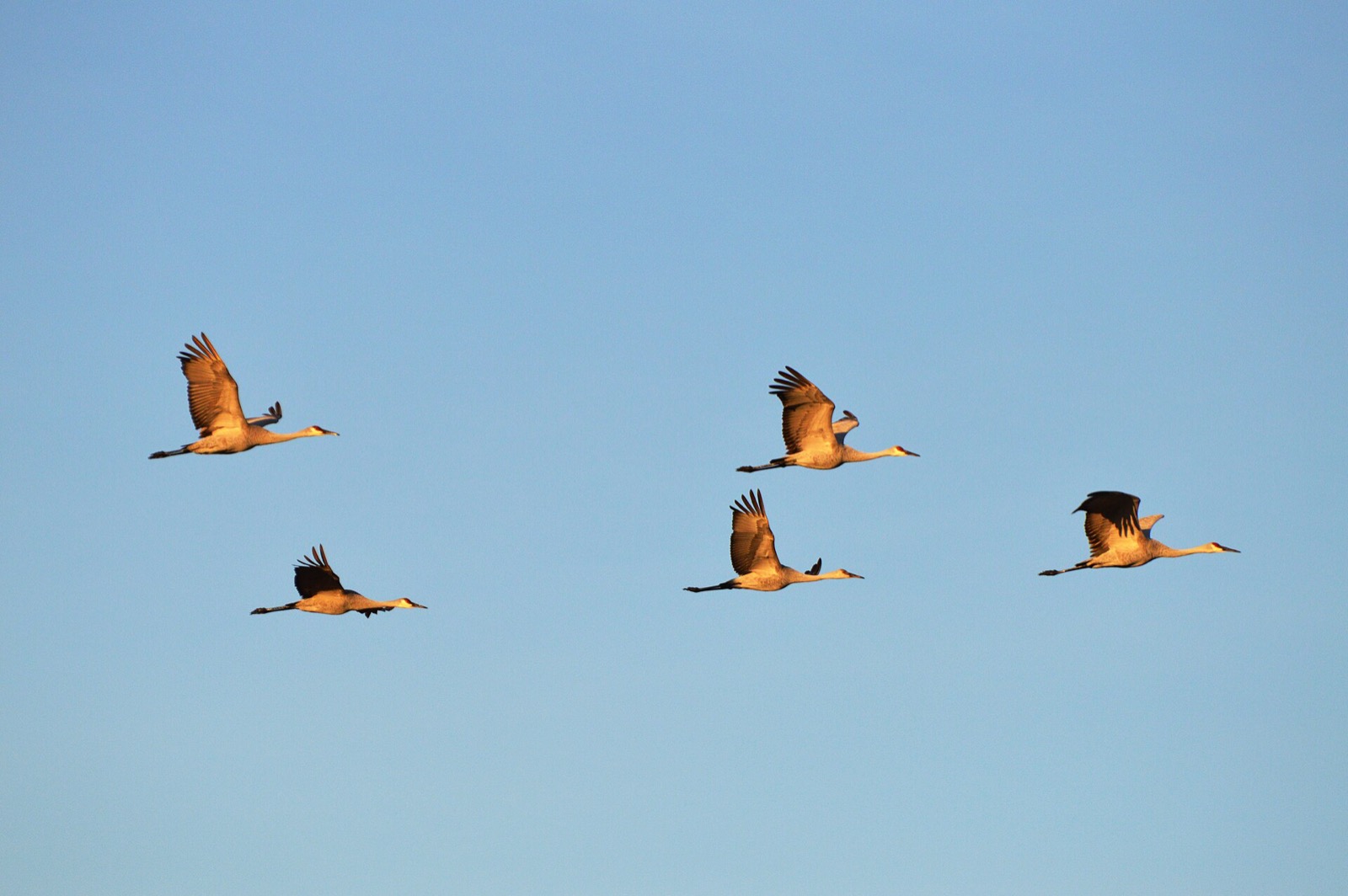
Sandhill cranes flying in a loose line across a pale open sky, necks held straight out in front and long legs trailing behind them
Sandhill cranes crossing a refuge on the morning flight. The movement is watched from the designated pullout or platform: the birds settle on shallow water for the night, and the roost itself is the one place a viewing site is never placed. “Sandhill cranes flying over Sherburne National Wildlife Refuge (24542820818)” by USFWS Midwest Region from United States, CC BY 2.0
Latest reports

What people have reported in Mississippi lately

The most recent research grade autumn observation of each species that anyone has uploaded to iNaturalist for Mississippi, as a date and the platform’s own coarse locality. Evidence that people do find sandhill crane and snow goose here. Each is one bird on one past day: the flocks move with the weather, so where they are this week is what the agency page and its counts answer.

Checking the most recent autumn uploads for Mississippi on iNaturalist...

Where Mississippi counts are published

Advertisement

Questions about Mississippi

Inventory compiled 2026-09-19 from the agency pages linked above. Agency text is quoted exactly with its source named and linked; the observation curves and latest reports are counts and dates from public uploads to iNaturalist.