
Skip to content

Fall Bird Migration in Vermont

The Champlain Valley's snow goose stop: the state agency's Dead Creek Wildlife Management Area has a Route 17 pull-off built for watching geese that peak from late October into early November, and a state park summit for the September to November hawk flight.

Agency viewing sites
2
Species documented
3
Mapped
2
Where to stand

Public viewing sites in Vermont

Every place below is one an agency itself describes for watching the fall passage, with the agency named and linked, the species it documents there, the months it names as the peak, and the facility that exists: a tour route, a platform, a tower, a visitor centre. Where the agency wrote a sentence worth reading, it is quoted exactly.

Dead Creek Wildlife Management Area, Route 17 viewing area StateMarquee site

Managed marsh, cornfields and clayplain forest along Dead Creek in Addison

Snow goose

The agency's brochure describes a pull-off on the south side of Route 17, one mile west of Route 22A, as an ideal place to view migrating waterfowl in fall, says the area has attracted around 20,000 snow geese each autumn with numbers typically peaking from late October to early November, and puts the best viewing in the first hours after sunrise and the last before sunset. The visitor center at 966 Route 17 opens Wednesday to Sunday, 10 to 4, from October 1 to November 23 in 2025. Gage Road's end gives a second view when geese are in the back of the refuge, and Brilyea Road follows the refuge's western boundary. The refuge and goose management area behind the viewing areas are closed to entry without a permit; the brochure says not to walk past the orange gates.

“Refuge Viewing Area. An easily-accessible pull-off along Route 17 is an ideal location to view migrating waterfowl in the fall.”
Vermont Fish and Wildlife Department, Dead Creek WMA brochure, quoted exactly.

Run by Vermont Fish and Wildlife Department

Mount Philo State Park State

968-foot summit above the Champlain Valley at Charlotte

Broad-winged hawkSharp-shinned hawk

Vermont Fish and Wildlife names the park as an especially good place to view hawks, with the migration starting in September and running through November, particularly on clear, warm autumn days, and says experienced birders are usually on hand on good days. The park page calls it an excellent spot to watch autumn bird migrations and notes it for raptor watching; the park's staffed season runs from the Friday of Memorial Day weekend through the second Monday in October, after which the summit road and facilities are closed for the season. The HawkCount profile says the count moved from the summit to the North Vista meadow at the blue gate, reached on foot from either parking lot, and records broad-winged and sharp-shinned hawks among the migrants counted.

Run by Vermont Department of Forests, Parks and Recreation; named for hawk watching by Vermont Fish and Wildlife

The map

Vermont sites, refuges and the reporting record

Style
Records
Layers

Viewing sites in Vermont, with the national wildlife refuges in the state drawn underneath. The coloured grid is where people have uploaded a verified sandhill crane record to iNaturalist in September, October, November and December, brighter where more have been logged. It is a map of reports rather than of birds: it thickens around refuges, car parks and towns because that is where observers stand, and it shows past reports rather than birds present today. Pins are public viewing sites an agency itself describes; grey dots are US Fish and Wildlife Service refuges and hatcheries, drawn because the refuge system is where most of the staging happens.

Advertisement
When

When the passage peaks in Vermont

Vermont Fish and Wildlife Department, Dead Creek WMA brochure and Top 10 Wildlife Watching Experiences puts the Vermont peak at late October to early November for snow geese, which are usually around from early October into mid-November. That describes a pattern across past autumns. The week itself swings with the weather: a cold front to the north moves cranes and geese south in a single night, and a warm spell holds them for weeks. Dawn and the last hour before dusk are when cranes and geese move between the fields and the water, and that movement is the spectacle the platforms are built for.

Vermont's fall migration concentrates where the Champlain Valley narrows the flyway. The state agency writes that geese on their journey from the Arctic tundra to the American South stop by the thousands in the wetlands and cornfields around Dead Creek, that snow geese have used the WMA each fall since the late 1980s, and that the best viewing is from the Route 17 pull-off at dawn and dusk; its brochure and map both describe the pull-off, the visitor center and the Gage Road and Brilyea Road viewpoints while keeping the refuge and goose management area behind them closed. The same agency's Top 10 list sends hawk watchers to Mount Philo, whose HawkCount count runs from the North Vista meadow. Missisquoi NWR at the north end of the lake is the federal counterpart for fall waterfowl.

Below, one curve per species the agencies document in Vermont: every research grade observation members of the public have uploaded to iNaturalist for the state, by calendar month across every year the platform holds, with September to December shaded. Counts of uploads, so they measure observers as well as birds, and the shape is worth reading where the absolute numbers are not.

Snow goose

302 research grade snow geese observations have been uploaded to iNaturalist for Vermont across every year the platform holds, and 59 percent of them fall in the four shaded autumn months. The busiest month in the record is November. An autumn month carries about 2.91 times as many uploads as an average month outside autumn. People upload most of everything in July, so a bar that rises after that is the stronger signal. Counts of what people reported, measuring observers as well as birds. See the autumn records.

Broad-winged hawk

1,155 research grade broad-winged hawks observations have been uploaded to iNaturalist for Vermont across every year the platform holds, and 11 percent of them fall in the four shaded autumn months. The busiest month in the record is May. An autumn month carries about 0.24 times as many uploads as an average month outside autumn. People upload most of everything in July, so a bar that rises after that is the stronger signal. Counts of what people reported, measuring observers as well as birds. See the autumn records.

Sharp-shinned hawk

282 research grade sharp-shinned hawks observations have been uploaded to iNaturalist for Vermont across every year the platform holds, and 39 percent of them fall in the four shaded autumn months. The busiest month in the record is April. An autumn month carries about 1.26 times as many uploads as an average month outside autumn. People upload most of everything in July, so a bar that rises after that is the stronger signal. Counts of what people reported, measuring observers as well as birds. See the autumn records.

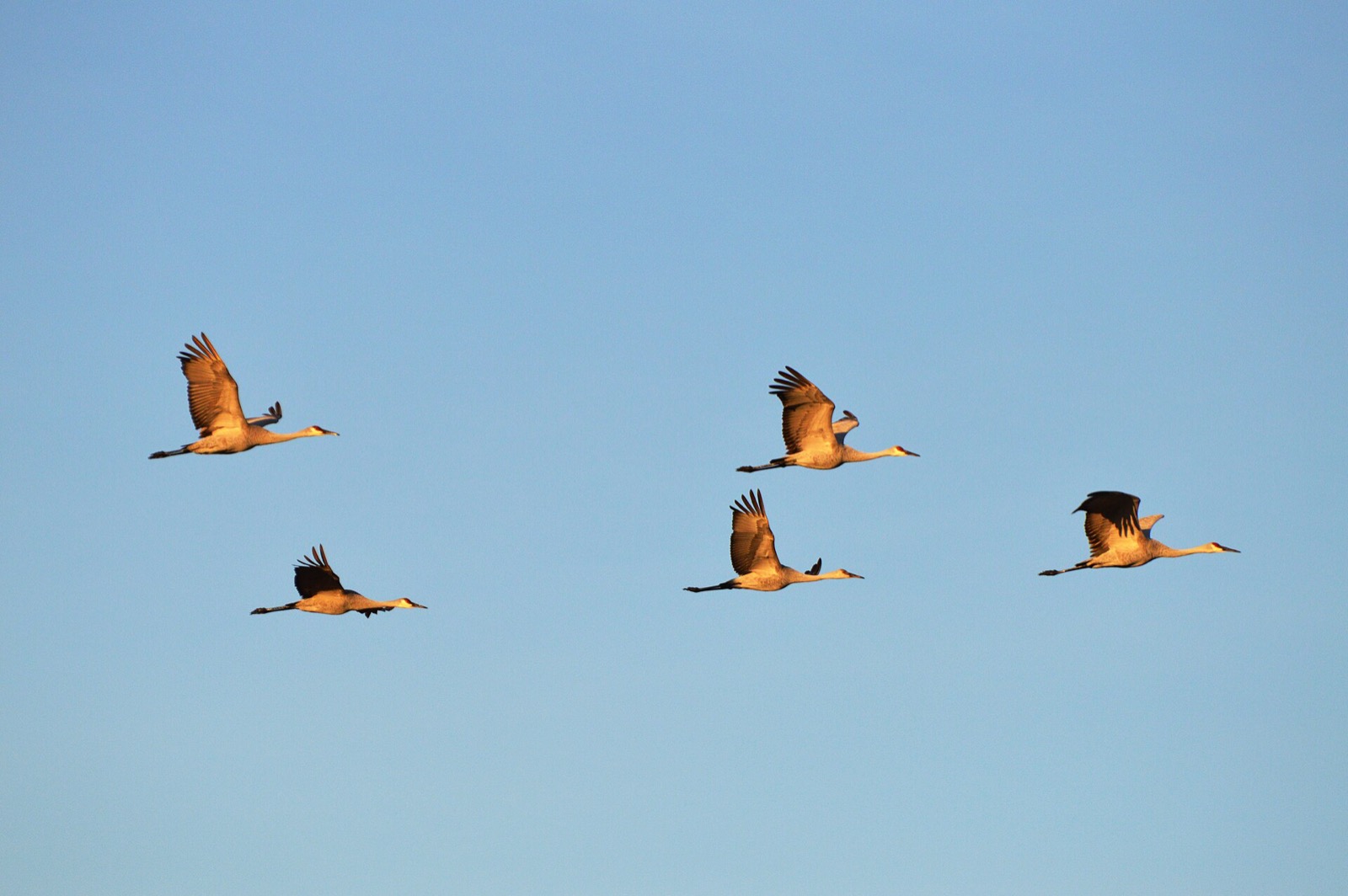
Sandhill cranes flying in a loose line across a pale open sky, necks held straight out in front and long legs trailing behind them
Sandhill cranes crossing a refuge on the morning flight. The movement is watched from the designated pullout or platform: the birds settle on shallow water for the night, and the roost itself is the one place a viewing site is never placed. “Sandhill cranes flying over Sherburne National Wildlife Refuge (24542820818)” by USFWS Midwest Region from United States, CC BY 2.0
Latest reports

What people have reported in Vermont lately

The most recent research grade autumn observation of each species that anyone has uploaded to iNaturalist for Vermont, as a date and the platform’s own coarse locality. Evidence that people do find snow goose and broad-winged hawk here. Each is one bird on one past day: the flocks move with the weather, so where they are this week is what the agency page and its counts answer.

Checking the most recent autumn uploads for Vermont on iNaturalist...

Organised events

Festivals and staffed weekends in Vermont

A staffed event is the easiest introduction to this: somebody has already found the birds, set up a scope and can say what is in view. Most organisers publish the dates only weeks ahead, so what follows names the organiser and the recurrence, and the organiser’s page carries this year’s date.

Advertisement

Questions about Vermont

Inventory compiled 2026-09-19 from the agency pages linked above. Agency text is quoted exactly with its source named and linked; the observation curves and latest reports are counts and dates from public uploads to iNaturalist.