
Skip to content

Fall Bird Migration in Texas

Texas has the Gulf Coast hawk flight at Corpus Christi, the wintering grounds of the last wild whooping crane flock at Aransas, and High Plains lakes where lesser sandhill cranes gather in one of North America's largest concentrations.

Agency viewing sites
5
Species documented
7
Mapped
5
Where to stand

Public viewing sites in Texas

Every place below is one an agency itself describes for watching the fall passage, with the agency named and linked, the species it documents there, the months it names as the peak, and the facility that exists: a tour route, a platform, a tower, a visitor centre. Where the agency wrote a sentence worth reading, it is quoted exactly.

Aransas National Wildlife Refuge, observation towers, Heron Flats Trail and the auto tour loop FederalMarquee site

Salt marsh, tidal flats and live oak savanna on San Antonio Bay near Austwell

Whooping crane

The refuge describes itself as the wintering home of the last wild flock of endangered whooping cranes and says they typically arrive in late October and depart by mid April. Public viewing is from the refuge's own structures: two observation towers, 20 and 40 feet, with a panoramic view of San Antonio Bay and Mustang Lake, the 1.22 mile Heron Flats Trail with two observation platforms equipped with spotting scopes, and a 16 mile paved auto tour loop that becomes one way at the observation tower. The visitor center at 1 Wildlife Circle, Austwell, opens Tuesday to Saturday, 9 am to 4 pm. The state agency reported the first pair of the 2023 season flying toward the refuge on November 1 and expected numbers near the estimated 540 cranes that wintered on the coast the previous year.

“Whooping cranes are the Refuge's most famous migrants, typically arriving in late October and departing by mid-April.”
US Fish and Wildlife Service, Aransas National Wildlife Refuge, quoted exactly.

Run by US Fish and Wildlife Service

Corpus Christi HawkWatch, Hazel Bazemore County Park viewing platform Public platformMarquee site

Bluff above a horseshoe bend of the Nueces River near Calallen, the highest ground on the coast in a four county area

Broad-winged hawkSharp-shinned hawk

The count runs daily from August 1 to November 15, 9 am to 5 pm weather permitting, from a deck that the HawkCount profile says holds up to 150 people with a 180 degree view and a shaded ramada; the operator says the public is always welcome to take advantage of the environmental education programs and hawkwatching at the site. The profile's season average for broad-winged hawks is 541,542 with a record season of 989,957 in 2004 and a record day on September 28, 2004; sharp-shinned hawks average 1,797 a season, Swainson's hawks 6,826 and Mississippi kites 19,307. The park is about 27 km west of Corpus Christi Bay off FM 624, and the operator's Celebration of Flight festival is timed to the peak broad-winged flight in the last week of September.

“The public is always welcome to take advantage of the environmental education programs and great hawkwatching at the site.”
HawkWatch International, Corpus Christi HawkWatch site profile on HawkCount, quoted exactly.

Run by HawkWatch International, on Nueces County's Hazel Bazemore Park

Smith Point Hawk Watch tower, Candy Cain Abshier Wildlife Management Area State

Tip of a peninsula jutting into Galveston Bay, Chambers County

Broad-winged hawkSharp-shinned hawk

The state agency says the WMA is famous for the daily hawk watches conducted from early August to November, sponsored by the Gulf Coast Bird Observatory, the Houston Ornithology Group and HawkWatch International, with tens of thousands of Mississippi kites, broad-winged hawks and other raptors seen annually. The HawkCount profile gives the count season as August 15 to November 15, run from a 7 metre tower at the southwestern tip of the peninsula, and reports a broad-winged hawk season average of 42,575 with a largest day of 49,992 on September 25, 2001, and a sharp-shinned average of 2,440. The WMA is reached by following FM 562 about 20 miles south from its junction with SH 61 and SH 65 to the parking area and tower.

“Candy Abshier WMA is famous for the daily hawk watches that are conducted from early August to November.”
Texas Parks and Wildlife Department, Candy Cain Abshier WMA, quoted exactly.

Run by Texas Parks and Wildlife Department, count by HawkWatch International and Gulf Coast Bird Observatory

Muleshoe National Wildlife Refuge, Paul's Lake Overlook and the White Lake and Goose Lake viewing areas Federal

Three saline lakes on the Southern High Plains, 20 miles south of Muleshoe

Sandhill crane

The oldest national wildlife refuge in Texas, established in 1935, says it is best known for hosting one of the largest concentrations of lesser sandhill cranes in North America, with roughly 15 percent of the population depending on it between fall and spring; the cranes typically begin arriving in September with peak numbers between December and February. The three lakes, Goose, White and Paul's, together hold nearly 600 acres of water when full. The agency's viewing points are Paul's Lake Overlook and the White Lake and Goose Lake viewing areas, plus a quarter mile nature trail by the primitive campground; the entrance gate at 1531 County Road 1248 operates 7:30 am to 7:30 pm and the headquarters office was listed as closed to public entry.

“The cranes typically begin arriving in September with peak numbers between December and February.”
US Fish and Wildlife Service, Muleshoe National Wildlife Refuge, quoted exactly.

Run by US Fish and Wildlife Service

Hagerman National Wildlife Refuge, Wildlife Drive and visitor center Federal

Shore of Lake Texoma and refuge grown wheat fields north of Sherman

Snow gooseRoss's gooseGreater white-fronted goose

The refuge says that starting in November geese by the thousands arrive from their northern breeding grounds, naming snow, white-fronted and Ross's geese along with pintails, mallards and gadwalls, that these winter residents feed on refuge grown grain, and that by late February the winter wheat has been eaten and the geese begin their journey north. The two mile Wildlife Drive along the Lake Texoma shore is open year round in daylight, the visitor center at 6465 Refuge Road, Sherman, opens Monday to Saturday 9 am to 4 pm and Sunday 1 to 5 pm, and five hiking trails and a photo blind are listed. Some units close for three day limited permit hunts in fall with the Wildlife Drive and trails staying open, and the drive is subject to flooding when Lake Texoma is high.

“Starting in November, geese by the thousands arrive at the refuge from their northern breeding grounds.”
US Fish and Wildlife Service, Hagerman National Wildlife Refuge, quoted exactly.

Run by US Fish and Wildlife Service

The map

Texas sites, refuges and the reporting record

Style
Records
Layers

Viewing sites in Texas, with the national wildlife refuges in the state drawn underneath. The coloured grid is where people have uploaded a verified sandhill crane record to iNaturalist in September, October, November and December, brighter where more have been logged. It is a map of reports rather than of birds: it thickens around refuges, car parks and towns because that is where observers stand, and it shows past reports rather than birds present today. Pins are public viewing sites an agency itself describes; grey dots are US Fish and Wildlife Service refuges and hatcheries, drawn because the refuge system is where most of the staging happens.

Advertisement
When

When the passage peaks in Texas

US Fish and Wildlife Service, Aransas, Hagerman and Muleshoe National Wildlife Refuges puts the Texas peak at late October into November for whooping cranes and geese, with sandhill crane numbers peaking December through February. That describes a pattern across past autumns. The week itself swings with the weather: a cold front to the north moves cranes and geese south in a single night, and a warm spell holds them for weeks. Dawn and the last hour before dusk are when cranes and geese move between the fields and the water, and that movement is the spectacle the platforms are built for.

Texas has three different fall migrations and an agency or operator page for each. On the Gulf Coast the movement is overhead: the Corpus Christi HawkWatch reports a season average above half a million broad-winged hawks from its public platform at Hazel Bazemore Park, and the state agency's own Smith Point tower on Galveston Bay hosts a second daily count from August to November. On the same coast the whooping cranes of the Aransas Wood Buffalo flock arrive at Aransas NWR in late October and stay to mid April, watched from the refuge's two towers, the Heron Flats platforms and the auto tour; this is the only whooping crane viewing recorded anywhere in this inventory. Inland, Hagerman on Lake Texoma reports geese by the thousands from November, and Muleshoe on the High Plains reports one of the largest lesser sandhill crane concentrations in North America, peaking December through February. TPWD publishes no fall count page; the count here is the operator's HawkCount summary.

Below, one curve per species the agencies document in Texas: every research grade observation members of the public have uploaded to iNaturalist for the state, by calendar month across every year the platform holds, with September to December shaded. Counts of uploads, so they measure observers as well as birds, and the shape is worth reading where the absolute numbers are not.

Sandhill crane

3,753 research grade sandhill cranes observations have been uploaded to iNaturalist for Texas across every year the platform holds, and 47 percent of them fall in the four shaded autumn months. The busiest month in the record is December. An autumn month carries about 1.8 times as many uploads as an average month outside autumn. People upload most of everything in April, so a bar that rises after that is the stronger signal. Counts of what people reported, measuring observers as well as birds. See the autumn records.

Snow goose

2,607 research grade snow geese observations have been uploaded to iNaturalist for Texas across every year the platform holds, and 51 percent of them fall in the four shaded autumn months. The busiest month in the record is December. An autumn month carries about 2.09 times as many uploads as an average month outside autumn. People upload most of everything in April, so a bar that rises after that is the stronger signal. Counts of what people reported, measuring observers as well as birds. See the autumn records.

Ross's goose

740 research grade Ross's geese observations have been uploaded to iNaturalist for Texas across every year the platform holds, and 49 percent of them fall in the four shaded autumn months. The busiest month in the record is January. An autumn month carries about 1.92 times as many uploads as an average month outside autumn. People upload most of everything in April, so a bar that rises after that is the stronger signal. Counts of what people reported, measuring observers as well as birds. See the autumn records.

Greater white-fronted goose

774 research grade greater white-fronted geese observations have been uploaded to iNaturalist for Texas across every year the platform holds, and 56 percent of them fall in the four shaded autumn months. The busiest month in the record is December. An autumn month carries about 2.58 times as many uploads as an average month outside autumn. People upload most of everything in April, so a bar that rises after that is the stronger signal. Counts of what people reported, measuring observers as well as birds. See the autumn records.

Broad-winged hawk

2,581 research grade broad-winged hawks observations have been uploaded to iNaturalist for Texas across every year the platform holds, and 24 percent of them fall in the four shaded autumn months. The busiest month in the record is April. An autumn month carries about 0.63 times as many uploads as an average month outside autumn. People upload most of everything in April, so a bar that rises after that is the stronger signal. Counts of what people reported, measuring observers as well as birds. See the autumn records.

Sharp-shinned hawk

1,622 research grade sharp-shinned hawks observations have been uploaded to iNaturalist for Texas across every year the platform holds, and 47 percent of them fall in the four shaded autumn months. The busiest month in the record is January. An autumn month carries about 1.77 times as many uploads as an average month outside autumn. People upload most of everything in April, so a bar that rises after that is the stronger signal. Counts of what people reported, measuring observers as well as birds. See the autumn records.

Whooping crane

2,875 research grade whooping cranes observations have been uploaded to iNaturalist for Texas across every year the platform holds, and 33 percent of them fall in the four shaded autumn months. The busiest month in the record is February. An autumn month carries about 0.99 times as many uploads as an average month outside autumn. People upload most of everything in April, so a bar that rises after that is the stronger signal. Counts of what people reported, measuring observers as well as birds. See the autumn records.

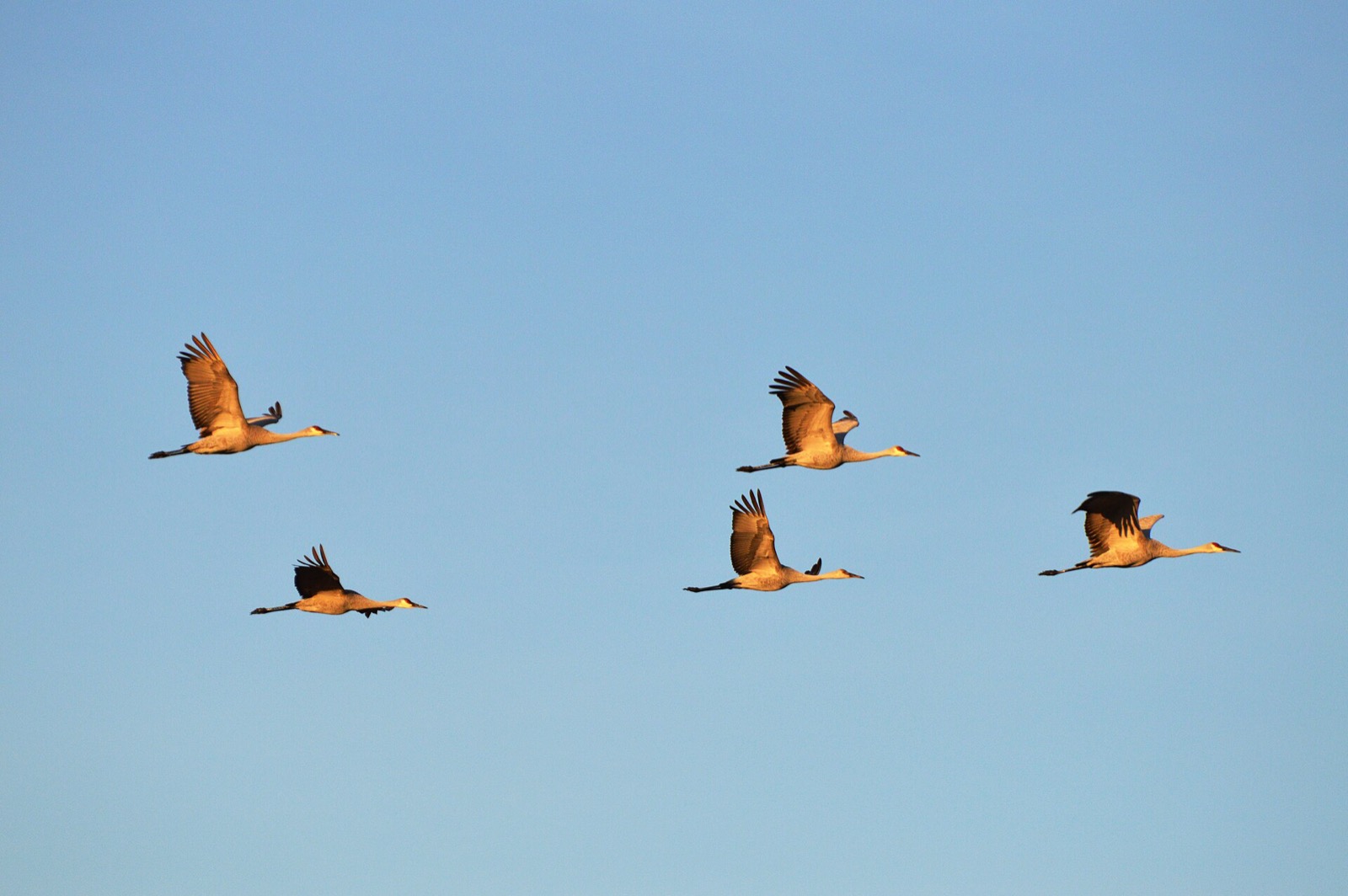
Sandhill cranes flying in a loose line across a pale open sky, necks held straight out in front and long legs trailing behind them
Sandhill cranes crossing a refuge on the morning flight. The movement is watched from the designated pullout or platform: the birds settle on shallow water for the night, and the roost itself is the one place a viewing site is never placed. “Sandhill cranes flying over Sherburne National Wildlife Refuge (24542820818)” by USFWS Midwest Region from United States, CC BY 2.0
Latest reports

What people have reported in Texas lately

The most recent research grade autumn observation of each species that anyone has uploaded to iNaturalist for Texas, as a date and the platform’s own coarse locality. Evidence that people do find sandhill crane and snow goose here. Each is one bird on one past day: the flocks move with the weather, so where they are this week is what the agency page and its counts answer.

Checking the most recent autumn uploads for Texas on iNaturalist...

Where Texas counts are published

Organised events

Festivals and staffed weekends in Texas

A staffed event is the easiest introduction to this: somebody has already found the birds, set up a scope and can say what is in view. Most organisers publish the dates only weeks ahead, so what follows names the organiser and the recurrence, and the organiser’s page carries this year’s date.

Celebration of Flight

annual, late September, during the peak broad-winged hawk flight

The operator's festival at the Hazel Bazemore Park viewing platform; the current listing gives September 25 to 27.

Dates are published by the organiser each year HawkWatch International, Corpus Christi HawkWatch

Advertisement

Questions about Texas

Inventory compiled 2026-09-19 from the agency pages linked above. Agency text is quoted exactly with its source named and linked; the observation curves and latest reports are counts and dates from public uploads to iNaturalist.