
Skip to content

Fall Bird Migration in New Mexico

The Middle Rio Grande and Pecos valleys, where Bosque del Apache, Bitter Lake and the state's Bernardo Wildlife Area flood fields for tens of thousands of sandhill cranes, snow geese and Ross's geese that begin arriving at the end of October.

Agency viewing sites
5
Species documented
4
Mapped
4
Where to stand

Public viewing sites in New Mexico

Every place below is one an agency itself describes for watching the fall passage, with the agency named and linked, the species it documents there, the months it names as the peak, and the facility that exists: a tour route, a platform, a tower, a visitor centre. Where the agency wrote a sentence worth reading, it is quoted exactly.

Bosque del Apache National Wildlife Refuge, auto tour loop FederalMarquee site

Flooded fields and managed wetlands along the Rio Grande south of San Antonio, New Mexico

Sandhill craneSnow gooseRoss's goose

The refuge says the first cranes and geese typically show up at the end of October and that from mid-November through late January thousands of snow geese, Ross's geese and sandhill cranes spend the night in water, leaving near dawn to feed in fields across the Middle Rio Grande Valley. The roughly 12 mile scenic drive is open every day from one hour before sunrise to one hour after sunset year round, with stops including the Dabbler and Diver Deck, a boardwalk and the Rio Viejo Trail. The visitor center is open Thursday through Tuesday, 9 am to 4 pm, and the refuge asks visitors to stop there for the most recent roosting and feeding sites, which change through the winter. A $5 daily vehicle fee applies.

“The first cranes and geese typically show up at the end of October.”
US Fish and Wildlife Service, Bosque del Apache National Wildlife Refuge, quoted exactly.

Run by US Fish and Wildlife Service

Bitter Lake National Wildlife Refuge, Wildlife Drive FederalMarquee site

Pecos River wetlands, springs and moist soil units where the Chihuahuan Desert meets the Southern Plains, east of Roswell

Sandhill craneSnow goose

The refuge says its sandhill cranes start showing up in October and continue through December, with the peak around Thanksgiving, and describes more than 26,000 cranes and more than 50,000 snow geese and ducks during fall migration. The 6.5 mile Wildlife Drive and the trails are open daily from sunrise to sunset, the visitor center with its viewing deck over the wetlands and Comanche Bluff is open Monday through Saturday, 9 am to 4 pm, from September through June, and the Pajaro bird blind sits off the drive. There is no charge to visit.

“The sandhill cranes start migrating and showing up at the refuge in October and continue through December, with the peak around Thanksgiving.”
US Fish and Wildlife Service, Bitter Lake National Wildlife Refuge, quoted exactly.

Run by US Fish and Wildlife Service

Bernardo Wildlife Area, Ladd S. Gordon Waterfowl Complex, auto tour route State

1,675 acres of flat cropland flooded in late fall and winter, between Belen and Socorro, between I-25 and the Rio Grande

Sandhill crane

The state agency's area sheet lists wildlife viewing and photography on an auto tour route with viewing platforms, restricts viewing, photography and hiking to the route, parking areas and platforms, and says wildlife watchers may see waterfowl, sandhill cranes, elk and raptors. Fields are flooded in late fall and winter for roosting waterfowl. Vehicle access is daily from November 10 to February 28, half an hour before sunrise to half an hour after sunset, and weekdays only from March 1 to November 9; walk-in access is daily. Wildlife viewers need no license. Restrooms, no drinking water, no camping.

“To protect wildlife and public safety, wildlife viewing/photography/hiking is restricted to the Auto Tour Route, parking areas, and viewing platforms.”
New Mexico Department of Game and Fish, Bernardo Wildlife Area, quoted exactly.

Run by New Mexico Department of Game and Fish

Las Vegas National Wildlife Refuge, auto tour loop and Crane Lake overlook Federal

Grassland, lakes and marsh on the edge of the Great Plains southeast of Las Vegas, New Mexico

Sandhill crane

Peak months as the agency page describes them.

The refuge says its sandhill cranes arrive in the fall on their way to their winter home and does not state months. An 8 mile horseshoe auto tour loop along County Road 22C and Highway 281 is accessible year round, with parts of the county road difficult after heavy rain; the Crane Lake overlook is about three quarters of a mile south of the visitor center on Highway 281, and the 1.75 mile Gallinas Nature Trail is open sunup to sundown. The visitor center keeps limited hours, Tuesday through Thursday, 9 am to 3 pm.

“The sandhill cranes arrive in the fall as they migrate to their winter home.”
US Fish and Wildlife Service, Las Vegas National Wildlife Refuge, quoted exactly.

Run by US Fish and Wildlife Service

Manzano Mountains HawkWatch, Capilla Peak Public platform

Ridge crest of the Manzano Mountains in the Cibola National Forest, southeast of Albuquerque

Sharp-shinned hawk

Listed so you do not drive to it this year. HawkWatch International has counted the fall raptor flight here since 1985, normally August 27 to November 5, with 5,000 to 7,000 migrants of up to 18 species a season and sharp-shinned and Cooper's hawks among the most numerous; the observation point is a 0.7 mile hike from the Capilla Peak trailhead. The HawkCount profile states that 2026 migration monitoring is suspended because of continued fire activity, containment and clean-up efforts and forest closures related to the Whiskey Fire, with counts expected to resume in 2027.

Run by HawkWatch International, with the Cibola National Forest

The map

New Mexico sites, refuges and the reporting record

Style
Records
Layers

Viewing sites in New Mexico, with the national wildlife refuges in the state drawn underneath. The coloured grid is where people have uploaded a verified sandhill crane record to iNaturalist in September, October, November and December, brighter where more have been logged. It is a map of reports rather than of birds: it thickens around refuges, car parks and towns because that is where observers stand, and it shows past reports rather than birds present today. Pins are public viewing sites an agency itself describes; grey dots are US Fish and Wildlife Service refuges and hatcheries, drawn because the refuge system is where most of the staging happens.

Advertisement
When

When the passage peaks in New Mexico

US Fish and Wildlife Service, Bosque del Apache National Wildlife Refuge puts the New Mexico peak at the first cranes and geese at the end of October, with thousands roosting on Bosque del Apache from mid-November through late January; Bitter Lake puts its crane peak around Thanksgiving. That describes a pattern across past autumns. The week itself swings with the weather: a cold front to the north moves cranes and geese south in a single night, and a warm spell holds them for weeks. Dawn and the last hour before dusk are when cranes and geese move between the fields and the water, and that movement is the spectacle the platforms are built for.

New Mexico is where the Rocky Mountain population of greater sandhill cranes ends its journey from Idaho, Wyoming and the San Luis Valley, joined on the Middle Rio Grande by lesser sandhills and by snow and Ross's geese from the Arctic. The federal refuge at Bosque del Apache and the state's Ladd S. Gordon Waterfowl Complex work the same valley the same way, flooding harvested fields so the birds roost in shallow water at night and fly out to feed at dawn, and both agencies describe that daily flight rather than promise it. Bitter Lake on the Pecos does the same for a separate, largely Central Flyway crowd east of the mountains. The Manzano ridge above the valley carries the state's long-running raptor count, whose 2026 season is suspended after the Whiskey Fire. La Joya Wildlife Area, the other viewing unit of the Ladd S. Gordon complex, is closed to wildlife viewing from September 1 to March 14 and is not listed.

Below, one curve per species the agencies document in New Mexico: every research grade observation members of the public have uploaded to iNaturalist for the state, by calendar month across every year the platform holds, with September to December shaded. Counts of uploads, so they measure observers as well as birds, and the shape is worth reading where the absolute numbers are not.

Sandhill crane

2,256 research grade sandhill cranes observations have been uploaded to iNaturalist for New Mexico across every year the platform holds, and 64 percent of them fall in the four shaded autumn months. The busiest month in the record is November. An autumn month carries about 3.53 times as many uploads as an average month outside autumn. People upload most of everything in July, so a bar that rises after that is the stronger signal. Counts of what people reported, measuring observers as well as birds. See the autumn records.

Snow goose

986 research grade snow geese observations have been uploaded to iNaturalist for New Mexico across every year the platform holds, and 54 percent of them fall in the four shaded autumn months. The busiest month in the record is November. An autumn month carries about 2.35 times as many uploads as an average month outside autumn. People upload most of everything in July, so a bar that rises after that is the stronger signal. Counts of what people reported, measuring observers as well as birds. See the autumn records.

Ross's goose

234 research grade Ross's geese observations have been uploaded to iNaturalist for New Mexico across every year the platform holds, and 54 percent of them fall in the four shaded autumn months. The busiest month in the record is November. An autumn month carries about 2.37 times as many uploads as an average month outside autumn. People upload most of everything in July, so a bar that rises after that is the stronger signal. Counts of what people reported, measuring observers as well as birds. See the autumn records.

Sharp-shinned hawk

293 research grade sharp-shinned hawks observations have been uploaded to iNaturalist for New Mexico across every year the platform holds, and 51 percent of them fall in the four shaded autumn months. The busiest month in the record is December. An autumn month carries about 2.1 times as many uploads as an average month outside autumn. People upload most of everything in July, so a bar that rises after that is the stronger signal. Counts of what people reported, measuring observers as well as birds. See the autumn records.

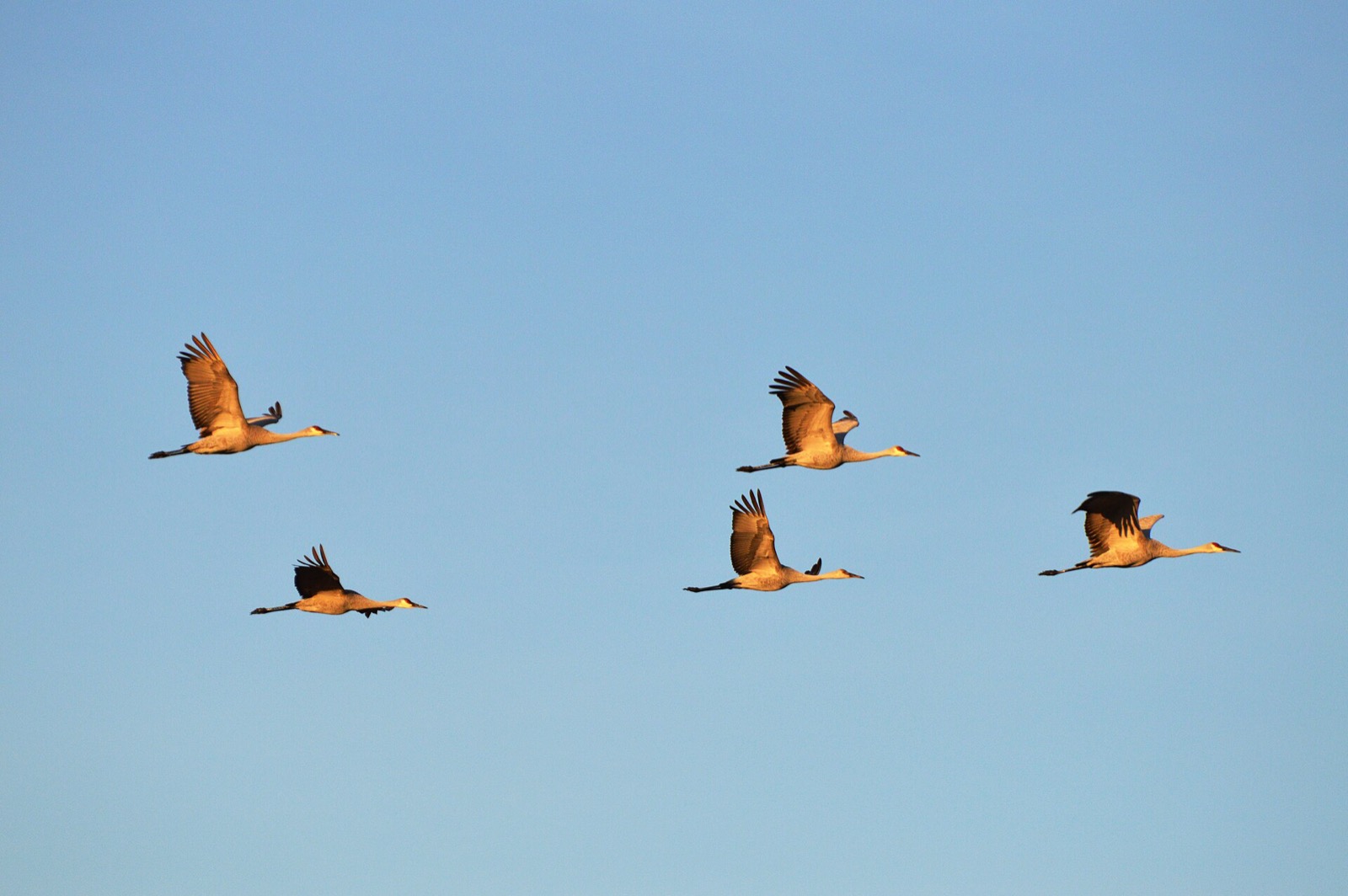
Sandhill cranes flying in a loose line across a pale open sky, necks held straight out in front and long legs trailing behind them
Sandhill cranes crossing a refuge on the morning flight. The movement is watched from the designated pullout or platform: the birds settle on shallow water for the night, and the roost itself is the one place a viewing site is never placed. “Sandhill cranes flying over Sherburne National Wildlife Refuge (24542820818)” by USFWS Midwest Region from United States, CC BY 2.0
Latest reports

What people have reported in New Mexico lately

The most recent research grade autumn observation of each species that anyone has uploaded to iNaturalist for New Mexico, as a date and the platform’s own coarse locality. Evidence that people do find sandhill crane and snow goose here. Each is one bird on one past day: the flocks move with the weather, so where they are this week is what the agency page and its counts answer.

Checking the most recent autumn uploads for New Mexico on iNaturalist...

Organised events

Festivals and staffed weekends in New Mexico

A staffed event is the easiest introduction to this: somebody has already found the birds, set up a scope and can say what is in view. Most organisers publish the dates only weeks ahead, so what follows names the organiser and the recurrence, and the organiser’s page carries this year’s date.

Festival of the Cranes

annual, early December; December 2 to 5 in 2026

Workshops, tours, hikes and photography sessions at the refuge and the Socorro Convention Center marking the arrival of wintering cranes and geese. The refuge's event page records that the 2025 festival was cancelled.

Dates are published by the organiser each year Friends of Bosque del Apache National Wildlife Refuge, co-hosted with the refuge

Advertisement

Questions about New Mexico

Inventory compiled 2026-09-19 from the agency pages linked above. Agency text is quoted exactly with its source named and linked; the observation curves and latest reports are counts and dates from public uploads to iNaturalist.