
Skip to content

Fall Bird Migration in Washington

Two flyway funnels: the Skagit delta, where the state bought Fir Island Farm as an undisturbed feeding area for snow geese, and the lower Columbia bottomlands at Ridgefield, which the state agency calls a staging area for the whole Pacific Flyway population of Canadian sandhill cranes.

Agency viewing sites
4
Species documented
3
Mapped
4
Where to stand

Public viewing sites in Washington

Every place below is one an agency itself describes for watching the fall passage, with the agency named and linked, the species it documents there, the months it names as the peak, and the facility that exists: a tour route, a platform, a tower, a visitor centre. Where the agency wrote a sentence worth reading, it is quoted exactly.

Fir Island Farm Reserve Wildlife Area Unit, dike top trail StateMarquee site

Managed farm fields and 131 acres of restored tidal estuary on Skagit Bay, Fir Island Road west of Conway

Snow goose

The state agency bought this 280 acre game reserve in the late 1990s as an undisturbed feeding and resting area for snow geese next to the Skagit Bay estuary and says it attracts thousands of snow geese, swans, ducks and shorebirds in the fall through early spring, with the geese staying through March 31. Hunting and trapping are not allowed on the unit. Public access is restricted to the entrance road, the parking area and a short dike top walking trail with estuary on both sides; the unit is closed during hours of darkness, there are no restrooms, and a Discover Pass is required.

“This unit attracts thousands of snow geese in the fall through early spring.”
Washington Department of Fish and Wildlife, quoted exactly.

Run by Washington Department of Fish and Wildlife

Ridgefield National Wildlife Refuge, River S Unit auto tour route FederalMarquee site

Columbia River floodplain lakes, marsh and pasture between the river and the town of Ridgefield, north of Vancouver

Sandhill crane

The refuge was established in 1965 for wintering dusky Canada geese and names sandhill cranes among its wildlife; the state agency's status review says the entire Pacific Flyway population of perhaps 4,500 Canadian sandhill cranes uses the lower Columbia bottomlands as a staging area and that cranes move through the state in late September and October. The River S Unit auto tour route at 1071 S Hillhurst Road is open daily, 7 am to 7:30 pm, with vehicles serving as viewing blinds from October through April, when walking the route is not permitted; walking is allowed May through September only. The Carty Unit's Oaks to Wetlands Trail stays open year round. This is a fee site.

“During fall, Canadian and Lesser Sandhill Cranes migrate through the state in late September and October using the same general routes and stopping in the same areas used for staging in spring.”
Washington Department of Fish and Wildlife, Periodic Status Review for the Sandhill Crane, quoted exactly.

Run by US Fish and Wildlife Service

Franz Lake National Wildlife Refuge, State Route 14 overlook Federal

Franz and Arthur lakes on the Columbia River floodplain in the Columbia River Gorge, east of Skamania

Tundra swan

Peak months as the agency page describes them.

The refuge describes itself as known for its seasonal abundance of tundra swans, with Franz and Arthur lakes providing critical habitat for wintering swans and other waterfowl, and says it offers travellers the chance to view nature from an overlook off State Route 14. The overlook is the only public facility the agency describes. No months are stated.

“Franz and Arthur lakes provide critical habitat for wintering tundra swans and other waterfowl.”
US Fish and Wildlife Service, Franz Lake National Wildlife Refuge, quoted exactly.

Run by US Fish and Wildlife Service

Columbia National Wildlife Refuge Federal

Channeled scablands lakes and irrigated cropland of the Columbia Basin south of Othello

Sandhill craneTundra swan

Peak months as the agency page describes them.

The refuge says its lakes and surrounding irrigated cropland, mild winters and refuge protection attract large numbers of migrating and wintering mallards, Canada geese, tundra swans and other waterfowl, and that it provides habitat for roosting sandhill cranes. Some of the refuge, including the main canoe trail and three of the four hiking trails, is open only from March 1 to September 30 as sanctuary for wintering waterfowl, and a small section closes from February 1 to April for roosting cranes, so fall access is limited to the areas that stay open. The office at 51 South Morgan Lake Road is open 8 am to 5 pm when staff are present.

“Some of the refuge is only open from March 1 to September 30 to provide sanctuary for wintering waterfowl.”
US Fish and Wildlife Service, Columbia National Wildlife Refuge, quoted exactly.

Run by US Fish and Wildlife Service

The map

Washington sites, refuges and the reporting record

Style
Records
Layers

Viewing sites in Washington, with the national wildlife refuges in the state drawn underneath. The coloured grid is where people have uploaded a verified sandhill crane record to iNaturalist in September, October, November and December, brighter where more have been logged. It is a map of reports rather than of birds: it thickens around refuges, car parks and towns because that is where observers stand, and it shows past reports rather than birds present today. Pins are public viewing sites an agency itself describes; grey dots are US Fish and Wildlife Service refuges and hatcheries, drawn because the refuge system is where most of the staging happens.

Advertisement
When

When the passage peaks in Washington

Washington Department of Fish and Wildlife, Periodic Status Review for the Sandhill Crane (2017) puts the Washington peak at late September and October for sandhill cranes moving through the state; snow geese arrive on the Skagit delta in fall and stay through early spring. That describes a pattern across past autumns. The week itself swings with the weather: a cold front to the north moves cranes and geese south in a single night, and a warm spell holds them for weeks. Dawn and the last hour before dusk are when cranes and geese move between the fields and the water, and that movement is the spectacle the platforms are built for.

Washington's fall migration runs down two corridors the state agency documents separately. On the coast, the Skagit and Samish flats take snow geese from Wrangel Island and swans from the north from October, and the state's own purchase of Fir Island Farm as a no-hunting reserve is the clearest agency-designated place to watch them from a dike. Inland and to the south, the state's status review for the sandhill crane says more than 35,000 lesser sandhills stop in the southcentral Columbia Basin around Othello and that the lower Columbia bottomlands at Ridgefield stage the whole Pacific Flyway population of Canadian sandhills, with the passage in late September and October. Ridgefield's answer to disturbance is to turn cars into blinds: from October through April the auto tour is driven, not walked.

Below, one curve per species the agencies document in Washington: every research grade observation members of the public have uploaded to iNaturalist for the state, by calendar month across every year the platform holds, with September to December shaded. Counts of uploads, so they measure observers as well as birds, and the shape is worth reading where the absolute numbers are not.

Sandhill crane

621 research grade sandhill cranes observations have been uploaded to iNaturalist for Washington across every year the platform holds, and 39 percent of them fall in the four shaded autumn months. The busiest month in the record is March. An autumn month carries about 1.29 times as many uploads as an average month outside autumn. People upload most of everything in July, so a bar that rises after that is the stronger signal. Counts of what people reported, measuring observers as well as birds. See the autumn records.

Snow goose

1,748 research grade snow geese observations have been uploaded to iNaturalist for Washington across every year the platform holds, and 45 percent of them fall in the four shaded autumn months. The busiest month in the record is March. An autumn month carries about 1.64 times as many uploads as an average month outside autumn. People upload most of everything in July, so a bar that rises after that is the stronger signal. Counts of what people reported, measuring observers as well as birds. See the autumn records.

Tundra swan

510 research grade tundra swans observations have been uploaded to iNaturalist for Washington across every year the platform holds, and 38 percent of them fall in the four shaded autumn months. The busiest month in the record is March. An autumn month carries about 1.25 times as many uploads as an average month outside autumn. People upload most of everything in July, so a bar that rises after that is the stronger signal. Counts of what people reported, measuring observers as well as birds. See the autumn records.

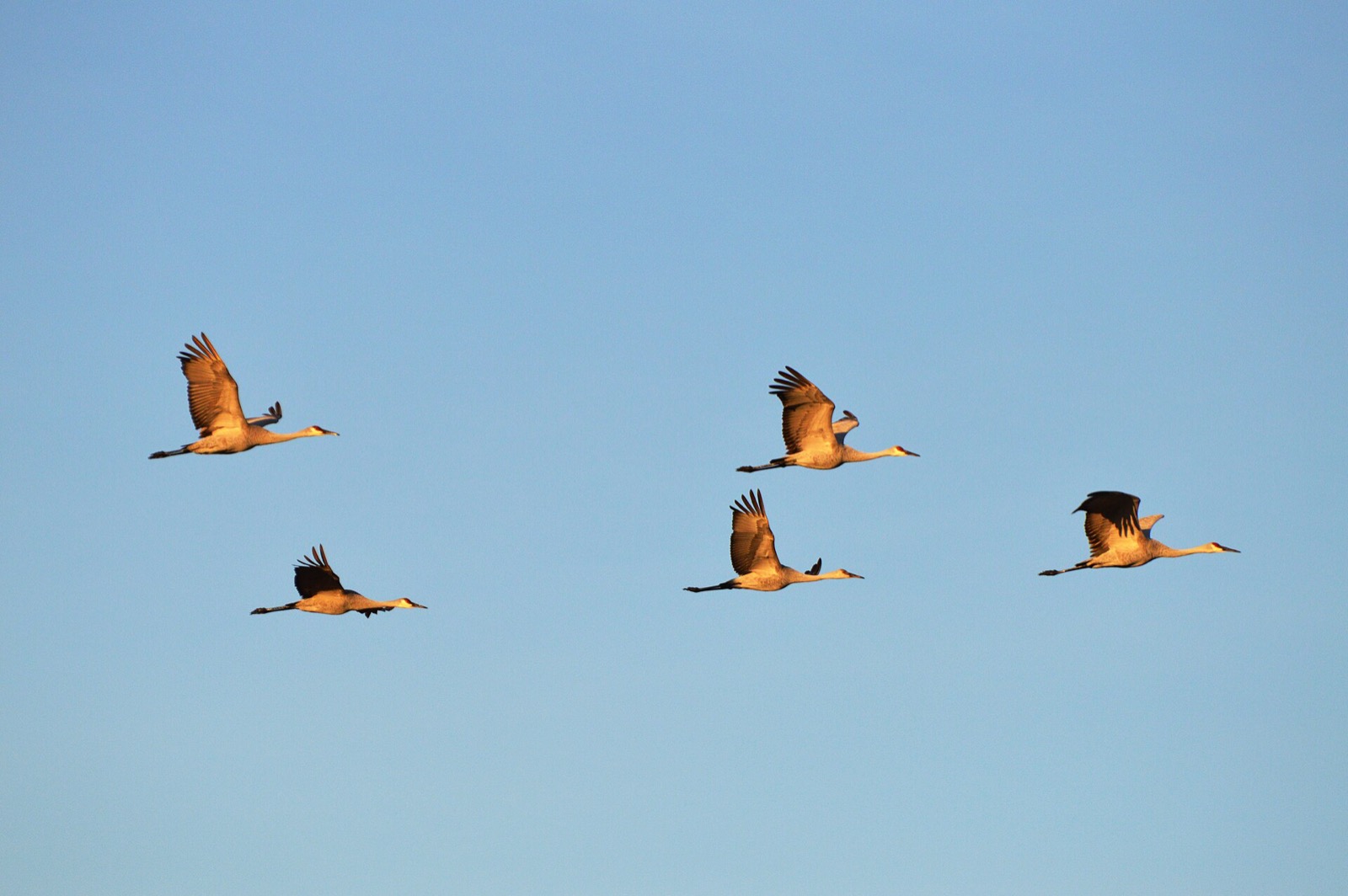
Sandhill cranes flying in a loose line across a pale open sky, necks held straight out in front and long legs trailing behind them
Sandhill cranes crossing a refuge on the morning flight. The movement is watched from the designated pullout or platform: the birds settle on shallow water for the night, and the roost itself is the one place a viewing site is never placed. “Sandhill cranes flying over Sherburne National Wildlife Refuge (24542820818)” by USFWS Midwest Region from United States, CC BY 2.0
Latest reports

What people have reported in Washington lately

The most recent research grade autumn observation of each species that anyone has uploaded to iNaturalist for Washington, as a date and the platform’s own coarse locality. Evidence that people do find sandhill crane and snow goose here. Each is one bird on one past day: the flocks move with the weather, so where they are this week is what the agency page and its counts answer.

Checking the most recent autumn uploads for Washington on iNaturalist...

Organised events

Festivals and staffed weekends in Washington

A staffed event is the easiest introduction to this: somebody has already found the birds, set up a scope and can say what is in view. Most organisers publish the dates only weeks ahead, so what follows names the organiser and the recurrence, and the organiser’s page carries this year’s date.

Advertisement

Questions about Washington

Inventory compiled 2026-09-19 from the agency pages linked above. Agency text is quoted exactly with its source named and linked; the observation curves and latest reports are counts and dates from public uploads to iNaturalist.