
Skip to content

Fall Bird Migration in Tennessee

Tennessee holds the largest winter flock of sandhill cranes in the Southeast outside Florida, and the state keeps the Hiwassee observation platform open through the months the rest of the refuge is closed.

Agency viewing sites
3
Species documented
4
Mapped
3
Where to stand

Public viewing sites in Tennessee

Every place below is one an agency itself describes for watching the fall passage, with the agency named and linked, the species it documents there, the months it names as the peak, and the facility that exists: a tour route, a platform, a tower, a visitor centre. Where the agency wrote a sentence worth reading, it is quoted exactly.

Hiwassee Refuge observation platform, Birchwood StateMarquee site

Six thousand acres of fields and open water on Chickamauga Lake where the Hiwassee River meets the Tennessee

Sandhill craneWhooping crane

TWRA describes 6,000 acres, about 2,500 of land and 3,500 of water, at the confluence of the Hiwassee and Tennessee rivers, and calls the flock that winters here the largest in the southeast United States outside Florida. Sandhill cranes started stopping in the early 1990s and the river reach now holds well over 20,000 in a winter. The agency publishes the platform's own coordinates and reaches it from Interstate 75 exit 25 at Cleveland, north on Highway 60 through Birchwood. The refuge itself closes from November 15 to the last day in February; the observation platform stays open through that stretch, which is exactly when the cranes are there.

“From the Observation Platform, visitors can view Sandhill Cranes and an occasional endangered Whooping Crane from November through February.”
Tennessee Wildlife Resources Agency, Hiwassee Refuge, quoted exactly.

Run by Tennessee Wildlife Resources Agency

Soddy Mountain Hawk Watch, Soddy-Daisy Public platformMarquee site

Eastern face of Walden Ridge on the Cumberland Escarpment, looking out over the Tennessee River valley

Broad-winged hawkSharp-shinned hawk

The HawkCount profile places the watch in southeast Tennessee on the eastern face of Walden Ridge in Hamilton County, a short way north of Soddy-Daisy at the eastern end of Jones Gap Road, on state-owned land. The fall season is given as September 8 through December 31. Broad-winged hawks are the volume bird, averaging a couple of thousand a season, with the best season past 8,000 in 2015.

Run by State-owned land in Hamilton County; count reported to HawkCount

Big Bald raptor count, Cherokee National Forest Public platform

Grassy bald with low hardwood forest near the summit, on the Tennessee and North Carolina line

Broad-winged hawkSharp-shinned hawk

The HawkCount profile describes a grassy bald with a low forest of hardwoods and long views to the north, northwest and northeast on clear days, on ground managed by the Cherokee and Pisgah national forests. Counts are made near the summit through the middle of the day from the first week in September until early November, which puts the broad-winged movement inside the first half of the season.

“Daily raptor migration counts are conducted near the summit of Big Bald Mountain, from approximately 1000 AM to 1700 PM from the first week in September until early November.”
HawkCount.org, Big Bald site profile, quoted exactly.

Run by Cherokee National Forest and Pisgah National Forest land; count reported to HawkCount

The map

Tennessee sites, refuges and the reporting record

Style
Records
Layers

Viewing sites in Tennessee, with the national wildlife refuges in the state drawn underneath. The coloured grid is where people have uploaded a verified sandhill crane record to iNaturalist in September, October, November and December, brighter where more have been logged. It is a map of reports rather than of birds: it thickens around refuges, car parks and towns because that is where observers stand, and it shows past reports rather than birds present today. Pins are public viewing sites an agency itself describes; grey dots are US Fish and Wildlife Service refuges and hatcheries, drawn because the refuge system is where most of the staging happens.

Advertisement
When

When the passage peaks in Tennessee

Tennessee Wildlife Resources Agency, Hiwassee Refuge, and HawkCount.org, Soddy Mountain site profile puts the Tennessee peak at Cranes are at the Hiwassee observation platform from November through February, with peak numbers in January; the raptor season on the Cumberland Escarpment at Soddy Mountain runs September 8 through December 31. That describes a pattern across past autumns. The week itself swings with the weather: a cold front to the north moves cranes and geese south in a single night, and a warm spell holds them for weeks. Dawn and the last hour before dusk are when cranes and geese move between the fields and the water, and that movement is the spectacle the platforms are built for.

Tennessee's fall splits cleanly in two. On the Cumberland Escarpment west of Chattanooga, the long eastern face of Walden Ridge works the way the Blue Ridge does further east, and the Soddy Mountain count picks up broad-winged hawks through September before the season runs on to the end of December; Big Bald does the same job up on the North Carolina line, counted from the first week of September until early November. Then, as the hawks thin out, the cranes arrive. Sandhill cranes began stopping at the Hiwassee bottoms in the early 1990s on their way to and from Georgia and Florida, and enough of them now stay that the reach holds the largest winter flock in the Southeast outside Florida, with an occasional whooping crane among them. TWRA closes the refuge from November 15 through February but keeps the observation platform open, so the viewing runs exactly through the months the birds are there.

Below, one curve per species the agencies document in Tennessee: every research grade observation members of the public have uploaded to iNaturalist for the state, by calendar month across every year the platform holds, with September to December shaded. Counts of uploads, so they measure observers as well as birds, and the shape is worth reading where the absolute numbers are not.

Sandhill crane

497 research grade sandhill cranes observations have been uploaded to iNaturalist for Tennessee across every year the platform holds, and 36 percent of them fall in the four shaded autumn months. The busiest month in the record is January. An autumn month carries about 1.14 times as many uploads as an average month outside autumn. People upload most of everything in April, so a bar that rises after that is the stronger signal. Counts of what people reported, measuring observers as well as birds. See the autumn records.

Broad-winged hawk

529 research grade broad-winged hawks observations have been uploaded to iNaturalist for Tennessee across every year the platform holds, and 10 percent of them fall in the four shaded autumn months. The busiest month in the record is April. An autumn month carries about 0.23 times as many uploads as an average month outside autumn. People upload most of everything in April, so a bar that rises after that is the stronger signal. Counts of what people reported, measuring observers as well as birds. See the autumn records.

Sharp-shinned hawk

120 research grade sharp-shinned hawks observations have been uploaded to iNaturalist for Tennessee across every year the platform holds, and 45 percent of them fall in the four shaded autumn months. The busiest month in the record is December. An autumn month carries about 1.64 times as many uploads as an average month outside autumn. People upload most of everything in April, so a bar that rises after that is the stronger signal. Counts of what people reported, measuring observers as well as birds. See the autumn records.

Whooping crane

39 research grade whooping cranes observations have been uploaded to iNaturalist for Tennessee across every year the platform holds, and 23 percent of them fall in the four shaded autumn months. With fewer than 60 records the series is too thin to summarise, so the bars stand on their own. Counts of what people reported, measuring observers as well as birds. See the autumn records.

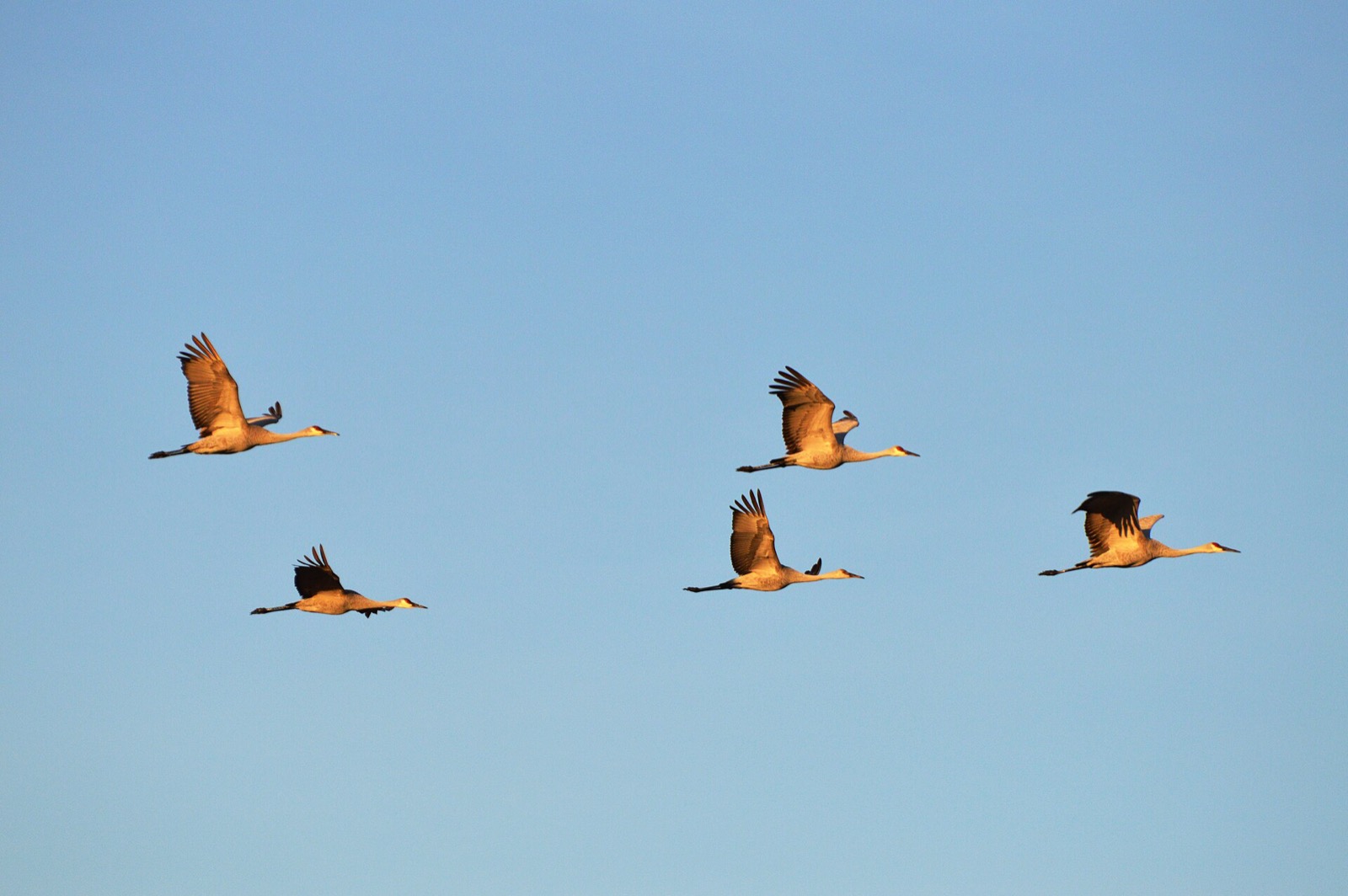
Sandhill cranes flying in a loose line across a pale open sky, necks held straight out in front and long legs trailing behind them
Sandhill cranes crossing a refuge on the morning flight. The movement is watched from the designated pullout or platform: the birds settle on shallow water for the night, and the roost itself is the one place a viewing site is never placed. “Sandhill cranes flying over Sherburne National Wildlife Refuge (24542820818)” by USFWS Midwest Region from United States, CC BY 2.0
Latest reports

What people have reported in Tennessee lately

The most recent research grade autumn observation of each species that anyone has uploaded to iNaturalist for Tennessee, as a date and the platform’s own coarse locality. Evidence that people do find sandhill crane and broad-winged hawk here. Each is one bird on one past day: the flocks move with the weather, so where they are this week is what the agency page and its counts answer.

Checking the most recent autumn uploads for Tennessee on iNaturalist...

Where Tennessee counts are published

Organised events

Festivals and staffed weekends in Tennessee

A staffed event is the easiest introduction to this: somebody has already found the birds, set up a scope and can say what is in view. Most organisers publish the dates only weeks ahead, so what follows names the organiser and the recurrence, and the organiser’s page carries this year’s date.

Tennessee Sandhill Crane Festival

annual, on a January weekend, at the Hiwassee Refuge, the Cherokee Removal Memorial Park and the Birchwood Community Center

TWRA and its volunteers set up spotting scopes at the crane viewing areas and run free shuttle buses from the Birchwood school to each location, in the weeks when crane numbers on the river are at their highest. The festival also carries the Native American history of the Hiwassee bottoms, which is why the Cherokee Removal Memorial Park is one of the stops.

TWRA publishes the weekend's dates on its own festival page each year. The 2026 edition, the 35th, ran January 17 and 18. Check the agency page before making the trip. Tennessee Wildlife Resources Agency

Advertisement

Questions about Tennessee

Inventory compiled 2026-09-19 from the agency pages linked above. Agency text is quoted exactly with its source named and linked; the observation curves and latest reports are counts and dates from public uploads to iNaturalist.