
Skip to content

Whale Watching in Oregon

Thousands of gray whales pass mid-December to mid-January going south and from late March going north, and about 200 stay all summer.

In season in Oregon right now: Gray whale, resident summer group
Species with a season
1
Agency windows
3
Named shore sites
2

Oregon whale season at a glance

Pacific coast
December 15
Season opens
Earliest agency window in the state
November 15
Season closes
Latest agency window in the state
Open
Right now
From the quoted windows, not a forecast
1
Species with a published window
Agencies name shore sites here
Today
The busiest stretch of the Oregon whale calendar, from March 25 to June 15. Climatological, from published agency windows, not a forecast.
The season

Which whale, and when, in Oregon

Every window below is the wording of the agency that publishes it, reproduced exactly, with a link. Where two agencies describe the same animal differently, both are shown.

Gray whale, southbound

Later in the year

December 15 to January 15

“In the winter we watch thousands of gray whales from mid-December through mid-January as they travel south to the warm lagoons of Baja Mexico.”

Oregon State Parks

What you are looking for: A low bushy blow about 10 to 15 feet high, often heart shaped from head on, then a knuckled ridge instead of a dorsal fin as the back rolls under. Gray whales travel close in, which is the entire reason they can be watched from land at all.
Gray whale, northbound

Over for this year

March 20 to June 30

“Spring watching begins in late March as the gray whales travel north on their way towards Alaska ... we watch the north-bound whales all the way until June.”

Oregon State Parks

What you are looking for: A low bushy blow about 10 to 15 feet high, often heart shaped from head on, then a knuckled ridge instead of a dorsal fin as the back rolls under. Gray whales travel close in, which is the entire reason they can be watched from land at all.
Gray whale, resident summer group

Happening now

June 1 to November 15

“These are the approximately 200 whales that remain in Oregon's coastal waters during the summer migration ... from June to mid-November.”

Oregon State Parks

What you are looking for: A low bushy blow about 10 to 15 feet high, often heart shaped from head on, then a knuckled ridge instead of a dorsal fin as the back rolls under. Gray whales travel close in, which is the entire reason they can be watched from land at all.
Worth knowing about Oregon

Oregon is the state where the crowd record and the agency calendar disagree most sharply, and it is worth knowing why before you plan a trip. The public observation record peaks in July and August, not in the migration months, because that is when people are on the Oregon coast and because the resident summer group is close in and easy to photograph. The migration itself happens in the dark, wet weeks either side of New Year, when almost nobody is out with a camera.

Checking the most recent public whale record in Oregon…

From land

Can you see whales from shore in Oregon?

Agencies name shore sites here

Oregon State Parks staffs 15 shore sites twice a year specifically so visitors can see whales from land, and keeps year-round staff at a whale watching centre on the seawall at Depoe Bay.

Oregon State Parks

Whale Watching Center, Depoe Bay

Oregon State Parks

“Year-round park staff are ready to answer your questions and help you spot Gray whales at the Whale Watching Center in Depoe Bay.”

The only staffed, year-round, purpose-built shore whale watching building on the US Pacific coast.

The 15 staffed Whale Watch Week sites

Oregon State Parks

“The program places volunteers at 15 whale watching sites in the winter and spring.”

Oregon State Parks does not publish the site list on that page. Ask at Depoe Bay or the state parks site rather than trusting a third party list.

Whale Watch Weeks

Oregon State Parks

Twice a year, in late December and again in late March

Oregon State Parks writes that it "celebrates the migration twice per year during Whale Watch Weeks in late December and late March" and that "The program places volunteers at 15 whale watching sites in the winter and spring."

Oregon State Parks publishes each year’s dates when the season is announced; check the state parks page in late autumn for the winter week. Agency page

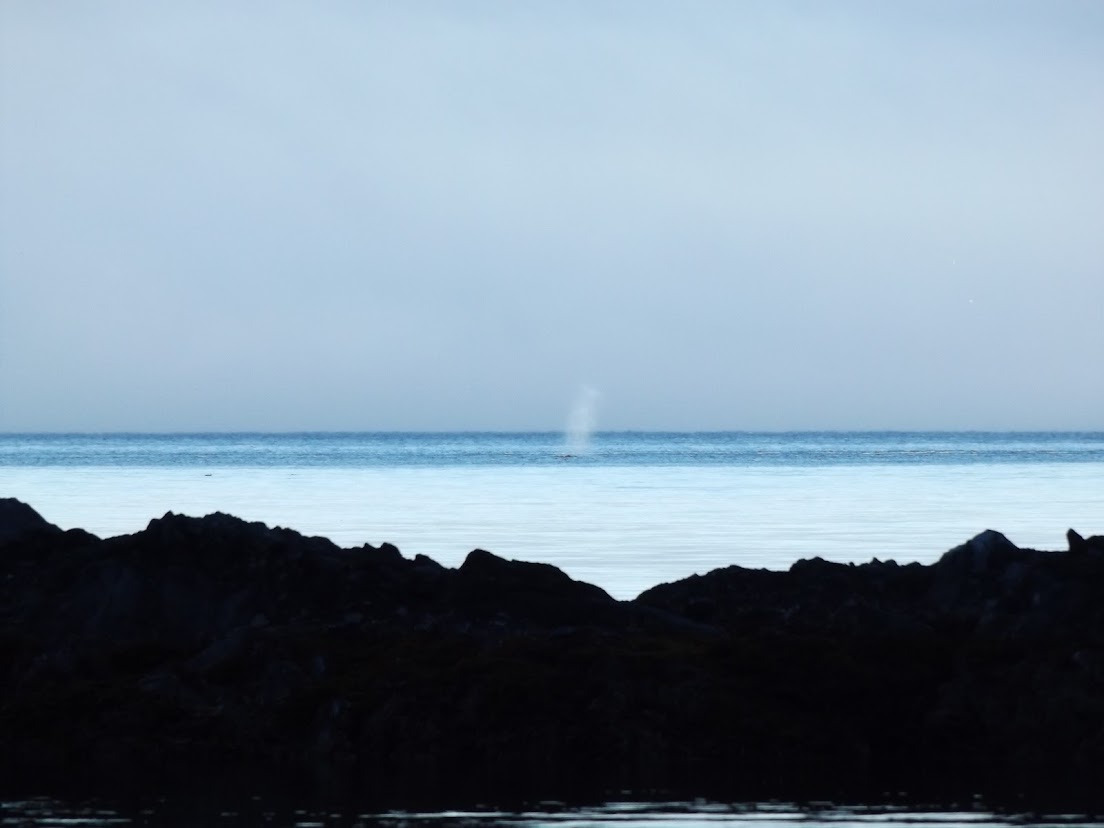
A distant white whale spout rising above a flat sea, seen over a dark rocky foreground from the shore
This is the realistic view from land: a blow on the horizon, over rock, gone in two seconds. Height above the water is what buys you distance, which is why agency lookouts sit on headlands and cliff tops rather than on the sand. “Whale spout, Alaska” — Forest Service Alaska Region, USDA — Public Domain
Advertisement
The law

How close you may legally get in Oregon

Approach distances differ by species and by region, and the differences are large enough that a number remembered from another coast can put you in breach of federal law. Below, the rule for each species that has a published season here, quoted from the agency that issues it.

Gray whaleEschrichtius robustus

“Remain at least 100 yards away, about the length of a football field, unless other rules apply.”

NOAA Fisheries, Marine Life Viewing Guidelines: Guidelines and Distances

Never approach a whale to get a better view, and never put a drone over one. If an animal comes to you, the instruction from NOAA is to move away from it, slowly, not to hold position for a photograph.

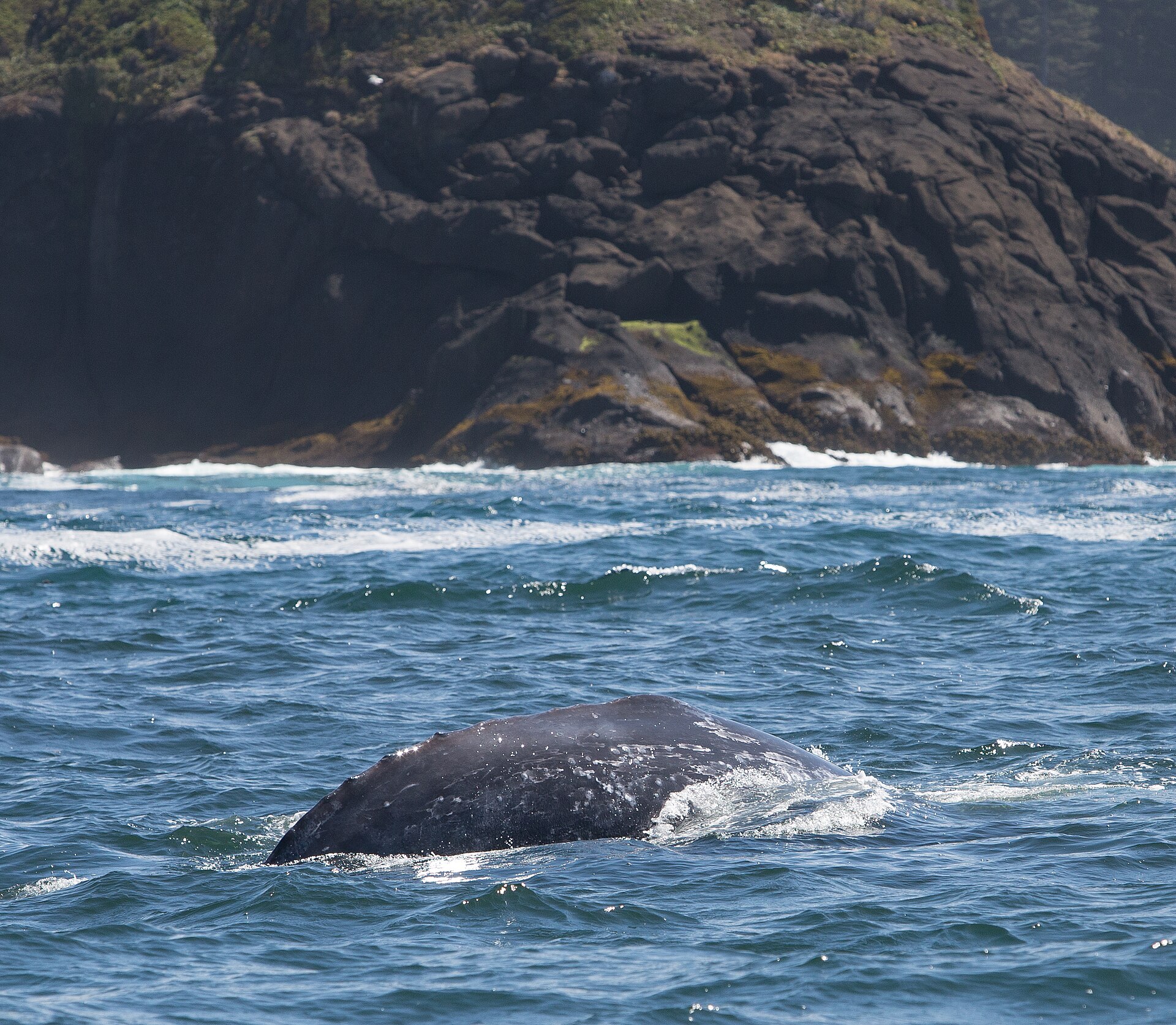
A gray whale surfacing close inshore below a dark rocky headland on the Oregon coast
Gray whale, Eschrichtius robustus. A low bushy blow about 10 to 15 feet high, often heart shaped from head on, then a knuckled ridge instead of a dorsal fin as the back rolls under. Gray whales travel close in, which is the entire reason they can be watched from land at all. “Gray whale, Depoe Bay OR” by Nicki Dugan Pogue, CC BY-SA 2.0
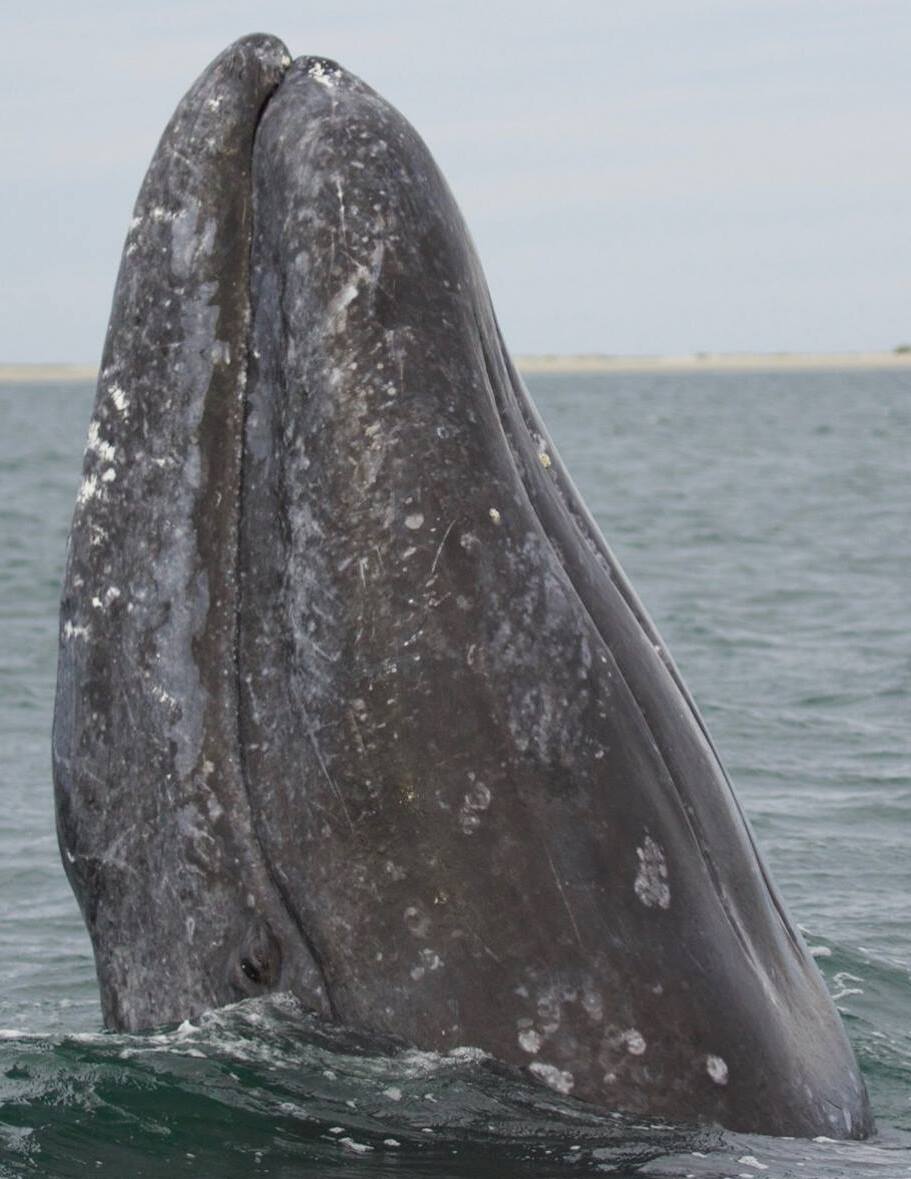
A gray whale raising its mottled head above the surface in a spyhop
also occurs off Oregon. “Gray Whale Spyhopping” — Marc Webber / USFWS — Public Domain
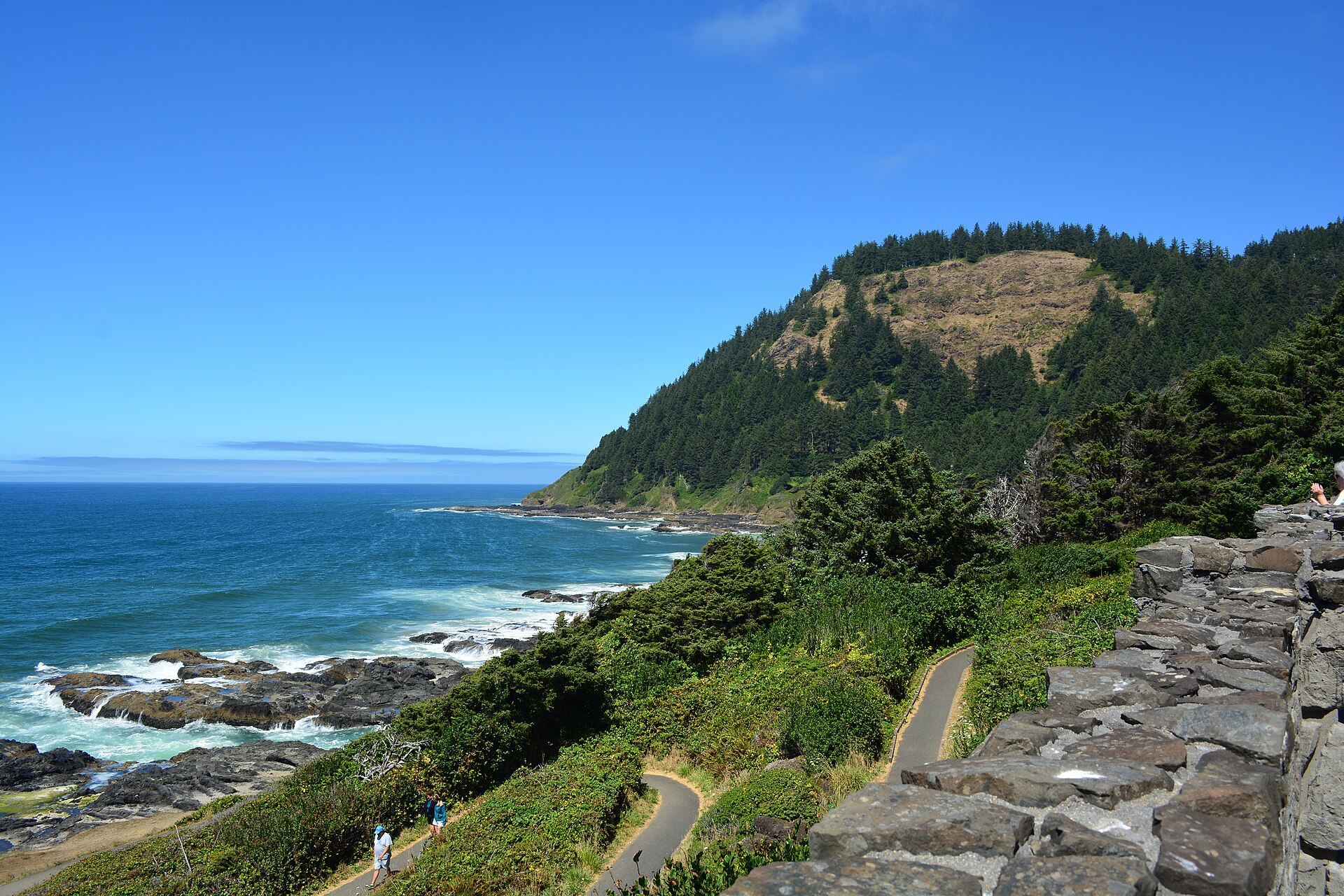
A headland overlook with a railing and interpretive sign above the open Pacific
A shore vantage of the kind this page is built around. Every site listed here is watched from land, which is what NOAA itself asks for: viewing from shore keeps one more boat off the water. “Looking north from Cooks Chasm roadside” by Joe Mabel, CC BY-SA 4.0
A cross-check

When people actually reported gray whales in Oregon

The chart below counts research-grade public observations by month. It is not a season. It is a record of when somebody was standing in the right place with a camera and knew what they were looking at, and that depends at least as much on tourism and daylight as on whales. Winter is systematically under-counted everywhere on this coast for exactly that reason.

It earns its place because when it disagrees with the agency window, the disagreement usually has a cause worth understanding.

Reading the public observation record for Gray whale in Oregon…

Elsewhere

Whale watching season in other states

California

Gray whales pass twice, southbound from December and northbound from mid-February, and California has more agency-named shore lookouts than any other state.

Agencies name shore sites here

Washington

Gray whales pass the outer coast in spring, and the inland waters hold killer whales under the strictest state approach law in the country.

Shore viewing is possible but agencies are cautious

Alaska

The summer feeding ground for the humpbacks that spend their winter in Hawaii, and the National Park Service says they feed within a mile of shore.

Shore viewing is possible but agencies are cautious

Hawaii

Humpbacks are here November through April with the peak from January through March, and the sanctuary itself says you can see them from shore.

Agencies name shore sites here

Massachusetts

Humpbacks arrive in April and are in large numbers through the summer, and right whales fill Cape Cod Bay in late winter under a federal January to May shipping rule.

Shore viewing is possible but agencies are cautious

Maine

Humpbacks, finbacks and minkes feed in the Gulf of Maine through spring, summer and autumn, and the National Park Service says do not expect to see them from shore.

Agencies say do not expect to see whales from shore

New York

Humpbacks are close to shore in summer and autumn in the New York Bight, and right whales are detected in spring and winter.

Agencies say do not expect to see whales from shore

Georgia

The only known calving ground on earth for the North Atlantic right whale, occupied from mid-November to mid-April.

Shore viewing is possible but agencies are cautious

Florida

The southern half of the right whale calving ground, mid-November to mid-April, and the one state whose wildlife agency says the whales are often visible from the beach.

Shore viewing is possible but agencies are cautious

Virginia

A winter state, unusually: humpbacks concentrate off the Virginia coast in January and February while New England is empty.

Agencies say do not expect to see whales from shore

Not seeing your state? The hub names every coastal state without a page here and explains why, including the whole Gulf coast and most of the mid-Atlantic.

Common questions

Whale watching in Oregon: FAQ

Advertisement

Seasons and approach distances on this page are quoted from the agency named beside each one, with a link. Nothing is modelled or averaged. Monthly observation counts are read live in your browser from the iNaturalist API and record when people reported whales, not when whales were present.
Hero image: “Gray whale, Depoe Bay OR” by Nicki Dugan Pogue, CC BY-SA 2.0