
Skip to content

Can You See a Rocket Launch From South Carolina?

Cape Canaveral is 294 miles south of Charleston. Launches from Cape Canaveral that head northeast, up the coast are plainly visible from Charleston, up to 25 degrees. 3 more of the 8 launch paths show from at least one of the three cities.

Checking the upcoming launches against the sky over Columbia, SC.

Somewhere else in South Carolina? Enter a ZIP for its own list

Launches and the South Carolina sky

From each launch path and the distance
294 mi
To the nearest site
Cape Canaveral, south of Charleston
4 of 8
Launch paths that reach
over at least one of Columbia, Charleston and Greenville
25°
Highest a launch climbs
over Charleston, heading northeast, up the coast
3
Cities worked out
Columbia, Charleston and Greenville

A rocket can be followed up to about 174 miles in daylight and 621 miles after dark, and a plume lit by the sun above a dark ground carries farther still. The figures here are for a launch at night or in twilight, the best case.

City by city

Launch paths that reach Columbia, Charleston and Greenville

Each row is a direction rockets fly from one site, with the best view among the three cities. Most launches on the list follow one of these paths, and the tag on each upcoming launch above says which.

Launch paths that reach the sky over South Carolina’s three reference cities
Launch headsFromBest viewUp toLook
northeast, up the coastCape CanaveralPlainly visible from Charleston25 degreessouth
east, out over the AtlanticCape CanaveralLow on the horizon from Charleston11 degreessouth
south, along the Florida coastCape CanaveralLow on the horizon from Charleston6 degreessouth
southeast, out over the AtlanticWallops IslandLow on the horizon from Columbia6 degreesnortheast

Worked out from each launch path and the distance to the city, for a launch at night or in twilight. A fist held at arm’s length is about 10 degrees.

Advertisement
Where to watch

Where to watch near Cape Canaveral

The nearest site is Cape Canaveral and Kennedy Space Center, 294 miles from Charleston. If you are traveling there, these are the usual public places.

Cape Canaveral and Kennedy Space Center, FL

SLC-40: SpaceX Falcon 9. LC-39A: SpaceX Falcon 9 and Falcon Heavy. SLC-41: United Launch Alliance Atlas V and Vulcan. SLC-37: Delta IV Heavy site, being rebuilt for Starship. LC-36: Blue Origin New Glenn.

  • Space View ParkTitusvilleAcross the Indian River from the pads, free, and the park fills up fast for high profile missions.“Parking is free and plentiful in the surrounding downtown streets, though it fills up fast for high-profile missions.” We Report Space: where to watch a launch on the Space Coast
  • Max Brewer BridgeTitusvilleA slightly higher vantage point than ground level, looking east over the river toward the pads.“The bridge itself gives you a slightly higher vantage point than ground level.” We Report Space: where to watch a launch on the Space Coast
  • Jetty ParkPort CanaveralThe mouth of Port Canaveral, closest of the easy spots to the southern pads. Parking has a fee.“A full-service park at the mouth of Port Canaveral with a fishing pier, beach, campground, and restrooms.” We Report Space: where to watch a launch on the Space Coast
  • Playalinda BeachCanaveral National SeashoreThe closest public beach to the Kennedy pads. It closes ahead of launches, so plan to arrive early.“The beach itself is beautiful and undeveloped, so the wait is not unpleasant.” We Report Space: where to watch a launch on the Space Coast
  • Kennedy Space Center Visitor ComplexMerritt IslandTicketed viewing on the grounds for select launches.
Reading the list

What the tags mean

What the tags mean

  • Spectacular A big show. Close enough, or lit by the sun after dark, that the whole climb and the plume are easy to follow.
  • Visible Plainly visible. A bright point and a trail, well above the treeline.
  • Low on the horizon Low on the horizon. Up for a short time near the horizon, so you need a clear view in that direction.
  • Not from here Not from here. Too far, or hidden below the horizon. The webcast is the way to see it.

A rocket in daylight can be followed to about 174 miles, after dark to about 621 miles, and a plume lit by the sun while the ground is dark carries to about 808 miles.

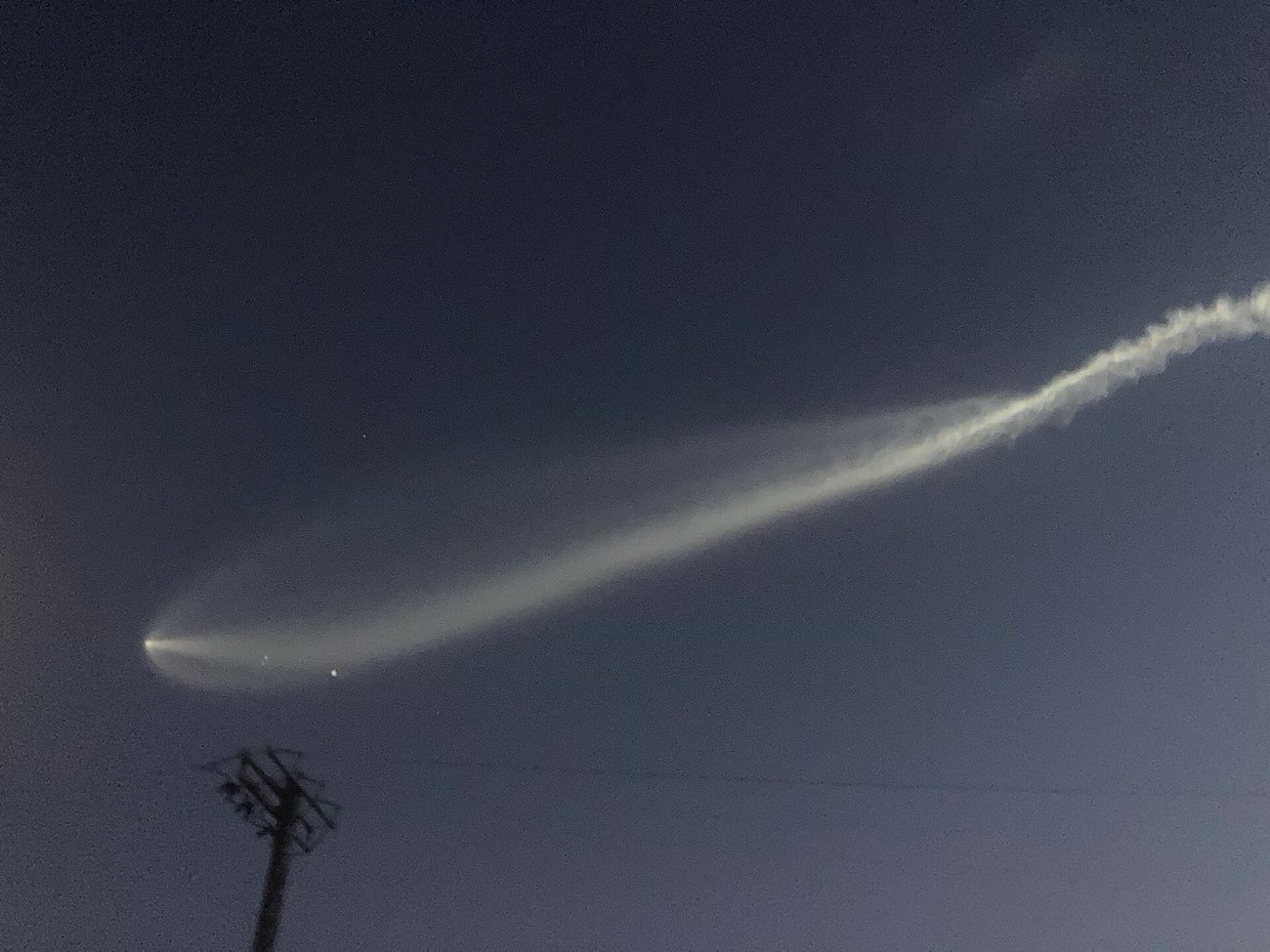
A thin pale trail of rocket exhaust curving across a dark blue evening sky above a power pole, with a small bright point of light at its left end
A Falcon 9 launch on June 18, 2024, seen from an ordinary street as the twilight effect lights its plume. No telescope and no trip to the coast: a clear view toward the launch and a phone were enough. “Falcon 9 rocket launch June 18 2024”, Jebeadso, CC0

South Carolina rocket launch questions

Advertisement