Skip to content
New Hampshire · tree pests and tree mortality

What is killing the trees in New Hampshire

Ash, town by town. New Hampshire tracks emerald ash borer at town resolution rather than county, so the spread reads like a map of the state.

Ash borer
Leads the list
Ash (Fraxinus), and white fringetree
5
Agents documented
named in the 2025 state report
2
On watch this month
Spongy moth, Beech bark
2,289
Photographed here
research grade iNaturalist records, all time
The list

What New Hampshire documents

Every state forestry agency publishes a Forest Health Highlights report each year in cooperation with USDA Forest Service Forest Health Protection. It is the only source that answers this question uniformly for all fifty states, and it is what this page is built from. New Hampshire’s most recent edition is the 2025 one, published by the New Hampshire Forest Health Program.

Emerald ash borer was detected in 4 additional towns in 2025: Bethlehem, Franconia, Milan, and Sugar Hill.
New Hampshire Forest Health Program, Forest Health Highlights 2025

Emerald ash borer

Agrilus planipennis

Federal quarantine repealed

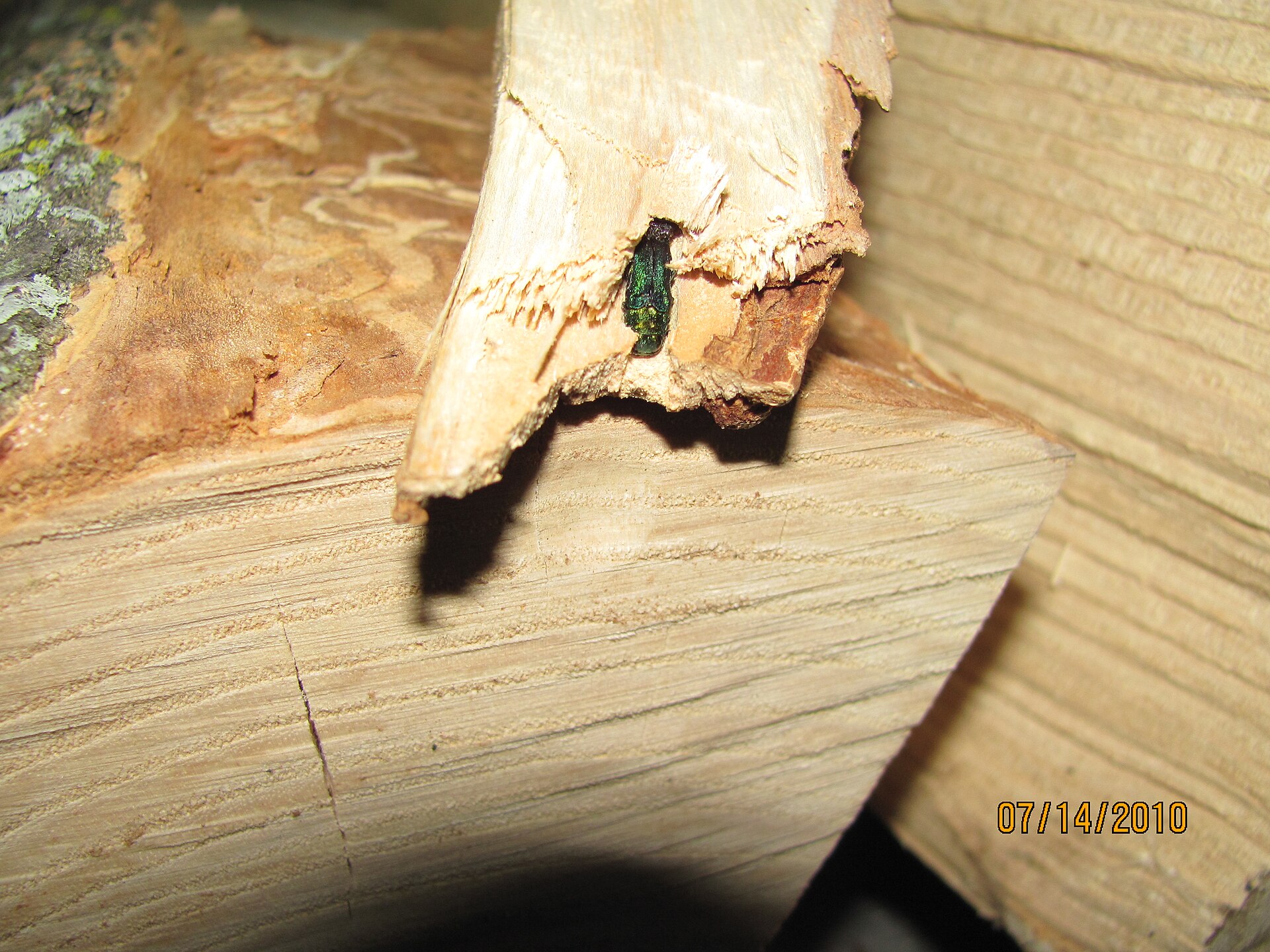
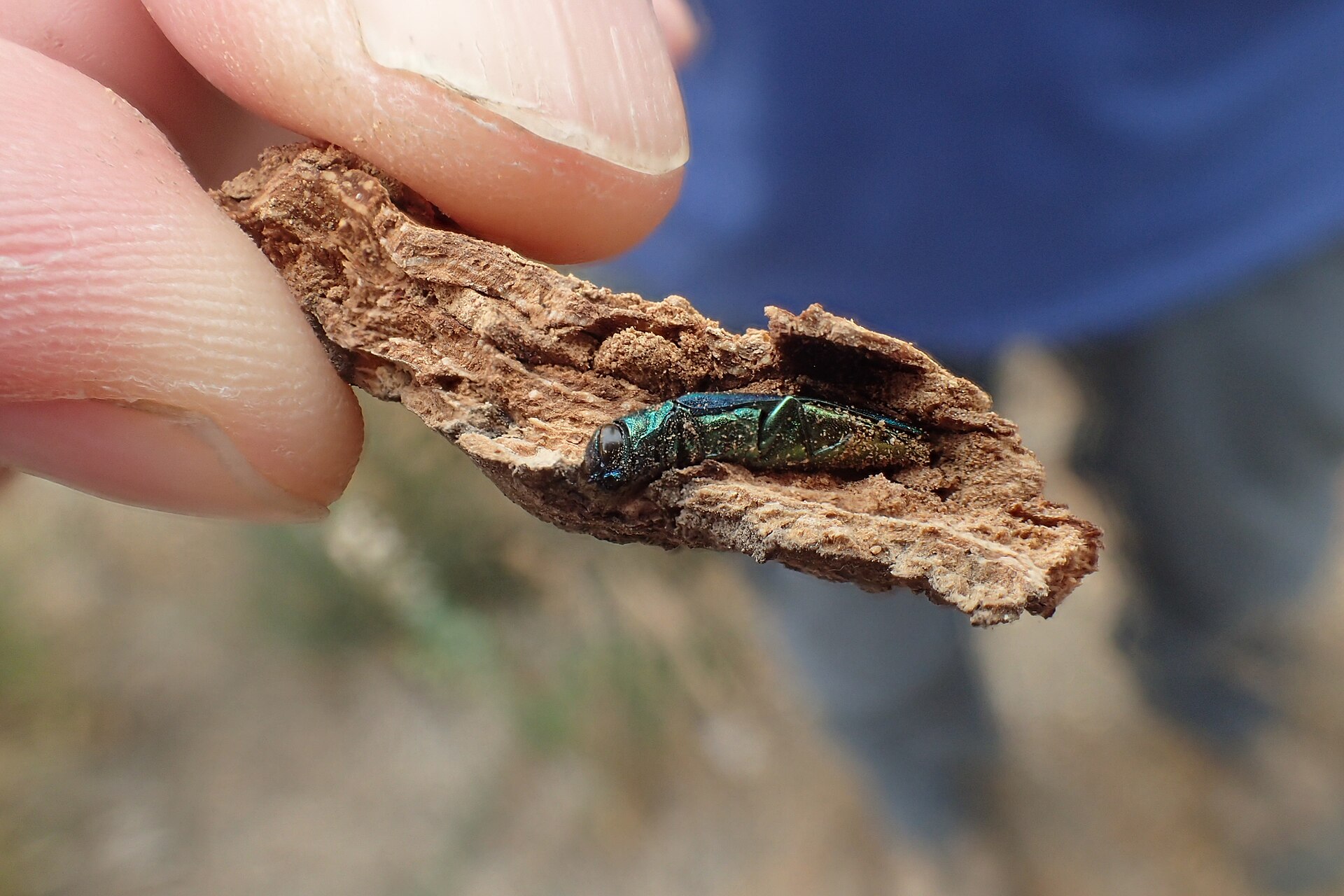
The reason the ash trees died. A half inch metallic green beetle whose larvae girdle the tree from the inside.

Kills
Ash (Fraxinus), and white fringetree
When you would notice it
May 15 to Sep 1: adult beetles, and thinning in the top of the crown. Then again Nov 1 to Mar 31: blonde bark where woodpeckers have stripped it, plus D shaped exit holes, both far easier to see with the leaves off.
Photographed in New Hampshire
58 research grade iNaturalist records, all time

Commonly confused with Every metallic green beetle in the Midwest gets reported as emerald ash borer, and most of them are six spotted tiger beetles or Japanese beetles. The tell is the tree, not the beetle: emerald ash borer is only ever on ash.
Hemlock woolly adelgid

Adelges tsugae

Not federally quarantined

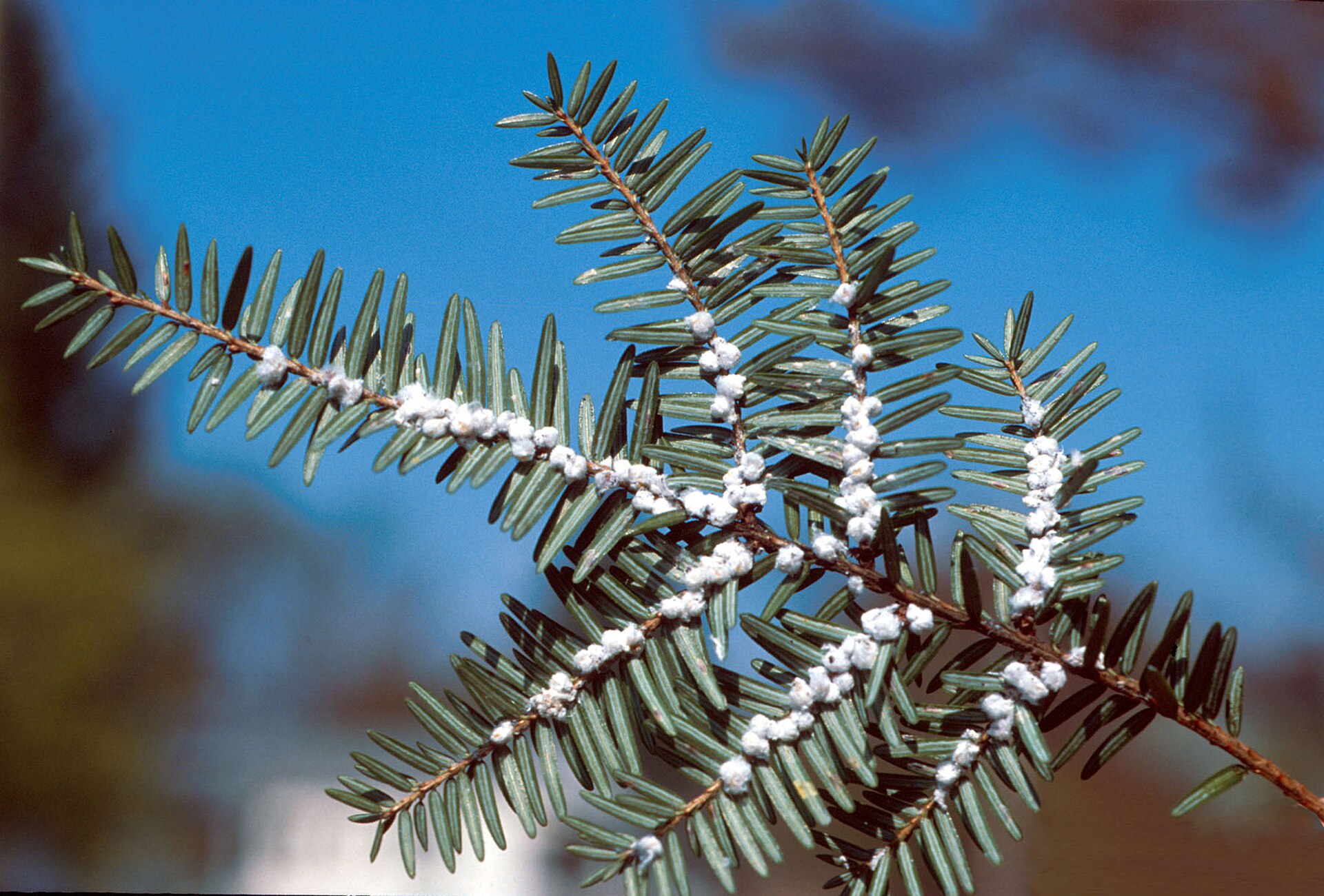
White woolly dots on the underside of hemlock needles. The tree starves over several years and does not come back on its own.

Kills
Eastern and Carolina hemlock (Tsuga)
When you would notice it
Nov 1 to Apr 30: the white woolly egg sacs, which stand out most on bare winter branches.
Photographed in New Hampshire
402 research grade iNaturalist records, all time

Commonly confused with The woolly dots are easy to mistake for spider egg sacs or scale. Position is the tell: adelgid sits at the base of a needle, on the underside of the twig, in rows.

Beech leaf disease

Litylenchus crenatae

Not federally quarantined

Dark bands between the veins of a beech leaf, visible from underneath against the sky. First recorded in Ohio in 2012 and moving fast.

Kills
American beech (Fagus grandifolia), and ornamental European beech
When you would notice it
May 1 to Jul 31: dark interveinal banding on newly expanded leaves, seen from below looking up.
Photographed in New Hampshire
801 research grade iNaturalist records, all time

Commonly confused with Banded beech leaves look enough like drought scorch or anthracnose that people wave them off. The difference is geometry: beech leaf disease bands follow the veins in stripes, and they are darkest looking up through the leaf.

Spongy moth

Lymantria dispar

Federally quarantined

The caterpillar that eats a whole oak ridge bare in June, formerly called the gypsy moth. Still federally quarantined, and the boundary still moving.

Kills
Oak above all, plus aspen, birch, apple and many others. Repeated defoliation kills
When you would notice it
May 15 to Jul 15: caterpillars, frass falling like rain, and bare crowns in high summer. Then again Aug 1 to Apr 30: tan felt egg masses on trunks, walls, grills and wheel wells.
Photographed in New Hampshire
735 research grade iNaturalist records, all time

Commonly confused with A defoliated oak in June looks dead and usually is not. Healthy oaks refoliate. It is the second and third consecutive year, especially with drought on top, that kills them.

Beech bark disease

Cryptococcus fagisuga with Neonectria

Not federally quarantined

A scale insect first, then a fungus through the wounds it makes. Not the same thing as beech leaf disease, and the two now overlap.

Kills
American beech
When you would notice it
Sep 1 to Apr 30: a white waxy crust on the trunk, then sunken cankers, then a snapped stem in a wind event.

Commonly confused with Beech bark disease is on the TRUNK and beech leaf disease is on the LEAF. They are unrelated organisms with similar names attacking the same tree in the same forests, and confusing them is the most common mistake in this whole subject.

What New Hampshire says it does NOT have

This is the rarest thing in the whole subject and it is worth more than a map with a blank space on it. The New Hampshire Forest Health Program states that oak wilt and thousand cankers disease have not been confirmed in the state. If you are looking at a sick tree and that was your first guess, the state has already looked and not found it. Read the 2025 report.

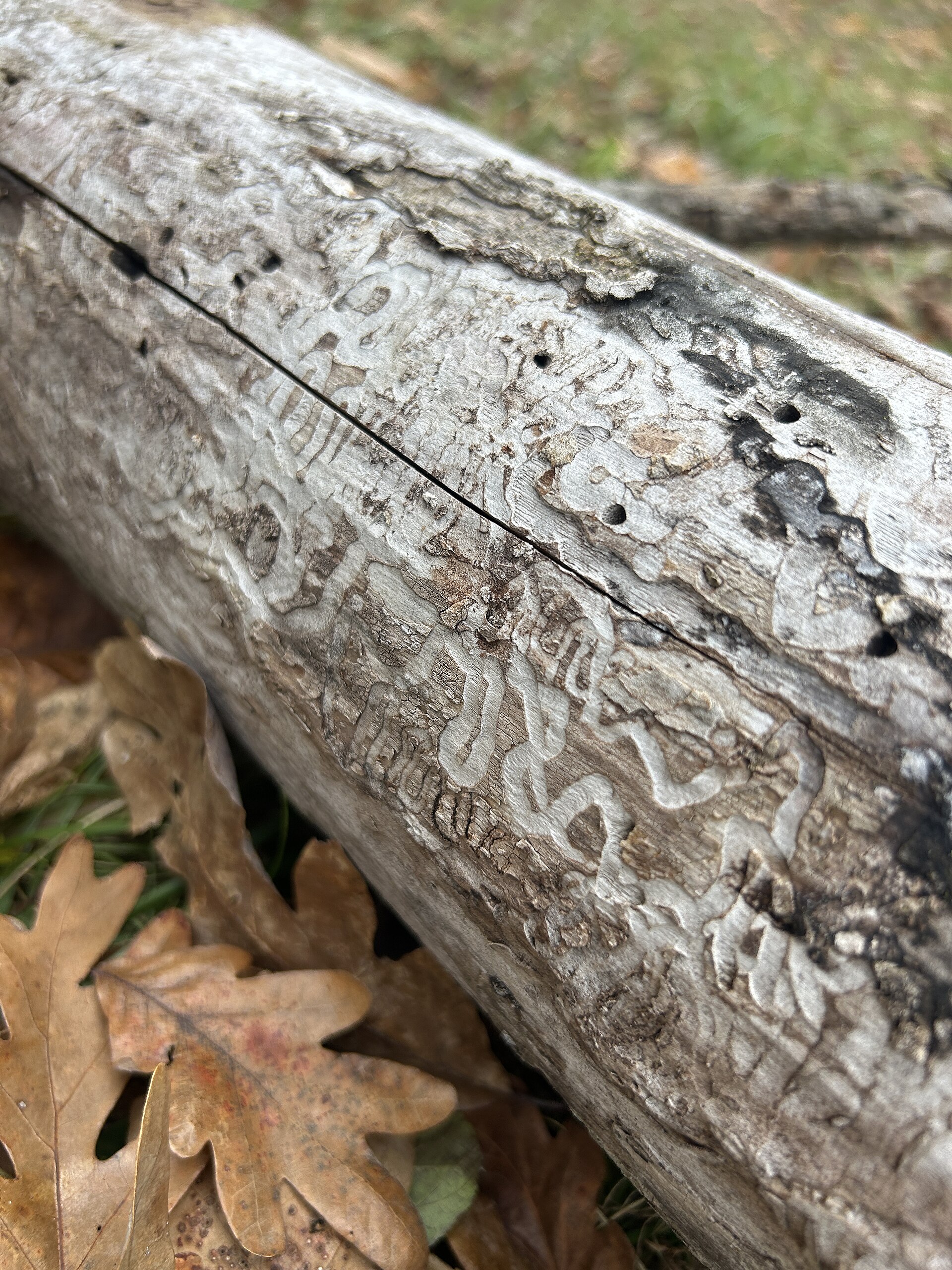
A fallen ash log with the bark gone, covered in winding S shaped larval tunnels and small dark exit holes
The record of an infestation, on a dead ash in southeastern Wisconsin that fell and lost its bark. Every winding channel is one larva that ate its way around the trunk under the bark. The small dark holes are where the adults left. “Bore remnants” by TheLostPariah, CC BY 4.0
Advertisement
The timing

When you would actually notice it

This is the part almost nobody publishes. A pest has a season in which it shows itself to a person walking past, and it is frequently not the season you would guess. Hemlock woolly adelgid is easiest to find in the middle of winter, when the white egg sacs stand out on a bare branch and the insect is not moving. Emerald ash borer signs are clearest with the leaves off, because that is when you can see where the woodpeckers have been.

When in the year you would actually notice each one. A second, lighter band is a second window: several of these are easiest to spot in winter, when the leaves are off and the sign is on the bark.
AgentJFMAMJJASOND
Ash borersecond windowsecond windowsecond windownot typically visiblemain windowmain windowmain windowmain windowmain windownot typically visiblesecond windowsecond window
Adelgidmain windowmain windowmain windowmain windownot typically visiblenot typically visiblenot typically visiblenot typically visiblenot typically visiblenot typically visiblemain windowmain window
Beech leafnot typically visiblenot typically visiblenot typically visiblenot typically visiblemain windowmain windowmain windownot typically visiblenot typically visiblenot typically visiblenot typically visiblenot typically visible
Spongy mothsecond windowsecond windowsecond windowsecond windowmain windowmain windowmain windowsecond windowsecond windowsecond windowsecond windowsecond window
Beech barkmain windowmain windowmain windowmain windownot typically visiblenot typically visiblenot typically visiblenot typically visiblemain windowmain windowmain windowmain window

Windows are ours, built from what the federal agencies publish about each organism’s life stages and about what is visible when. They are typical seasons for the country, not a forecast for New Hampshire, and a warm or late year moves them. The current month is outlined.

Live

Has anybody seen it in New Hampshire lately

The panel below reads iNaturalist as you load the page: research grade records in New Hampshire in the last twelve months, for the agents that a person can actually photograph. Research grade means the observer posted a photograph with a date and a location and at least two other people agreed on the identification.

Recent confirmed sightings in New Hampshire

Reading iNaturalist…

The monthly curve, from a stored snapshot

Below is when these records were actually made in New Hampshire, by month, across the whole history of the platform. Switch to the adjusted series to divide out observer effort: the raw counts partly track how many people were outdoors with a phone, and the adjusted index removes that.

Emerald ash borer records in New Hampshire, by month
0481115January: 1 recordsJFebruary: 5 recordsFMarch: 5 recordsMApril: 9 recordsAMay: 5 recordsMJune: 13 recordsJJuly: 8 recordsJAugust: 4 recordsASeptember: 1 recordsSOctober: 2 recordsONovember: 2 recordsNDecember: 3 recordsD
58 research grade iNaturalist records of Agrilus planipennis in New Hampshire, grouped by the month they were observed. Snapshot taken 2026-08-29.This is when people PHOTOGRAPHED it, which is a good proxy for when it is visible and a poor one for how much of it there is. Presence in New Hampshire comes from the state agency, not from this chart. Curves are drawn only where a state has at least 25 records.
Hemlock woolly adelgid records in New Hampshire, by month
019385675January: 9 recordsJFebruary: 6 recordsFMarch: 57 recordsMApril: 44 recordsAMay: 72 recordsMJune: 68 recordsJJuly: 69 recordsJAugust: 26 recordsASeptember: 9 recordsSOctober: 16 recordsONovember: 14 recordsNDecember: 12 recordsD
402 research grade iNaturalist records of Adelges tsugae in New Hampshire, grouped by the month they were observed. Snapshot taken 2026-08-29.This is when people PHOTOGRAPHED it, which is a good proxy for when it is visible and a poor one for how much of it there is. Presence in New Hampshire comes from the state agency, not from this chart. Curves are drawn only where a state has at least 25 records.

What iNaturalist cannot see, and why that matters

Two of the agents on this page can be photographed on a leaf. The rest cannot, and the national record counts make the gap impossible to argue with. Sudden oak death has killed millions of trees and has a few hundred research grade records in the entire history of the platform, because it is confirmed on a culture plate. The gap in this table is a gap in visibility, not in damage.

Research grade iNaturalist records in the United States, whole platform history. The gap between the top group and the bottom group is not a measure of how much damage each one does.
AgentUS recordsWhy
Spongy moth28,732Sits on a leaf, a needle or a trunk where anybody can photograph it.
Beech leaf disease8,003Sits on a leaf, a needle or a trunk where anybody can photograph it.
Hemlock woolly adelgid7,880Sits on a leaf, a needle or a trunk where anybody can photograph it.
Emerald ash borer4,362Sits on a leaf, a needle or a trunk where anybody can photograph it.
Beech bark disease803Lives under bark or in the crown, where a phone camera cannot reach it.
A metallic green emerald ash borer beetle held on a piece of bark between finger and thumb
An emerald ash borer held on a piece of bark in Oregon in August 2022, photographed by the US Fish and Wildlife Service. Oregon was the first West Coast detection. The beetle is about half an inch long, which is most of the reason nobody notices it. “Emerald ash borer (52485411408)” — USFWS Pacific — Public domain
The rules

What is regulated in New Hampshire

The most common wrong belief about this whole subject is that emerald ash borer is still federally quarantined. It is not, and has not been since the start of 2021. Four other agents are, and the boundaries move by federal order several times a year, so the issuing agency, linked below, is the source for the current boundary.

APHIS removed its domestic EAB quarantine regulations in 2020. The final rule was effective January 14, 2021.
USDA APHIS, Emerald Ash Borer as of April 23, 2026

Spotted lanternfly

The New Hampshire Department of Agriculture, Markets and Food confirmed spotted lanternfly in Salem in August 2026: a small number of adults, seen by trained observers and confirmed by USDA identifiers, with field surveys under way to find out whether anything is established. That is the newest detection anywhere in this dataset. Recorded August 2026.

Source: New Hampshire Department of Agriculture, Markets and Food. Restated in our own words.

The one thing you can actually do

Almost every agent on this page reached almost every place it is by riding in a piece of wood somebody put in a car. USDA APHIS says it in three words on both its emerald ash borer page and its spongy moth page:

Buy local firewood and burn it on site. Do not move firewood.
USDA APHIS, Spongy Moth

APHIS links dontmovefirewood.org from its own pest pages, so that is where this page points too. The campaign is run by The Nature Conservancy and its text is copyrighted, so nothing on this site quotes it; the wording above is APHIS’s own and is in the public domain.

What to do

You have a dying tree in New Hampshire

You have a dying tree. Here is where to go.

Whether to treat a tree or take it down is a decision for somebody standing under it with a credential and a licence. These are the three doors.

  1. Find a certified arboristA diagnosis on a specific tree, and any decision about what to do with it, belongs to somebody standing under it with a credential. That is not us. International Society of Arboriculture keeps the directory.
  2. New Hampshire Forest Health Program, Forest Health Highlights 2025The New Hampshire forest health programme is the body that documents what is actually here, and its annual report is what this page is built from.
  3. Report a suspected pestAPHIS keeps the current contact for every state plant health director and state plant regulatory official. For a regulated pest, that call is the one that matters.

Several of the diseases on this page can only be confirmed in a laboratory, and several of the materials used against these organisms are restricted use and need a licensed applicator. This page tells you what is documented in New Hampshire and when it shows itself; the decision about your tree is an arborist’s.

Rows of small white woolly balls along the underside of hemlock twigs against a blue sky
Hemlock woolly adelgid ovisacs on the underside of eastern hemlock branches, photographed for the USDA Forest Service. This is the thing to look for, and the time to look is winter: the white stands out and the insect is not moving. “Adelges tsugae 1276001” by Michael Montgomery, USDA Forest Service, CC BY 3.0 US

New Hampshire tree pest questions

Advertisement
Split firewood logs with the bark peeled back to show winding beetle galleries in the wood beneath
Emerald ash borer found in wood intercepted at a California agricultural inspection station. This is the whole argument for the firewood rule in one photograph: the beetle was in the wood, and the wood was in a vehicle. “Emerald Ash Borer in firewood (5815090311)” — USDA Forest Service Pacific Southwest Region 5 — Public domain

Everything on this page about what is present in New Hampshire comes from the New Hampshire Forest Health Program Forest Health Highlights report for 2025 and from USDA APHIS. Sentences in quotation marks are verbatim from those sources with the issuer named; everything else is ours. iNaturalist counts are a record of where people looked and are not a survey. MyWild states no diagnosis, recommends no treatment and names no product. The national tree pest guide.