Skip to content
South Dakota · tree pests and tree mortality

What is killing the trees in South Dakota

Emerald ash borer in the east, mountain pine beetle in the Black Hills. South Dakota is where the two halves of this subject meet.

Ash borer
Leads the list
Ash (Fraxinus), and white fringetree
3
Agents documented
named in the 2024 state report
0
On watch this month
nothing in its window in October
1
Photographed here
research grade iNaturalist records, all time
The list

What South Dakota documents

Every state forestry agency publishes a Forest Health Highlights report each year in cooperation with USDA Forest Service Forest Health Protection. It is the only source that answers this question uniformly for all fifty states, and it is what this page is built from. South Dakota’s most recent edition is the 2024 one, published by the South Dakota Department of Agriculture and Natural Resources.

We received enquiries from around the state about ash trees infested by EAB.
South Dakota Department of Agriculture and Natural Resources, Forest Health Highlights 2024

Emerald ash borer

Agrilus planipennis

Federal quarantine repealed

The reason the ash trees died. A half inch metallic green beetle whose larvae girdle the tree from the inside.

Kills
Ash (Fraxinus), and white fringetree
When you would notice it
May 15 to Sep 1: adult beetles, and thinning in the top of the crown. Then again Nov 1 to Mar 31: blonde bark where woodpeckers have stripped it, plus D shaped exit holes, both far easier to see with the leaves off.
Photographed in South Dakota
No research grade iNaturalist records, which is a statement about photographers rather than about the pest

Commonly confused with Every metallic green beetle in the Midwest gets reported as emerald ash borer, and most of them are six spotted tiger beetles or Japanese beetles. The tell is the tree, not the beetle: emerald ash borer is only ever on ash.
Dutch elm disease

Ophiostoma novo-ulmi

Not federally quarantined

The one that already happened. It removed the American elm from the American street between the 1930s and the 1970s and it is still here.

Kills
American elm, and other elms to varying degrees
When you would notice it
Jun 1 to Aug 31: flagging: one branch high in the crown yellowing and wilting while the rest of the tree is green.

Commonly confused with Elm yellows, elm leaf beetle and simple drought all yellow an elm. Flagging, one branch at a time from the top, is the classic Dutch elm pattern.

Mountain pine beetle

Dendroctonus ponderosae

Not federally quarantined

The native beetle behind the red hillsides of the Interior West. Drought and warm winters are what turn it from background noise into an outbreak.

Kills
Lodgepole, ponderosa, limber and whitebark pine
When you would notice it
Jun 1 to Sep 30: pitch tubes and boring dust in bark crevices this year, red needles next year.

Commonly confused with Every red conifer in the Rockies gets called beetle kill. Drought, root disease, dwarf mistletoe and simple old age all do it too.

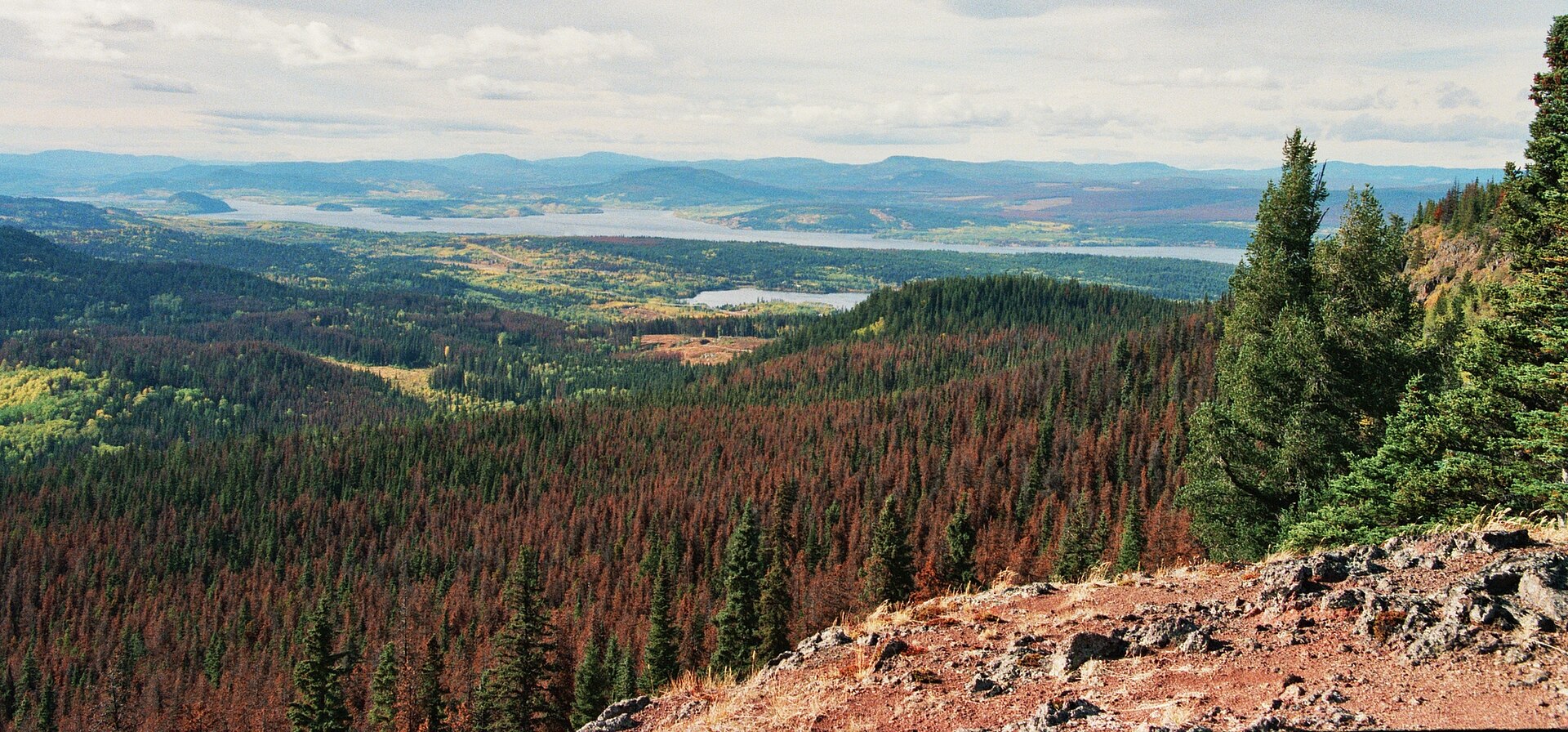
A wide valley view of conifer forest in which most of the trees are rust red and dead, with a lake beyond
Beetle killed forest seen from Mount Fraser in British Columbia. The rust red trees are dead or dying lodgepole pine; the green ones are what is left. This is a mountain pine beetle landscape rather than a US one, and it is here because nothing shows the scale of a bark beetle outbreak better. “Mt Fraser - Pine Beetle Damage” by Themightyquill, CC BY-SA 3.0
Advertisement
The timing

When you would actually notice it

This is the part almost nobody publishes. A pest has a season in which it shows itself to a person walking past, and it is frequently not the season you would guess. Hemlock woolly adelgid is easiest to find in the middle of winter, when the white egg sacs stand out on a bare branch and the insect is not moving. Emerald ash borer signs are clearest with the leaves off, because that is when you can see where the woodpeckers have been.

When in the year you would actually notice each one. A second, lighter band is a second window: several of these are easiest to spot in winter, when the leaves are off and the sign is on the bark.
AgentJFMAMJJASOND
Ash borersecond windowsecond windowsecond windownot typically visiblemain windowmain windowmain windowmain windowmain windownot typically visiblesecond windowsecond window
Dutch elmnot typically visiblenot typically visiblenot typically visiblenot typically visiblenot typically visiblemain windowmain windowmain windownot typically visiblenot typically visiblenot typically visiblenot typically visible
Mountain pine beetlenot typically visiblenot typically visiblenot typically visiblenot typically visiblenot typically visiblemain windowmain windowmain windowmain windownot typically visiblenot typically visiblenot typically visible

Windows are ours, built from what the federal agencies publish about each organism’s life stages and about what is visible when. They are typical seasons for the country, not a forecast for South Dakota, and a warm or late year moves them. The current month is outlined.

Live

Has anybody seen it in South Dakota lately

The panel below reads iNaturalist as you load the page: research grade records in South Dakota in the last twelve months, for the agents that a person can actually photograph. Research grade means the observer posted a photograph with a date and a location and at least two other people agreed on the identification.

Recent confirmed sightings in South Dakota

Reading iNaturalist…

What iNaturalist cannot see, and why that matters

Two of the agents on this page can be photographed on a leaf. The rest cannot, and the national record counts make the gap impossible to argue with. Sudden oak death has killed millions of trees and has a few hundred research grade records in the entire history of the platform, because it is confirmed on a culture plate. The gap in this table is a gap in visibility, not in damage.

Research grade iNaturalist records in the United States, whole platform history. The gap between the top group and the bottom group is not a measure of how much damage each one does.
AgentUS recordsWhy
Mountain pine beetle31Lives under bark or in the crown, where a phone camera cannot reach it.
Dutch elm disease1Diagnosed in a laboratory, not from a photograph.
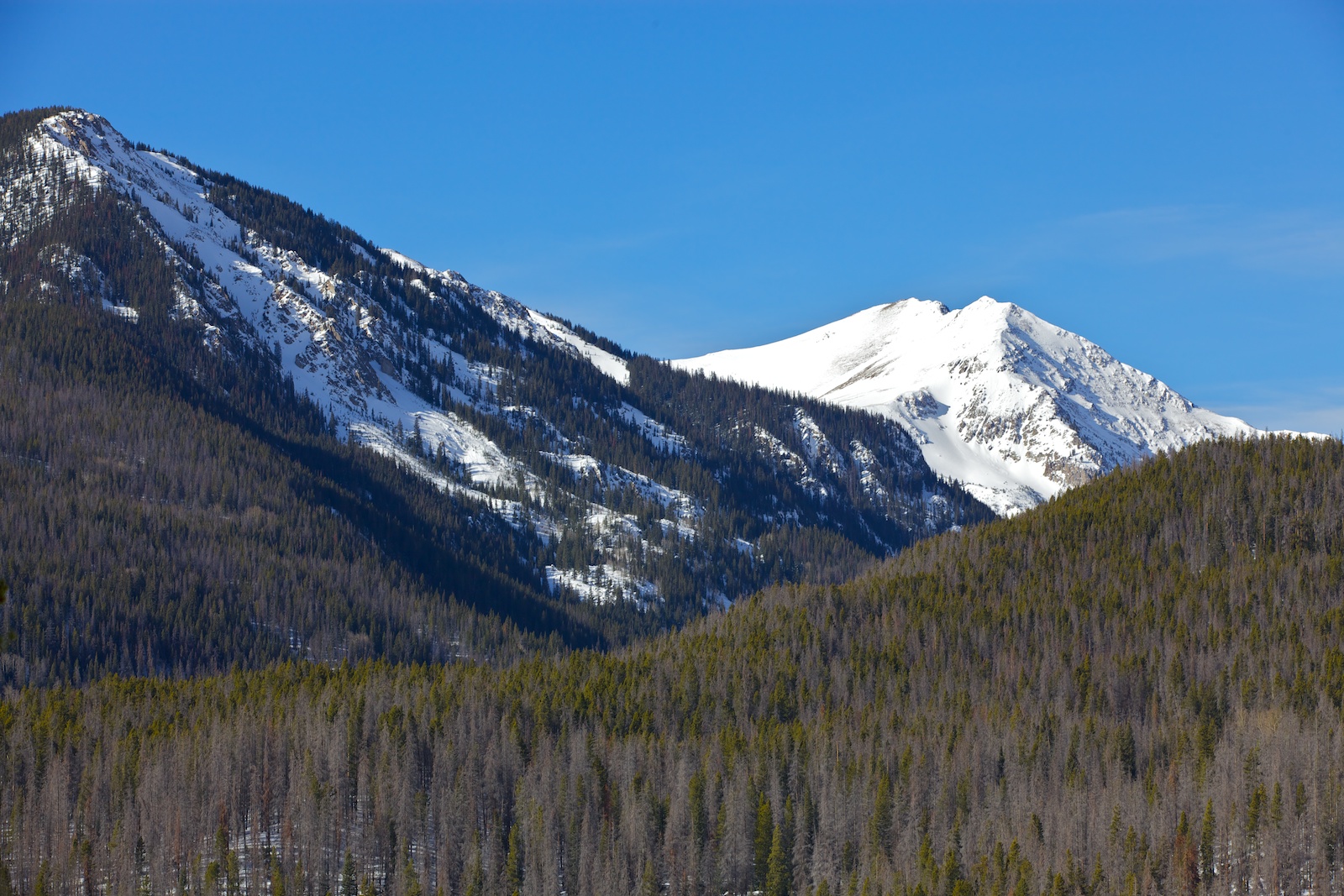
A stand of pine trees in a mountain landscape with a high proportion of red and grey dead crowns
Mountain pine beetle damage in Rocky Mountain National Park in January 2012. The red needles are the year after the attack: the beetle killed these trees the previous summer and the colour arrived later. “Mountain pine beetle damage in Rocky Mountain National Park” by Bchernicoff, CC BY-SA 3.0
The rules

What is regulated in South Dakota

The most common wrong belief about this whole subject is that emerald ash borer is still federally quarantined. It is not, and has not been since the start of 2021. Four other agents are, and the boundaries move by federal order several times a year, so the issuing agency, linked below, is the source for the current boundary.

APHIS removed its domestic EAB quarantine regulations in 2020. The final rule was effective January 14, 2021.
USDA APHIS, Emerald Ash Borer as of April 23, 2026

No current state level quarantine specific to South Dakota appears in the sources behind this page. State plant regulatory orders change without much publicity, and the South Dakota plant health contacts at the reporting link below are the authority on what is in force.

The one thing you can actually do

Almost every agent on this page reached almost every place it is by riding in a piece of wood somebody put in a car. USDA APHIS says it in three words on both its emerald ash borer page and its spongy moth page:

Buy local firewood and burn it on site. Do not move firewood.
USDA APHIS, Spongy Moth

APHIS links dontmovefirewood.org from its own pest pages, so that is where this page points too. The campaign is run by The Nature Conservancy and its text is copyrighted, so nothing on this site quotes it; the wording above is APHIS’s own and is in the public domain.

What to do

You have a dying tree in South Dakota

You have a dying tree. Here is where to go.

Whether to treat a tree or take it down is a decision for somebody standing under it with a credential and a licence. These are the three doors.

  1. Find a certified arboristA diagnosis on a specific tree, and any decision about what to do with it, belongs to somebody standing under it with a credential. That is not us. International Society of Arboriculture keeps the directory.
  2. South Dakota Department of Agriculture and Natural Resources, Forest Health Highlights 2024The South Dakota forest health programme is the body that documents what is actually here, and its annual report is what this page is built from.
  3. Report a suspected pestAPHIS keeps the current contact for every state plant health director and state plant regulatory official. For a regulated pest, that call is the one that matters.

Several of the diseases on this page can only be confirmed in a laboratory, and several of the materials used against these organisms are restricted use and need a licensed applicator. This page tells you what is documented in South Dakota and when it shows itself; the decision about your tree is an arborist’s.

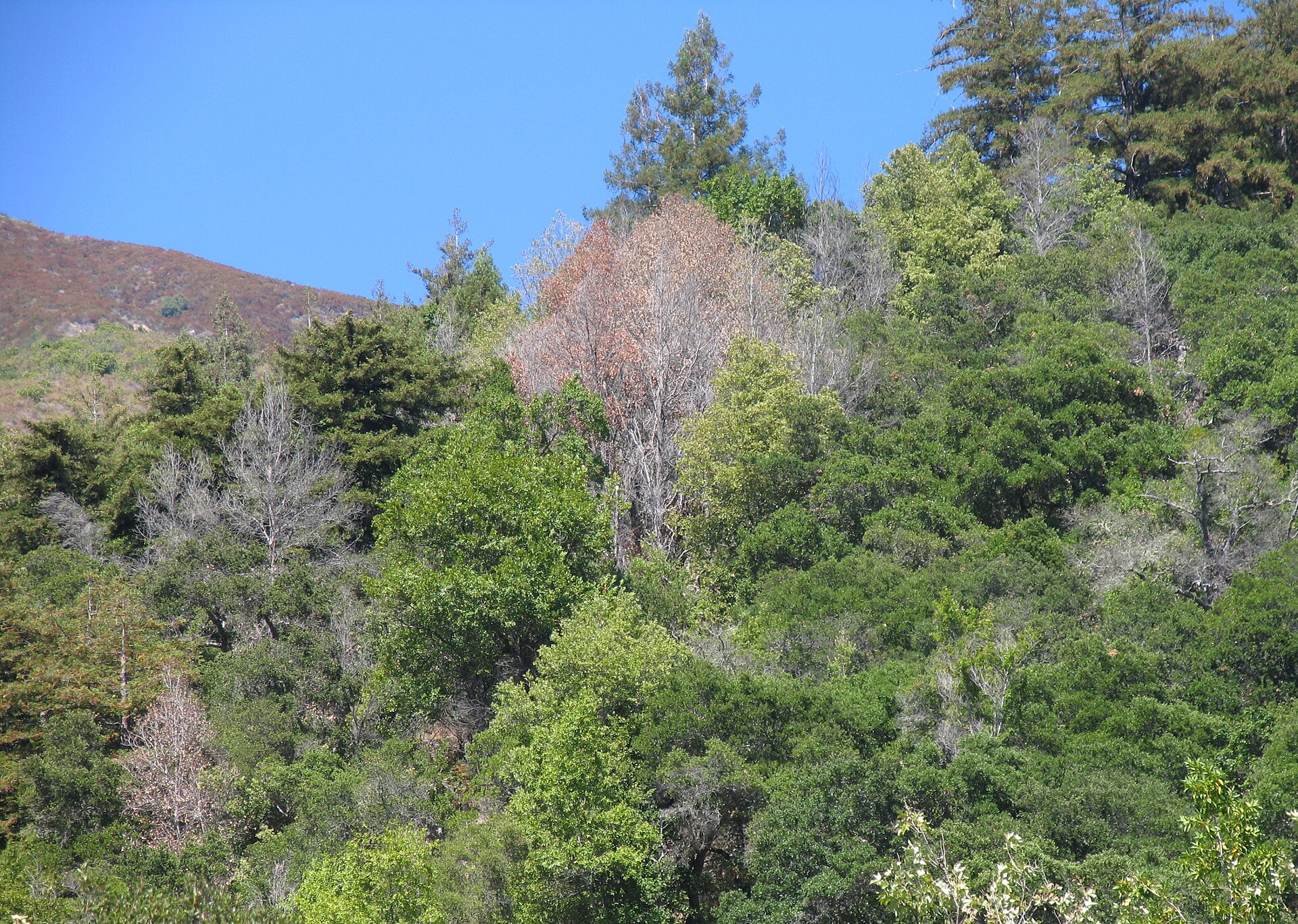
Dead grey tanoak trees standing among green vegetation on a California hillside
Tanoak killed by Phytophthora ramorum, photographed for the USDA Forest Service. Sudden oak death is the West Coast answer to the question this page is about, it is federally quarantined, and APHIS states plainly that there is no cure. “Lithocarpus densiflorus dead” by Joseph O'Brien, USDA Forest Service, CC BY 3.0 US

South Dakota tree pest questions

Advertisement
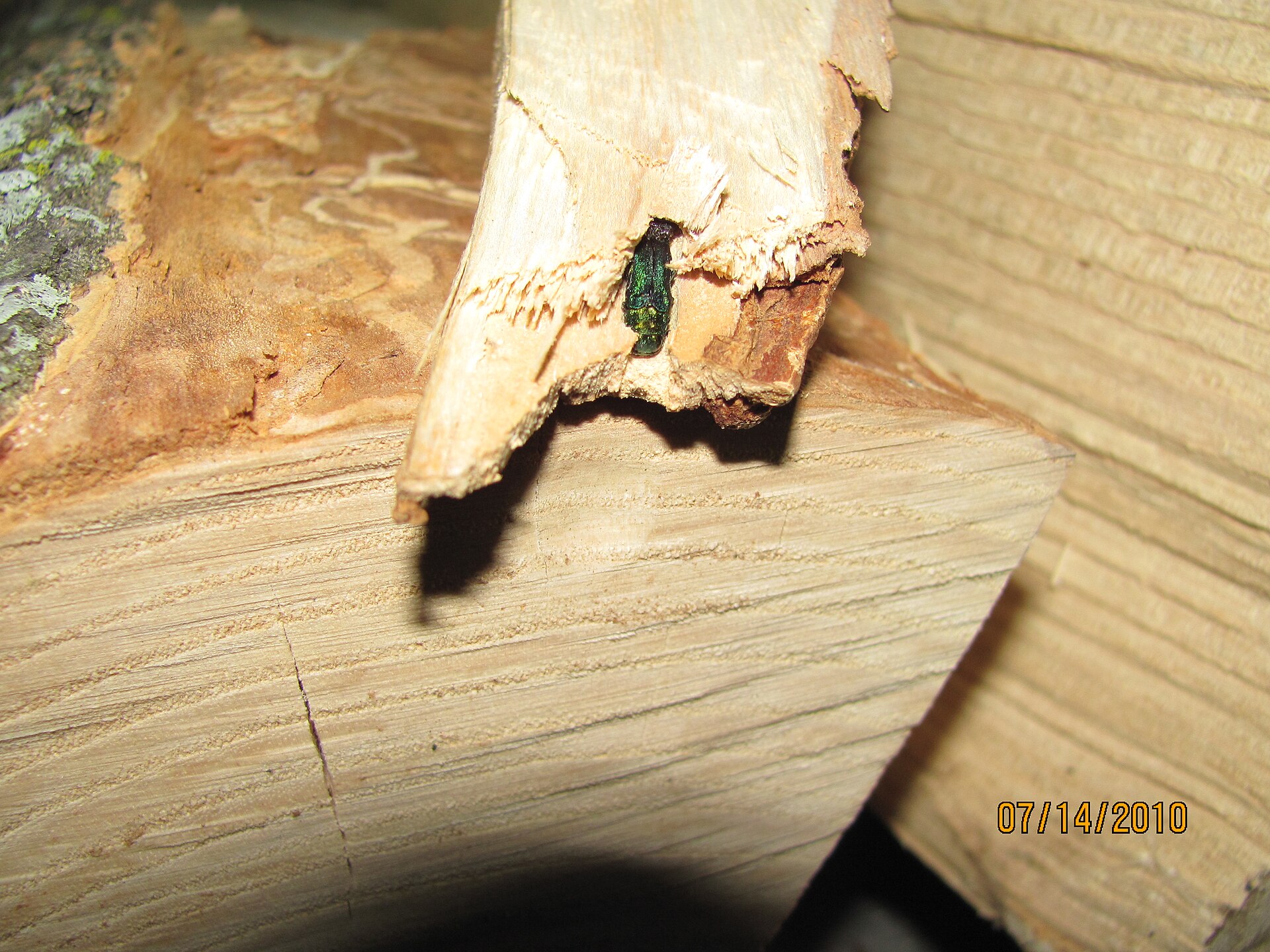
Split firewood logs with the bark peeled back to show winding beetle galleries in the wood beneath
Emerald ash borer found in wood intercepted at a California agricultural inspection station. This is the whole argument for the firewood rule in one photograph: the beetle was in the wood, and the wood was in a vehicle. “Emerald Ash Borer in firewood (5815090311)” — USDA Forest Service Pacific Southwest Region 5 — Public domain

Everything on this page about what is present in South Dakota comes from the South Dakota Department of Agriculture and Natural Resources Forest Health Highlights report for 2024 and from USDA APHIS. Sentences in quotation marks are verbatim from those sources with the issuer named; everything else is ours. iNaturalist counts are a record of where people looked and are not a survey. MyWild states no diagnosis, recommends no treatment and names no product. The national tree pest guide.