
Skip to content
Historical record · Iowa · 1916 to 2007

When Iowa Lakes Freeze Over: Ice In Dates

Iowa has three lakes in the record and all three sit in one basin in Dickinson County. Because they share a shoreline and differ enormously in depth, the Iowa Great Lakes are the cleanest natural experiment in this dataset on what actually sets a freeze date.

3
Water bodies with a freeze record
40 or more recorded winters each
236
Recorded freezes
individual dates written down
1916
Oldest observation
East Okoboji Lake
0
Century long records
spanning 100 winters or more

Dates from past winters. For today’s ice, ask the agency that manages the water.

Typical ice in on East Okoboji Lake

November 30

That is the median across 92 recorded winters from 1916 to 2007, the deepest freeze record in Iowa. Across the 3 Iowa water bodies on this page the typical closing runs from November 30 on East Okoboji Lake to December 12 on West Okoboji Lake. Each of those is a median from a record of past winters, not a forecast or an observation of any lake now.

December 1
East Okoboji Lake across its last 30 recorded winters
12 days
Between the earliest and latest typical freeze in the state
1 of 2
Records long enough to state a century trend that show a later freeze
0
Winters with no freeze at all, on 0 of these water bodies

Every Iowa water body, in the order they close

Nov 1Dec 1Jan 1East Okoboji LakeNov 30Spirit LakeNov 30West Okoboji LakeDec 12

Each bar runs from that water body's earliest recorded closing to its latest, across the whole Iowa record. The solid dot is the median over every recorded winter and the ring is the median over the most recent 30. The scale starts near the earliest date in the set rather than at January 1, because these are dates a few weeks apart.

Where this winter’s dates come from

Iowa publishes no compiled freeze list. The three records here were contributed to the international database by state fisheries staff and they stop in 2007, so treat them as twentieth century history rather than as a description of the last fifteen winters.

Iowa Department of Natural Resources

Today against the record

How this point in the season has usually played out

Where today sits in the East Okoboji Lake record

Today is earlier in the ice season than any closing in this record. The earliest East Okoboji Lake ever closed over in 92 recorded winters was November 4, in 1991, which is 16 days from now on this year’s calendar.

The median across the whole record is November 30, which is 42 days from now on this year’s calendar. The record itself ends in 2007, so this is a comparison against past winters and not a statement about the current one.

This counts recorded winters, not this one; the current winter comes from the agency linked above.

East Okoboji Lake, recorded closings by winter

1968 to 2007, 40 winters, median Nov 30median Nov 301968: December 71969: November 201970: November 241971: November 301972: December 51973: December 61974: December 11975: November 301976: November 301977: November 251978: November 211979: November 301980: December 31981: December 21982: December 91983: November 301984: December 41985: November 211986: November 131987: December 41988: November 291989: November 181990: December 41991: November 41992: November 291993: November 261994: December 71995: November 181996: November 261997: December 231998: December 221999: December 162000: November 222001: December 222002: December 52003: December 112004: December 152005: November 302006: December 12007: November 301970198019902000
Taller means later in the season. The darker columns are the more recent half of the window. The dashed line is the median across the whole record, not just this window, and the vertical scale starts near the earliest date on the chart rather than at January 1 so that a three week shift stays visible. The source ships the most recent 40 observations here, so this window is the tail of a record that begins in 1916.
Advertisement
Water body by water body

The deepest Iowa freeze records

Ordered by how much record is behind them. The median is across every recorded winter; the second figure is across the most recent 30, which is the fairer thing to compare against a lake you know today.

Names are reproduced exactly as the source database records them, which is often a shortened form: a lake filed as “Detroit” or “Otsego” is Detroit Lake or Otsego Lake to everyone who lives on it. The names stay as recorded, because United States lakes split unpredictably between “Lake X” and “X Lake”; the subtitle on each card carries the water body type and the state.

East Okoboji Lake

Lake in Iowa · 92 recorded winters, 1916 to 2007record ends 2007

Nov 30
typical ice in
Dec 1
last 30 recorded winters
Nov 4
earliest, 1991
Jan 2
latest, 1933

Across the whole record the closing date has moved barely at all across the record.

Its ice out has moved 4 days later per century across the record, so adding the two lines together this lake’s ice season is about 5 days longer per century.

1910sDec 31920sNov 291930sDec 81940sDec 11950sNov 271960sDec 41970sNov 291980sNov 281990sDec 32000sDec 6

Mean closing date per decade. Only decades with four or more observations appear, and the scale starts near the shortest bar rather than at January 1 so that small differences stay visible rather than collapsing into one length.
West Okoboji Lake

Lake in Iowa · 91 recorded winters, 1916 to 2007record ends 2007

Dec 12
typical ice in
Dec 12
last 30 recorded winters
Nov 29
earliest, 1926
Jan 13
latest, 2007

Across the whole record the closing date has moved 4 days later per century across the record.

Its ice out has moved barely at all across the record, so adding the two lines together this lake’s ice season is about 5 days shorter per century.

1910sDec 111920sDec 131930sDec 181940sDec 131950sDec 91960sDec 181970sDec 131980sDec 131990sDec 172000sDec 19

Mean closing date per decade. Only decades with four or more observations appear, and the scale starts near the shortest bar rather than at January 1 so that small differences stay visible rather than collapsing into one length.
Spirit Lake

Lake in Iowa · 53 recorded winters, 1951 to 2007record ends 2007

Nov 30
typical ice in
Nov 30
last 30 recorded winters
Nov 4
earliest, 1991
Jan 13
latest, 2007

The record spans 56 years, under the 80 year span needed to state a century trend. The median and the extremes above are unaffected.

1950sNov 231960sDec 71970sNov 271980sNov 271990sNov 302000sDec 10

Mean closing date per decade. Only decades with four or more observations appear, and the scale starts near the shortest bar rather than at January 1 so that small differences stay visible rather than collapsing into one length.

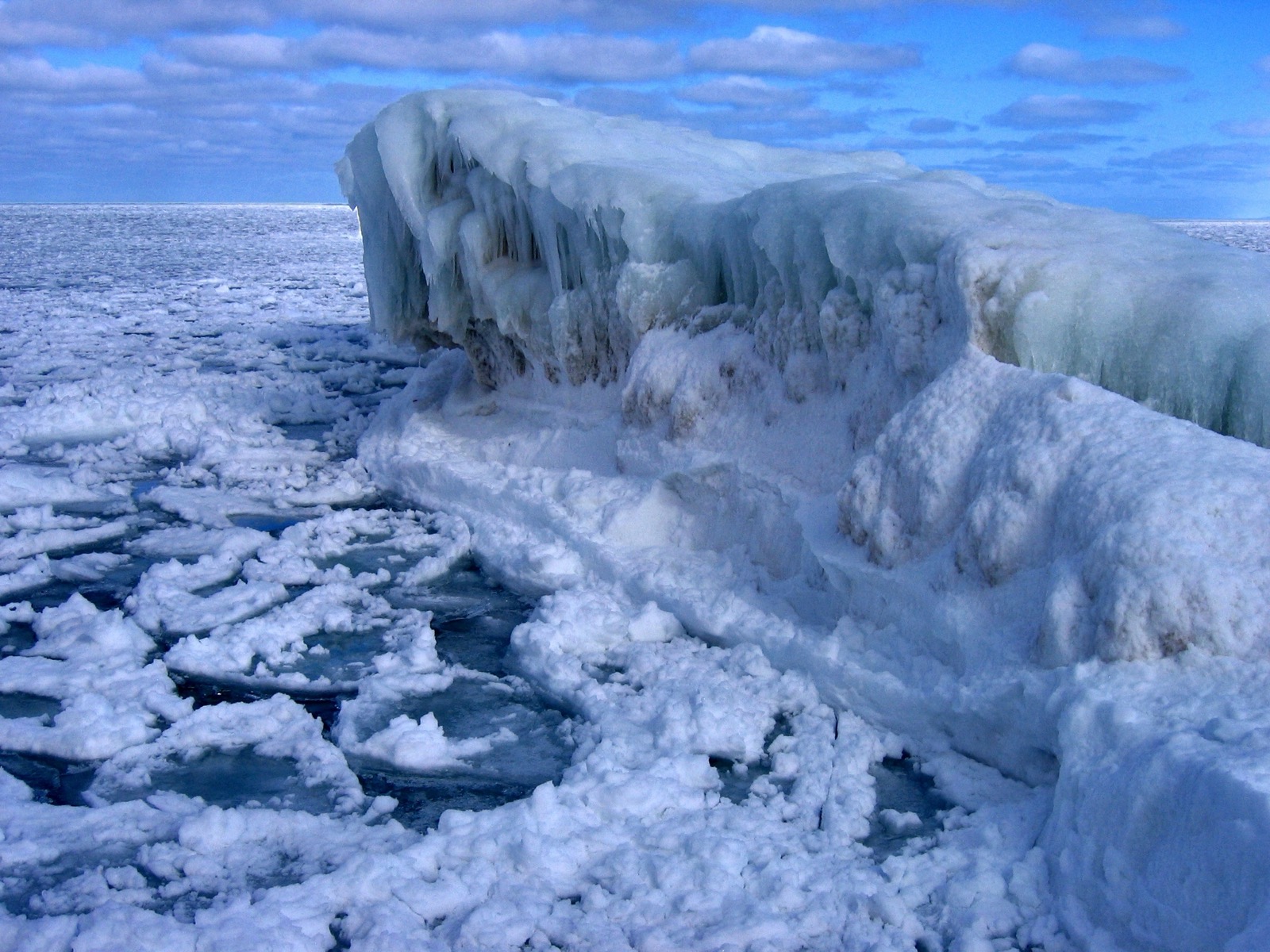
A wall of shelf ice rising above a lake surface strewn with broken plates of new ice and patches of dark open water, under a blue sky with high cloud
Shelf ice standing above a field of broken new plates, with open water still showing between them. This is the state a lake is in for days or weeks before anybody writes a closing date against it, and it is why two observers standing on the same shore can pick two different days. “Ice along Lake Superior” — National Park Service, Pictured Rocks National Lakeshore — Public domain
Every record

All 3 Iowa water bodies with a freeze record

Water bodyRecordTypical ice inLast 30 wintersEarliestLatestChange per centuryWinters open
East Okoboji Lake1916 to 2007 (92)Nov 30Dec 1Nov 4 1991Jan 2 1933-0.3 days0
Spirit Lake1951 to 2007 (53)Nov 30Nov 30Nov 4 1991Jan 13 2007record too short0
West Okoboji Lake1916 to 2007 (91)Dec 12Dec 12Nov 29 1926Jan 13 2007+4.3 days0

Dates are day of year, rendered on a common non leap calendar so the same stored value always reads the same way. Freeze dates are stored on a winter axis, where a January closing sorts after a December one instead of jumping back to the start of the year; the labels above are ordinary calendar dates. “Change per century” is a least squares line through the observations, shown only where a record spans 80 years or more, because a century figure extrapolated from a 40 year window describes the decades that happened to be sampled rather than the lake. “Winters open” counts the winters the source marks as never closing over, which are observations rather than gaps and are not included in the record counts.

Both ends of the season

How much shorter the Iowa ice season has got

2 Iowa water bodies carry a least squares slope on both the freeze and the thaw, which is the only way to see the season from both ends at once. Adding one lake’s own freeze line to its own thaw line, the widest here is West Okoboji Lake at 5.1 days shorter per century.

That is addition on two numbers the source data already publishes for that lake: a description of what one lake’s own record did across the years somebody was watching it, not a model and not a projection of what the next decade will do.

no changeWest Okoboji Lake (IA)5.1d shorterEast Okoboji Lake (IA)4.7d longer
  • Freeze arriving later
  • Thaw arriving earlier

Each bar is one Iowa lake's own freeze line added to its own thaw line, both fitted by least squares to that lake's observations and both already published in the source data. Only records spanning 80 years or more on both variables appear, which is why not every water body in the table above is here.

Reading the record

What the Iowa freeze record shows

Of the 2 Iowa freeze records long enough to state a century trend, 1 show the closing date arriving later. Those are least squares lines fitted to observations, the same simple description the ice phenology literature uses. They describe what each record did. Any single lake can swing three or four weeks between consecutive winters, and several here have.

A typical ice in date is a median drawn from a record: the middle of a distribution whose ends, on these Iowa records, sit 45 days apart on West Okoboji Lake alone. It describes past winters, not the current one.

The Iowa series were logged by state fisheries staff working the same three lakes, recording both the day each lake closed over and the day it opened. One set of observers on one basin is the best case for comparing lakes against each other, and it is rarer in this dataset than you would expect.

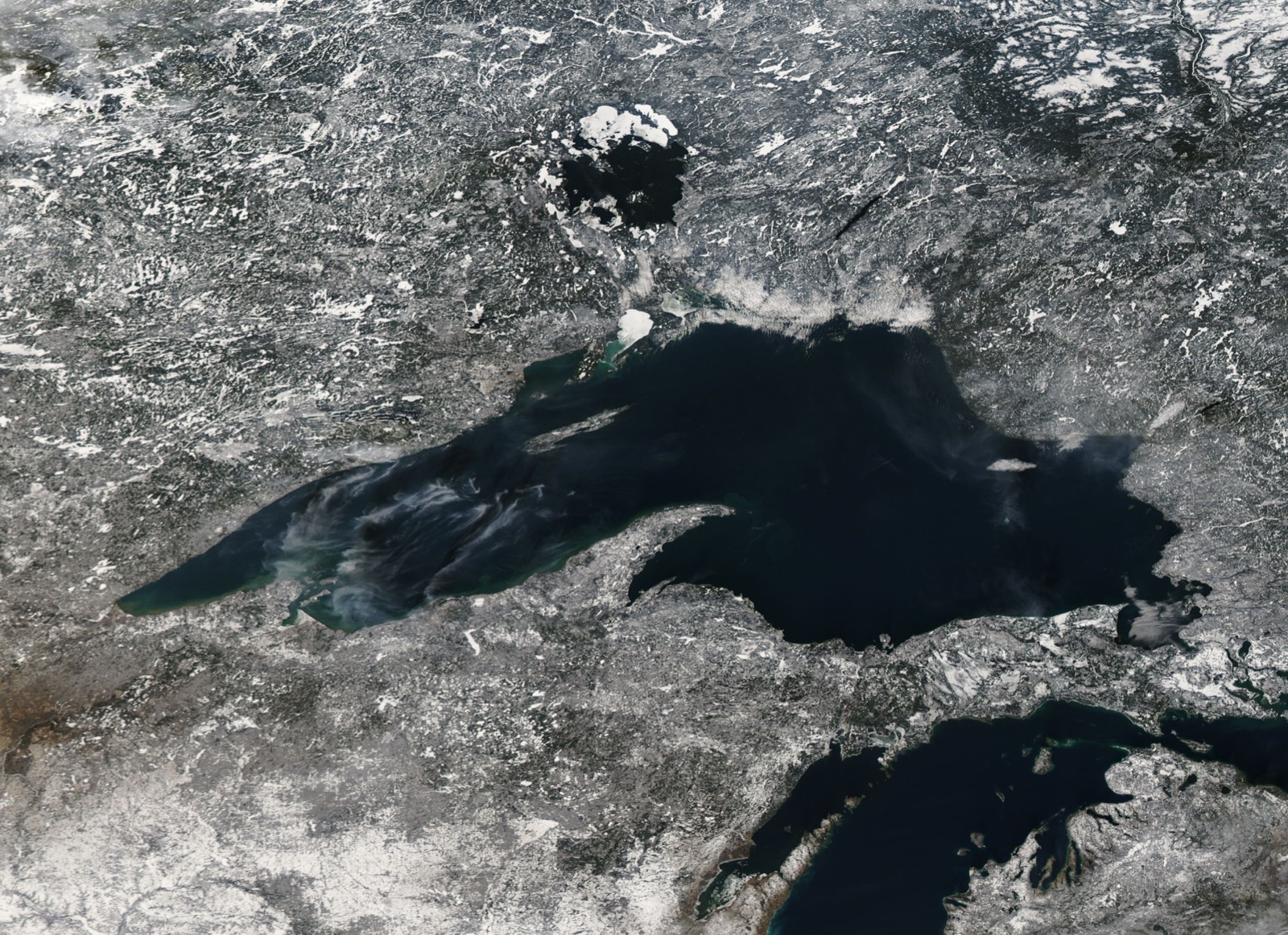
Deep water freezes last. East Okoboji is shallow and typically closes in the last days of November. West Okoboji next door is forty metres deep, holds the summer heat far longer, and typically closes about twelve days later. Same weather, same day, same observers, two weeks apart, which is the whole argument for reading a lake against its own past rather than against its neighbour.

Satellite view of Lake Superior in mid December with the surrounding land under snow, the open lake dark, and pale new ice showing in the shallow western bays
Lake Superior on December 15, with the first ice of that winter forming in the shallow western bays while the deep middle stays open. Depth is what sets a freeze date: a shallow bay gives up its summer heat in weeks and the deep middle can take all winter or never manage it. “Lake Superior (MODIS 2018-12-20)” — MODIS Land Rapid Response Team, NASA GSFC — Public domain
Provenance

Where these Iowa numbers came from

The observations

236 recorded closings across 3 Iowa water bodies, from 1916 to 2007. Only records with 40 or more usable observations are included, and every derived figure is computed from them.

Benson, B., Magnuson, J. and Sharma, S. (2000). Global Lake and River Ice Phenology Database. (G01377, Version 1). Boulder, Colorado USA. National Snow and Ice Data Center. https://doi.org/10.7265/N5W66HP8 Accessed 2026-08-24.

West Okoboji recorded its latest closing of the whole period in the final winter of the series, in January 2007, and Spirit Lake recorded its own latest in the same winter.

Common questions

Iowa lake ice in FAQ

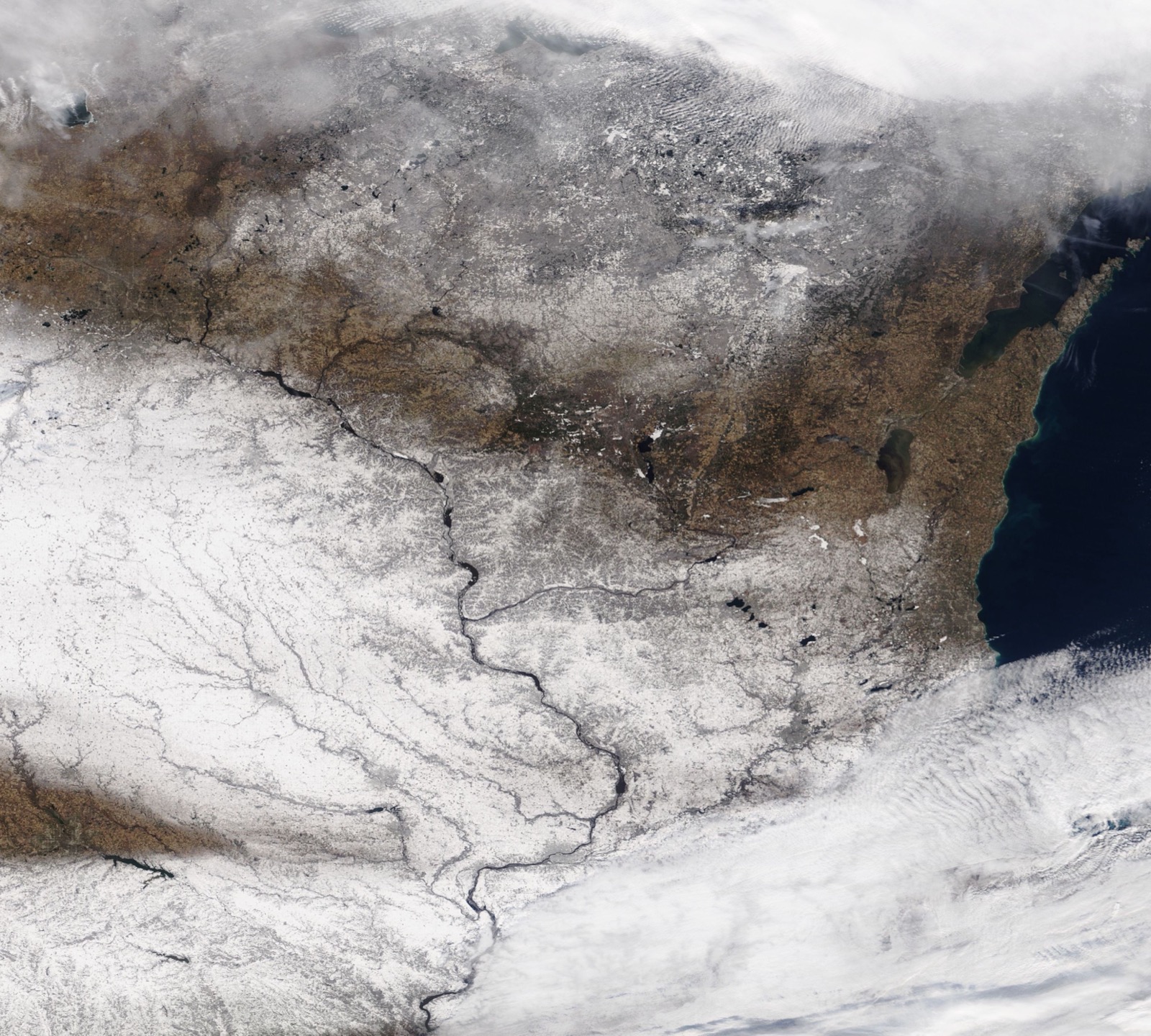
Satellite view of snow across Iowa and southern Minnesota in mid November, with the Mississippi River threading through it, bare brown ground to the northeast and Lake Michigan dark at the right edge
Snow across Iowa and southern Minnesota on November 18, from the first Alberta clipper of that winter. This is the week the Iowa Great Lakes typically close: East Okoboji and Spirit Lake both have a median closing date of November 30. “Snow in Wisconsin, Iowa, Minnesota (MODIS 2018-11-22)” — MODIS Land Rapid Response Team, NASA GSFC — Public domain
The other end of the season

Ice in, ice out, and the rest of the Iowa winter

Iowa ice inWhen 3 Iowa water bodies have typically closed over, from 236 recorded winters. You are on it.
Iowa ice outThe spring half of the same records, lake by lake, from the same source. Together they are the length of the Iowa ice season.

More Midwest states with a lake freeze record

Advertisement

Ice in dates are historical observations compiled by the National Snow and Ice Data Center. They describe past winters only: a median freeze date is a record of winters that have already happened, and says nothing about the ice on any lake today. For current ice and for anything involving going out on it, contact Iowa Department of Natural Resources. National picture: every state with a lake freeze record → The thaw half: Iowa lake ice out dates.
Hero image: “Snow in Wisconsin, Iowa, Minnesota (MODIS 2018-11-22)” — MODIS Land Rapid Response Team, NASA GSFC — Public domain