
Skip to content
Best days on the calendar: November 4 to 24

New Hampshire Deer Movement Forecast

The next seven days in Concord, Keene and Berlin, each rated Slow to Prime for daylight deer movement from the National Weather Service forecast, the rut stage and first and last light, with the best sit for every day.

Nov 25
Peak breeding
our date for the agency window
Nov 18 to Nov 24
Chasing week
when bucks cover the most ground
21
Best days, November 2026
Great or better with a season open
3
Towns rated live
Concord, Keene, Berlin
This week

Deer movement in New Hampshire for the next seven days

Three towns spread across New Hampshire, each with its own forecast and the state’s rut timing. Open a day for every factor and its points. For your own spot, enter a ZIP code on the forecast.

Concord

peak breeding about Nov 25

Reading the National Weather Service forecast for Concord, NH.

Keene

peak breeding about Nov 25

Reading the National Weather Service forecast for Keene, NH.

Berlin

peak breeding about Nov 25

Reading the National Weather Service forecast for Berlin, NH.

The rut

Where the New Hampshire rut stands

Peak breeding in New Hampshire is about November 25, the middle of the agency’s breeding window, our reading.

Bucks cover the most ground in the seeking and chasing weeks before peak breeding and settle in with does at the peak itself, which is why the forecast scores the chasing week highest. The stages below count out from the peak date, which comes from the agency’s own source, quoted on the New Hampshire deer rut page.

  1. Oct 21 to Nov 3Pre rutPre rut: bucks are starting to widen their range.
  2. Nov 4 to Nov 17SeekingSeeking: bucks are covering ground looking for the first does, the best stretch of the year to see one.
  3. Nov 18 to Nov 24ChasingChasing: the week before peak breeding, when buck movement peaks.
  4. Nov 25 to Dec 2Peak breedingPeak breeding: many bucks are holed up with a doe, so fewer are on their feet.
  5. Dec 3 to Dec 16Post rutPost rut: worn down bucks go back to feeding.
  6. Dec 17 to Dec 30Second rutSecond rut: a smaller round of breeding three to four weeks after the peak.
Advertisement
Best days this November

The New Hampshire November calendar

Every day of November 2026 rated on the rut stage alone, with the deer seasons open that day. The full and new moons are marked for reference and score zero, here and in the week ahead. Days tagged Best are rated Great or better with a season open somewhere in New Hampshire. The week ahead above adds the weather to the days in front of you.

Best days: November 4 to 24, rated Great or better on the rut stage with a deer season open.

Sun
Mon
Tue
Wed
Thu
Fri
Sat
1Pre rutAM
2Pre rutAM
3Pre rutAM
4BestSeekingAM
5BestSeekingAM
6BestSeekingAM
7BestSeekingNewAM
8BestSeekingNewAM
9BestSeekingNewAM
10BestSeekingNewAM
11BestSeekingAF
12BestSeekingAF
13BestSeekingAF
14BestSeekingAF
15BestSeekingAF
16BestSeekingAF
17BestSeekingAF
18BestChasingAF
19BestChasingAF
20BestChasingAF
21BestChasingAF
22BestChasingAF
23BestChasingFullAF
24BestChasingFullAF
25PeakFullAF
26PeakAF
27PeakAF
28PeakAF
29PeakAF
30PeakAF
  • Prime
  • Great
  • Good
  • Fair
  • Slow
  • Best Great or better with a season open
  • A Archery
  • F Firearm
  • M Muzzleloader

Rated on the rut stage alone. The full and new moons are shown for reference and score zero, as the moon does in the week ahead. A season letter means it is open in at least one zone on that day, from New Hampshire Fish and Game Department’s dates on the New Hampshire deer season page.

The research

What moves deer, and how much

The ratings follow the GPS collar studies: the rut and the hour first, the weather second. These four factors do most of the work; the forecast hub has all eight, with the barometer, the wind and the moon.

The rut sets the week

Biggest factor. A day scores 45 to 74 from the rut stage alone, highest in the chasing week just before peak breeding.

  • “within the reproductive season, movements and space use were greatest during the rut, followed by pre-rut and post-rut, and least during the non-breeding season.”

    Simoneaux 2015 Bucks cover the most ground during the rut, then the pre rut and post rut, and the least outside the breeding season.

  • “Hunters should remember that breeding periods vary annually and peak breeding times are not necessarily peak buck movement times. Bucks may be more active before or after peak breeding periods, but research has shown that peak buck movement is one to two weeks before peak breeding.”

    Louisiana Wildlife and Fisheries Buck movement peaks one to two weeks before peak breeding, which is why the chasing week scores highest.

  • “Once the peak of the rut arrives a week or two later, hunters will typically see fewer bucks because they are courting and breeding receptive does, rather than searching for receptive does.”

    Mississippi State Deer Lab At peak breeding, bucks stay with a doe, so the lockdown week scores lower than the weeks before it.

  • “During the rut, males will expand their home range 2-4 times in size.”

    Farther and Faster, 2023 Rutting bucks roam two to four times their usual range.

  • “within each region the duration is relatively consistent; about 30-45 days with most of breeding taking place within a 21-day period centered on the peak breeding date. There may be a second, much smaller peak of breeding 3-4 weeks later”

    Mississippi State Deer Lab Most breeding falls in the three weeks around the peak, with a smaller second peak three to four weeks later.
The clock sets the window

Picks the best window: the first two hours of light or the last two, or all day in the chasing week.

  • “Activity was greater at night than during the day and was highest within 2 hours of sunrise or sunset.”

    Wandering in the Moonlight, 2017 Deer move most in the two hours around sunrise and sunset, which is where the best window sits every day.

  • “Female and male movements were primarily crepuscular.”

    Webb et al. 2010 Both bucks and does move mostly at dawn and dusk.

  • “If we look at the average hourly speed of Buck 12776 from November 3rd through November 12th – the two weeks leading up to when half the does are bred – there are no morning and evening bursts of activity.”

    Chasing the Ladies, 2017 In the chasing days before the peak, a collared buck moved all day, so the window opens up to midday.

A colder day helps, a little

Up to 14 points for a day 5 or more degrees colder than the days before it; down up to 10 for a day 6 or more degrees warmer.

  • “activity of both sexes decreased with increasing daytime ambient temperatures, and generally increased with increasing nighttime temperatures during the breeding and post- breeding seasons.”

    Goethlich 2019 In the breeding season, deer moved less by day as the daytime temperature rose.

  • “Changing weather can stimulate deer movement, but a drop in temperature does not influence when the breeding season occurs.”

    Mississippi State Deer Lab A change in weather can get deer moving, while the rut keeps its own dates.

  • “Deer may respond to cold fronts but we likely would need a lot more data to tease out any effect.”

    Cold Wet Winds of Change, The Verdict, 2023 The cold front effect is real enough to count and small enough to keep modest.

  • “First off, I could find no effect of temperature on deer movements.”

    Deer and Rain, 2015 Penn State found no temperature effect, which is why the cold front lift is capped at 14 points.

Steady rain slows bucks

Minus 8 for a tenth of an inch or more of daylight rain at 50 percent odds or better, minus 3 for a 30 to 49 percent chance.

  • “when it rains they travel about 4-tenths of a mile less per day.”

    Deer and Rain, 2015 Bucks travel about four tenths of a mile less on a rainy day.

  • “Rain alone causes a decrease in buck movement.”

    Blown Away, 2018 Rain on its own cuts buck movement.

  • “For females I found NO EFFECT of rain on their movements.”

    Deer and Rain, 2015 Does kept moving in the rain, so a wet day loses 8 points, not more.

  • “less likely to be active when rain was falling at night, and more likely to be active when rain was falling during the day.”

    Goethlich 2019 In South Carolina, daytime rain did not stop deer, which is another reason the rain penalty stays small.

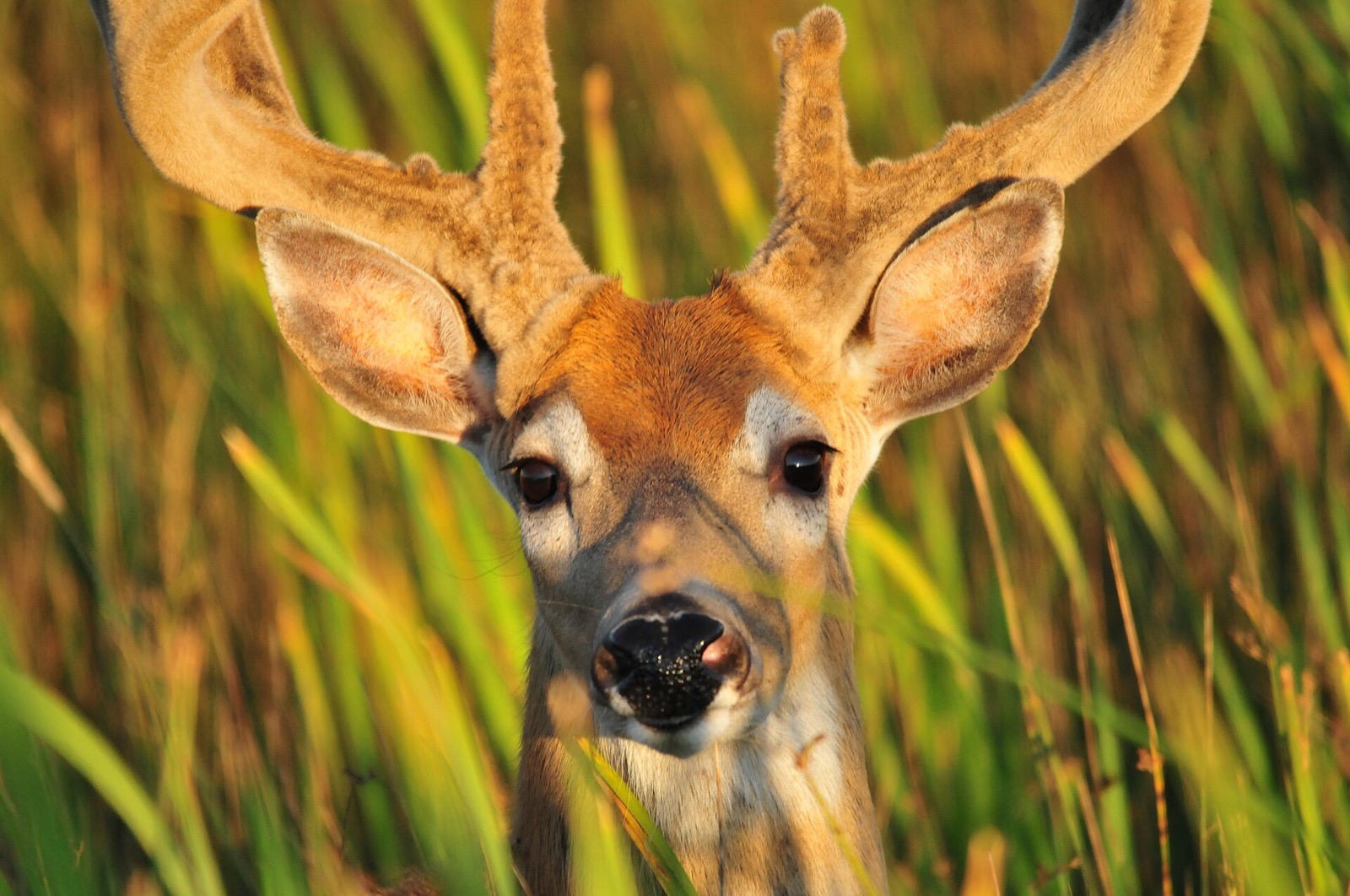
A close view of a white-tailed buck in velvet antlers looking straight at the camera through tall green grass lit by low evening sun
A buck in velvet in the low sun of an August evening on a Wyoming refuge. Heat costs a deer energy, so the forecast takes points off a day that reaches 77F, more at 85F, and on any warm afternoon it points you to the cool of the morning sit. “White-tailed buck on Seedskadee NWR” by Tom Koerner, USFWS Mountain-Prairie, CC BY 2.0

New Hampshire deer movement questions

Advertisement