
When to Plant Garlic: Your Date, From Your Frost Date
Garlic wants 4–6 weeks to root before the ground freezes and no top growth to speak of. Enter your ZIP for the window and today’s soil temperature.
Covers all 50 states. Windows are frost-date typicals; live soil temperature adjusts the soil-gated tasks.
Plant garlic: when, in one line
Cool/transition: 2 weeks before to 3 weeks after first frost (before the ground freezes). Warm South: 2 weeks before to 3 weeks after first frost.
Garlic needs 4–6 weeks to root before the ground freezes but should not push much top growth — planting around the first frost, 2 weeks either side, is the sweet spot.
Soil-temperature rule: Plant when soil at 4 inches is below about 60°F and falling — the cloves root in cool soil without sprouting. The live reading in the tool above is the trigger; the calendar window is the backup.
When to plant garlic: the complete guide
The timing rule, and why it works
Garlic is planted in fall and harvested the following July because it needs two things a spring planting cannot give it: a long cool rooting period, and vernalization — several weeks below about 40°F that tell the clove to divide into a bulb instead of growing as a single round. The sweet spot is roughly two weeks before to three weeks after your typical first frost. Planted then, the clove pushes roots for four to six weeks in soil that is cooling but not frozen, and either stays below ground or shows an inch or two of green that winter does not hurt.
Plant too early — late August in the North, say — and the clove sends up a tall shoot that winter damages, and it burns stored energy on leaves instead of roots. Plant too late, after the ground has frozen, and the clove sits unrooted and heaves out in the freeze-thaw cycles of March. Northern growers with a late-September frost are planting in early-to-mid October; the Midwest and Northeast in mid-to-late October; the mid-South in November; and the Gulf South and Southwest from late November into December.
Hardneck or softneck?
Hardneck garlic (Allium sativum var. ophioscorodon) — varieties like Music, German Extra Hardy, Chesnok Red, Spanish Roja, Georgian Crystal — produces a woody central stalk, a single ring of large easy-to-peel cloves, and a curly flower stalk called a scape in June that you snap off and eat. Hardnecks need real winter cold (roughly zones 3–7) and are the right choice for the North, the Midwest, the Northeast, and the mountains. They store three to six months.
Softneck garlic (var. sativum) — Inchelium Red, California Early, California Late, Silverskin types — has no stalk, more and smaller cloves in layered rings, braids well, and stores nine months or more. Softnecks tolerate mild winters and are the choice for the South, the Southwest, coastal California, and zone 8 and warmer. In the warm South, many growers pre-chill softneck seed garlic in the refrigerator for six to eight weeks before a late-November planting to make up for the missing winter.
Buy seed garlic from a seed company or farmers’ market grower, not the supermarket — grocery garlic is often a softneck from a mild climate, sometimes treated with a sprout inhibitor, and may carry disease. One pound of seed garlic is roughly 50–60 cloves, or about a 25–30 foot row.
Site, soil, and bed prep
Full sun, minimum six hours. Garlic hates wet feet and does poorly in heavy clay that stays saturated in winter — in those soils, plant on a raised bed or ridge. Work two to three inches of compost into the top eight inches, and add a balanced organic fertilizer or about a half pound of 10-10-10 per 100 square feet. Target pH is 6.0–7.0. Rotate: do not follow onions, leeks, or last year’s garlic in the same bed, to dodge white rot and onion maggot.
Planting, step by step
- Break bulbs into cloves the day you plant, not weeks ahead — separated cloves dry out. Keep the papery skin on. Use the largest cloves; plant the small inner ones in a separate “green garlic” row to harvest young.
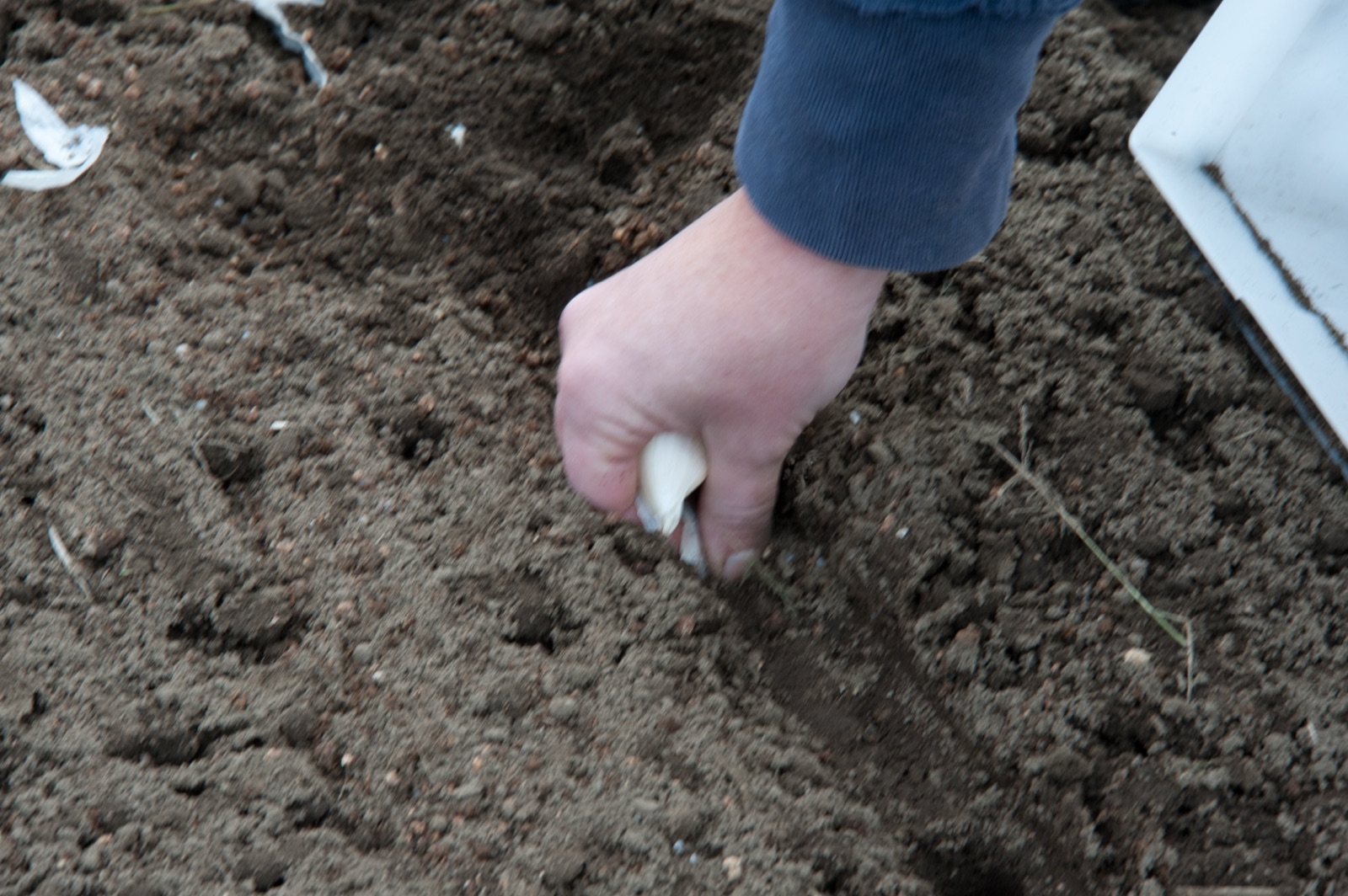
- Orientation: pointy end up, flat root plate down. Upside-down cloves grow, but crooked and smaller.
- Depth: 2 inches to the top of the clove in mild climates, 3–4 inches in zones 3–5 where frost heave is a problem. Spacing: 6 inches in the row, rows 8–12 inches apart. Intensive beds: 6 × 6 inches.
- Water once after planting if the soil is dry. Do not keep it wet.
- Mulch 4–6 inches of clean straw (not hay — weed seed) in cold-winter regions after the ground begins to freeze; 2 inches in the mid-South; none needed on the Gulf Coast. Mulch moderates freeze-thaw heaving and suppresses spring weeds, which garlic competes with poorly.
Spring and summer care through harvest
Pull mulch back from the shoots in early spring if it mats. Side-dress with nitrogen (blood meal, fish emulsion, or a light 21-0-0) twice — when shoots are 4–6 inches tall and again three weeks later — and stop all nitrogen by early May, or you get leaves instead of bulb. Water an inch a week through May; stop watering two weeks before harvest so the wrappers cure dry. Snap hardneck scapes off when they curl in June to push size into the bulb.
Harvest when the bottom three or four leaves have browned and the top five or six are still green — late June in the South, mid-to-late July in the North. Each green leaf is one intact wrapper layer on the bulb. Loosen with a fork (pulling snaps the stem), do not wash, and cure in a shady, airy spot for three to four weeks before trimming and storing at 55–65°F.
Mistakes that cost the crop
- Planting supermarket garlic — often the wrong type for your winter and sometimes sprout-inhibited.
- Planting in August or early September in the North — tall shoots winter-kill and the bulb is small.
- Skipping mulch in zones 3–5 — cloves heave out of the soil by March.
- Wet clay beds — rot over winter. Raise the bed.
- Feeding nitrogen into June — big leaves, small bulbs, poor storage.
- Harvesting too late — wrappers split, bulbs shatter and store badly.
Plant garlic windows by state
Typical windows computed from each state’s median frost dates and grass zone; the state page has the city-by-city soil readings and the rest of the calendar.
| State | Zone | Typical window | First frost | Status |
|---|---|---|---|---|
| Alabama | Warm-season | October 27 – December 1 | November 10 | Soon |
| Alaska | Cool-season | August 22 – September 26 | September 5 | Passed |
| Arizona | Warm-season | November 1 – December 6 | November 15 | Later |
| Arkansas | Transition zone | October 16 – November 20 | October 30 | Soon |
| California | Transition zone | November 17 – December 22 | December 1 | Later |
| Colorado | Cool-season | September 18 – October 23 | October 2 | Open now |
| Connecticut | Cool-season | September 30 – November 4 | October 14 | Open now |
| Delaware | Transition zone | October 14 – November 18 | October 28 | Soon |
| Florida | Warm-season | November 26 – December 31 | December 10 | Later |
| Georgia | Warm-season | October 27 – December 1 | November 10 | Soon |
| Hawaii | Warm-season | not applicable | none | — |
| Idaho | Cool-season | September 14 – October 19 | September 28 | Open now |
| Illinois | Cool-season | October 2 – November 6 | October 16 | Open now |
| Indiana | Cool-season | October 2 – November 6 | October 16 | Open now |
| Iowa | Cool-season | September 26 – October 31 | October 10 | Open now |
| Kansas | Transition zone | October 6 – November 10 | October 20 | Open now |
| Kentucky | Transition zone | October 8 – November 12 | October 22 | Open now |
| Louisiana | Warm-season | November 12 – December 17 | November 26 | Later |
| Maine | Cool-season | September 14 – October 19 | September 28 | Open now |
| Maryland | Transition zone | October 10 – November 14 | October 24 | Soon |
| Massachusetts | Cool-season | September 28 – November 2 | October 12 | Open now |
| Michigan | Cool-season | September 21 – October 26 | October 5 | Open now |
| Minnesota | Cool-season | September 12 – October 17 | September 26 | Open now |
| Mississippi | Warm-season | October 27 – December 1 | November 10 | Soon |
| Missouri | Transition zone | October 8 – November 12 | October 22 | Open now |
| Montana | Cool-season | September 8 – October 13 | September 22 | Open now |
| Nebraska | Cool-season | September 26 – October 31 | October 10 | Open now |
| Nevada | Transition zone | September 18 – October 23 | October 2 | Open now |
| New Hampshire | Cool-season | September 11 – October 16 | September 25 | Open now |
| New Jersey | Cool-season | October 6 – November 10 | October 20 | Open now |
| New Mexico | Transition zone | October 1 – November 5 | October 15 | Open now |
| New York | Cool-season | September 21 – October 26 | October 5 | Open now |
| North Carolina | Transition zone | October 14 – November 18 | October 28 | Soon |
| North Dakota | Cool-season | September 8 – October 13 | September 22 | Open now |
| Ohio | Cool-season | October 2 – November 6 | October 16 | Open now |
| Oklahoma | Transition zone | October 18 – November 22 | November 1 | Soon |
| Oregon | Cool-season | October 14 – November 18 | October 28 | Soon |
| Pennsylvania | Cool-season | September 26 – October 31 | October 10 | Open now |
| Rhode Island | Cool-season | October 4 – November 8 | October 18 | Open now |
| South Carolina | Warm-season | October 29 – December 3 | November 12 | Soon |
| South Dakota | Cool-season | September 16 – October 21 | September 30 | Open now |
| Tennessee | Transition zone | October 12 – November 16 | October 26 | Soon |
| Texas | Warm-season | November 6 – December 11 | November 20 | Later |
| Utah | Cool-season | September 24 – October 29 | October 8 | Open now |
| Vermont | Cool-season | September 10 – October 15 | September 24 | Open now |
| Virginia | Transition zone | October 11 – November 15 | October 25 | Soon |
| Washington | Cool-season | October 14 – November 18 | October 28 | Soon |
| West Virginia | Cool-season | September 28 – November 2 | October 12 | Open now |
| Wisconsin | Cool-season | September 18 – October 23 | October 2 | Open now |
| Wyoming | Cool-season | September 6 – October 11 | September 20 | Open now |
When to plant garlic FAQ
More fall timing guides
Windows are climatological typicals from NOAA 1991–2020 frost normals and grass-zone rules following land-grant extension guidance; any year runs ±2 weeks. Soil temperature is modeled at 6 cm by Open-Meteo, read live in your browser. Always follow the product label. Hero image: “Planting the Garlic (6270333923)” by Dwight Sipler from Stow, MA, USA, CC BY 2.0