Rainbow Falls
Rain fedHilo's drive-up falls on the Wailuku River, 80 feet over a lava cave said to be the home of Hina, and named for the rainbows in its morning mist.

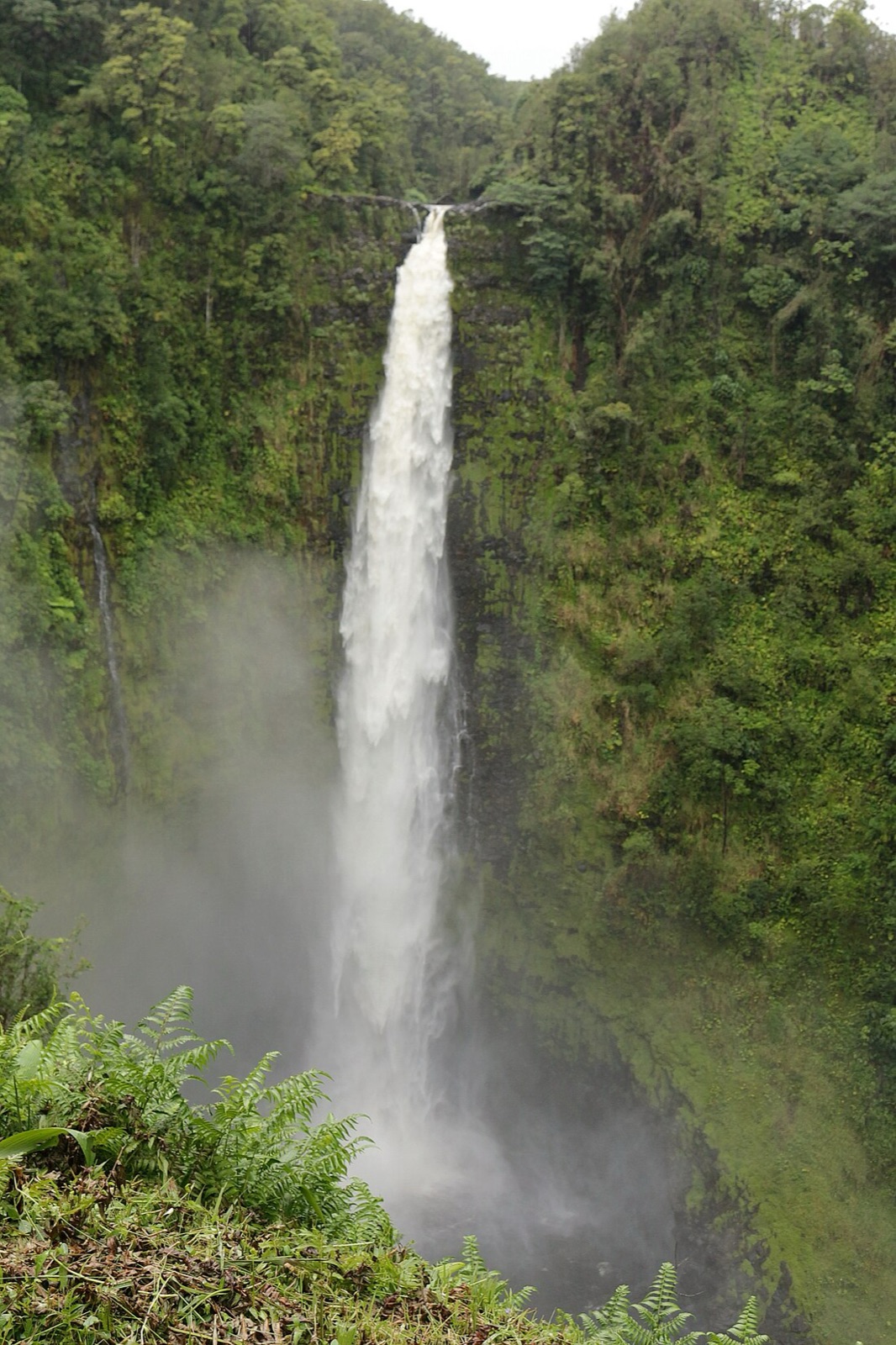
Hawaii's postcard plunge: 442 feet of free fall into a stream-eroded gorge on the Hamakua Coast, framed by a paved loop through tropical forest.
Trail status, closures and safety rules belong to each falls' managing agency, named and linked on every page.
Kolekole Stream drains one of the wettest coasts in the country, so Akaka runs year round with its heaviest water in the November through April wet season and quick surges after any Hilo-side downpour; the rain-fed label is our classification of that regime. The neighboring Kahuna Falls shares the same loop trail and the same weather.
Typical best flow: November through April
Pleasant self-guided walk through lush tropical vegetation to scenic vista points overlooking the cascading Kahuna Falls and the free-falling 'Akaka Falls, which plunges 442 feet into a stream-eroded gorge. The 0.4-mile loop footpath requires some physical exertion.
The 0.4 mile paved loop involves steps and some exertion and is not wheelchair accessible, per the state park. As of 2026 the park charges non-residents a $5 entrance fee plus $10 parking, card only, with Hawaii residents free; paying online before arrival is encouraged since cell service is thin.
Current access and closures: Akaka Falls State Park (Hawaii DLNR Division of State Parks).
Hilo's drive-up falls on the Wailuku River, 80 feet over a lava cave said to be the home of Hina, and named for the rainbows in its morning mist.
The 400 foot wall of water at the end of Haleakala's Pipiwai Trail, past the bamboo forest in the Kipahulu District beyond Hana.
Kauai's easiest great falls: a roadside overlook above the Wailua River valley, with the falls splitting and rejoining across its basalt lip as the rain dictates.
The double falls at the end of Maalo Road made famous by television, pouring off the South Fork Wailua and swelling into a single curtain after Kauai rain.
Make a trip of it
Things to doGuided trips and experiences from local operators.
Browse on Viator Places to stay
Vacation rentals and cabins close to the water.
Browse on VrboWe may earn a commission on bookings made through these links.
Flow windows are typical-year climatology drawn from the driver and the agency language quoted above, not forecasts. Live readings and per-date percentiles are U.S. Geological Survey data, public domain; the above-or-below-typical line is our comparison and is labelled as such. Access, trail and safety information belongs to Akaka Falls State Park (Hawaii DLNR Division of State Parks). National picture: waterfall season across the US →
Hero image: “Akaka Falls, Akaka Falls State Park, Pepeekeo (504214) (23174492261)” by Robert Linsdell from St. Andrews, Canada, CC BY 2.0