Skip to content
Indiana, by county or zone, 3 cities measured

Indiana Frost Line Depth by County

Indiana publishes a frost depth for every one of its 92 counties in the residential code's own climatic table, 24 inches across the southern counties, 30 inches through the middle of the state and 36 inches along the northern tier.

24 to 36 inches
Frost line depth
92 countys in the code
2018 IResidential Code, amended by the state
Code in force
Indiana Fire Prevention and Building Safety Commission
558
Freezing index
degree days a winter at Fort Wayne
127
Nights below freezing
a winter at Fort Wayne, since 1951
The answer

How deep is the frost line in Indiana?

A depth per place

24 to 36 inches

Indiana's code carries a frost line depth table: 92 countys, running 24 to 36 inches.

Who publishes it
Indiana Fire Prevention and Building Safety Commission
Code in force
2020 Indiana Residential Code, 675 IAC 14-4.4
Based on
2018 International Residential Code, amended by the state
Foundation is the minimum depth, in inches, from the finish grade to the bottom of the footing.
675 IAC 14-4.4, 2020 Indiana Residential Code, Indiana Fire Prevention and Building Safety Commission, read September 23, 2026. Read it at the source

The table in full. A jurisdiction may amend upward, so a town’s own figure can be deeper than the row below, never shallower.

CountyFrost line depth
Adams County36 inches
Allen County36 inches
Benton County36 inches
Carroll County36 inches
Cass County36 inches
DeKalb County36 inches
Elkhart County36 inches
Fulton County36 inches
Huntington County36 inches
Jasper County36 inches
Kosciusko County36 inches
LaGrange County36 inches
Lake County36 inches
LaPorte County36 inches
Marshall County36 inches
Miami County36 inches
Newton County36 inches
Noble County36 inches
Porter County36 inches
Pulaski County36 inches
St. Joseph County36 inches
Starke County36 inches
Steuben County36 inches
Wabash County36 inches
Wells County36 inches
White County36 inches
Whitley County36 inches
Blackford County30 inches
Boone County30 inches
Clinton County30 inches
Delaware County30 inches
Fayette County30 inches
Fountain County30 inches
Grant County30 inches
Hamilton County30 inches
Hancock County30 inches
Hendricks County30 inches
Henry County30 inches
Howard County30 inches
Jay County30 inches
Johnson County30 inches
Madison County30 inches
Marion County30 inches
Montgomery County30 inches
Morgan County30 inches
Parke County30 inches
Putnam County30 inches
Randolph County30 inches
Rush County30 inches
Shelby County30 inches
Tippecanoe County30 inches
Tipton County30 inches
Union County30 inches
Vermillion County30 inches
Warren County30 inches
Wayne County30 inches
Bartholomew County24 inches
Brown County24 inches
Clark County24 inches
Clay County24 inches
Crawford County24 inches
Daviess County24 inches
Dearborn County24 inches
Decatur County24 inches
Dubois County24 inches
Floyd County24 inches
Franklin County24 inches
Gibson County24 inches
Greene County24 inches
Harrison County24 inches
Jackson County24 inches
Jefferson County24 inches
Jennings County24 inches
Knox County24 inches
Lawrence County24 inches
Martin County24 inches
Monroe County24 inches
Ohio County24 inches
Orange County24 inches
Owen County24 inches
Perry County24 inches
Pike County24 inches
Posey County24 inches
Ripley County24 inches
Scott County24 inches
Spencer County24 inches
Sullivan County24 inches
Switzerland County24 inches
Vanderburgh County24 inches
Vigo County24 inches
Warrick County24 inches
Washington County24 inches
Advertisement
What the code asks

Footings and buried water lines in Indiana

A frost line depth turns into two separate requirements in most codes: how far a footing has to bear below grade, and how far a buried water service has to sit below the same line. Indiana writes both of them out.

Footings

Foundation walls, piers and other permanent supports must be protected from frost, and the first listed way to do that is to extend them below the frost line the county table gives.

Below the frost line
Yes, the code says so in these words
Exemptions
freestanding accessory structures with an area of 721 square feet or less, when constructed in accordance with Table R309 decks not supported by a dwelling
Except where otherwise protected from frost, foundation walls, piers, and other permanent supports of buildings and structures shall be protected from frost by one or more of the following methods: 1. Extended below the frost line specified in Table R301.2(1). 2. Constructed in accordance with Section R403.3. 3. Constructed in accordance with ASCE 32. 4. Erected on solid rock. Footings shall not bear on frozen soil unless the frozen condition is permanent.
675 IAC 14-4.4, 2020 Indiana Residential Code, Indiana Fire Prevention and Building Safety Commission, read September 23, 2026. Read it at the source

Buried water lines

A water service pipe must be at least 12 inches deep and at least 6 inches below the frost line, so in most of the state the county frost depth plus 6 inches is what governs.

Depth
12 inches
Water service pipe shall be installed not less than 12 inches (305 mm) deep and not less than 6 inches (152 mm) below the frost line.
675 IAC 14-4.4, 2020 Indiana Residential Code, Indiana Fire Prevention and Building Safety Commission, read September 23, 2026. Read it at the source
The winter behind it

The freezing index in Indiana

The air freezing index is the quantity the frost provisions of the model codes are written on: add up how far each day’s mean temperature fell below freezing over a winter, in degree days, and take the deepest run the winter managed. It measures how much cold the ground had to absorb, which is why it is the honest way to set one place beside another. Fort Wayne is the coldest of the 3 cities on the record in Indiana.

Fort Wayne

Moderate

558degree days

average freezing index a winter

Hardest winter on record
1,460 degree days, winter of 1977
Hard winter, once a century
1,455 degree days
Nights below freezing
127 a year
Days that never thaw
42 a year
Winters measured
75, 1951 to 2025

Fort Wayne Intl AP

CityStateFreezing indexOnce a centuryNights below freezing
Fort WayneIndiana5581,455127
IndianapolisIndiana3831,111112
EvansvilleIndiana19666294

Computed from NOAA National Centers for Environmental Information, Global Historical Climatology Network daily temperature records for each station, from 1951 onward. These are measurements of winter, not depths.

In context

What states with a comparable winter ask for

Only a handful of states answer with one number for the whole state, and they are the only codes that can be set beside each other directly. Ranked by the freezing index at their own reference cities, with Indiana marked at 379 degree days for comparison alongside what those codes settled on:

  1. North Carolina3412 inches
  2. Massachusetts4224 feet
  3. Connecticut52142 inches
  4. Michigan1,12042 inches
  5. Vermont1,1485 feet
  6. Wisconsin1,1624 feet
  7. Indiana379None published

Left to right, the mildest winters to the hardest. The figure on the right is what that state wrote into its code.

The nearest by winter are Massachusetts at 4 feet, Connecticut at 42 inches and North Carolina at 12 inches. That is a reading of other states’ codes rather than a depth for an address in Indiana: soil, drainage, snow cover and local amendments all move the figure, and the building department issuing the permit is the office whose number binds.

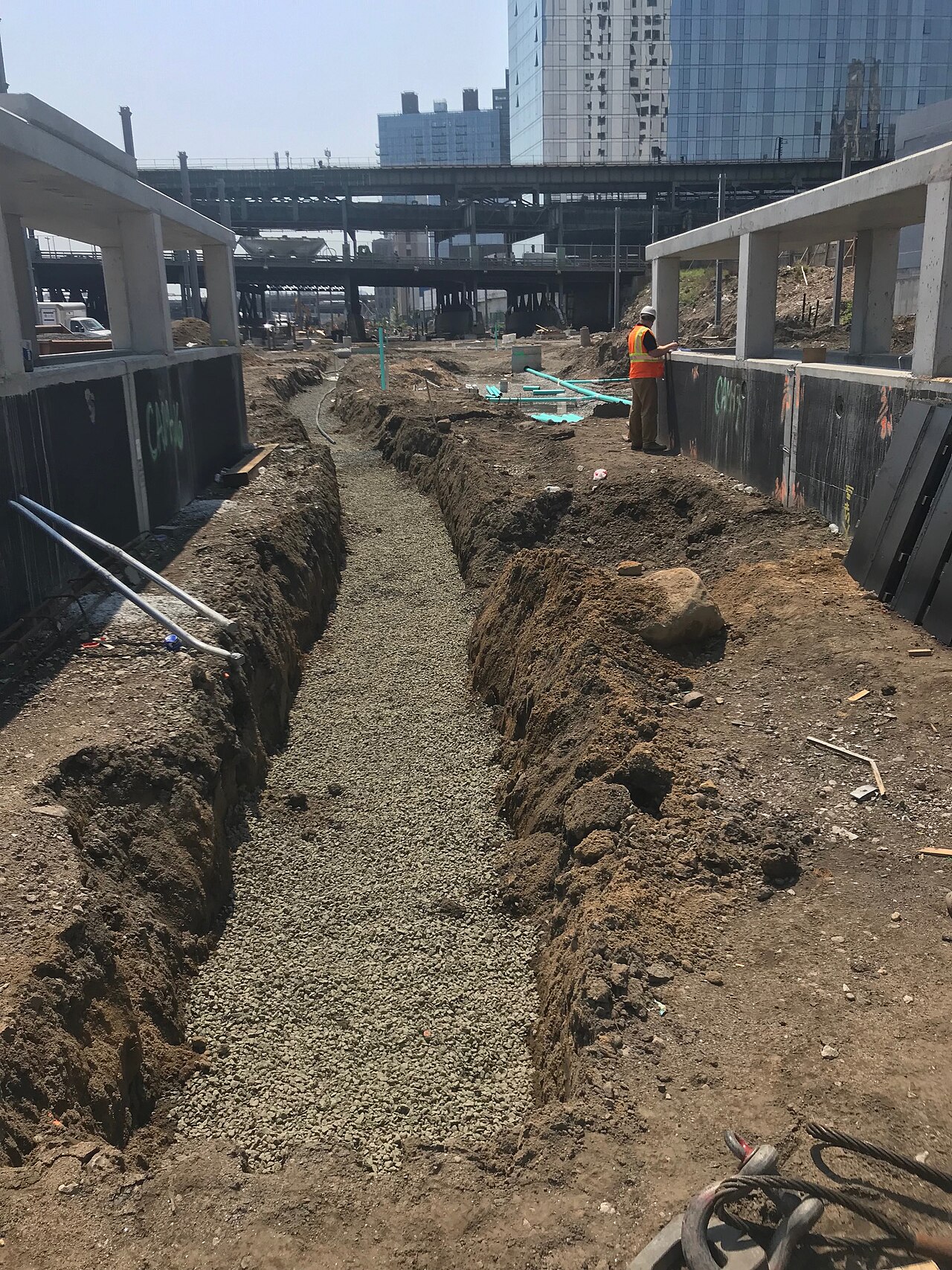
A long open trench with a gravel bed running down the middle of a city construction site, lengths of blue water pipe staged on the ground beside it
A water main trench, bedded and waiting for pipe, in Queens. Buried water service has its own depth rule in the plumbing side of a state code, written separately from the footing rule and not always to the same number. “Excavation for a water main trench in the future LIRR Mid-day Storage Yard”, MTA Capital Construction Mega Projects, CC BY 2.0

Indiana frost line questions

Advertisement

Indiana code read September 23, 2026 from 675 IAC 14-4.4, 2020 Indiana Residential Code, Indiana Fire Prevention and Building Safety Commission. Codes are amended and a local amendment can be deeper than the state figure, so the building department issuing the permit has the number that binds. Every state is on the frost line depth hub.