Major periods
About two hours, centered on the moment the moon crosses your meridian: once overhead and once underfoot, roughly twelve hours and 25 minutes apart.

Today on one 24 hour timeline, then the next seven days rated Fair to Best, each with the one window worth planning around.
Photo: “Fall fishing on the Madison River at sunrise”, Jacob W. Frank, Yellowstone National Park (NPS), Public domain
The moon and the sun come from your own coordinates, and the weather from the National Weather Service forecast for the same spot. Each state page adds that state’s fishing year in its wildlife agency’s own words.
About two hours, centered on the moment the moon crosses your meridian: once overhead and once underfoot, roughly twelve hours and 25 minutes apart.
About an hour, centered on moonrise and moonset. Like the majors, they run about 50 minutes later each day, so a dawn window drifts into the morning over the week.
Any window within an hour of sunrise or sunset is marked in gold. Those are the windows the rating leans on, and the days they fall on rise to Great and Best.
Dawn and dusk are the reliable part; the moon windows are the old angler’s rule.
The rule is nearly a century old. John Alden Knight drew it from anglers’ lore and the movements of the sun and moon, and every solunar table since has laid the windows out the same way:
“In May 1926, John Alden Knight put together some fishing folklore and other fishing factors such as the sun and the moon, hence the name Solunar (Sol for sun and Lunar for moon) to form a theory on the patterns of animal movement.”
Solunar theory, Wikipedia
The modern evidence for the moon is mixed. The best controlled look, from commercial longline catches in the Gulf of Mexico, found the moon mattered for some fish and not for others:
“A lunar effect on catch rates was detected for Red Grouper Epinephelus morio and Tilefish Lopholatilus chamaeleonticeps; however, no lunar effect was detected for Yellowedge Grouper Hyporthodus flavolimbatus, Red Snapper Lutjanus campechanus, or Vermilion Snapper Rhomboplites aurorubens based on either method.”
Does the Lunar Cycle Affect Reef Fish Catch Rates?, North American Journal of Fisheries Management 37:536-549 (Pulver, 2017)
So the rating starts from the moon phase, adds points when a window meets the light, and lets the forecast move a day by up to 12 points either way. A day scores out of 100: Good from 44, Great from 62, Best from 80. Each factor and the sentence it rests on:
Most at the new and full moon, falling to nothing at the quarters.
“The strongest activity occurs when there is a full moon or a new moon, and is weakest when there is a quarter moon or a three quarter moon.”
Wikipedia
For each window within an hour of sunrise or sunset, up to +36.
“However, fish seem to prefer the low light conditions of morning and evening better than the bright sun of midday.”
Missouri Department of Conservation
A falling barometer usually means a front is on its way. Read over the last 24 hours at the nearest station, for today only.
“Fishing before a cold front is a good time for catching fish, and if a warm front happens to roll in, get to the water and wet a line before, during, and after.”
Indiana Department of Natural Resources
Read as a forecast high 10 degrees or more below the day before.
“Cold fronts often reduce fish movements.”
Missouri Department of Conservation
Light to moderate is 5 to 15 mph; strong is 20 mph or more in daylight.
“A light to moderate wind is better than no wind.”
Missouri Department of Conservation
Gentle is a 40 percent chance or more with under a quarter inch; heavy is half an inch or more.
“Fishing is good before and during a gentle rain but poor during and after a thunderstorm.”
Missouri Department of Conservation
Sky cover of 70 percent or more in daylight.
“Cloud cover creates a twilight of its own and may encourage fish to bite.”
Missouri Department of Conservation
A 30 percent chance or more in daylight.
“Fishing is good before and during a gentle rain but poor during and after a thunderstorm.”
Missouri Department of Conservation
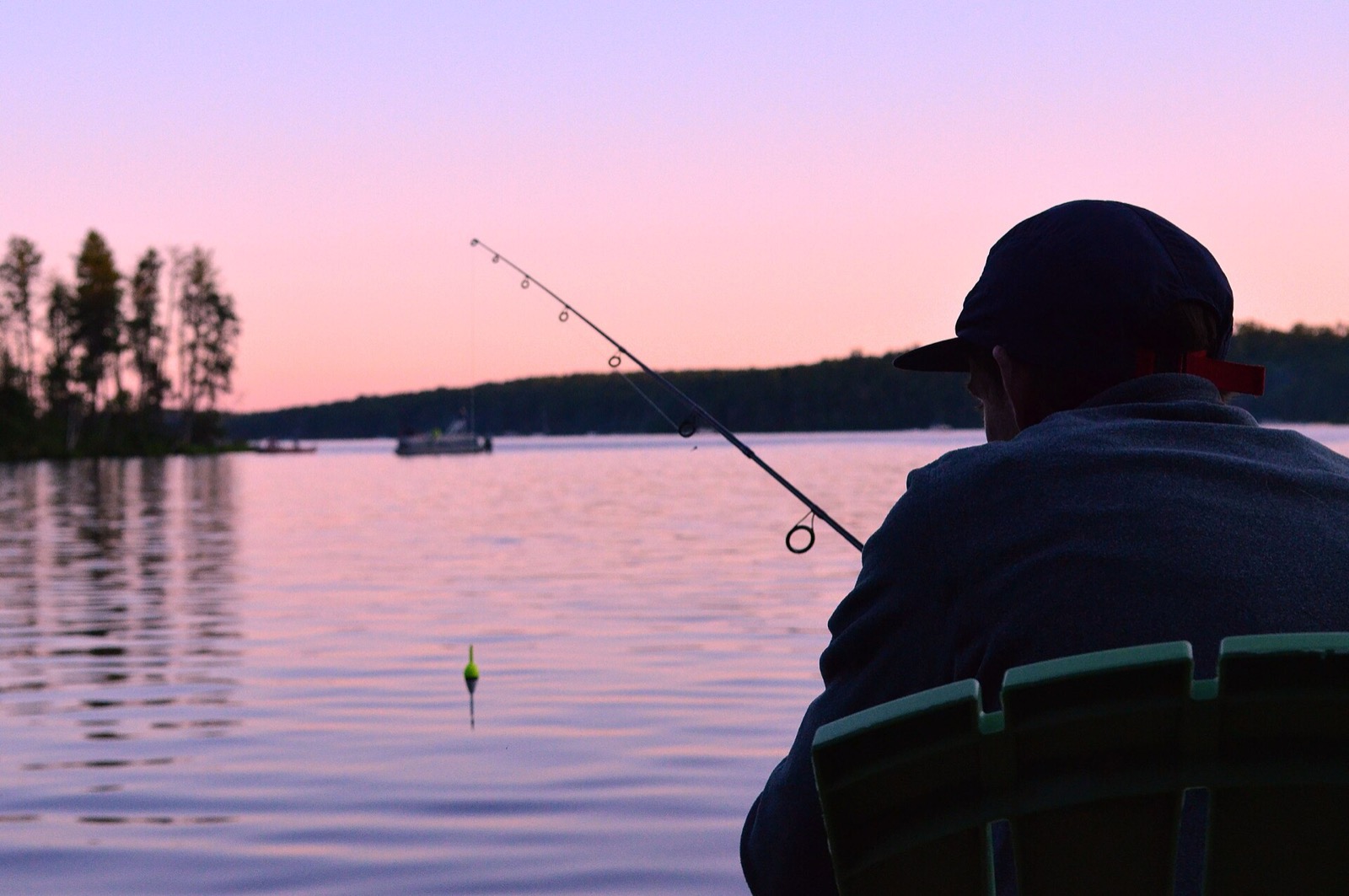
The hour that fishes best moves with the water temperature. These are the agencies’ own words for each season; the state pages have the dated runs and bites for each state.
Fish move shallow as the water warms. By late May the early morning and late afternoon windows are the ones to fish, and bass bite into the night.
“Fish are often shallower in the spring and early summer.”
Missouri Department of Conservation
“Later in May, after a stretch of warm sunny days, the best times to fish are early morning, late afternoon, and even nighttime, especially for bass.”
Indiana Department of Natural Resources
Heat pushes fish deep in the middle of the day, which makes the dawn and dusk windows count for more. A moon window at first light is the one to plan around.
“Summer heat sends fish deeper to find cooler temperatures.”
Missouri Department of Conservation
“Brook trout actively feed during low-light conditions of early morning and dusk when aquatic insects emerge.”
Wisconsin Department of Natural Resources
Early fall still favors morning and evening. As the water cools, the best hours slide toward the afternoon, when the water is at its warmest.
“Early fall, fish in the morning and evening. Mid to late fall, fish in the afternoon or early evening when the water is at its warmest and fish are the most active.”
Indiana Department of Natural Resources
“Fall fish tend to remain deep.”
Missouri Department of Conservation
Mid to late afternoon is the window. On the ice, fish often hold near the surface, especially late in the season.
“Mid to late afternoon is the best time to fish in winter.”
Indiana Department of Natural Resources
“Fish in ice-covered lakes often stay near the surface, especially in late winter.”
Missouri Department of Conservation
Each state page rates this week for three reference towns and lays out the state’s fishing year from its wildlife agency, with the license, trout stocking and ice pages beside it.