Skip to content
Mississippi Flyway

Iowa Duck Migration Report 2026

Duck observations in Iowa usually jump to their fall high in a single week, around the week of Nov 2; they stay above the halfway mark between their July level and that high through the week of Dec 21.

Week of Nov 2
Usual fall high in observations
2016 to 2025
30,390
2026 fall count
ducks, October 2, 2026
Mississippi
Flyway
freeze watch below
The agency counts

Where ducks are counted in Iowa

2026 fall count

Fall Migration Waterfowl Survey (Waterfowl Migration Report)

Iowa Department of Natural Resources

Counted October 2, 2026
30,390 ducks
The statewide duck count increased by 33.4% and the Canada goose count increased by 27.2% from last week.
In the agency’s words
Fall Migration Waterfowl Survey Week Ending: October 2, 2026 ... Total 30390 22789 12 88 0 6660 5237 100 0. Blue-winged teal were the most abundant duck followed by wood ducks and mallards. At a statewide scale, observers counted 53.4% more ducks and 37.8% fewer Canada geese than during this week last year.
Iowa Department of Natural Resources, October 2, 2026. Read it at the source

Ducks and geese at about 20 survey sites across Iowa, counted each week of the fall migration, with the duck share split into mallard, other dabblers and divers

How often
Weekly each fall (2026 reports dated September 4, 11, 18, 25 and October 2)
Season
September
Counted at
Bays Branch Areas, Big Marsh, Black Hawk Areas, Coralville Areas, Green Island, Ingham Areas, Lake Odessa Areas, Lake Sugema, and 12 more
2026 fall count

INHS Waterfowl Aerial Inventory, Central Mississippi River

Illinois Natural History Survey (Forbes Biological Station) · Illinois

Counted September 23, 2026
4,275 ducks
395 of them mallards
The 10-year average (2016 to 2025) for this flight is 18,380 ducks
In the agency’s words
TOTAL MISSISSIPPI 395 0 945 2,090 650 15 25 155 0 0 0 0 0 0 0 0 0 4,275 ... 10-Year Average 750 0 8,352 3,132 4,708 34 127 1,269 0 7 0 0 0 0 0 0 0 18,380 ... 2016-2025
Illinois Natural History Survey (Forbes Biological Station), September 23, 2026. Read it at the source

Ducks, geese and other waterbirds at 18 sites on the central Mississippi River from Alton to Moline, by species, from the air

How often
Weekly from September through early January
Season
September to January
The usual peak
early December (the highest 10-year average in the 2025 sheets is 585,751 ducks for the 12/05 flight)
Highest published count
642,330 ducks, November 2025
Long term
10-year average for 2016 to 2025, printed under each weekly total (for example 585,751 ducks for December 5, 2025 and 537,271 for December 9, 2025)
Counted at
Keokuk-Nauvoo, Arthur Refuge, Nauvoo-Ft. Madison, Ft. Madison-Dallas, Henderson Creek, Keithsburg Refuge, Louisa Refuge, Swan Lake, and 10 more
Advertisement
Observations this week

Iowa against a normal year

Observations this week in Iowa

Duck observations here usually reach their fall high around the week of Nov 2. Counting this week’s research grade observations.

Observations this week in the Mississippi Flyway

Duck observations here usually reach their fall high around the week of Nov 2. Counting this week’s research grade observations.

Which ducks come through Iowa, and when

Each row is one species’ share of Iowa bird observations by week from August to July, darkest at its high point, from research grade iNaturalist observations 2016 to 2025. The last column is the week each species first comes four fifths of the way from its July level to its August to December high.

SpeciesAugSepOctNovDecJanFebMarAprMayJunJulUsual fall high
Mallarddabblingweek of Sep 7
Green-winged tealdabblingtoo few fall records
Blue-winged tealdabblingtoo few fall records
Northern pintaildabblingtoo few fall records
American wigeondabblingtoo few fall records
Gadwalldabblingtoo few fall records
Wood duckdabblingno fall rise; as common in summer
Canvasbackdivingtoo few fall records
Redheaddivingtoo few fall records
Lesser scaupdivingtoo few fall records
Ring-necked duckdivingtoo few fall records
Buffleheaddivingtoo few fall records
Common goldeneyedivingweek of Nov 23
What moves the birds

Freeze watch up the Mississippi Flyway

When the shallow water at the northern staging areas locks up, dabbling ducks move south to open water. These are the National Weather Service seven day forecast lows there, with nights at or below 28°F marked.

Freeze watch on the Mississippi Flyway

Reading the seven day forecast lows at Bemidji, Fergus Falls, Green Bay, Alpena, Saginaw Bay.

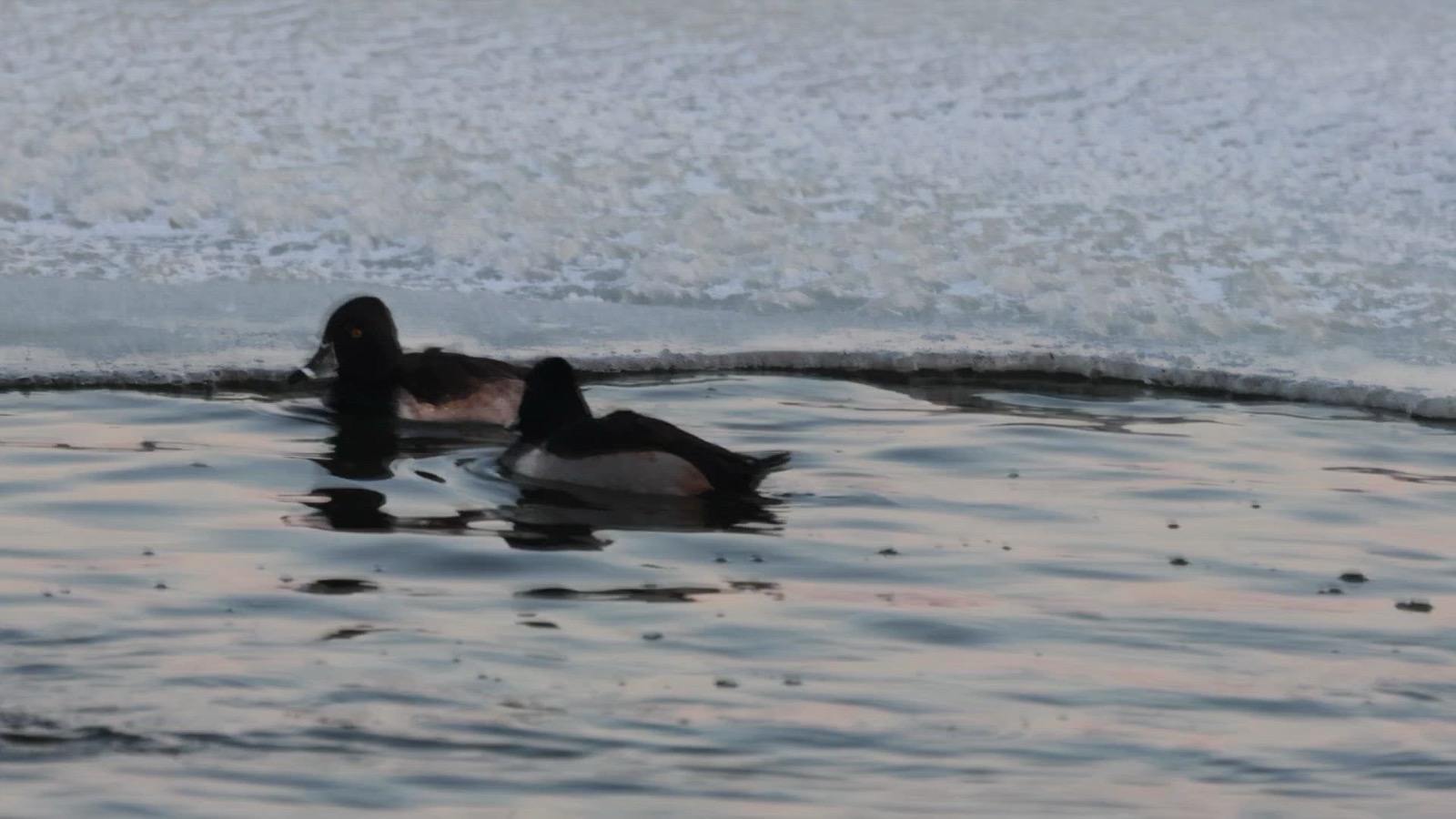
Two ring-necked ducks swimming in dark open water along the edge of a sheet of ice
Ring-necked ducks on the open water left at the ice edge, Lake Andes National Wildlife Refuge, South Dakota. When the shallow pools lock up, the birds that feed in them have to move. “Ring-Necked Duck in Winter Lake Andes National Wildlife Refuge South Dakota (54202161621)”, USFWS Mountain-Prairie (Liz Julian), Public domain

Iowa duck migration questions

Advertisement

Duck migration in other states

Agency counts read up to October 8, 2026, each from the page linked on its card, and the agency’s own report is the one that governs. Observation curves from iNaturalist research grade records 2016 to 2025; this week’s figures and the forecast lows are read when the page opens. Every state is on the duck migration report.