Skip to content
Central Flyway

South Dakota Duck Migration Report 2026

Duck observations in South Dakota usually jump to their fall high in a single week, around the week of Nov 2, and the share stays that high into January; they stay above the halfway mark between their July level and that high through the week of Apr 20.

Week of Nov 2
Usual fall high in observations
2016 to 2025
1
Agency survey
listed below
Central
Flyway
freeze watch below
The agency counts

The nearest counts to South Dakota on the Central Flyway

The nearest agency counts on the Central Flyway are in Kansas (about 420 miles away) and Oklahoma (about 620 miles away), measured center to center, so read them as the flyway’s trend rather than a count of South Dakota’s own birds.

2026 fall count

KDWP Bi-weekly Waterfowl Survey

U.S. Fish and Wildlife Service, Kirwin National Wildlife Refuge (on the Kansas Department of Wildlife and Parks form) · Kansas · about 420 miles from South Dakota

Counted September 18, 2026
18 ducks
One of them a mallard
17 green-winged teal; the reservoir at 1,703.91 feet, near its 20-year low of 1,702.03 feet
Total added up from the published species counts
In the agency’s words
Survey Location: Kirwin NWR Date: 9/18/26 ... Mallard 1 ... Green-winged 17 ... Comments: Winds 17 mph. Low reservoir water level (1,703.91 feet). Historic 20-year low – 1,702.03 feet.
U.S. Fish and Wildlife Service, Kirwin National Wildlife Refuge (on the Kansas Department of Wildlife and Parks form), September 18, 2026. Read it at the source

Ducks, geese, swans and coots on Kirwin Reservoir in north central Kansas, by species, from the ground

How often
Bi-weekly
Season
September
Counted at
Kirwin NWR
Counted through the season

Waterfowl and Wetland Status Reports

Oklahoma Department of Wildlife Conservation · Oklahoma · about 620 miles from South Dakota

Last season’s count, January 15, 2026
Copan: duck numbers improving with every front
In the agency’s words
Copan ... Updated: January 15, 2026 ... Elevation: 0.87ft above normal pool, duck numbers improving with every front, flooded all summer long, poor food in lake.
Oklahoma Department of Wildlife Conservation, January 15, 2026. Read it at the source

Written duck and goose conditions and water levels on 25 wildlife management areas and their wetland units, by area, without counts

How often
Updated every other Thursday, beginning on Nov. 12, 2026 through Jan. 21, 2027
Season
November to January
Counted at
Copan, Red Slough, Deep Fork, Drummond Flats, Eufaula, Ft. Cobb, Grassy Slough, Hackberry Flat, and 17 more

Counts from earlier seasons in South Dakota

Earlier seasons

Central Flyway Mid-Winter Waterfowl Survey

South Dakota Game, Fish and Parks with the U.S. Fish and Wildlife Service (Central Flyway Mid-Winter Survey)

Last published midwinter survey, January 2024
38,990 ducks, 34,308 mallards
4,275 mergansers
In the agency’s words, and the survey
JANUARY 2024 MID-WINTER WATERFOWL SURVEY - CENTRAL FLYWAY: SPECIES ND MT SD WY CO NE KS OK NM TX TOTAL / Mallard 43,807 66,682 34,308 15,306 116,654 16,115 479,045 64,436 9,065 246,830 1,092,248 / Total Ducks 44,716 66,682 38,990 17,648 139,961 21,402 600,483 123,572 40,874 2,514,143 3,608,471
South Dakota Game, Fish and Parks with the U.S. Fish and Wildlife Service (Central Flyway Mid-Winter Survey), January 2024. Read it at the source

Ducks and geese counted across South Dakota by aerial and ground crews once each January, by species

How often
Once a year, in early January
Season
January to January
Advertisement
Observations this week

South Dakota against a normal year

Observations this week in South Dakota

Duck observations here usually reach their fall high around the week of Nov 2. Counting this week’s research grade observations.

Observations this week in the Central Flyway

Duck observations here usually reach their fall high around the week of Nov 9. Counting this week’s research grade observations.

Which ducks come through South Dakota, and when

Each row is one species’ share of South Dakota bird observations by week from August to July, darkest at its high point, from research grade iNaturalist observations 2016 to 2025. The last column is the week each species first comes four fifths of the way from its July level to its August to December high.

SpeciesAugSepOctNovDecJanFebMarAprMayJunJulUsual fall high
Mallarddabblingweek of Nov 2
Green-winged tealdabblingtoo few fall records
Blue-winged tealdabblingtoo few fall records
Northern pintaildabblingtoo few fall records
American wigeondabblingtoo few fall records
Gadwalldabblingweek of Nov 2
Wood duckdabblingweek of Sep 21
Canvasbackdivingtoo few fall records
Redheaddivingweek of Nov 2holds into winter
Lesser scaupdivingtoo few fall records
Ring-necked duckdivingtoo few fall records
Buffleheaddivingtoo few fall records
Common goldeneyedivingweek of Nov 30holds into winter
What moves the birds

Freeze watch up the Central Flyway

When the shallow water at the northern staging areas locks up, dabbling ducks move south to open water. These are the National Weather Service seven day forecast lows there, with nights at or below 28°F marked.

Freeze watch on the Central Flyway

Reading the seven day forecast lows at Devils Lake, Minot, Aberdeen, Valentine.

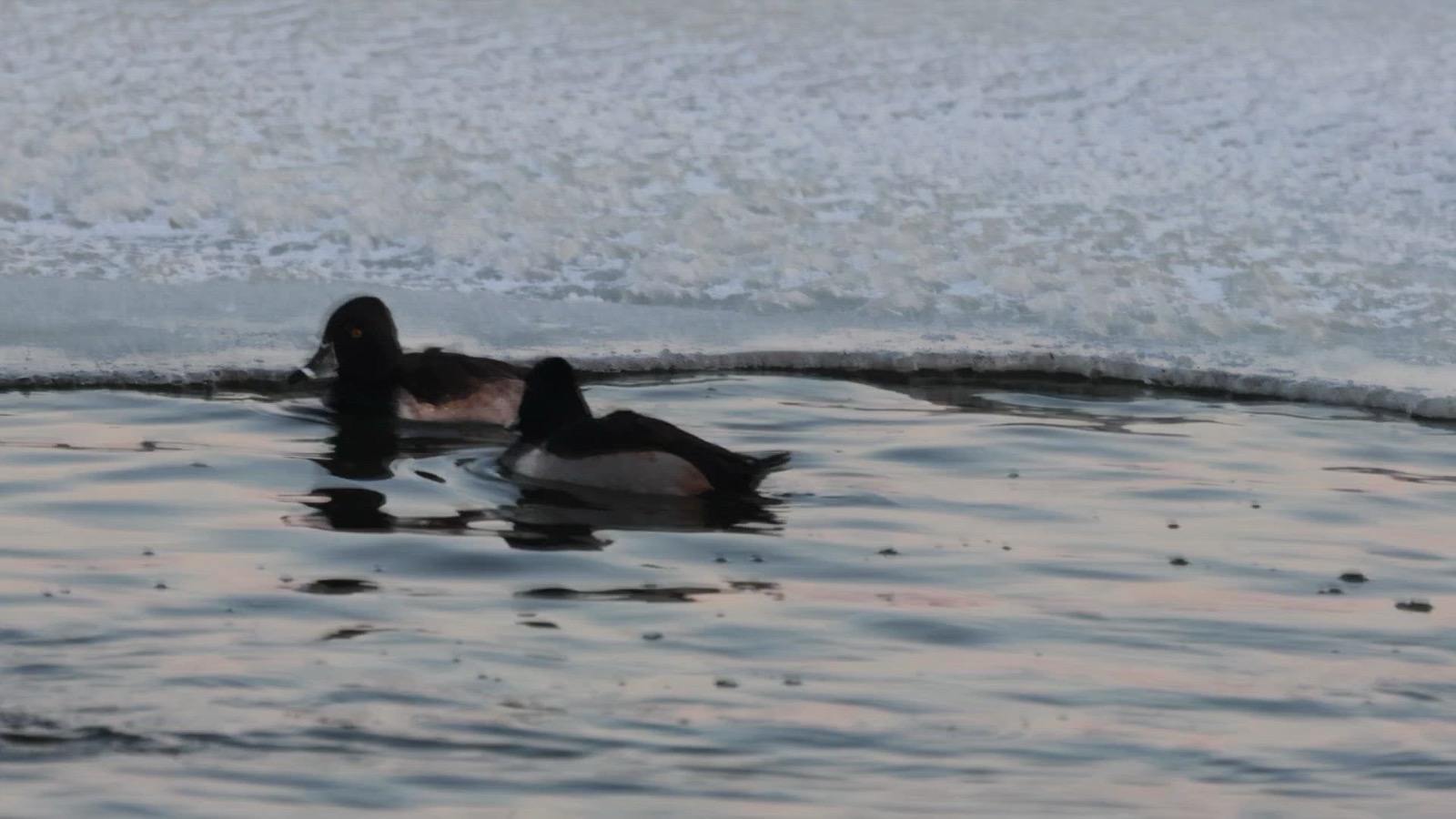
Two ring-necked ducks swimming in dark open water along the edge of a sheet of ice
Ring-necked ducks on the open water left at the ice edge, Lake Andes National Wildlife Refuge, South Dakota. When the shallow pools lock up, the birds that feed in them have to move. “Ring-Necked Duck in Winter Lake Andes National Wildlife Refuge South Dakota (54202161621)”, USFWS Mountain-Prairie (Liz Julian), Public domain

South Dakota duck migration questions

Advertisement

Duck migration in other states

Agency counts read up to October 8, 2026, each from the page linked on its card, and the agency’s own report is the one that governs. Observation curves from iNaturalist research grade records 2016 to 2025; this week’s figures and the forecast lows are read when the page opens. Every state is on the duck migration report.