Skip to content
Atlantic Flyway

Maryland Duck Migration Report 2026

Duck observations in Maryland usually climb from the week of Nov 9 and reach their fall high around the week of Nov 23, and the share stays that high into January; they stay above the halfway mark between their July level and that high through the week of Mar 16.

Week of Nov 23
Usual fall high in observations
2016 to 2025
Week of Nov 9
Usually climbing from
halfway up from the July level
3
Agency surveys
listed below
Atlantic
Flyway
freeze watch below
The agency counts

Where ducks are counted in Maryland

Counted through the season

Eastern Neck Wildlife Refuge Weekly Waterfowl Survey

U.S. Fish and Wildlife Service, Eastern Neck National Wildlife Refuge

Last season’s count, March 25, 2026
No mallards
1,040 scaup and 500 ruddy ducks
In the agency’s words
Survey Date 3/4/2026 3/11/2026 3/18/2026 3/25/2026 ... Mallard 18 5 4 0 ... Refuge Total 5630 7282 2982 1586
U.S. Fish and Wildlife Service, Eastern Neck National Wildlife Refuge, March 25, 2026. Read it at the source

Ducks, geese and swans around Eastern Neck Island at the mouth of the Chester River on the Chesapeake Bay, by species

How often
Weekly
Season
November to March
Highest published count
26,703 ducks, January 2026
Counted at
Eastern Neck NWR
Counted through the season

Blackwater National Wildlife Refuge Ground Waterfowl Survey

U.S. Fish and Wildlife Service, Blackwater National Wildlife Refuge

Last season’s count, March 19, 2026
469 ducks
62 of them mallards
In the agency’s words
Winter 2026 ... 3/19/2026 ... Mallard MALL ... 62 ... total waterfowl ... 621 ... total duck ... 469
U.S. Fish and Wildlife Service, Blackwater National Wildlife Refuge, March 19, 2026. Read it at the source

Ducks, geese, swans and other water birds on Blackwater NWR on Maryland's Eastern Shore, by species, from the ground, plus a January aerial survey

How often
Roughly weekly
Season
November to March
Highest published count
5,613 ducks, January 2026
Counted at
Blackwater, Barren Island, Bishops Head, Smith Island, South Marsh and Bloodsworth Island
Midwinter survey

Midwinter Waterfowl Survey

Maryland Department of Natural Resources (with the U.S. Fish and Wildlife Service)

Last published midwinter survey, January 2026
379,600 ducks
63,900 of them mallards
105,800 scaup and 72,300 ruddy ducks; diving ducks (239,100) were higher than the 100,200 counted in 2025 and the 5-year average (145,860)
In the agency’s words
This year, the survey teams counted about 926,900 waterfowl which was higher than both the 705,300 birds observed in 2025 and the most recent five-year average of 684,280 birds. ... Total Ducks 179,800 289,100 215,400 233,300 379,600
Maryland Department of Natural Resources (with the U.S. Fish and Wildlife Service), January 2026. Read it at the source

Ducks, geese and swans wintering along Maryland's Chesapeake Bay, tidal Potomac River and Atlantic coast shorelines, counted from the air once each January

How often
Once a year, during the first week of January
Season
January to January
Long term
five-year average of 684,280 birds (all waterfowl); mallards 5-year average 56,320; diving ducks 5-year average 145,860
Counted at
Chesapeake Bay, Tidal Potomac River, Atlantic coast shorelines

The nearest other counts on the Atlantic Flyway

Midwinter survey

Aerial Waterfowl Survey

Delaware Department of Natural Resources and Environmental Control, Division of Fish and Wildlife · Delaware · about 70 miles from Maryland

Last published midwinter survey, January 2026
59,709 ducks
18,363 of them mallards
22,649 American black ducks, the most in any January flight in the dataset since 1978, and 24,174 snow geese against 248,322 in 2025
Total added up from the published species counts
In the agency’s words
{"year":"2026","sum_atlantic_brant":"74","sum_canada_goose":"84257","sum_snow_goose":"24174",...,"sum_american_black_duck":"22649","sum_mallard":"18363","sum_northern_pintail":"5190"
Delaware Department of Natural Resources and Environmental Control, Division of Fish and Wildlife, January 2026. Read it at the source

Ducks, geese and swans across the eastern half of Delaware from the Pennsylvania line to the Maryland line, by species and survey zone, from the air; the January flight is the statewide Midwinter count and the fall flights cover the bayshore zones only

How often
Fall flights in October, November and December over three bayshore zones (zones 5 to 7), then one statewide January Midwinter flight over every zone
Season
October to January
Counted at
  • Zone 1, Pennsylvania State line south to the Delaware Memorial Bridge
  • Zone 2, Delaware Memorial Bridge to the C&D Canal
  • Zone 3, C&D Canal to Liston Point and Kenton
  • Zone 4, Liston Point to Route 6 Smyrna
  • and 7 more
Midwinter survey

Midwinter Aerial Waterfowl Survey, Mattamuskeet National Wildlife Refuge

U.S. Fish and Wildlife Service, Southeast Region National Wildlife Refuge System (Mattamuskeet National Wildlife Refuge) · North Carolina · about 270 miles from Maryland

Last published midwinter survey, January 2026
217,264 dabbling ducks
45,097 diving ducks
9,474 of them mallards
286,972 total waterfowl, the second highest of 61 Southeast refuges flown, led by an estimated 82,671 American wigeon and 52,298 northern pintail
USFWS estimate, corrected for birds missed from the air
In the agency’s words
Mattamuskeet NWR 217,264 45,097 9,663 14,948 0 286,972 286,972
U.S. Fish and Wildlife Service, Southeast Region National Wildlife Refuge System (Mattamuskeet National Wildlife Refuge), January 6, 2026. Read it at the source

A January aerial survey of ducks, geese and swans on Mattamuskeet NWR and Lake Mattamuskeet in eastern North Carolina, reported as visibility corrected estimates by species and by guild, not raw counts

How often
One January aerial survey a year (Midwinter), published as a regional report the following spring
Season
January to January
Counted at
Open water transects (unit GX), Survey unit A, Survey unit B, Survey unit D, Survey unit E
Advertisement
Observations this week

Maryland against a normal year

Observations this week in Maryland

Duck observations here usually reach their fall high around the week of Nov 23. Counting this week’s research grade observations.

Observations this week in the Atlantic Flyway

Duck observations here usually reach their fall high around the week of Nov 9. Counting this week’s research grade observations.

Which ducks come through Maryland, and when

Each row is one species’ share of Maryland bird observations by week from August to July, darkest at its high point, from research grade iNaturalist observations 2016 to 2025. The last column is the week each species first comes four fifths of the way from its July level to its August to December high.

SpeciesAugSepOctNovDecJanFebMarAprMayJunJulUsual fall high
Mallarddabblingweek of Nov 16holds into winter
Green-winged tealdabblingweek of Nov 16
Blue-winged tealdabblingno fall rise; as common in summer
Northern pintaildabblingweek of Nov 23
American wigeondabblingweek of Dec 14
Gadwalldabblingweek of Nov 16
Wood duckdabblingno fall rise; as common in summer
Canvasbackdivingweek of Dec 21holds into winter
Redheaddivingweek of Dec 14holds into winter
Lesser scaupdivingweek of Dec 14holds into winter
Greater scaupdivingweek of Nov 30holds into winter
Ring-necked duckdivingweek of Nov 16
Buffleheaddivingweek of Nov 23holds into winter
Common goldeneyedivingweek of Dec 14holds into winter
What moves the birds

Freeze watch up the Atlantic Flyway

When the shallow water at the northern staging areas locks up, dabbling ducks move south to open water. These are the National Weather Service seven day forecast lows there, with nights at or below 28°F marked.

Freeze watch on the Atlantic Flyway

Reading the seven day forecast lows at Presque Isle, Lake Champlain at Burlington, Watertown.

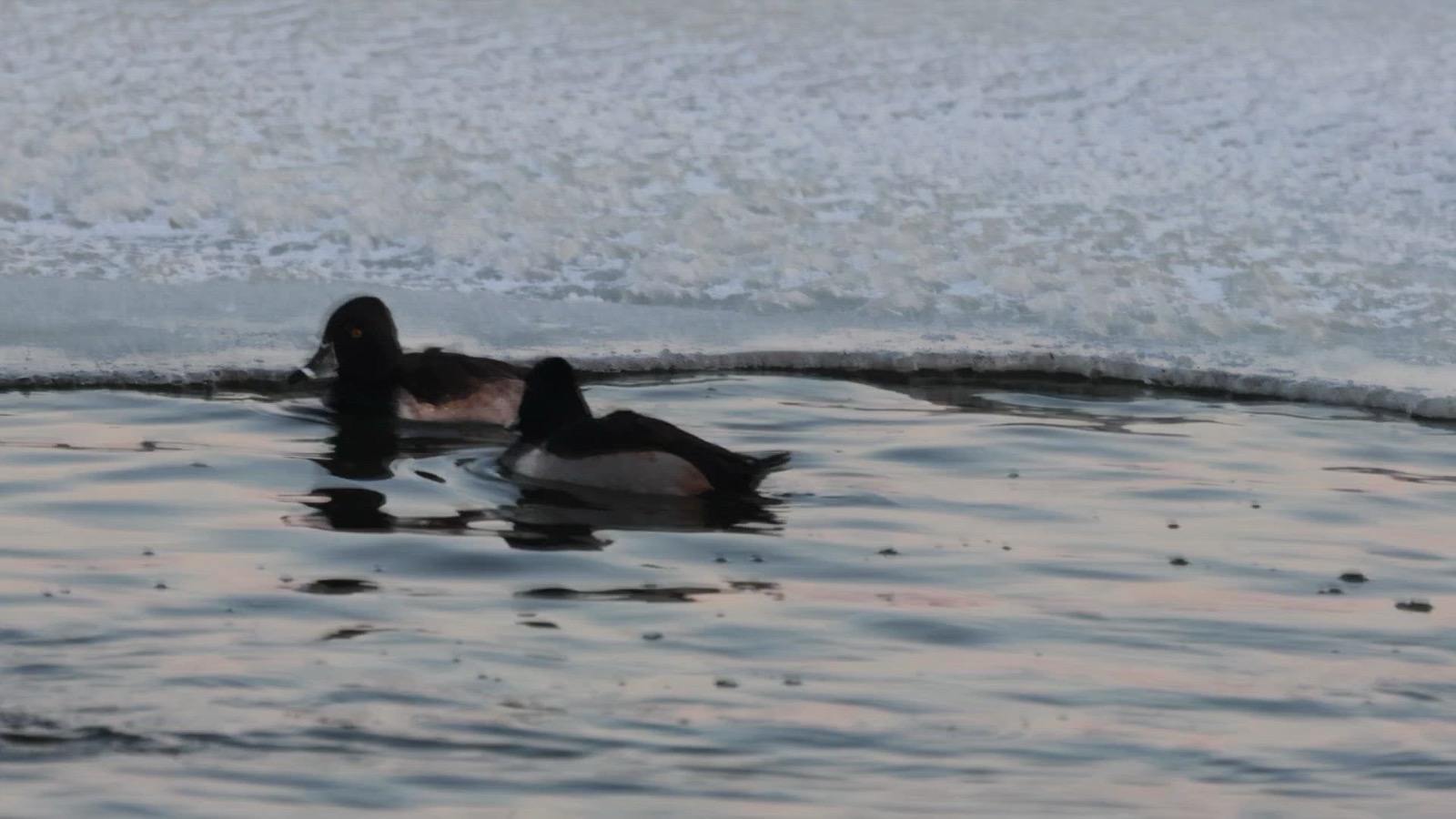
Two ring-necked ducks swimming in dark open water along the edge of a sheet of ice
Ring-necked ducks on the open water left at the ice edge, Lake Andes National Wildlife Refuge, South Dakota. When the shallow pools lock up, the birds that feed in them have to move. “Ring-Necked Duck in Winter Lake Andes National Wildlife Refuge South Dakota (54202161621)”, USFWS Mountain-Prairie (Liz Julian), Public domain

Maryland duck migration questions

Advertisement

Duck migration in other states

Agency counts read up to October 8, 2026, each from the page linked on its card, and the agency’s own report is the one that governs. Observation curves from iNaturalist research grade records 2016 to 2025; this week’s figures and the forecast lows are read when the page opens. Every state is on the duck migration report.