Skip to content
Pacific Flyway

Oregon Duck Migration Report 2026

Duck observations in Oregon usually climb from the week of Oct 5 and reach their fall high around the week of Nov 9; they stay above the halfway mark between their July level and that high through the week of Apr 13.

Week of Nov 9
Usual fall high in observations
2016 to 2025
Week of Oct 5
Usually climbing from
halfway up from the July level
31,865
2026 fall count
ducks, October 7, 2026
Pacific
Flyway
freeze watch below
The agency counts

Where ducks are counted in Oregon

2026 fall count

Summer Lake Wildlife Area Weekly Waterfowl Counts

Oregon Department of Fish and Wildlife (Summer Lake Wildlife Area)

Counted October 7, 2026
31,865 ducks
470 snow and Ross's geese the same week
In the agency’s words
Summer Lake Wildlife Area Weekly Waterfowl Counts Ducks ... 9/22 - 9/28 33,285 ... 9/29 - 10/5 30,700 ... 10/6 - 10/12 31,865 44,802 50,856 97,073 36,057 60,839 59,687 39,728 42,368 42,785 51,879 57,925
Oregon Department of Fish and Wildlife (Summer Lake Wildlife Area), October 7, 2026. Read it at the source

Ducks, geese, swans and coots on the Summer Lake Wildlife Area in south central Oregon, counted each week of the season and set against past years

How often
Weekly, early September to late January
Season
September to January
The usual peak
10/6 - 10/12, the highest week in the Pre 5-Yr average column (57,925 ducks)
Long term
Pre 5-Yr average for 10/6 - 10/12: 57,925 ducks
Counted at
Summer Lake Wildlife Area

Counts from earlier seasons in Oregon

Earlier seasons

Klamath Basin refuge aerial waterfowl survey (Lower Klamath and Tule Lake NWR)

U.S. Fish and Wildlife Service, Klamath Basin National Wildlife Refuge Complex · California

High count of the last season flown, March 7, 2025
334,732 ducks
Funding cuts eliminated aerial surveys beginning fall 2025. This marks the end of the nation's longest-running refuge-based aerial waterfowl survey.
U.S. Fish and Wildlife Service, Klamath Basin National Wildlife Refuge Complex. Read it at the source
About the survey

Ducks and geese on Lower Klamath and Tule Lake national wildlife refuges, from the air, during fall and spring migration; ended after the 2024-25 season

How often
Ten aerial surveys between fall 2024 and spring 2025; discontinued from fall 2025
Counted at
Lower Klamath National Wildlife Refuge, Tule Lake National Wildlife Refuge
Advertisement
Observations this week

Oregon against a normal year

Observations this week in Oregon

Duck observations here usually reach their fall high around the week of Nov 9. Counting this week’s research grade observations.

Observations this week in the Pacific Flyway

Duck observations here usually reach their fall high around the week of Nov 16. Counting this week’s research grade observations.

Which ducks come through Oregon, and when

Each row is one species’ share of Oregon bird observations by week from August to July, darkest at its high point, from research grade iNaturalist observations 2016 to 2025. The last column is the week each species first comes four fifths of the way from its July level to its August to December high.

SpeciesAugSepOctNovDecJanFebMarAprMayJunJulUsual fall high
Mallarddabblingweek of Aug 31
Green-winged tealdabblingweek of Sep 28
Blue-winged tealdabblingweek of Aug 17
Northern pintaildabblingweek of Oct 12holds into winter
American wigeondabblingweek of Nov 9
Gadwalldabblingweek of Oct 5
Wood duckdabblingweek of Aug 17
Canvasbackdivingweek of Nov 23holds into winter
Redheaddivingweek of Oct 26
Lesser scaupdivingweek of Nov 9holds into winter
Greater scaupdivingweek of Nov 23holds into winter
Ring-necked duckdivingweek of Nov 16holds into winter
Buffleheaddivingweek of Nov 9
Common goldeneyedivingweek of Dec 7
What moves the birds

Freeze watch up the Pacific Flyway

When the shallow water at the northern staging areas locks up, dabbling ducks move south to open water. These are the National Weather Service seven day forecast lows there, with nights at or below 28°F marked.

Freeze watch on the Pacific Flyway

Reading the seven day forecast lows at Freezeout Lake, Klamath Falls.

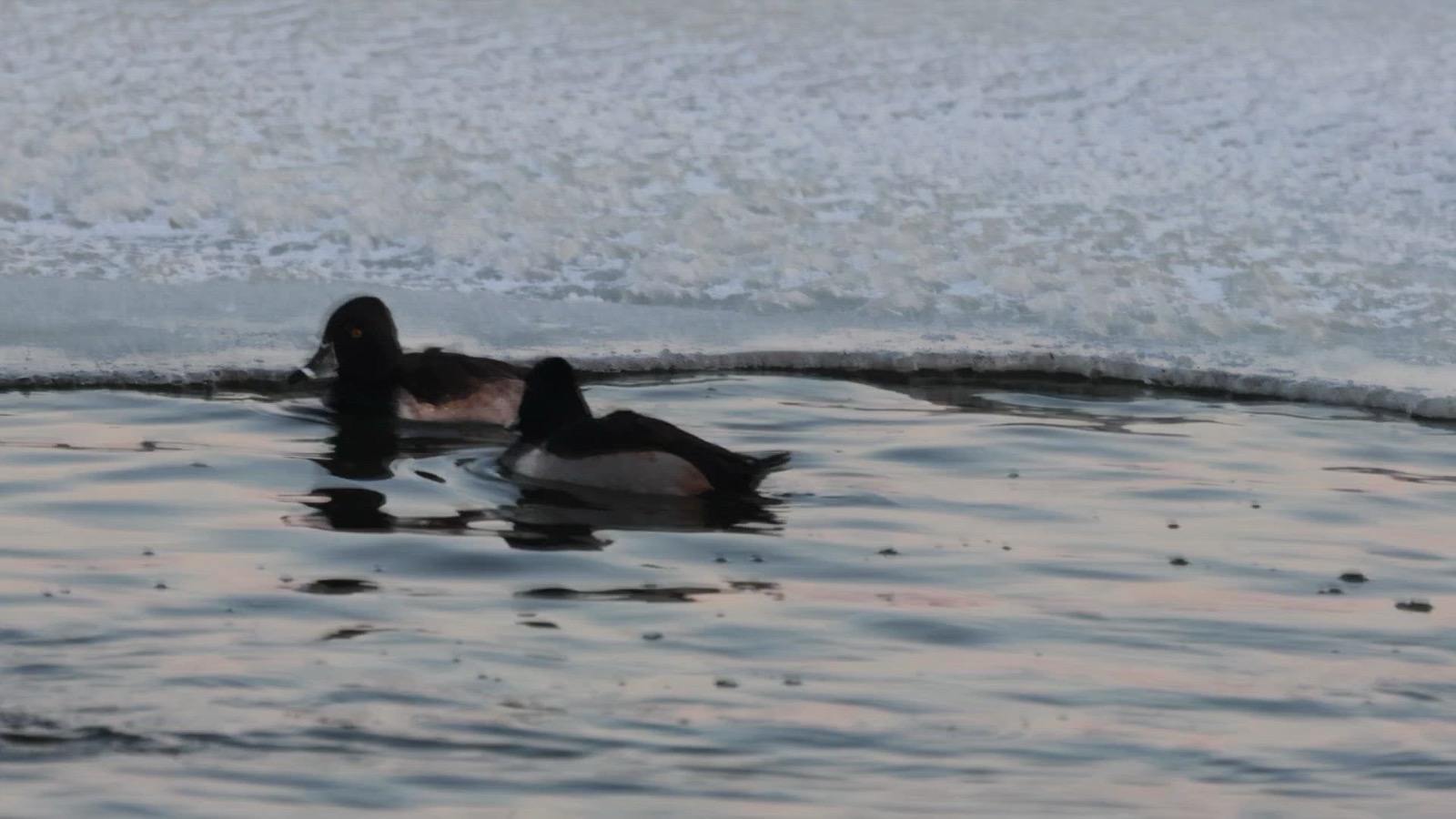
Two ring-necked ducks swimming in dark open water along the edge of a sheet of ice
Ring-necked ducks on the open water left at the ice edge, Lake Andes National Wildlife Refuge, South Dakota. When the shallow pools lock up, the birds that feed in them have to move. “Ring-Necked Duck in Winter Lake Andes National Wildlife Refuge South Dakota (54202161621)”, USFWS Mountain-Prairie (Liz Julian), Public domain

Oregon duck migration questions

Advertisement

Duck migration in other states

Agency counts read up to October 8, 2026, each from the page linked on its card, and the agency’s own report is the one that governs. Observation curves from iNaturalist research grade records 2016 to 2025; this week’s figures and the forecast lows are read when the page opens. Every state is on the duck migration report.